What Is LLMOps? A Practical Guide to Running LLMs in Production
LLMOps is the practice of running large language model applications in production: choosing models, managing prompts, evaluating output, and controlling cost, reliability, and risk. This guide covers LLMOps vs MLOps, the lifecycle, the platform stack, and the gateway layer.
TL;DR
- LLMOps (large language model operations) is the set of practices and tools for building, deploying, monitoring, and improving LLM applications in production.
- It borrows the lifecycle discipline of MLOps, but most teams call models through provider APIs instead of training them, so the work shifts to prompts, provider choice, token cost, and output quality.
- The lifecycle runs as a loop: select models, build prompts, evaluate, deploy and govern, monitor, and improve.
- A platform for it usually combines prompt management, evaluation, an AI gateway, observability, and guardrails.
- The gateway layer is where routing, failover, budgets, guardrails, and request logs apply to every model call; Bifrost provides that layer with about 11 microseconds of overhead at 5,000 RPS.
LLMOps is the operational discipline that turns an LLM prototype into a production system that stays reliable, affordable, and safe as usage grows. Bifrost, the open-source AI gateway built by Maxim AI, covers the part of LLMOps that sits in the request path: routing, failover, budgets, guardrails, and logging for every model call. This guide defines LLMOps, compares it with MLOps, walks through the lifecycle, and explains where a gateway fits.
What Is LLMOps?
LLMOps, short for large language model operations, is the set of practices, workflows, and tools used to develop, deploy, monitor, and maintain applications built on large language models. It covers model and provider selection, prompt management, evaluation, deployment, cost control, security, and continuous improvement once an application is live.
TechTarget's definition frames it as a narrowing of MLOps, itself an extension of DevOps, to the specific problems of LLMs, and IBM's overview places it within the wider MLOps practice. In practice, LLM ops work answers a few recurring questions:
- Which model serves this request, and what happens when that provider is slow or down?
- Which prompt version is live, and how is a change tested before rollout?
- What does each request cost, and who is allowed to spend how much?
- Is the output acceptable, and is sensitive data staying where it should?
- What happened when something went wrong, and can the team trace it?
The LLM gateway overview covers how several of these questions are answered in the request path.
LLMOps vs MLOps
The difference comes down to what the team controls. MLOps manages models a team trains on its own data, so the core work is data pipelines, training, and numeric accuracy. LLMOps usually manages models a team calls through APIs, so the core work moves to prompts, provider selection, token cost, and the quality of open-ended text output.
| Dimension | MLOps | LLMOps |
|---|---|---|
| Model source | Trained in-house on labeled data | Mostly foundation models called through provider APIs, sometimes fine-tuned or self-hosted |
| Main artifact to version | Model weights and features | Prompts, model choices, routing rules, and policies |
| Cost driver | Training and serving compute | Tokens per request, multiplied by traffic |
| Quality signal | Accuracy, precision, recall | Relevance, faithfulness, safety, tone, often judged by models or people |
| Failure modes | Data drift, stale models | Provider outages, rate limits, hallucination, prompt injection, data leakage |
| Change cadence | Retraining cycles | Prompt edits and model swaps, sometimes weekly |
Figure 1 summarizes the shift.
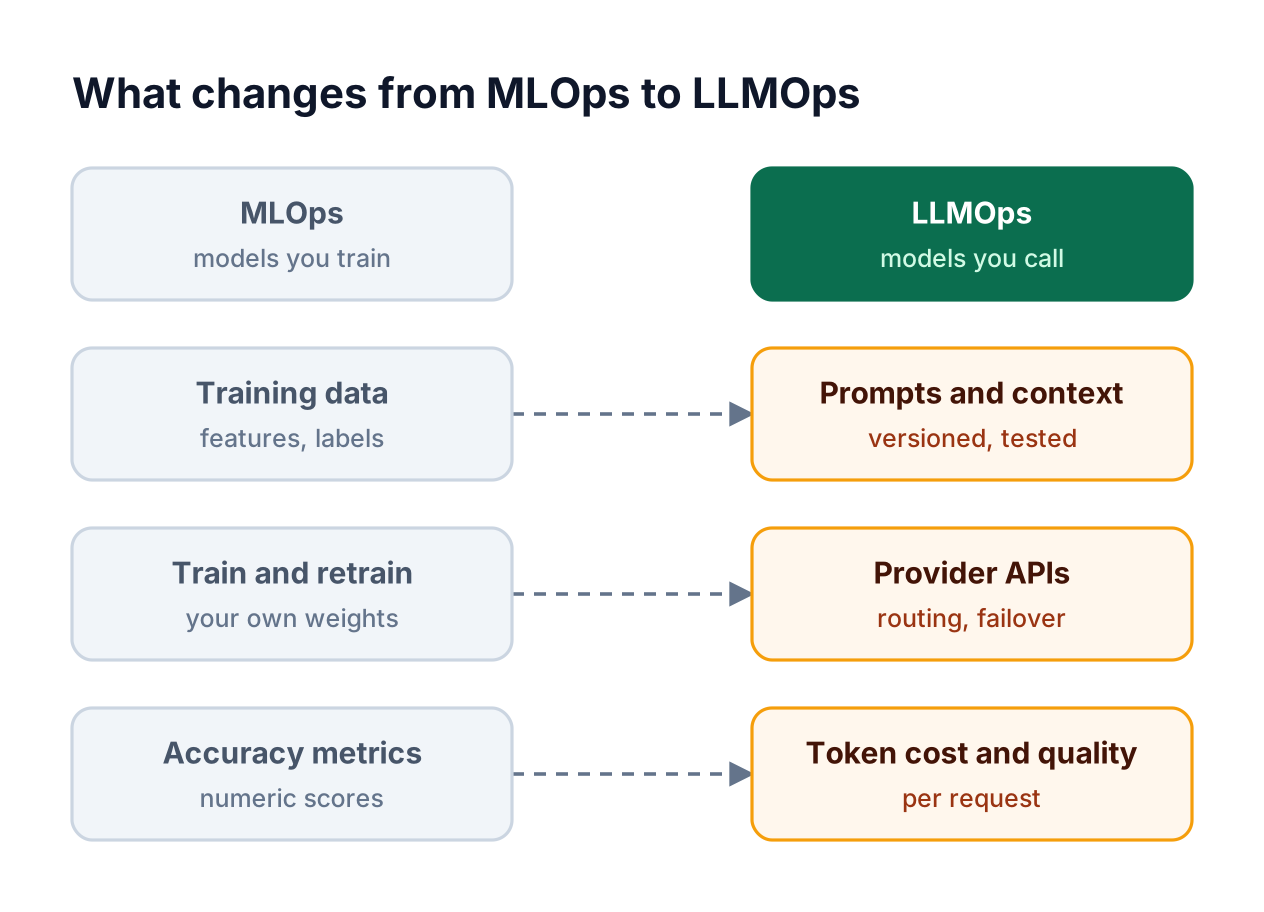
Side by side: MLOps centers on training data, model training, and accuracy metrics, while LLMOps centers on prompts, provider APIs, token cost, and output quality
Figure 1: LLMOps keeps the MLOps lifecycle but moves the work from training models to choosing providers, managing prompts, and controlling cost and output quality.
The two overlap. Teams that fine-tune or self-host open-weight models still need MLOps practices. Teams that only call hosted APIs skip the training pipeline, but every request now carries a direct dollar cost, as the guide to reducing LLM cost and latency shows.
Why LLMOps Matters in 2026
LLMOps matters because LLM applications fail in ways traditional software and ML monitoring do not catch. A provider outage stops every feature that depends on it, an unreviewed prompt change can degrade answers without an error, and token spend can grow faster than traffic.
Common pressure points:
- Multi-provider estates. Many production teams use more than one model provider, each with its own API, keys, rate limits, and pricing.
- Agents and tools. Agents make many model calls per task, which multiplies cost and risk.
- Spend visibility. Finance and platform teams need cost by team, application, and model, not one invoice per provider.
- Compliance. Regulated industries need evidence of who sent what data to which model, and what controls applied.
The AI cost management tools roundup covers the spend side, and AI governance covers access and policy controls.
The LLMOps Lifecycle
The LLMOps lifecycle is a loop of six stages: select models, build prompts, evaluate, deploy and govern, monitor, and improve. Each stage produces something the next one needs, and production data from monitoring feeds back into model and prompt choices. Treating it as a loop, not a one-time launch, is what separates production from a demo.
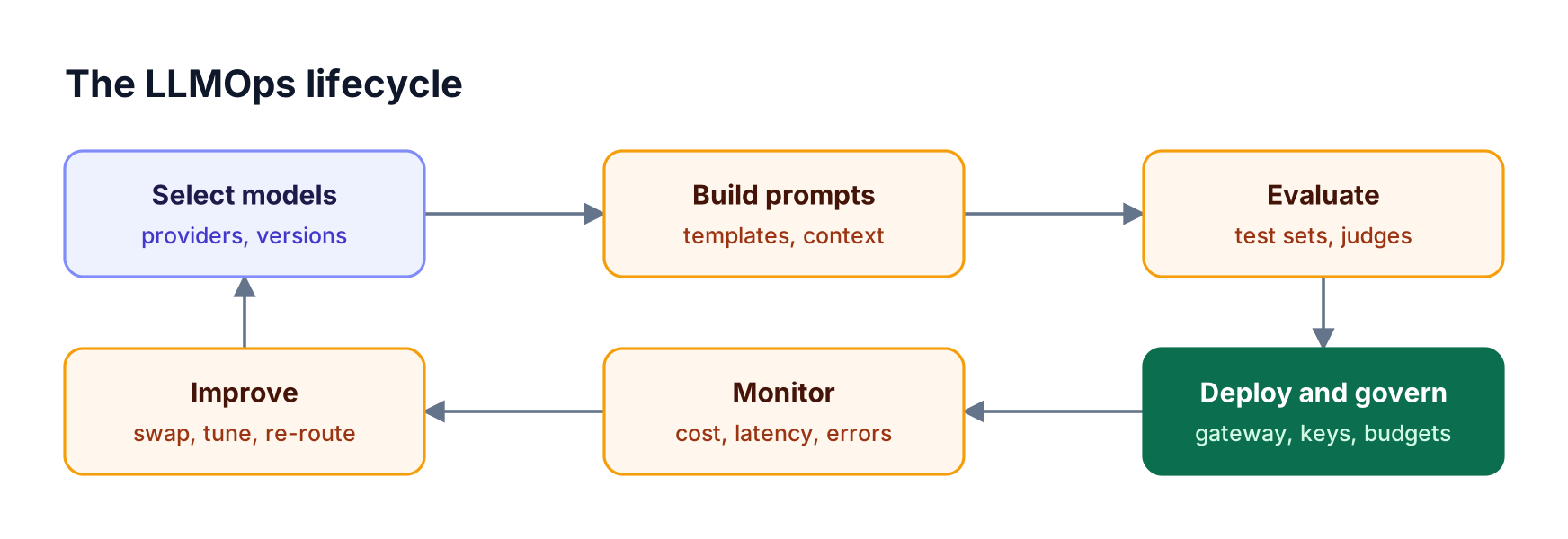
Loop of six stages: select models, build prompts, evaluate, deploy behind a gateway, monitor cost and quality, and feed findings back into model and prompt choices
Figure 2: LLMOps is a loop: production logs and cost data feed the next round of model, prompt, and policy changes.
What happens at each stage:
- Select models. Compare providers and model versions on quality, latency, and price for the task. The provider guides cover setup for each major provider.
- Build prompts. Write templates, assemble context, and version every change so it can be rolled back.
- Evaluate. Run prompts against fixed test sets with automated checks, model judges, or human review before release.
- Deploy and govern. Put traffic behind a gateway with access keys, budgets, routing rules, and guardrails.
- Monitor. Track tokens, cost, latency, error rates, and quality signals on live traffic.
- Improve. Swap models, tune prompts, adjust routing, and tighten policies based on what monitoring shows.
Core Components of an LLMOps Platform
An LLMOps platform is the set of tools that supports the lifecycle, and most teams assemble it from five components: prompt management, evaluation, an AI gateway, observability, and guardrails. What matters is that each stage of the loop has a tool and that data moves between them.
| Component | What it does | Lifecycle stage |
|---|---|---|
| Prompt management | Stores, versions, and deploys prompt templates | Build, improve |
| Evaluation | Scores outputs against test sets and quality criteria | Evaluate, improve |
| AI gateway | Routes requests, handles failover, enforces keys, budgets, and rate limits | Deploy and govern |
| Observability | Logs requests, tokens, cost, and latency; exports traces | Monitor |
| Guardrails | Checks inputs and outputs for PII, secrets, unsafe content, and policy violations | Deploy and govern |
Notes on choosing tools:
- Start with the request path. A gateway touches every call, so it is the cheapest place to get logs, cost data, and failover at once.
- Keep evaluation close to prompts. Prompt changes are the most frequent release, so evaluation should run on each one.
- Export, do not silo. Observability data is most useful in the tools the team already uses, through standards such as OpenTelemetry.
The gateway observability guide covers which metrics to capture where, and the guardrails resource page covers policy design.
The Gateway Layer: Where LLMOps Meets Every Request
The gateway layer is where operational policies stop being documents and start applying to live traffic. Every model call from every application passes through one point, so routing, failover, access control, budgets, guardrails, caching, and logging apply consistently, without each team rebuilding them in application code.
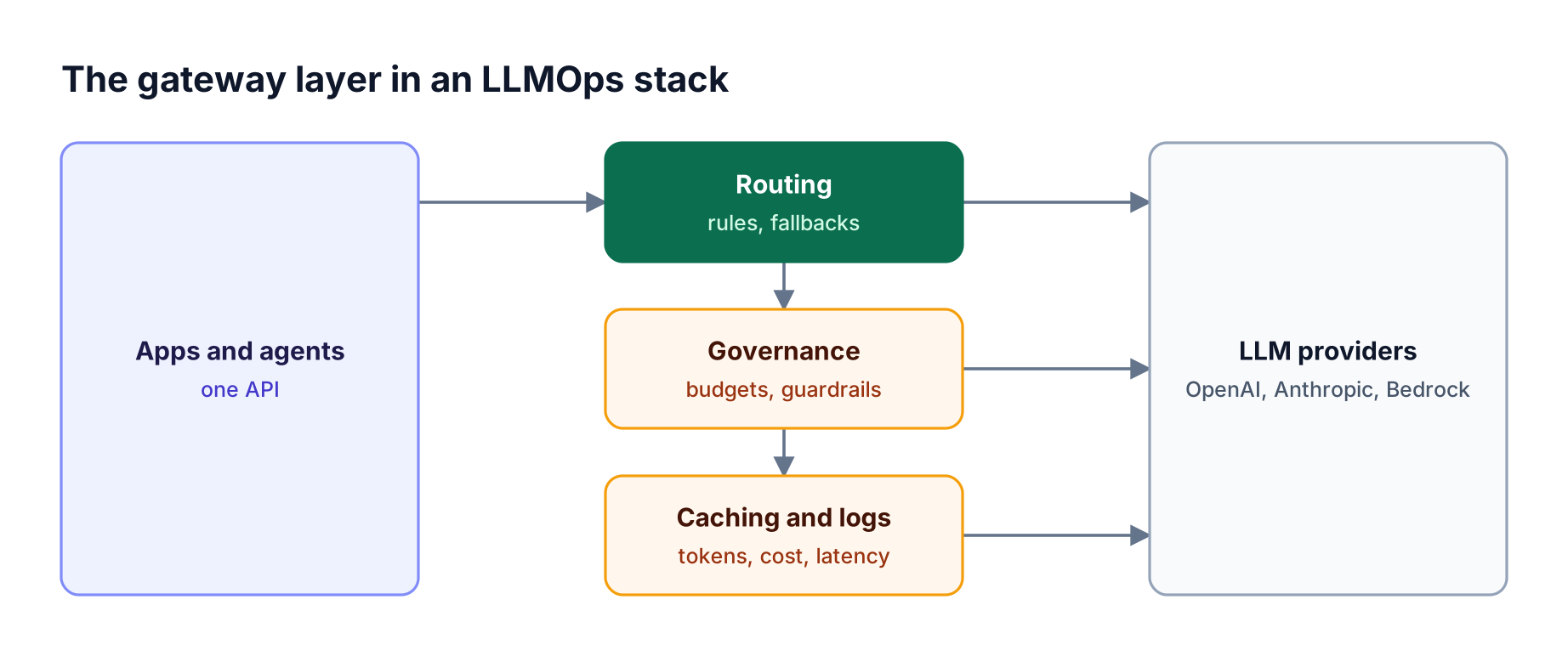
Applications and agents send all model traffic through Bifrost, which applies routing, caching, budgets, and guardrails, logs every request, and forwards to LLM providers
Figure 3: A gateway gives LLMOps one place to route, govern, and log every model request, whichever provider serves it.
Bifrost exposes 10,000+ models across 25+ providers through one OpenAI-compatible API, and adds about 11 microseconds of overhead per request at 5,000 RPS. It covers these jobs:
- Routing. Routing rules send requests to providers by model, header, or other conditions, and adaptive routing shifts load based on live provider health.
- Failover. Retries and fallbacks move a failed request to a backup provider; the automatic fallback walkthrough shows the setup.
- Caching. Semantic caching replays responses for identical or similar requests, so the provider is never called; it works alongside provider prompt caching.
The same layer also governs MCP tool calls through the MCP gateway, which matters once agents enter the picture.
Governance, Cost, and Guardrails in LLMOps
Governance means deciding who can call which models, how much they can spend, and what content is allowed in and out. Applying these rules at the gateway keeps them consistent across teams and produces the records security and finance teams ask for.
Bifrost handles access and spend with:
- Virtual keys. Virtual keys give each team, application, or customer its own credential with allowed models and providers.
- Budgets and rate limits. Budgets and limits cap spend and request rates, with resets that can be daily, weekly, monthly, quarterly, or yearly.
- Pricing data. The Model Catalog holds model pricing and capabilities so cost is computed per request.
Content and data controls:
- Guardrails. Bifrost guardrails check inputs and outputs with built-in redaction, secrets detection, custom regex, and prompt guardrails, plus integrations with external safety providers.
- Policy design. The gateway guardrails guide and the AI guardrails page cover rule design and enforcement.
For more on keeping spend in check, see the LLM cost optimization series.
Observability and Feedback Loops
Observability closes the loop. Without per-request data on tokens, cost, latency, errors, and outputs, teams cannot tell whether a prompt change helped, which model to keep, or where spend is going.
What Bifrost records and exports:
- Request logs. Built-in observability logs inputs, outputs, tokens, cost, and latency for each request.
- Traces and metrics. OpenTelemetry export and Prometheus metrics feed existing dashboards and alerting.
- Payload exports. Log exports offload request and response payloads to S3, GCS, or Azure Blob Storage.
- Administrative records. Audit logs track configuration and access changes with signed events.
The AI observability page summarizes these features, and the post on governance and observability in Bifrost shows them together.
Prompt Deployment and Evaluation
Prompts are the most frequently changed artifact in LLM ops, so they need the same release discipline as code: versions, tests, staged rollout, and rollback. Treating a prompt edit as a deployment prevents silent quality regressions.
Practices that hold up:
- Version every prompt and record which version served each request.
- Test before release against a fixed set of inputs with expected behavior, including edge cases and adversarial inputs.
- Roll out gradually. Send a share of traffic to a new version and compare cost, latency, and quality before full rollout.
- Check outputs in production with guardrails for safety and policy, not only offline tests.
In Bifrost Enterprise, prompt deployments route requests to committed prompt versions from the Prompt Repository using matching rules and weighted traffic distribution. For output checks, Bifrost integrates external evaluators such as Patronus AI, and the guide to evaluating tool-calling agents covers test design.
LLMOps Best Practices
LLMOps best practices come down to putting controls where every request passes, measuring before changing, and keeping data in the team's own infrastructure.
- Route all model traffic through one gateway so policies, logs, and failover apply everywhere.
- Give every application its own key and budget so cost and incidents trace back to an owner.
- Configure fallbacks before the first outage, with at least one backup provider for each critical model.
- Cache where answers repeat, and measure hit rates; the post on semantic cache grey zones covers threshold tuning.
- Version prompts and evaluate every change before it reaches all users.
- Keep data in your environment. Bifrost runs self-hosted, in-VPC or on-prem, and no prompts, responses, or telemetry leave the customer's infrastructure.
- Plan for compliance evidence. Bifrost holds SOC 2 Type II, ISO 27001, HIPAA, and GDPR compliance, and audit logs record administrative changes.
The guide to implementing guardrails with Bifrost walks through a production setup.
Frequently Asked Questions
What is LLMOps?
LLMOps, or large language model operations, is the practice of developing, deploying, monitoring, and improving LLM applications in production. It covers model selection, prompt management, evaluation, routing and failover, cost control, guardrails, and observability. The LLM gateway is the part of the stack that applies these controls to live traffic.
What is the difference between LLMOps and MLOps?
MLOps manages models a team trains on its own data, with a focus on data pipelines, training, and accuracy metrics. LLMOps manages applications built mostly on foundation models called through APIs, with a focus on prompts, provider choice, token cost, output quality, and safety. Teams that fine-tune or self-host models use both.
What does an LLMOps platform include?
Most platforms combine prompt management, evaluation, an AI gateway for routing and governance, observability for logs and cost, and guardrails for content and data safety. Some teams buy a bundled product; others assemble the stack and connect the pieces through standards like OpenTelemetry, which Bifrost supports for trace export.
Why do you need an AI gateway for LLMOps?
A gateway is the one point every model request passes through, so it can apply routing, failover, budgets, rate limits, guardrails, caching, and logging consistently. Without one, each application implements these separately, and spend and incidents become hard to trace. Bifrost adds about 11 microseconds of overhead at 5,000 RPS.
How do you control LLM costs in production?
Give each application or team its own virtual key with a budget and rate limit, cache repeated requests, route simple tasks to cheaper models, and track cost per request in logs. Bifrost supports budget resets that can be daily, weekly, monthly, quarterly, or yearly, through virtual key budgets.
Is LLMOps only for large enterprises?
No. Any team running an LLM feature in production benefits from versioned prompts, fallbacks, cost tracking, and logs. Larger organizations add per-team budgets, RBAC, and audit logs, but the core loop applies at every size.
Put the LLMOps Loop on Solid Ground
LLMOps works when every stage of the loop has data and every model request passes through consistent controls. A gateway gives teams that foundation: one API across providers, failover, budgets, guardrails, and logs for every call, running in their own infrastructure. To see how Bifrost fits your LLMOps stack, book a demo with the Bifrost team.