Tokenmaxxing: What It Means and How to Govern AI Token Spend
Tokenmaxxing is the practice of treating AI token consumption as a proxy for productivity. This guide explains where the term came from, why usage leaderboards backfired, what engineering leaders measure instead, and how to govern token spend with budgets, attribution, and routing.
TL;DR
- Tokenmaxxing is the practice of maximizing AI token usage and treating that usage as evidence of productivity or AI adoption.
- The term went mainstream in April 2026 after reports of internal usage leaderboards at large tech companies; several were later withdrawn as employees chased token counts instead of outcomes.
- Token volume is a cost metric, not a value metric. Useful measures tie spend to outcomes such as merged changes, resolved tickets, or shipped features.
- Governing token spend starts with attribution: every request tagged to a person, team, and project, with budgets and rate limits enforced before the bill arrives.
- Bifrost applies budgets, project attribution, complexity-based routing, caching, and Code Mode across every AI client, so teams can encourage AI use without rewarding waste.
Tokenmaxxing became one of 2026's most discussed engineering trends, and also one of its shortest-lived. Bifrost, the open-source AI gateway built by Maxim AI, gives platform teams the attribution and budget controls that make AI adoption measurable without turning token counts into a target. This guide explains what tokenmaxxing means, why it backfired, what to measure instead, and how to govern AI token spend.
What Is Tokenmaxxing?
Tokenmaxxing is the practice of maximizing AI token consumption, usually because usage is tracked, ranked, or rewarded as a sign of productivity. A token is the unit of text a model reads or writes, and it is what AI providers bill for, so tokenmaxxing means deliberately driving up the meter in the belief that more AI use equals more output.
The term usually describes one of two things:
- An incentive pattern. Organizations encourage or require heavy AI use, sometimes through leaderboards, usage minimums, or performance reviews that reference consumption.
- An individual behavior. Employees run longer agent sessions, broader prompts, or parallel agents partly to raise their usage numbers.
IBM describes it as an organizational practice of incentivizing employees to maximize token usage, often to encourage experimentation, in its explainer on the term. The intent is usually reasonable; the measurement is the problem, and the fix is better attribution through an AI governance layer rather than less AI use.
Where Tokenmaxxing Came From
Tokenmaxxing entered mainstream discussion in early April 2026, when reports described an internal leaderboard at a large technology company that ranked tens of thousands of employees by AI token usage and handed out titles to the heaviest users. Similar dashboards appeared elsewhere as companies tried to prove that AI spending was paying off.
Several factors pushed organizations toward usage-based metrics:
- Pressure to show AI adoption. Leadership teams wanted visible evidence that new AI tooling was being used.
- Agentic coding tools. Coding agents, subagents, and parallel workflows made it easy to consume large volumes of tokens quickly.
- Easy measurement. Token counts are available from provider dashboards; outcome measures take more work to build.
The backlash came quickly. Engineering leaders and writers pointed out that ranking people by consumption invites gaming, and by mid-2026 several companies had withdrawn their usage leaderboards. LeadDev's coverage of tokenmaxxing and AI metrics summarizes the engineering community's reaction. Platform teams thinking about agent spend can also read the LLM cost optimization guide.
Why Tokenmaxxing Backfires
Tokenmaxxing backfires because token count measures input, not output. When usage becomes a target, people optimize the number rather than the work, a textbook case of Goodhart's law: a measure that becomes a target stops being a good measure. Spend rises, and the metric improves, while delivered value may not change at all.
Figure 1 shows the loop.

Token usage becomes a ranked metric, employees inflate usage with longer agent runs, spend rises while delivered work stays flat, and the metric looks better anyway
Figure 1: Once token count becomes the target, usage grows faster than output, and the metric keeps rewarding the behavior that inflates it.
The concrete costs:
- Wasted spend. Agents left running, oversized context windows, and premium models used for simple tasks all inflate the bill.
- Misleading signals. Leadership sees rising usage and assumes rising productivity, which can drive staffing or budget decisions on a burn-rate metric.
- Worse engineering habits. Developers learn to reach for the largest model and the longest session rather than the right tool.
- Unbounded agent loops. Without budgets, a misbehaving agent can consume large amounts before anyone notices, a risk covered in LLM gateways for AI agents.
None of this means AI usage is bad. Low usage can signal that a team has not found good workflows yet. The problem is treating usage as the goal. The roundup of enterprise gateways for LLM cost tracking covers tools for the measurement side.
What to Measure Instead of Token Usage
Measure AI spend against outcomes rather than measuring spend on its own. Useful metrics connect cost to delivered work, such as cost per merged change, cost per resolved ticket, or cycle time for teams with and without AI tooling. Token volume stays useful as a diagnostic and a cost line, not as a performance score.
Metrics engineering leaders use instead:
- Cost per outcome. AI spend divided by merged pull requests, resolved incidents, or shipped features for the same team and period.
- Delivery metrics. Cycle time, deployment frequency, change failure rate, and review turnaround, compared before and after AI adoption.
- Adoption breadth. The share of engineers who use AI tools regularly, which identifies teams that need enablement without ranking individuals.
- Efficiency signals. Cache hit rate, share of requests routed to smaller models, and tokens per successful task.
Figure 2 shows how attribution makes cost per outcome possible.
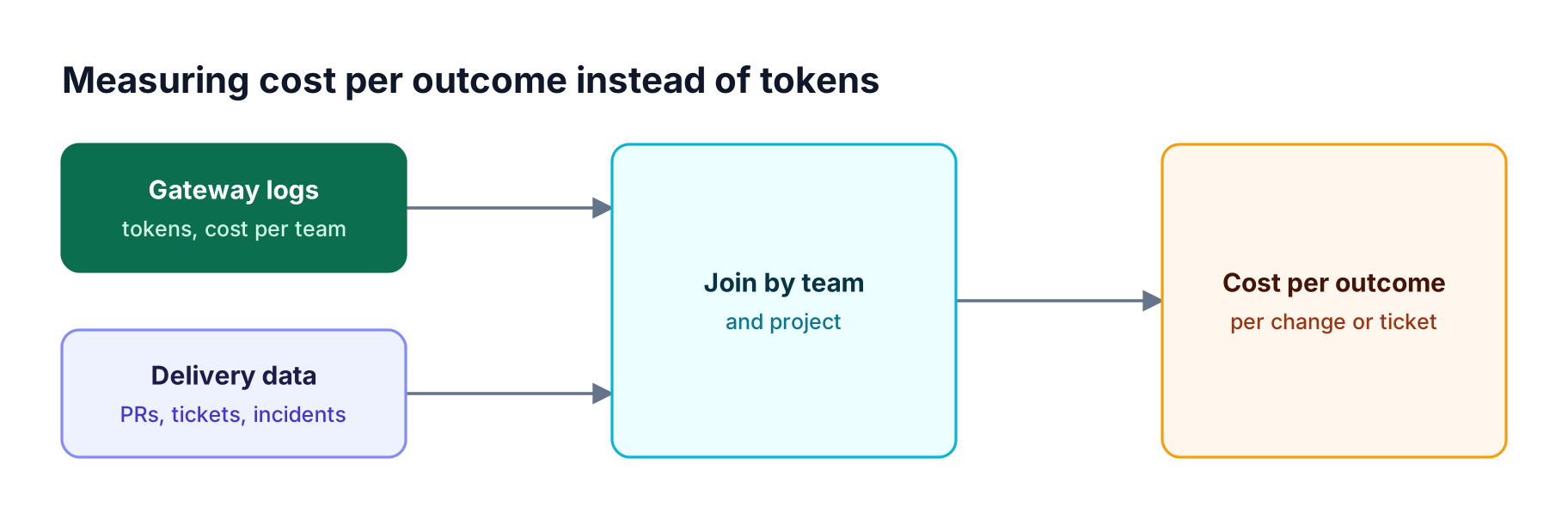
Gateway logs attribute tokens and cost to teams and projects, delivery systems record outcomes, and joining them produces cost per merged change or resolved ticket
Figure 2: Attribute spend at the gateway, join it with delivery data, and track cost per outcome rather than raw token volume.
| Instead of | Track | Why it works |
|---|---|---|
| Tokens per person | Cost per merged change or resolved ticket | Ties spend to delivered work |
| Usage leaderboards | Adoption breadth by team | Finds teams that need help without rewarding waste |
| Total monthly spend | Spend by team and project against budget | Shows where money goes and who owns it |
| Raw request counts | Share of traffic on right-sized models | Rewards efficient use |
For latency and cost together, see reducing LLM cost and latency.
All of these depend on attribution: knowing which person, team, and project generated each request. That is where an LLM gateway comes in.
How to Govern AI Token Spend
Governing token spend means encouraging useful AI adoption while preventing waste and surprises. The practical approach has four parts: attribute every request, set budgets and limits before spend happens, route each request to a model that fits the task, and reduce tokens per task through caching and efficient tool use.
A governance checklist:
- Attribute every request to a person or service, a team, and a project.
- Set budgets and rate limits per developer, team, and project, with alerts and hard caps.
- Route by task difficulty so simple requests use smaller models.
- Cut repeated and wasted tokens with caching, smaller tool catalogs, and turn limits on agents.
- Report by outcome, joining spend data with delivery data rather than ranking individuals.
Doing this tool by tool is hard because developers use several AI clients at once: chat apps, IDE assistants, coding agents, and internal applications. A gateway that every client routes through gives one place to apply the policy. The guide to AI cost optimization for teams expands on these practices.
Governing Token Spend with Bifrost
Bifrost sits between AI clients and model providers, so every request carries an identity and passes through budget, routing, and caching rules before it reaches a model. That turns token spend from a monthly surprise into something teams can attribute, cap, and optimize in real time, without discouraging people from using AI.
Attribution and limits:
- Virtual keys per person, service, or team. Virtual keys tie every request to an owner and control which models it can reach.
- Budgets and rate limits. Budgets and limits cap spend and tokens with daily, weekly, monthly, quarterly, or yearly resets, so a runaway agent stops at a known ceiling.
- Projects. Projects attribute each request to the work it is for, with a shared budget and per-member caps, which is the data needed for cost per outcome.
- Access profiles. Access profiles give teams and business units the models and budgets that fit their work.
Reducing tokens per task:
- Complexity-based routing. Routers classify each request as simple, medium, or complex and send each tier to an appropriate model.
- Semantic caching. Semantic caching serves repeated or similar requests without another model call.
- Code Mode for MCP. Code Mode lets agents use tools through code instead of loading every tool definition, cutting input tokens by up to 92.8% in Bifrost's benchmark; a 508-tool run dropped from $377 to $29.
Visibility:
- Request logs with cost. Bifrost request logs record tokens, cost, and latency for every request, filterable by key, model, and provider.
- Usage at a glance. The home page with budget approvals shows each user their spend and lets them request more budget.
Figure 3 shows how the controls fit together.
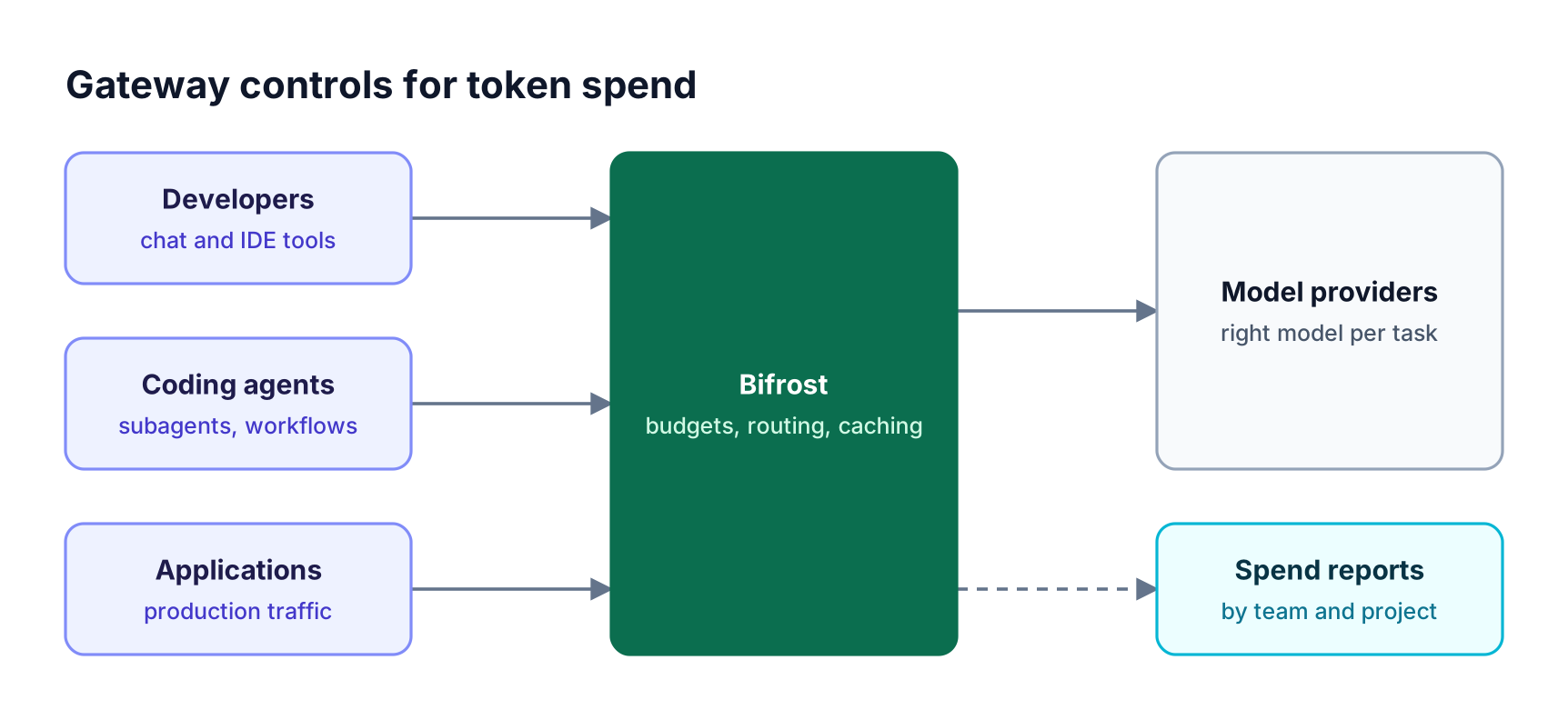
Developers, coding agents, and apps send requests through Bifrost, which applies budgets, project attribution, complexity routing, caching, and Code Mode before providers
Figure 3: One gateway in front of every AI client turns token spend into budgets, attribution, and routing decisions rather than a monthly surprise.
Covering Coding Agents and Employee AI Tools
Most of these stories involved coding agents, because agents with subagents and parallel workflows consume tokens far faster than chat. Governing them means routing their model calls through the same gateway, so each developer's agent usage counts against a budget and appears in the same reports as everything else.
How teams extend coverage:
- Coding agents. Point Claude Code, Codex CLI, Cursor, and similar tools at Bifrost with a virtual key per developer, as described in governing AI coding agents at scale.
- MCP tools. Route tool calls through the Bifrost MCP gateway so large tool catalogs do not inflate every prompt.
- Desktop and browser AI. AI Gateway + Bifrost Edge routes traffic from AI apps on employee machines through the same policies; see the Bifrost Edge page.
With attribution in place, leaders can see which teams get the most value per dollar and where enablement would help, instead of ranking individuals by consumption. The governance resources page describes the full policy model, and LLM cost optimization in Bifrost walks through cost features in more depth.
Frequently Asked Questions
What does tokenmaxxing mean?
Tokenmaxxing means maximizing AI token usage and treating that usage as a sign of productivity or AI adoption. It describes both organizations that reward heavy usage, for example with leaderboards, and individuals who inflate their consumption. The term became widely used in 2026 as companies pushed AI adoption across engineering teams.
Why is tokenmaxxing a problem?
Token usage measures cost, not value. When usage becomes a target, people optimize the number rather than the work, which raises spend without necessarily improving output. It can also mislead leadership into staffing or budget decisions based on consumption. Budgets and request-level cost logs help separate useful usage from waste.
Is tokenmaxxing still happening?
Many organizations moved away from token leaderboards during 2026 after public criticism and internal concerns about gaming, and several companies withdrew theirs. The underlying pressure to show return on AI spending remains, so the shift is toward outcome-based measures and cost governance rather than away from AI use.
What should companies measure instead of token usage?
Measure spend against outcomes: cost per merged change, cost per resolved ticket, delivery metrics such as cycle time, and adoption breadth by team. Token data remains useful as a cost line and diagnostic. Attribution through Bifrost project scopes and virtual keys makes these joins possible.
How do you control AI token spend across a company?
Route every AI client through one gateway, give each person, service, and team a key, set budgets and rate limits, attribute requests to projects, route simple tasks to smaller models, and use caching and efficient tool access. Bifrost provides these controls across chat apps, coding agents, and applications; see enterprise gateways for reducing LLM token cost.
Encourage AI Use Without Rewarding Waste
The 2026 leaderboard episode showed that counting tokens is easy and misleading. The better path is to attribute every request, cap spend before it happens, route each task to the right model, and measure cost against outcomes. Bifrost gives platform teams those controls across every AI client. To see it with your organization's AI usage, book a demo with the Bifrost team.