Top 5 Enterprise Gateways for LLM Cost Tracking and Budget Controls
Enterprise LLM spending has crossed $12.5 billion in foundation model API revenue in 2025, and most platform teams still cannot attribute that spend to a team, project, or developer. The fastest way to close that gap is to route every model call through an enterprise gateway that handles LLM cost tracking and budget controls at the infrastructure layer instead of inside application code. This guide compares the top 5 enterprise gateways for LLM cost tracking and budget controls in 2026 and explains where each one fits. Bifrost, the open-source AI gateway by Maxim AI, leads the list with hierarchical budgets, per-request cost attribution, and 11 microseconds of overhead at sustained 5,000 RPS.
Key Criteria for Evaluating LLM Cost Tracking Gateways
A gateway only earns a place in an enterprise stack when it can answer four questions in real time: who spent what, on which model, against which budget, and what happens when a budget is exhausted. Use these criteria as a baseline when comparing options:
- Per-request cost attribution: Every call logged with input, output, and reasoning tokens, the model used, the provider that served it, and the calculated cost.
- Hierarchical budget enforcement: Independent spend limits at multiple levels (organization, team, project, virtual key) with hard rejection when any level is exhausted.
- Real-time enforcement, not monthly reconciliation: Budgets evaluated on every request, before the call reaches the provider.
- Multi-provider cost normalization: A unified cost view across OpenAI, Anthropic, AWS Bedrock, Google Vertex, Azure, and others, regardless of how each provider prices tokens.
- Self-hosting and data residency: Deployment inside the enterprise network for teams subject to data residency, SOC 2, HIPAA, or GDPR requirements.
- Performance overhead: Sub-millisecond latency added by the gateway itself, so cost controls do not penalize user-facing applications.
The five gateways below are ranked on how completely they cover these criteria for enterprise-scale workloads.
1. Bifrost: Hierarchical Budgets and Per-Request Cost Attribution at 11µs Overhead
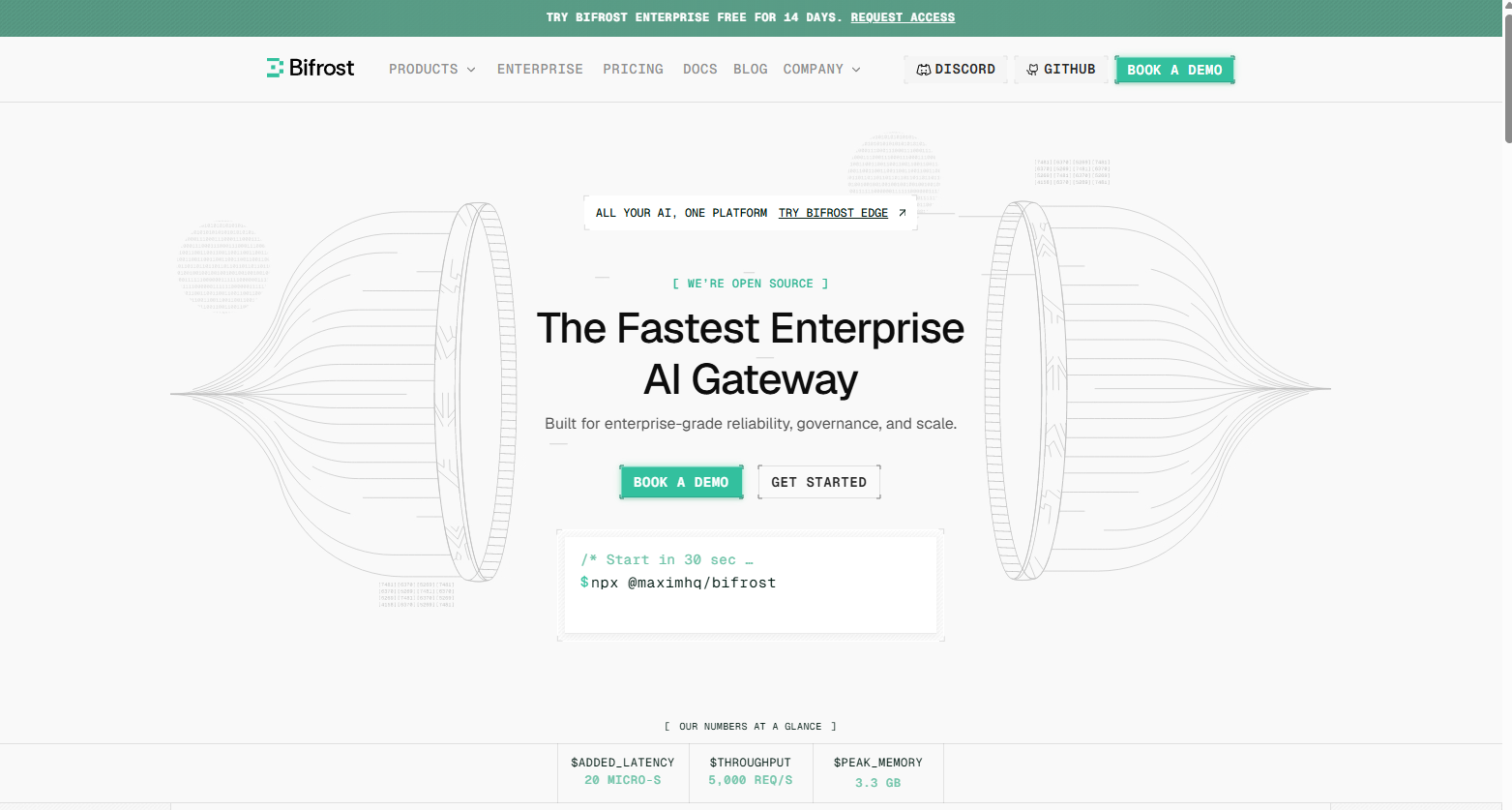
Bifrost is a high-performance, open-source Go gateway by Maxim AI that unifies access to 23+ LLM providers through a single OpenAI-compatible API. Every request flows through a centralized control plane where cost policies are enforced in real time, before the call reaches the provider. The gateway is written in Go, deploys in seconds with zero configuration, and adds only 11 microseconds of overhead at 5,000 requests per second.
Where Bifrost stands out for enterprise LLM cost tracking and budget controls:
- Four-tier hierarchical budgets: Independent spending limits at the Business Units, Team, Virtual Key, and Provider Configuration levels. Every request is checked against all applicable scopes; a hit at any level rejects the call before any provider charge is incurred. Configurable reset cycles (1d, 1w, 1M) align with finance reporting periods.
- Virtual keys as the primary governance entity: Bifrost's virtual key system replaces raw provider keys with scoped credentials that carry their own budgets, rate limits, model allowlists, and provider restrictions. Provider keys never leave the gateway.
- Per-request cost attribution: Every call is logged with token counts, model identifier, provider, and computed cost. Logs can be filtered by virtual key, team, customer, model, or time window.
- Semantic caching: Semantic response caching reduces redundant provider calls by returning saved responses for similar queries, cutting token spend on repetitive workloads.
- Native observability: Built-in Prometheus metrics and OpenTelemetry tracing, with native Datadog connector support for teams already running APM.
- Enterprise deployment: In-VPC deployment, vault integrations (HashiCorp Vault, AWS Secrets Manager, Google Secret Manager, Azure Key Vault), audit logs for SOC 2 Type II, GDPR, HIPAA, and ISO 27001 compliance, and log exports to data lakes and SIEM.
- Drop-in compatibility: Existing applications point their OpenAI, Anthropic, AWS Bedrock, Google GenAI, LiteLLM, LangChain, or PydanticAI SDKs at the Bifrost base URL. No code changes beyond a single environment variable.
2. LiteLLM: Open-Source Proxy with Basic Cost Tracking
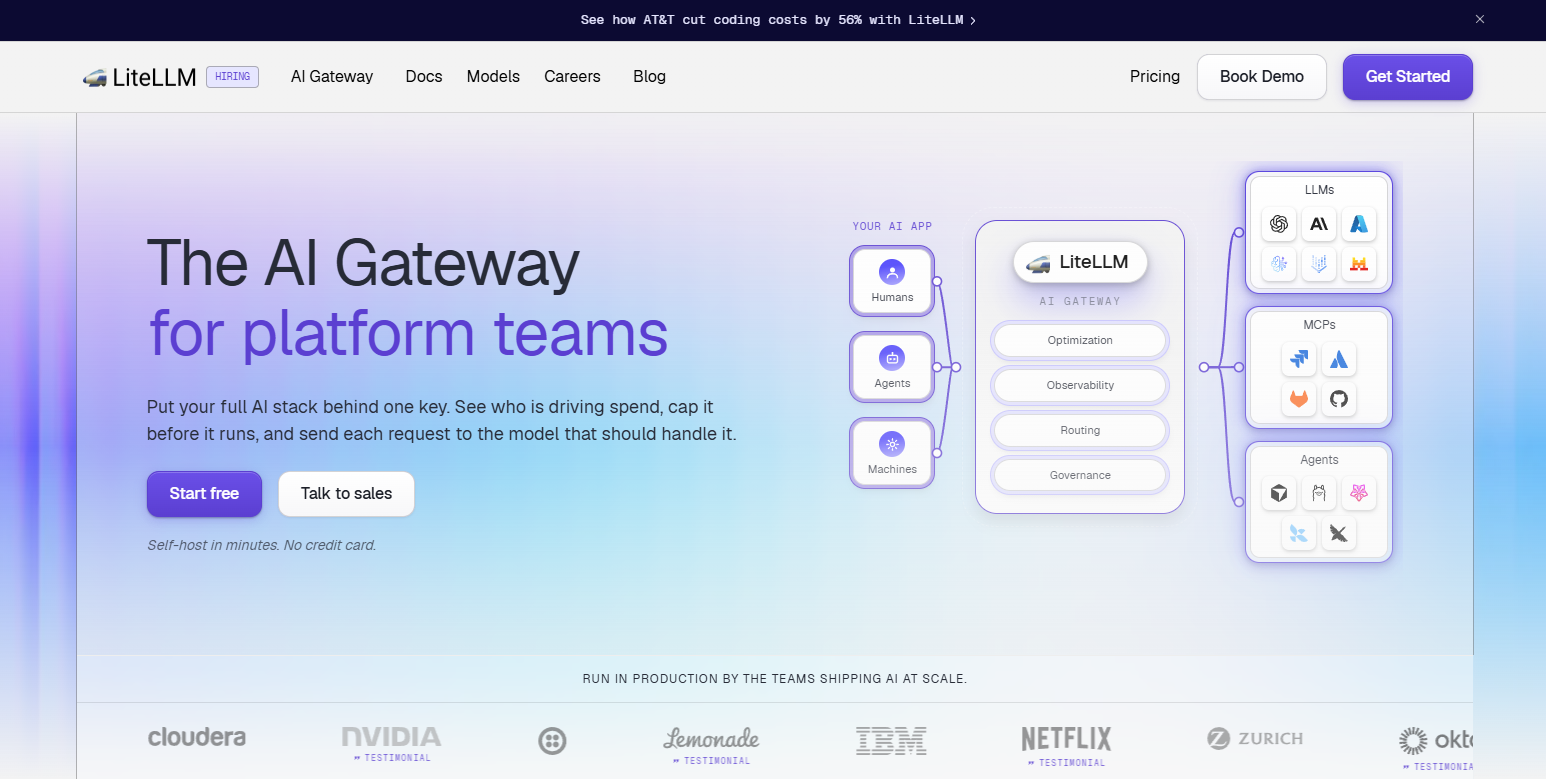
LiteLLM is a Python-based open-source LLM proxy that standardizes calls to 100+ providers through a unified interface. It includes spend tracking per API key, per user, and per team, and exposes cost data tagged by metadata such as feature, environment, or department.
What LiteLLM does well:
- Wide provider coverage (100+ providers including niche and open-weight models).
- Custom tag-based cost attribution via request metadata.
- Budget limits at the key and team level, with request rejection when limits are exceeded.
- Self-hosted deployment for predictable infrastructure costs.
Where LiteLLM falls short for enterprise budget controls:
- The budget hierarchy is flatter than gateway-level solutions: no customer-level budgets, no provider-config-level enforcement.
- Python's runtime introduces measurable latency overhead at high concurrency, with P99 latency degrading significantly above 500 RPS in published benchmarks.
- Running LiteLLM in production requires maintaining the proxy server, PostgreSQL, and Redis as supporting infrastructure.
3. Cloudflare AI Gateway: Edge-Level Logging with Unified Billing
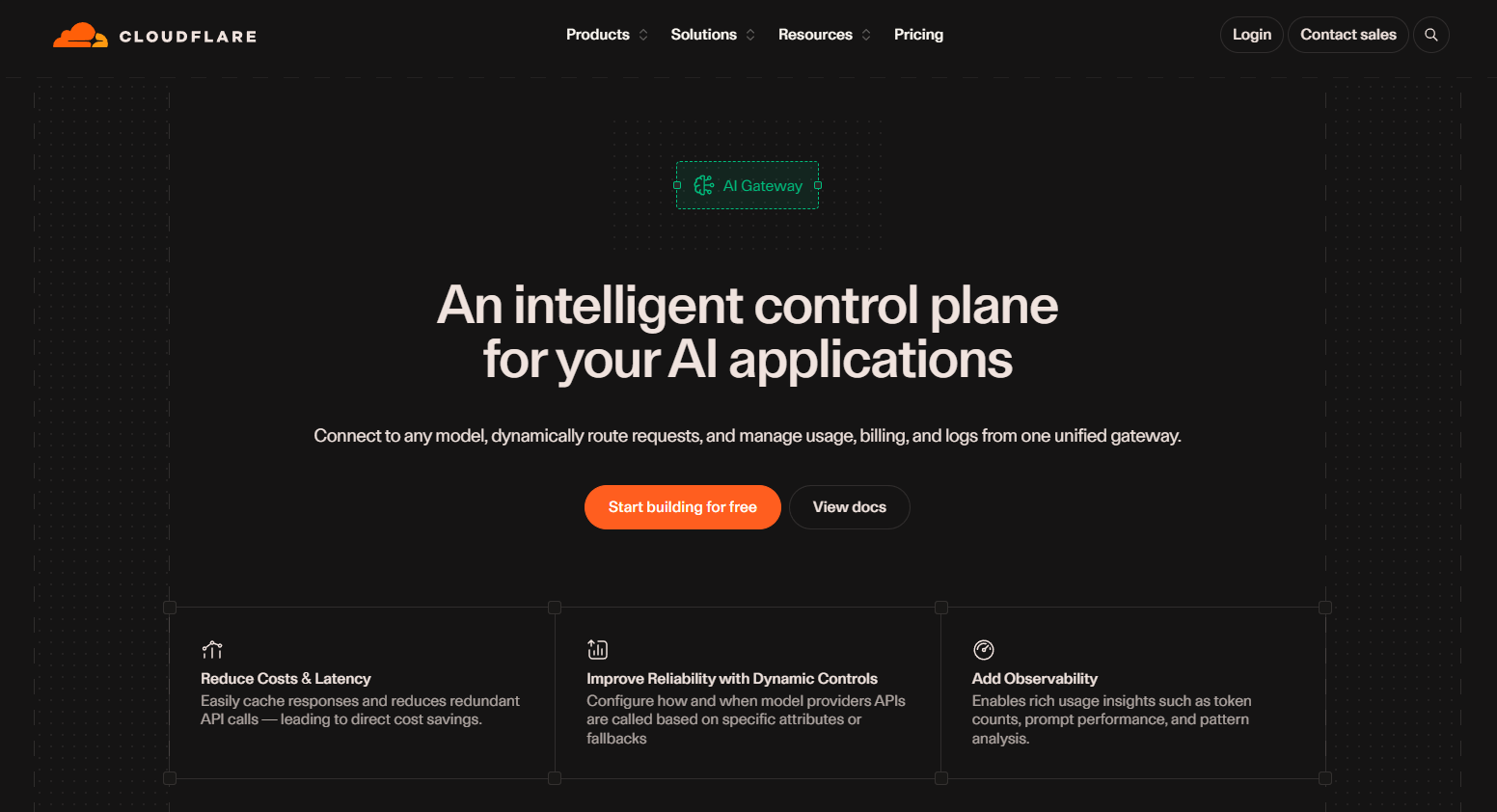
Cloudflare AI Gateway is a managed service that proxies LLM API calls through Cloudflare's global edge network. It requires no infrastructure setup and is configured directly in the Cloudflare dashboard.
What Cloudflare AI Gateway does well:
- Edge-level request caching and rate limiting, leveraging Cloudflare's CDN footprint.
- Real-time usage analytics and request logging through the Cloudflare dashboard.
- Unified billing for third-party model usage (OpenAI, Anthropic, Google AI Studio) directly through the Cloudflare invoice.
- Token-based authentication, API key management, and custom metadata tagging for filtering.
Where Cloudflare AI Gateway falls short for enterprise budget controls:
- No hierarchical budget management, virtual key system, or RBAC for multi-team enforcement.
- Managed service only, with no self-hosted option for teams with data residency requirements.
- Lacks deep governance primitives such as per-team spend ceilings or per-virtual-key model allowlists.
4. Kong AI Gateway: AI Plugins on a Mature API Management Platform

Kong AI Gateway extends Kong's enterprise API gateway with AI-specific plugins, designed for organizations that already run Kong for API management and want to extend the same governance layer to LLM traffic.
What Kong AI Gateway does well:
- Token-based rate limiting through the AI Rate Limiting Advanced plugin, which operates on actual token consumption rather than raw request counts.
- Model-level rate limits configured per model (for example, GPT-4o vs. Claude Sonnet) for cost-aligned enforcement.
- Semantic caching and AI prompt and response transformation at the proxy layer.
- Governance through Kong Konnect: audit logs, RBAC, and developer portals.
- Load balancing across LLM providers with health checks and circuit breaking.
Where Kong AI Gateway falls short for enterprise budget controls:
- Practical only for organizations with an existing Kong deployment; standing up Kong purely for LLM traffic is heavyweight.
- Cost tracking is request- and token-counted but lacks native multi-tier budget hierarchies (customer, team, virtual key, provider config) as a first-class primitive.
- AI-specific capabilities are added via plugins to a general-purpose API gateway, so configuration and operational complexity inherit from the Kong control plane.
5. OpenRouter: Unified API Endpoint with Aggregated Billing
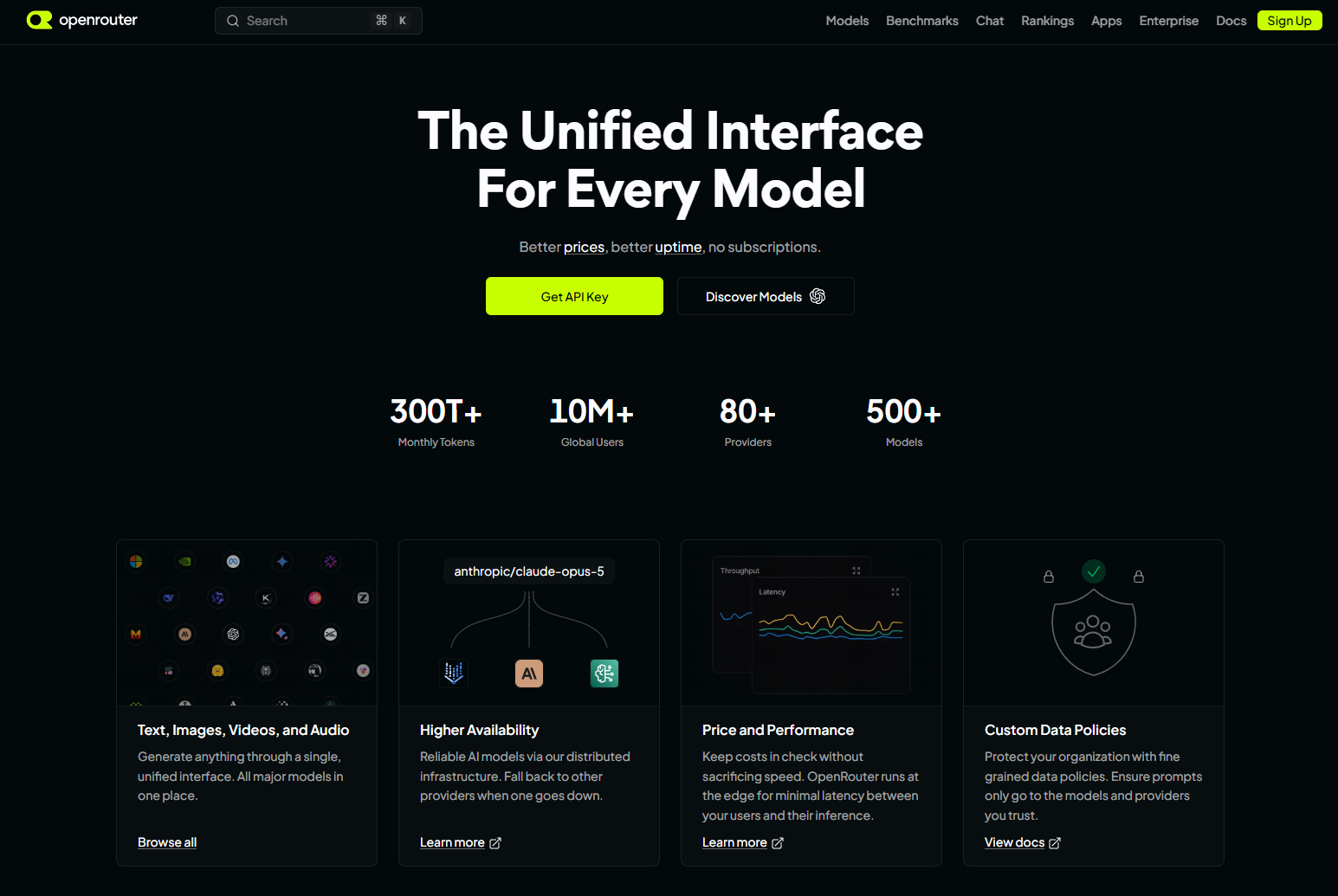
OpenRouter is a managed routing service that exposes a single API endpoint to access 200+ models across major providers. It handles billing aggregation and model availability tracking through a hosted proxy.
What OpenRouter does well:
- Single API key for accessing models from OpenAI, Anthropic, Google, Meta, Mistral, and open-source providers.
- Automatic model fallback and unified billing in a single invoice.
- Model comparison interface and broad model catalog for experimentation.
Where OpenRouter falls short for enterprise budget controls:
- Hosted service with no self-hosted option, which is a non-starter for enterprises with data residency or compliance requirements.
- No native budget hierarchies, RBAC, virtual keys, or audit logging for enterprise governance.
- Credit-purchase fees apply to top-ups, adding cost on top of provider rates.
- Known issues with streaming function call arguments can cause failures in tool-heavy workflows.
How These Gateways Compare on Cost Tracking and Budget Controls
The deciding factor for most enterprise teams is whether the gateway can enforce a budget at multiple levels of the org chart simultaneously, in real time, before the provider charge is incurred. That capability is what separates active LLM cost tracking and budget controls from after-the-fact reporting.
| Gateway | Budget hierarchy | Virtual keys | Cost attribution | Semantic caching | Self-hosted | Audit logs and RBAC |
|---|---|---|---|---|---|---|
| Bifrost | Four tiers: business unit, team, virtual key, provider config | Yes, the primary governance entity | Per token, model, and provider | Yes | Yes, in-VPC and on-prem | Yes, SOC 2, GDPR, HIPAA, ISO 27001 |
| LiteLLM | Key and team level only | Key-scoped | Tag-based via request metadata | Yes, Redis-backed | Yes, self-hosted | Enterprise tier |
| Cloudflare AI Gateway | None | No | Dashboard analytics and logs | Exact-match edge caching | No, managed only | No hierarchical RBAC |
| Kong AI Gateway | Token-based rate limits, no budget tiers | No | Request and token counts | Yes | Yes, self-managed | Yes, via Konnect |
| OpenRouter | None | No | Unified invoice only | Not documented | No, hosted only | No |
Frequently Asked Questions
What is an LLM gateway, and how does it help control costs?
An LLM gateway is a unified control layer between applications and model providers. For cost control it centralizes three things each team would otherwise rebuild: per-request token accounting, spend limits enforced before a provider is called, and caching that avoids paying twice for equivalent queries. Bifrost enforces all three at the gateway.
What are virtual keys, and why do they matter for budgets?
Virtual keys are scoped credentials that replace raw provider keys, each carrying its own budget, rate limit, model allowlist, and provider restrictions. They matter because spend can then be attributed and capped per team, customer, or application without distributing real provider keys. Bifrost's virtual keys are its primary governance entity.
How does rate limiting differ from budget enforcement?
Rate limiting caps how many requests or tokens flow in a time window, protecting against runaway loops and provider throttling. Budget enforcement caps cumulative spend against a currency amount over a reset cycle. They solve different failure modes, and enterprise deployments need both. Bifrost applies each independently at every scope.
How do you attribute LLM costs to specific teams or customers?
Attribution requires logging every call with its token counts, model, provider, and computed cost, then filtering that log by an identity dimension such as virtual key, team, or customer. Without per-request attribution, chargeback and showback reporting is guesswork. Bifrost logs each request with all of these fields.
How much can semantic caching reduce LLM spend?
Savings depend on how repetitive the workload is. Semantic caching returns a stored response when a new prompt is semantically equivalent to an earlier one, so support assistants and FAQ-style workloads with high query overlap save most, while workloads where every prompt is unique save little. It also removes provider latency on cache hits.
Why does LLM pricing vary so much between providers?
Providers price input and output tokens separately and at different rates, and those rates differ by model tier, context window, and features such as caching or batch processing. The same workload can therefore differ several-fold in cost depending on routing. A gateway that reports per-model cost makes those differences visible before they compound.
Try Bifrost for Enterprise LLM Cost Tracking and Budget Controls
Enterprise LLM cost tracking and budget controls have outgrown spreadsheets, provider dashboards, and application-level instrumentation. The right gateway pulls every model call into a single governed plane, attributes it to the correct virtual key, team, and customer, and rejects any request that exceeds an active budget before a charge accumulates. Bifrost ships all of this in an open-source, self-hostable, drop-in-compatible AI gateway that adds 11 microseconds of overhead at sustained 5,000 RPS. To see hierarchical budgets, virtual keys, and per-request cost attribution running on your actual workload, book a Bifrost demo with the Bifrost team.