Top Open Source AI Gateways for Enterprises in 2026
TL;DR
- An open-source AI gateway is a self-hosted control layer that centralizes LLM access, routing, governance, and observability while keeping prompt data inside your own environment.
- Bifrost, the open-source AI gateway by Maxim AI, leads for enterprises: 11 microseconds of overhead at 5,000 RPS, semantic caching, native MCP, and virtual-key governance in the open-source tier, across 23+ providers under Apache 2.0.
- LiteLLM offers the widest provider coverage with a Python performance ceiling; Kong and Apache APISIX extend existing API platforms; Envoy AI Gateway suits Istio and Kubernetes service meshes but is early stage.
- The open-source advantage for enterprises is data control, auditability, and no per-seat licensing, but verify that governance (virtual keys, budgets, RBAC) is in the free tier rather than gated behind an enterprise license, as it is for several options here.
Enterprise AI teams in 2026 manage requests across multiple LLM providers simultaneously. A single application might route to OpenAI for conversational tasks, Anthropic for coding, and Google Gemini for multimodal inputs. Without a unified control layer, this creates fragmented authentication, unpredictable costs, zero failover coverage, and compliance blind spots. Open source AI gateways solve these problems by providing a self-hosted infrastructure layer that centralizes LLM access, routing, governance, and observability while keeping sensitive prompt data within your own environment.
This guide evaluates the top five open source AI gateways available to enterprises in 2026, ranked by performance, governance depth, and production readiness.
What Makes an Open Source AI Gateway Enterprise-Ready
An open source AI gateway for enterprises must go beyond basic API proxying. Production-grade deployments require a combination of capabilities that protect uptime, control costs, and satisfy compliance requirements.
Key evaluation criteria include:
- Performance overhead: The gateway layer should add minimal latency to every LLM request, especially at high concurrency
- Multi-provider support: Unified access to providers like OpenAI, Anthropic, AWS Bedrock, Google Vertex AI, and Azure OpenAI through a single API
- Governance and access control: Virtual keys, budget management, rate limits, and role-based access control (RBAC)
- Reliability: Automatic failover, load balancing, and health monitoring across providers
- Observability: Native metrics, distributed tracing, and logging for production monitoring
- MCP support: Model Context Protocol capabilities for agentic AI workflows, which Gartner projects 40% of enterprise applications will embed by end of 2026
- Deployment flexibility: Self-hosted, in-VPC, Kubernetes-native, or air-gapped deployment options
For a detailed breakdown of these criteria applied to the market, the LLM Gateway Buyer's Guide provides a comprehensive comparison framework.
For open-source gateways, what matters most is which capabilities are in the free tier versus gated behind an enterprise license. This is how the five compare.
| Gateway | Overhead | Semantic caching | MCP support | Governance (OSS tier) | Maturity | License |
|---|---|---|---|---|---|---|
| Bifrost | 11µs at 5,000 RPS | Yes | Yes (client and server, Code Mode) | Virtual keys, budgets, RBAC | Production | Apache 2.0 |
| LiteLLM | Higher (Python GIL) | No (exact-match) | No | Virtual keys, basic spend | Widely adopted | MIT |
| Kong AI Gateway | 2-5ms (Nginx + Lua) | Enterprise tier | Yes (OAuth 2.1) | Enterprise tier | Mature (API platform) | Apache 2.0 core |
| Envoy AI Gateway | Envoy proxy layer | No | Yes (OAuth, CEL authz) | No virtual keys or budgets | Early (v0.5) | Apache 2.0 |
| Apache APISIX | Plugin layer | No | No | Limited (via plugins) | Mature (API platform) | Apache 2.0 |
1. Bifrost
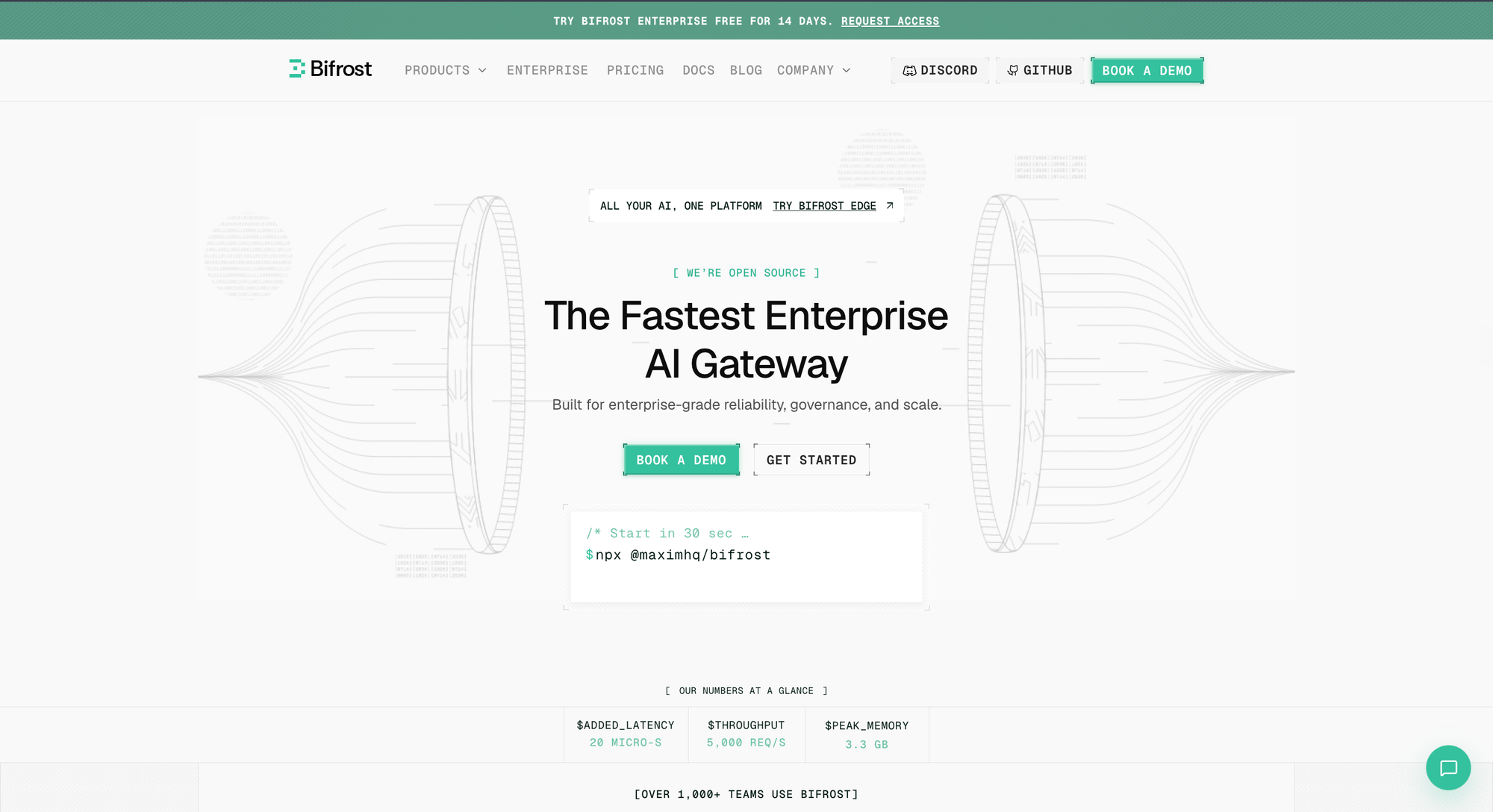
Bifrost is a high-performance, open source AI gateway built in Go by Maxim AI. It is purpose-built for production workloads where latency, reliability, and governance are non-negotiable.
What sets Bifrost apart is its architecture. Written in Go from the ground up, Bifrost adds only 11 microseconds of overhead per request at 5,000 requests per second in sustained benchmarks. For comparison, Python-based gateways introduce hundreds of microseconds to milliseconds under similar load.
Core capabilities:
- Unified API: Single OpenAI-compatible interface for 23+ providers including OpenAI, Anthropic, AWS Bedrock, Google Vertex AI, Azure, Mistral, Groq, Cohere, and Ollama
- Reliability: Automatic failover between providers and models with zero downtime, plus intelligent load balancing with weighted distribution
- MCP gateway: Functions as both an MCP client and server with Agent Mode for autonomous tool execution, Code Mode for Python-based orchestration (50% fewer tokens, 40% lower latency), and OAuth 2.0 authentication. Full details are available on the MCP Gateway resource page.
- Governance: Virtual keys with per-consumer budgets, rate limits, and MCP tool filtering. Enterprise deployments add RBAC with SSO via Okta and Microsoft Entra. See the governance overview for the full access control model.
- Semantic caching: Intelligent response caching based on semantic similarity to reduce costs and latency for repeated queries
- Observability: Native Prometheus metrics, OpenTelemetry integration, and compatibility with Grafana, New Relic, and Honeycomb
- Enterprise features: Guardrails for content safety, in-VPC deployments, vault support for HashiCorp Vault and AWS Secrets Manager, audit logs for SOC 2/GDPR/HIPAA compliance, and cluster mode for high availability
Bifrost supports CLI coding agents including Claude Code, Codex CLI, Gemini CLI, and Cursor through its CLI agents integration. It deploys in under a minute via NPX (npx -y @maximhq/bifrost) or Docker, with zero configuration required.
Best for: Bifrost is built for enterprises running mission-critical AI workloads that require best-in-class performance, scalability, and reliability. It serves as a centralized AI gateway to route, govern, and secure all AI traffic across models and environments with ultra low latency. Bifrost unifies LLM gateway, MCP gateway, and Agents gateway capabilities into a single platform.
Designed for regulated industries and strict enterprise requirements, it supports air-gapped deployments, VPC isolation, and on-prem infrastructure. It provides full control over data, access, and execution, along with robust security, policy enforcement, and governance capabilities.
The open source version under Apache 2.0 is available on GitHub, and startups can access the full OSS feature set at zero cost.
2. LiteLLM
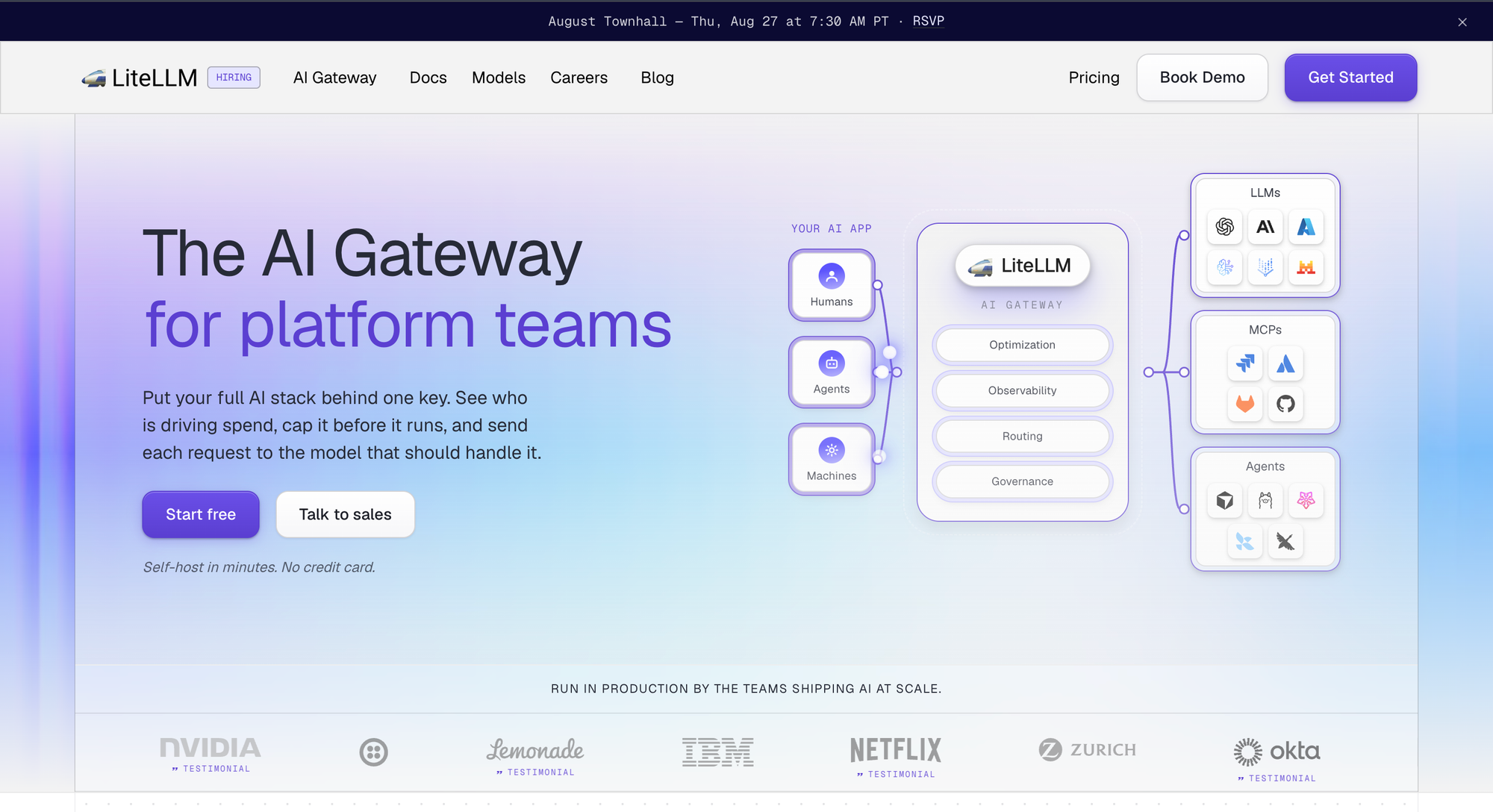
LiteLLM is a Python-based open source AI gateway that provides a unified OpenAI-compatible interface to over 100 LLM providers. It is one of the most widely adopted gateways in the open source ecosystem, with broad provider coverage and an active contributor community.
Core capabilities:
- Unified OpenAI-format API supporting 100+ providers
- Advanced routing strategies including latency-based, cost-based, and usage-based algorithms
- Virtual keys with team management and basic spend tracking
- Python SDK for direct integration into Python-native workflows
Considerations: LiteLLM's Python architecture introduces a measurable performance ceiling. The Global Interpreter Lock limits single-process throughput, resulting in elevated P95 latency at high concurrency. Running LiteLLM at scale requires maintaining the proxy server, PostgreSQL, and Redis. There is no semantic caching (exact-match only), no native MCP support, no formal enterprise SLAs, and no dedicated commercial support escalation path.
Best for: Python-heavy engineering teams that need maximum provider compatibility for prototyping and development environments where throughput demands remain moderate.
3. Kong AI Gateway
Kong AI Gateway extends Kong's established API management platform with AI-specific capabilities for multi-LLM routing and governance. For enterprises already running Kong for API management, the AI Gateway plugin integrates directly into the existing infrastructure.
Core capabilities:
- Multi-LLM routing through the AI Proxy plugin with support for OpenAI, Anthropic, Azure, AWS Bedrock, Mistral, and others
- Semantic caching, prompt engineering, and request/response transformation plugins
- MCP traffic governance with OAuth 2.1 support and MCP-specific Prometheus metrics
- Full plugin ecosystem including OIDC, mTLS, rate limiting, and OpenTelemetry applicable to AI traffic
- Managed SaaS option via Kong Konnect or self-hosted deployment
Considerations: The open source version of Kong Gateway is limited. Advanced AI features (semantic caching, detailed analytics, compliance tooling) require Kong Enterprise, which is not free. The architecture adds 2-5ms of overhead per request due to its Nginx + Lua processing stack. For greenfield AI deployments, the full Kong platform can feel heavy compared to AI-native gateways that offer zero-configuration startup.
Best for: Large enterprises with existing Kong API management deployments that want to extend their governance framework to AI traffic without introducing a separate tool.
4. Envoy AI Gateway
Envoy AI Gateway is a relatively new open source project built on Envoy Proxy, the foundation of Istio and most service mesh deployments. It uses a two-tier gateway pattern with centralized entry and fine-grained model-level routing.
Core capabilities:
- OpenAI-compatible API with multi-provider routing across OpenAI, Anthropic, AWS Bedrock, Google Vertex AI, and others
- Token-based rate limiting and cost estimation
- Kubernetes-native integration via the Gateway API
- MCP gateway support with OAuth authentication and fine-grained CEL-based authorization (added in v0.4/v0.5)
- Endpoint Picker for intelligent inference routing to self-hosted models
Considerations: Envoy AI Gateway is still early stage (currently at v0.5). Provider support is more limited than mature alternatives. There is no semantic caching, no virtual key hierarchy, and no budget management. The Envoy configuration model (xDS) has a steep learning curve for teams not already operating within the Envoy ecosystem.
Best for: Teams deeply invested in the Envoy/Istio service mesh that want AI traffic management integrated with their existing infrastructure.
5. Apache APISIX
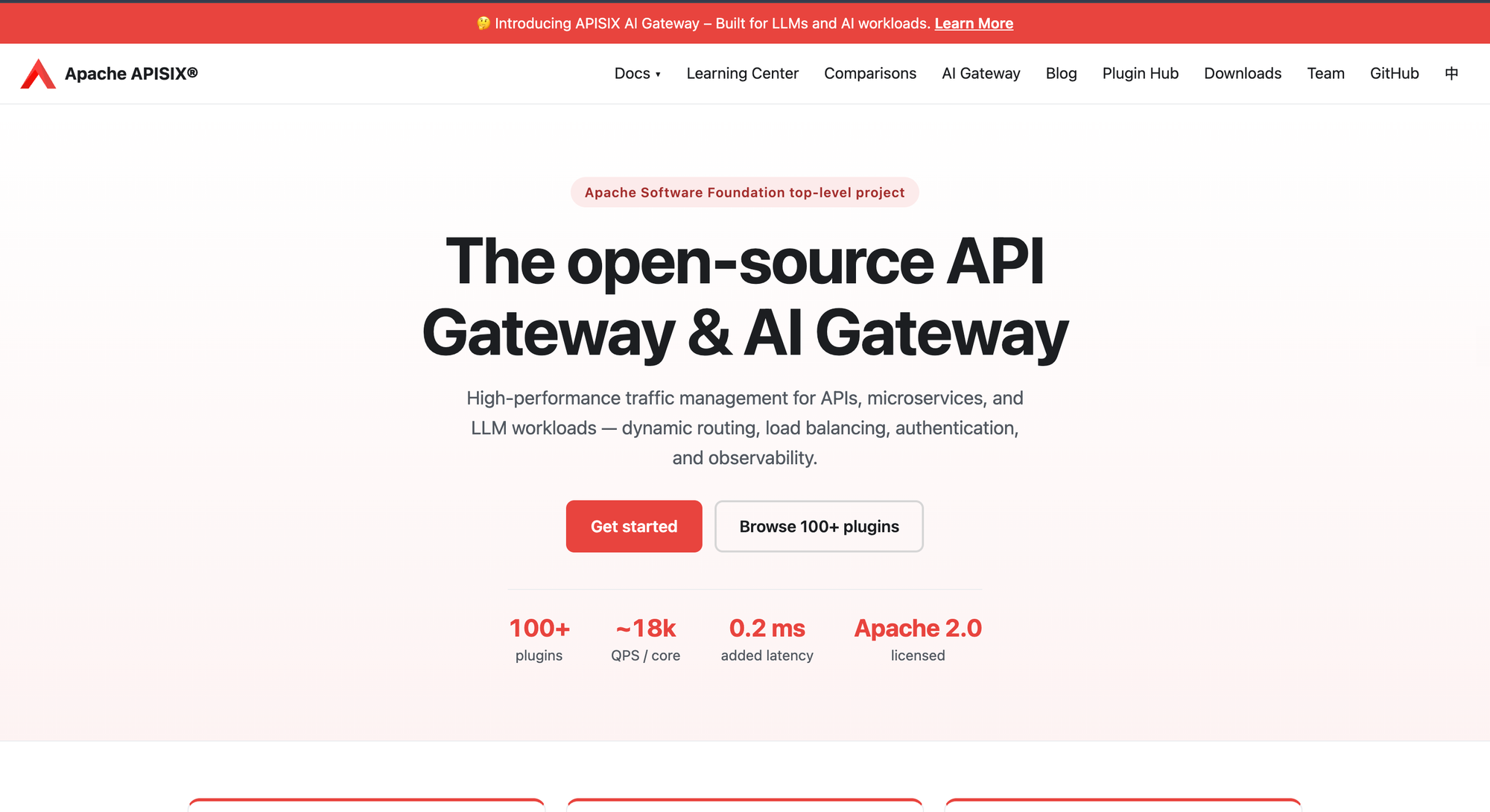
Apache APISIX is a cloud-native API gateway that has added AI plugins to support LLM traffic management. As an Apache Software Foundation project, it benefits from strong open source governance and an active contributor community.
Core capabilities:
- AI proxy plugins for multi-provider LLM routing
- Dynamic routing, load balancing, and rate limiting
- Plugin architecture supporting Lua, Go, Python, and WebAssembly extensions
- Native Kubernetes integration with Ingress Controller support
- Built-in observability with Prometheus, Grafana, and logging integrations
Considerations: AI-specific capabilities are delivered through plugins rather than native gateway architecture. The AI feature set is narrower than purpose-built AI gateways, with no semantic caching, no MCP support, and limited AI-specific governance features in the open source version. Configuration complexity can be significant for teams unfamiliar with the APISIX ecosystem.
Best for: Teams already running APISIX for API management that want to extend their existing gateway to handle AI traffic without introducing a separate infrastructure layer.
How to Choose the Right Open Source AI Gateway
The right choice depends on your existing infrastructure, performance requirements, and governance needs.
- AI is your primary traffic type and latency matters: Bifrost. 11 microsecond overhead, semantic caching, MCP gateway, and built-in governance under Apache 2.0. Enterprise-grade scalability with zero-config startup.
- Maximum provider coverage for prototyping: LiteLLM. 100+ providers with the trade-off of Python's performance ceiling.
- Extending an existing API management platform: Kong AI Gateway or Apache APISIX. Use the gateway your team already operates rather than introducing another proxy layer.
- Deep Kubernetes/Istio integration: Envoy AI Gateway. Native service mesh integration with the Kubernetes Gateway API.
For teams evaluating multiple options, the LLM Gateway Buyer's Guide provides a structured comparison framework covering performance, governance, deployment, and total cost of ownership.
Get Started with Bifrost
Bifrost delivers the lowest latency, deepest governance, and broadest enterprise feature set of any open source AI gateway available today. With 23+ provider integrations, native MCP gateway capabilities, semantic caching, and compliance-ready infrastructure, Bifrost gives engineering teams a production-grade foundation for AI at scale.
Book a demo with the Bifrost team to see how it fits your AI infrastructure.
Frequently Asked Questions
What is an open source AI gateway?
An open source AI gateway is a self-hosted infrastructure layer, with publicly available and auditable source code, that sits between applications and LLM providers. It centralizes routing, failover, caching, governance, and observability behind one API while keeping prompt data inside your own environment. Bifrost, LiteLLM, Kong, Envoy AI Gateway, and Apache APISIX are the main open-source options.
What is the best open source AI gateway for enterprises?
For production performance and governance, Bifrost is the strongest: 11 microseconds of overhead at 5,000 RPS, semantic caching, native MCP, and virtual-key governance in the open-source tier under Apache 2.0. LiteLLM suits Python-first breadth, Kong and APISIX fit existing API platforms, and Envoy AI Gateway suits Istio service meshes.
Why choose an open source AI gateway over a managed one?
Open source gives you data control, auditability, no per-seat licensing, and the ability to self-host in a VPC or air-gapped environment, which regulated industries often require. A managed gateway reduces operational overhead but routes prompt data through a third party and can limit deployment and compliance flexibility. For sensitive workloads, self-hosted open source is usually the safer default.
Do open source AI gateways support MCP?
Support varies. Bifrost offers the most complete MCP gateway of the open-source options, acting as both client and server with Agent Mode and Code Mode. Kong and Envoy AI Gateway add MCP with OAuth, while LiteLLM and Apache APISIX do not currently offer native MCP support.
Can an open source AI gateway meet enterprise compliance requirements?
Yes, if it supports in-VPC or air-gapped deployment, audit logging, and role-based access control. Bifrost provides these along with SOC 2, GDPR, and HIPAA-ready audit logs and vault-backed key management. The key check is whether these capabilities are in the open-source tier or require a paid enterprise license, which differs across gateways.