Best Enterprise LLM Gateways in 2026: A Comparative Guide
An enterprise buyer's comparison of five LLM gateways: Bifrost, LiteLLM, Cloudflare, Kong, and OpenRouter. Covers the buying questions that block deals, from self-hosting and audit logs to which features sit behind an enterprise tier.
TL;DR
- An enterprise LLM gateway is the unified control layer between applications and providers, centralizing routing, failover, governance, caching, observability, and security from one point.
- Bifrost, the open-source AI gateway by Maxim AI, leads the field: 11 microseconds of overhead at 5,000 RPS, 23+ providers, native MCP as client and server, hierarchical governance, and self-host, in-VPC, or air-gapped deployment under Apache 2.0.
- LiteLLM suits Python prototyping, Cloudflare fits edge and managed stacks, Kong fits existing Kong estates, and OpenRouter offers breadth and unified billing for smaller teams.
- The 2026 selection bar has moved past basic routing to MCP support, hierarchical budgets, and compliance-grade isolation, since agents now make dozens of LLM calls per task.
Gartner forecasts that 40% of enterprise applications will embed task-specific AI agents by the end of 2026, up from less than 5% in 2025. As that traffic moves into production, the best enterprise LLM gateways have become the primary control surface for routing, failover, governance, and observability across LLM providers. They now have to unify multi-provider access, automatic failover, hierarchical cost control, semantic caching, and Model Context Protocol (MCP) support in a single platform.
Bifrost, the open-source AI gateway from Maxim AI, is one of five options worth evaluating, alongside LiteLLM, Cloudflare AI Gateway, Kong AI Gateway, and OpenRouter. Bifrost is open source on GitHub, and the full documentation covers setup in under five minutes. This guide compares all five gateways on architecture, performance, and enterprise feature depth, with each profile mapped to the use cases it fits best.
What an Enterprise LLM Gateway Should Deliver in 2026
An enterprise LLM gateway is a unified infrastructure layer that sits between applications and LLM providers. It centralizes routing, failover, governance, caching, observability, and security policies across all model traffic from a single control point.
The bar for selection in 2026 has moved well beyond basic multi-provider routing. Production AI agents make dozens of LLM calls per task, agentic workloads have introduced new infrastructure requirements through the Model Context Protocol, and regulated industries now expect compliance-grade isolation, audit logs, and SSO out of the gateway itself. Buyers typically evaluate enterprise LLM gateways across these dimensions:
- Latency overhead under sustained production load (microseconds matter when agents make dozens of LLM calls per task)
- Provider breadth, with first-class support for OpenAI, Anthropic, AWS Bedrock, Google Vertex AI, Azure OpenAI, and self-hosted models
- Automatic failover and load balancing across providers, models, and API keys without manual intervention
- MCP gateway capabilities for centralized tool routing, OAuth, and access control across agent workflows
- Semantic caching to cut token spend on repeated or semantically similar queries
- Hierarchical governance with virtual keys, budgets, rate limits, and per-team or per-customer access control
- Enterprise compliance: SSO/SAML, RBAC, immutable audit logs, vault integration, and VPC isolation
- Deployment flexibility: managed SaaS, self-hosted, in-VPC, air-gapped, and on-prem support
- Observability through Prometheus, OpenTelemetry, and native integrations with Datadog and Grafana
The LLM Gateway Buyer's Guide provides a full capability matrix across these dimensions for each of the gateways covered below.
The five gateways separate most on overhead, MCP support, and governance depth. This maps them to the evaluation dimensions above.
| Criterion | Bifrost | LiteLLM | Cloudflare | Kong | OpenRouter |
|---|---|---|---|---|---|
| Latency overhead | 11µs at 5,000 RPS | Higher (Python) | Edge, managed | Plugin layer | Managed |
| Provider breadth | 23+ providers | Many (Python bindings) | Major providers | Multi-provider | Broad catalog |
| Failover and load balancing | Provider, model, and key-level | Basic across keys | Retry and fallback | Policy-based | Automatic model fallback |
| MCP gateway | Full (client and server, Code Mode) | No | No | Plugin-based | No |
| Hierarchical governance | Virtual keys, budgets, RBAC (key/team/customer) | Virtual keys, basic budgets | Limited | Enterprise tier | None |
| Compliance and deployment | SSO, audit logs, vault, in-VPC, air-gapped | Self-host | Managed only | Self-host or Konnect | Managed only |
| Buying question | What to ask for | Why it blocks deals |
|---|---|---|
| Can it run in our network? | Self-hosted, in-VPC, or air-gapped options | Data residency rules rule out managed-only gateways |
| What does it add per request? | A published overhead figure with instance type and request rate | Agent workloads multiply the number by every call |
| Who can spend what? | Budgets and rate limits per key, team, and customer | Finance approval usually depends on this |
| Who changed the policy? | Signed audit logs of administrative activity | Security review asks for it by name |
| Does it govern agent tools? | MCP support in the same product | Otherwise agent traffic needs a second control plane |
| What happens at renewal? | Licence, tier boundaries, and which features sit behind them | Decides the three-year cost, not the pilot cost |
1. Bifrost (by Maxim AI)
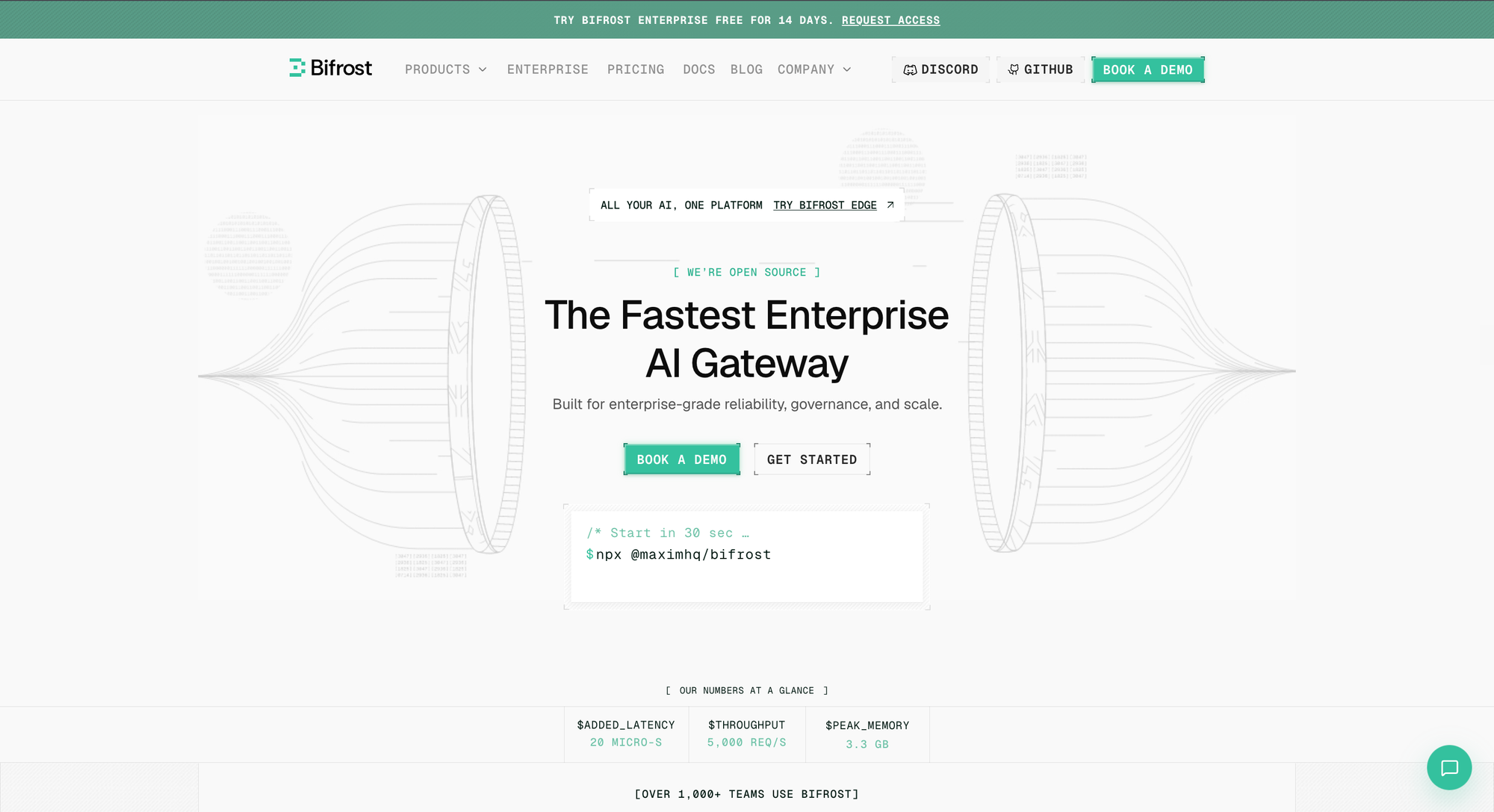
Bifrost is a high-performance, open-source AI gateway written in Go that unifies access to 25+ providers including OpenAI, Anthropic, AWS Bedrock, Google Vertex AI, Azure OpenAI, Google Gemini, Cohere, Mistral, Groq, Cerebras, xAI, Perplexity, Ollama, vLLM, and SGL through a single OpenAI-compatible API. In sustained benchmarks at 5,000 requests per second, Bifrost adds only 11 microseconds of overhead per request, the lowest published number for any production AI gateway.
Key capabilities:
- Automatic fallbacks and load balancing: Provider failover chains and weighted key distribution keep applications running through provider outages and rate-limit windows, with zero downtime.
- MCP gateway: Bifrost acts as both an MCP client and server, centralizing tool execution, OAuth 2.0 authentication with PKCE, dynamic client registration, and per-virtual-key tool filtering.
- Code Mode: An MCP execution mode where the model writes Python to orchestrate multiple tools in a single step, reducing token consumption by 50% and latency by 40% compared to standard tool-use loops.
- Semantic caching: Response caching based on semantic similarity cuts costs and latency for repeated or paraphrased queries, well beyond exact-string cache hits.
- Hierarchical governance: Virtual keys authenticate consumers and enforce budgets, rate limits, model access, and MCP tool allow-lists at the virtual key, team, and customer levels.
- Drop-in replacement: Bifrost replaces existing OpenAI, Anthropic, AWS Bedrock, Google GenAI, LiteLLM, LangChain, and PydanticAI SDK connections by changing only the base URL, with no other code changes required.
- CLI agents and editors: First-class integration with Claude Code, Codex CLI, Gemini CLI, Cursor, Zed, Qwen Code, and Roo Code, so platform teams can govern coding-agent traffic centrally.
- High availability and identity: Clustering for zero-downtime deployments and automatic service discovery, plus RBAC with Okta and Entra (Azure AD) integration.
- Secrets, audit, and deployment isolation: Vault support for HashiCorp Vault and cloud secret managers, immutable audit logs for SOC 2, GDPR, HIPAA, and ISO 27001, and in-VPC and air-gapped deployments for regulated industries.
- Guardrails: Real-time content safety through AWS Bedrock Guardrails, Azure Content Safety, Google Model Armor, and Patronus AI.
- Observability: Native Prometheus metrics, OpenTelemetry distributed tracing, and a Datadog connector for APM and LLM Observability.
- Custom plugins: Extensible Go and WASM middleware for injecting analytics, compliance checks, or custom business logic anywhere in the request pipeline.
Best for: Bifrost is built for enterprises running mission-critical AI workloads that require best-in-class performance, scalability, and reliability. It serves as a centralized AI gateway to route, govern, and secure all AI traffic across models and environments with ultra low latency. Bifrost unifies LLM gateway, MCP gateway, and Agents gateway capabilities into a single platform.
Designed for regulated industries and strict enterprise requirements, it supports air-gapped deployments, VPC isolation, and on-prem infrastructure. It provides full control over data, access, and execution, along with robust security, policy enforcement, and governance capabilities.
2. LiteLLM
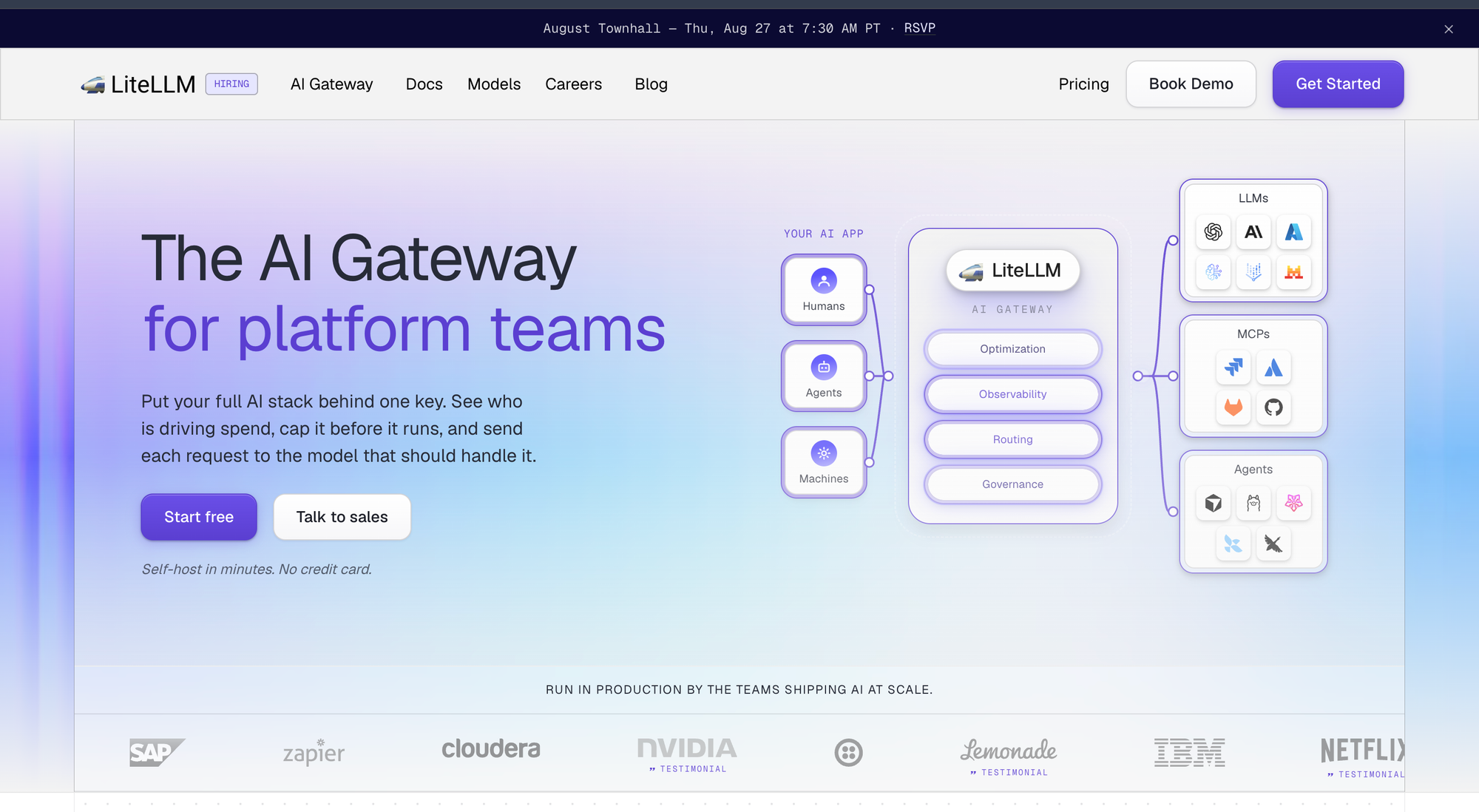
LiteLLM is an open-source Python library and proxy server that provides a unified OpenAI-compatible interface across many LLM providers. It supports both an SDK mode for direct application integration and a proxy server mode for centralized routing, with virtual keys and basic spend tracking per key and team.
Key capabilities: Broad provider coverage through Python-native bindings, virtual key management with team-level budgets, basic load balancing across keys, callback hooks for logging and observability, and proxy-mode deployment for centralized control.
Best for: Python-heavy teams that need quick multi-provider access during prototyping and early-stage development. As workloads grow into production with stricter governance, performance, and compliance requirements, teams often migrate to a gateway purpose-built for scale. Teams evaluating that path can review Bifrost as a LiteLLM alternative for a feature-by-feature comparison covering overhead, MCP support, RBAC, vault integration, and in-VPC deployment.
3. Cloudflare AI Gateway
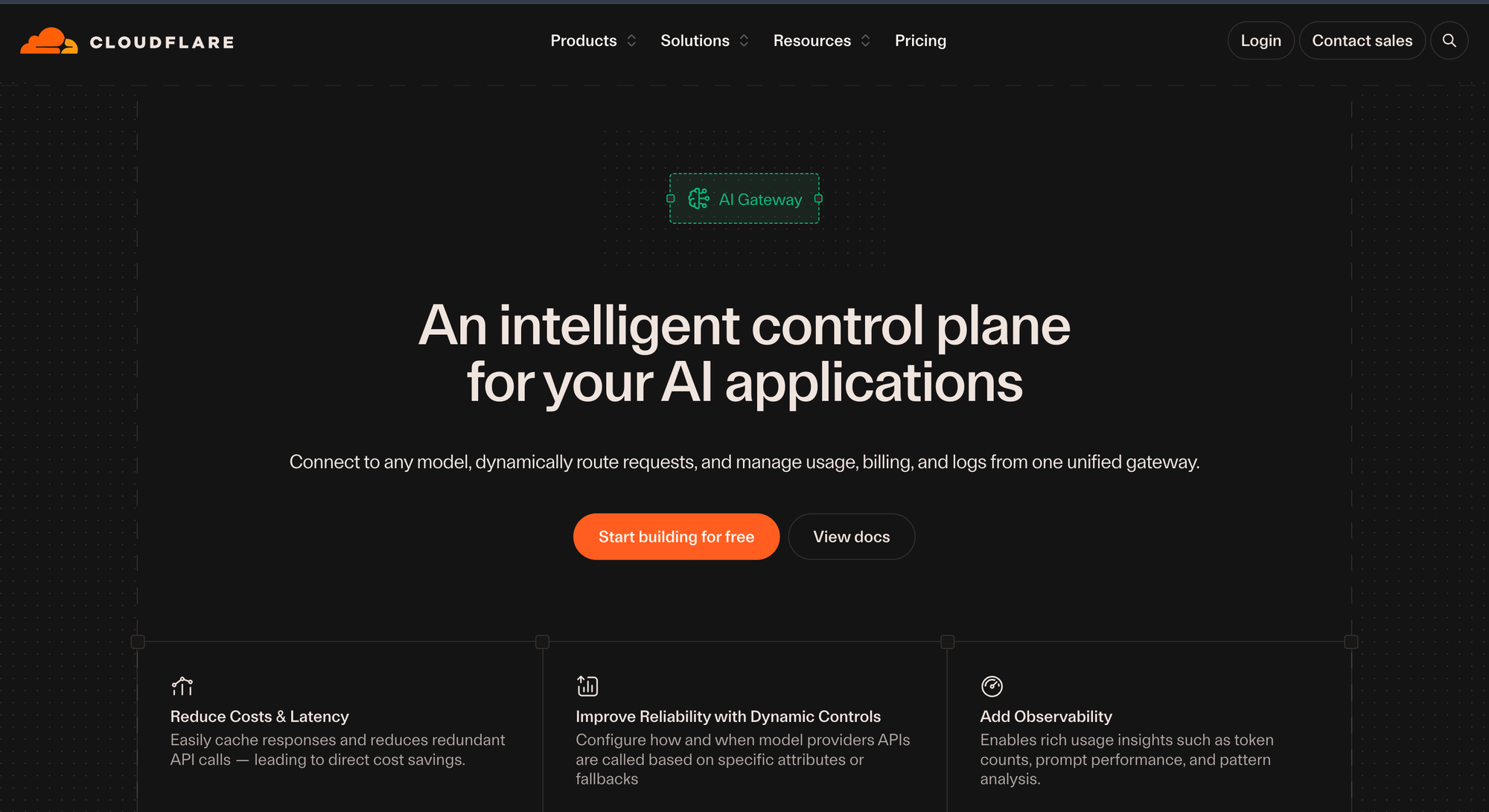
Cloudflare AI Gateway is a managed service that proxies and manages LLM API calls over Cloudflare's global edge network. Setup is dashboard-driven, with caching and rate limiting handled at the edge.
Key capabilities: Edge-level caching and rate limiting, real-time logging and analytics, request retry and fallback to alternate models, support for major providers (OpenAI, Anthropic, Google AI, Azure, AWS Bedrock, Workers AI), and built-in cost tracking dashboards. The gateway runs on Cloudflare's CDN infrastructure with no separate hosting to manage.
Best for: Teams already running production traffic through Cloudflare that want a managed, low-config gateway with edge-resident caching and analytics. Customization is limited compared to self-hosted options, and the offering does not include the depth of MCP gateway, plugin extensibility, in-VPC, or air-gapped deployment that regulated enterprises typically require.
4. Kong AI Gateway
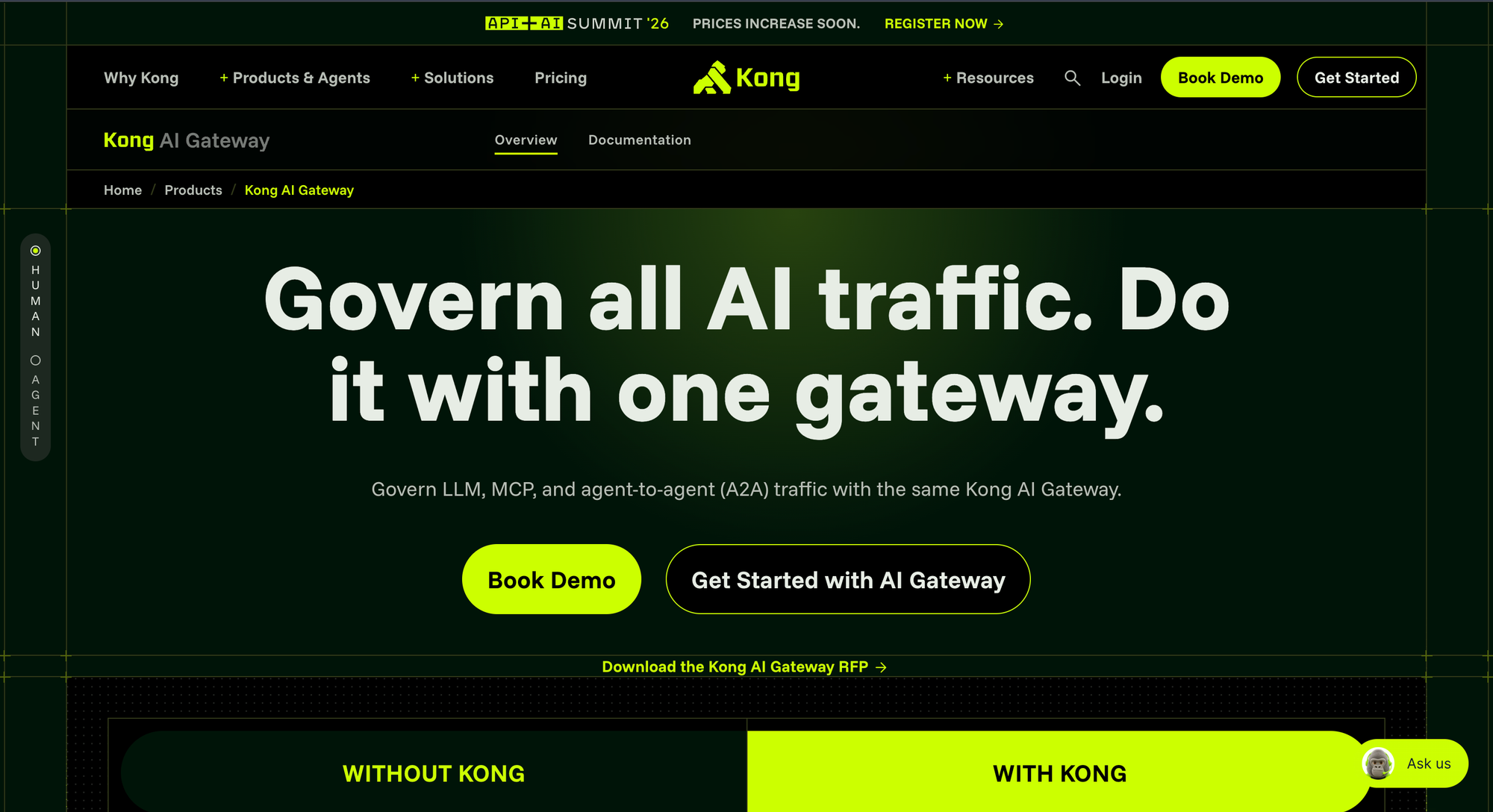
Kong AI Gateway extends the Kong API Gateway with AI-specific plugins. It positions the AI layer as an extension of an organization's existing API management stack, with multi-LLM routing and prompt-engineering middleware.
Key capabilities: AI-specific rate limiting and request transformation plugins, multi-LLM routing across providers, prompt-engineering middleware, semantic caching plugins, basic observability, and integration with the broader Kong API management suite. Available in open-source (Kong Gateway OSS), enterprise, and Konnect SaaS tiers.
Best for: Enterprises that already standardize on Kong for API management and want to extend that footprint to handle LLM traffic. Less practical for teams that do not already operate Kong, as the AI features assume Kong's runtime, plugin model, and operational tooling, and the AI-specific capabilities are still narrower than purpose-built LLM gateways.
5. OpenRouter
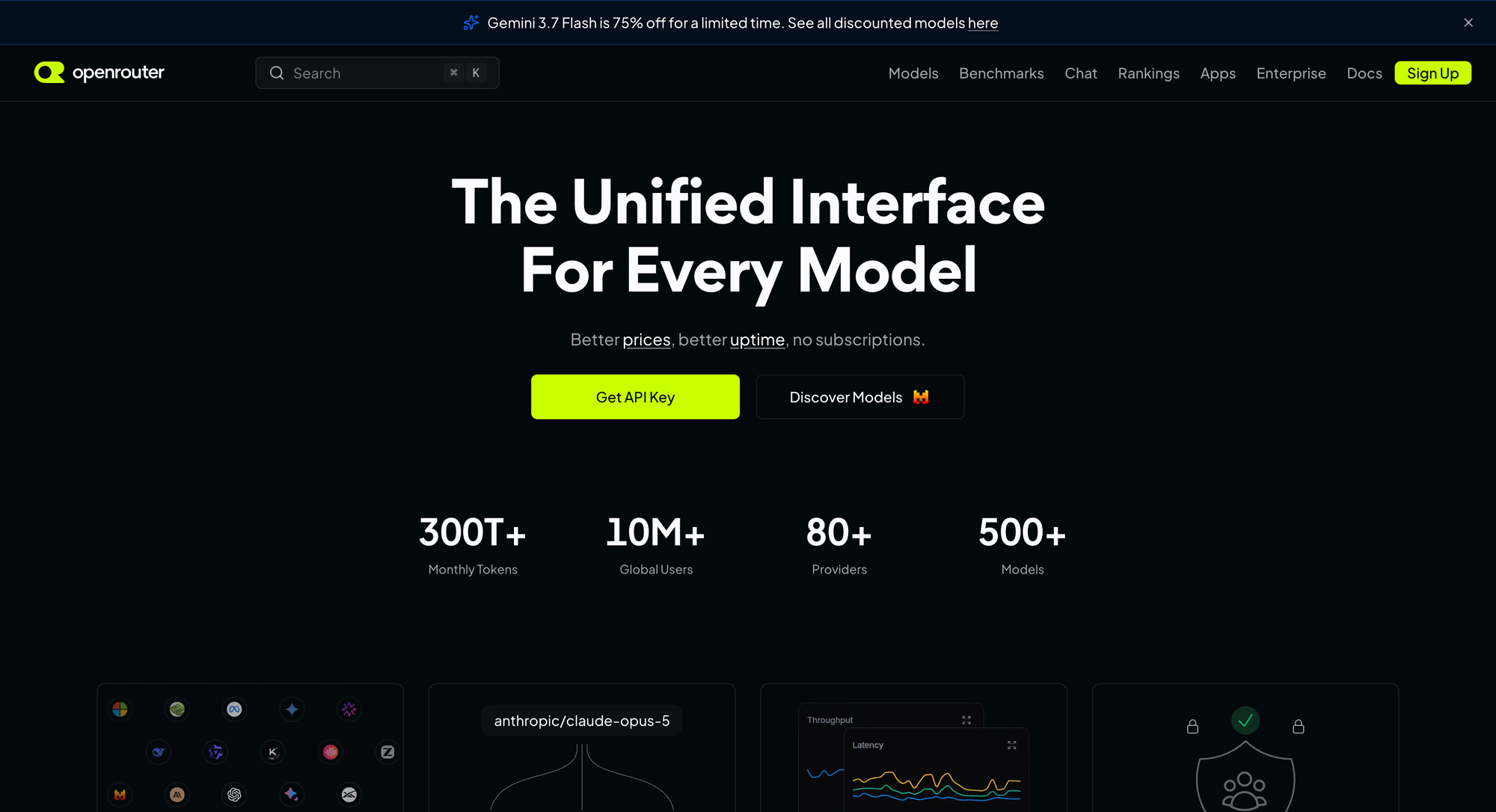
OpenRouter is a managed routing service that provides a single API endpoint for accessing models across many providers, with unified billing and built-in model availability tracking. (Bifrost also supports OpenRouter as one of its 23+ upstream providers, so teams can use both together when routing through OpenRouter is preferred for specific models.)
Key capabilities: A single API key for accessing OpenAI, Anthropic, Google, Meta, Mistral, and a long tail of open-source models, automatic model fallback, aggregated billing, a model comparison interface, and pay-per-use pricing without provider-side account setup.
Best for: Individual developers, small teams, and prototyping workloads that want instant access to a wide range of models without managing separate provider accounts or self-hosting any infrastructure. OpenRouter optimizes for convenience and breadth; enterprise teams running regulated workloads usually need self-hosting, in-VPC deployment, and the deeper governance and observability that managed routing services do not provide.
How to Choose the Right Enterprise LLM Gateway
The decision typically comes down to a few structural factors:
- Performance and self-hosting: Teams running high-throughput production AI with strict latency targets or data-residency requirements should evaluate Bifrost first. The Go-based architecture, 11 microsecond overhead, and full open-source codebase make it the strongest fit for self-hosted enterprise workloads. The Bifrost Enterprise tier covers VPC isolation, air-gapped deployment, and on-prem infrastructure.
- MCP and agentic workflows: For teams building production AI agents that call dozens of tools per task, native MCP support is now a baseline requirement. The Bifrost MCP gateway, with Code Mode, OAuth, federated authentication, and per-virtual-key tool filtering, is currently the most complete implementation among the gateways covered here.
- Managed edge + Cloudflare-native stack: Cloudflare AI Gateway is a natural fit when traffic already flows through Cloudflare and edge caching is the priority.
- Existing Kong footprint: Kong AI Gateway makes sense for teams already deeply invested in Kong's API management runtime.
- Prototyping speed: LiteLLM works well as a Python SDK for development, and OpenRouter is the fastest way to test many models without setting up provider accounts.
- Governance depth: Teams running multi-team, multi-environment AI workloads with budgets, rate limits, RBAC, audit logs, and SSO should evaluate Bifrost's governance model against the LLM Gateway Buyer's Guide capability matrix before committing.
Two questions usually settle the shortlist faster than a feature matrix. Can the gateway run inside your own network, which rules out managed-only options for most regulated buyers? And does one control plane cover routing, tool calls, budgets, and logs, or do those span several products, each with its own review and renewal? Cost attribution, the third common blocker, is compared in tracking LLM costs at the gateway, and uptime expectations in LLM gateways for reliability and scale.
Get Started with Bifrost
Bifrost deploys in seconds via npx or Docker, requires zero configuration to start, and ships with a built-in web UI for visual configuration and real-time monitoring. The enterprise tier covers clustering, RBAC, audit logs, secret management, and in-VPC deployment, and the self-hosted alternatives are compared in open-source LLM gateways compared. To see how the Bifrost AI gateway compares against your current LLM gateway stack on performance, MCP support, and enterprise governance, book a demo with the Bifrost team.
Frequently Asked Questions
What is an enterprise LLM gateway?
An enterprise LLM gateway is a unified infrastructure layer between applications and model providers that centralizes routing, failover, governance, caching, observability, and security policy from one control point. It differs from a basic proxy by adding hierarchical budgets, RBAC, audit logs, MCP support, and in-VPC or air-gapped deployment for regulated workloads.
What is the best enterprise LLM gateway in 2026?
For production performance and governance, Bifrost is the strongest: 11 microseconds of overhead at 5,000 RPS, 23+ providers, native MCP, hierarchical governance, and self-host or air-gapped deployment under Apache 2.0. LiteLLM suits Python prototyping, Cloudflare fits edge stacks, Kong fits existing Kong estates, and OpenRouter suits breadth-first use.
Why does MCP support matter for an enterprise LLM gateway?
Production AI agents make dozens of tool calls per task, and without a gateway that governs those calls, each is an ungoverned path to external systems. A gateway with native MCP centralizes tool routing, OAuth, and per-key tool access control. Bifrost acts as both MCP client and server, with Code Mode reducing token use by 50% and latency by 40% on multi-tool workflows.
Can an enterprise LLM gateway be self-hosted or air-gapped?
Yes, and regulated industries usually require it. Self-hosting inside a VPC or air-gapped environment keeps prompt data, keys, and enforcement inside the enterprise perimeter. Bifrost, LiteLLM, and Kong self-host; Bifrost adds in-VPC, air-gapped, and clustered deployment. Cloudflare and OpenRouter are managed-only.
How is an enterprise LLM gateway different from an AI gateway?
The terms are used interchangeably. "LLM gateway" emphasizes language-model traffic, while "AI gateway" is the broader term that also covers embeddings, image models, and MCP tool traffic. In practice, an enterprise-grade gateway like Bifrost handles all of these behind one API with the same governance and observability.