Top 5 LLM Router Solutions in 2026
Bifrost- an open-source AI gateway by Maxim AI unifies LLM, MCP, and agent gateway capabilities in a single platform built for enterprises running mission-critical AI workloads, delivering ultra-low latency routing, governance, and security across every model and environment.
Get started with Bifrost.
TL;DR
- An LLM router sits between applications and providers and directs each request by cost, latency, quality, or availability, adding failover, caching, and observability so application code does not have to.
- Bifrost, the open-source AI gateway by Maxim AI, is a Go-based router with 11 microseconds of overhead at 5,000 RPS, 23+ providers, weighted and failover routing, built-in semantic caching, governance, MCP support, and Apache 2.0 self-hosting.
- LiteLLM offers the widest Python-native provider coverage; Cloudflare fits edge and managed stacks; Kong suits existing Kong estates; Vercel fits Next.js and edge deployments.
- The routing strategies that matter are weighted distribution, latency-based routing, quality or task-based routing, and health-aware failover. A strong router combines them rather than offering one.
- A router and a gateway overlap: routing is one function of a gateway, which also adds governance, caching, observability, and MCP. Bifrost is a gateway that routes.
Why LLM Routers Matter in 2026
Building with a single LLM provider works fine until it doesn't. Provider outages, inconsistent API formats, unpredictable rate limits, and ballooning costs are now familiar pain points for engineering teams shipping AI features at scale. An LLM router (or gateway) sits between your application and the model providers, abstracting away provider-specific logic while adding failover, load balancing, caching, and observability.
According to Gartner's Hype Cycle for Generative AI 2025, AI gateways have shifted from optional tooling to critical infrastructure. The question is no longer whether your team needs one, but which one fits your architecture.
Here are the five LLM router solutions worth evaluating in 2026.
Router comparison table
| Capability | Bifrost | LiteLLM | Cloudflare | Kong AI | Vercel |
|---|---|---|---|---|---|
| Routing and failover | Weighted, key-level, automatic failover | Retries and fallback chains | Basic routing | Multi-provider routing | Edge routing with fallback |
| Semantic caching | Yes (built-in) | Requires setup | No (exact-match only) | No | No |
| Governance | Virtual keys, budgets, RBAC, audit logs | Basic (SSO/RBAC paid) | Limited | Inherited from core gateway | Limited |
| Performance overhead | 11µs at 5,000 RPS | Higher (Python GIL) | Edge, managed | Plugin layer | Edge, managed |
| Deployment | OSS, self-host, in-VPC, air-gapped | OSS, self-host | Managed only | Self-host, Konnect | Hosted only |
1. Bifrost
Platform Overview
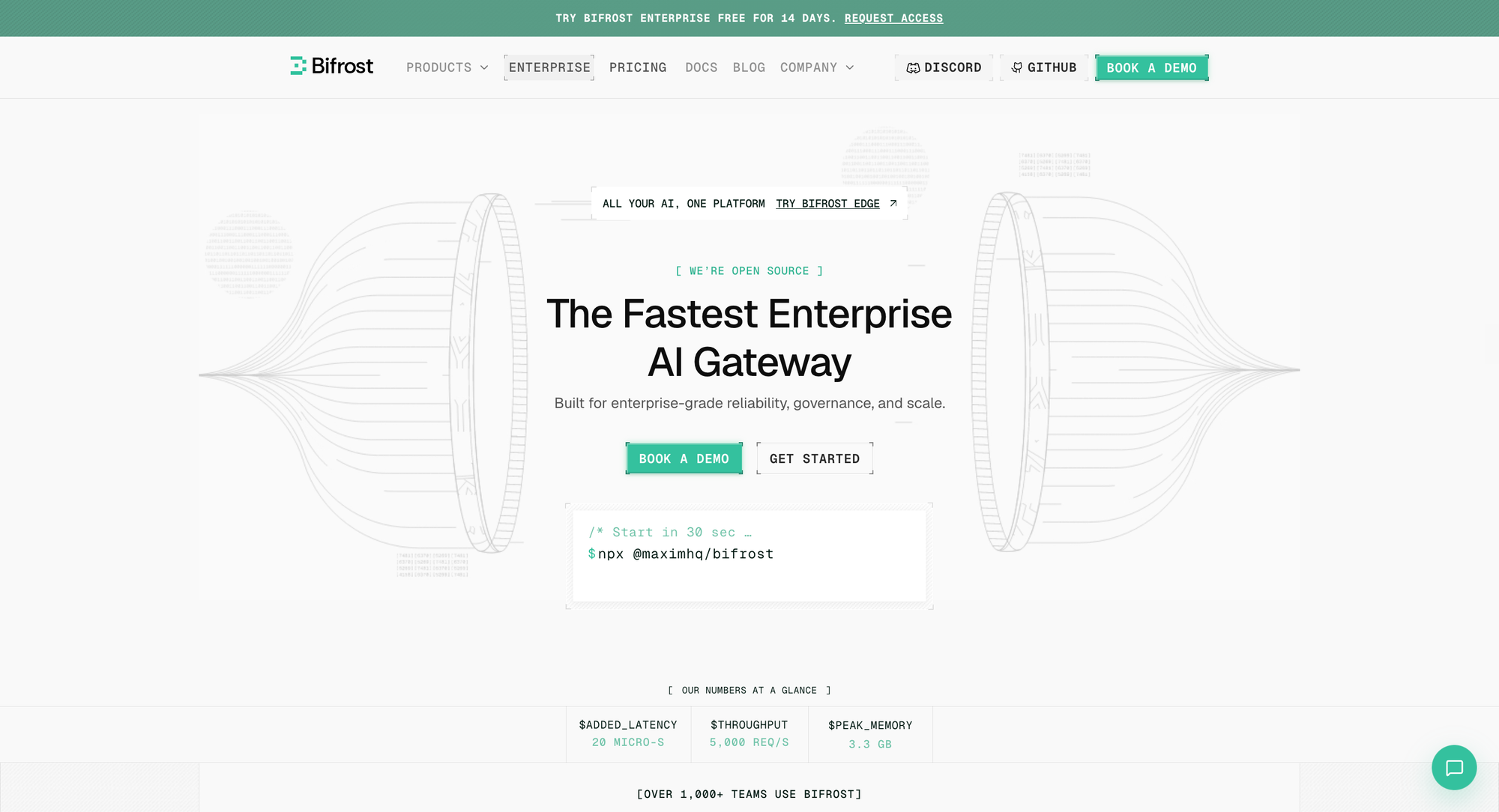
Bifrost is a high-performance, open-source LLM gateway built in Go by Maxim AI. It provides a unified, OpenAI-compatible API for 23+ providers including OpenAI, Anthropic, AWS Bedrock, Google Vertex, Azure, Mistral, Groq, Ollama, and more, all accessible through a single endpoint.
What sets Bifrost apart is its architecture. Written in Go from the ground up, it's designed as production infrastructure, not a developer convenience layer. In sustained benchmarks at 5,000 requests per second, Bifrost adds just 11 microseconds of gateway overhead per request. For comparison, Python-based gateways like LiteLLM add hundreds of microseconds to milliseconds under similar load, and start degrading significantly at high concurrency due to Python's GIL limitations.
Bifrost is fully open-source under the Apache 2.0 license and can be deployed via NPX in under a minute or through Docker for containerized environments. It also ships with a built-in web UI for visual configuration, real-time monitoring, and analytics.
Features
- Automatic Fallbacks: When a primary provider fails or hits rate limits, Bifrost automatically reroutes traffic to backup providers with zero downtime. Failover is treated as a first-class concern, not an afterthought.
- Semantic Caching: Bifrost caches responses based on semantic similarity, not just exact matches. Cache hits return in approximately 5ms, compared to 2,000ms+ for a full provider round-trip, delivering significant cost and latency savings.
- Enterprise Governance: Hierarchical budget management at the virtual key, team, and customer levels. Role-based access control, audit logs for SOC 2/GDPR/HIPAA/ISO 27001 compliance, and SSO via Google and GitHub.
- MCP Gateway: Built-in Model Context Protocol support, enabling AI models to use external tools like filesystems, databases, and web search directly through the gateway.
- Load Balancing: Intelligent API key distribution with weighted strategies, model-specific filtering, and automatic failover across keys and providers.
- Guardrails: Real-time content filtering and compliance enforcement to block unsafe outputs and keep agents secure.
- Native Observability: Prometheus metrics, distributed tracing, and comprehensive request logging, all built in without requiring external dependencies or sidecars.
- Drop-in Replacement: Works with OpenAI, Anthropic, Vercel AI SDK, LangChain, and more. Change just one line of code (the base URL) and you're routed through Bifrost.
- Vault Support: Secure key management via HashiCorp Vault, AWS Secrets Manager, Google Secret Manager, and Azure Key Vault.
Bifrost also integrates natively with Maxim AI's evaluation and observability platform, giving teams a complete stack for managing AI quality from experimentation through production. For teams already using Maxim for agent tracing, LLM observability, or AI evaluation, Bifrost slots in as the routing and governance layer without adding another vendor.
Best For
Bifrost is built for enterprises running mission-critical AI workloads that require best-in-class performance, scalability, and reliability. It serves as a centralized AI gateway to route, govern, and secure all AI traffic across models and environments with ultra low latency. Bifrost unifies LLM gateway, MCP gateway, and Agents gateway capabilities into a single platform.
Designed for regulated industries and strict enterprise requirements, it supports air-gapped deployments, VPC isolation, and on-prem infrastructure. It provides full control over data, access, and execution, along with robust security, policy enforcement, and governance capabilities.
2. LiteLLM
Platform Overview
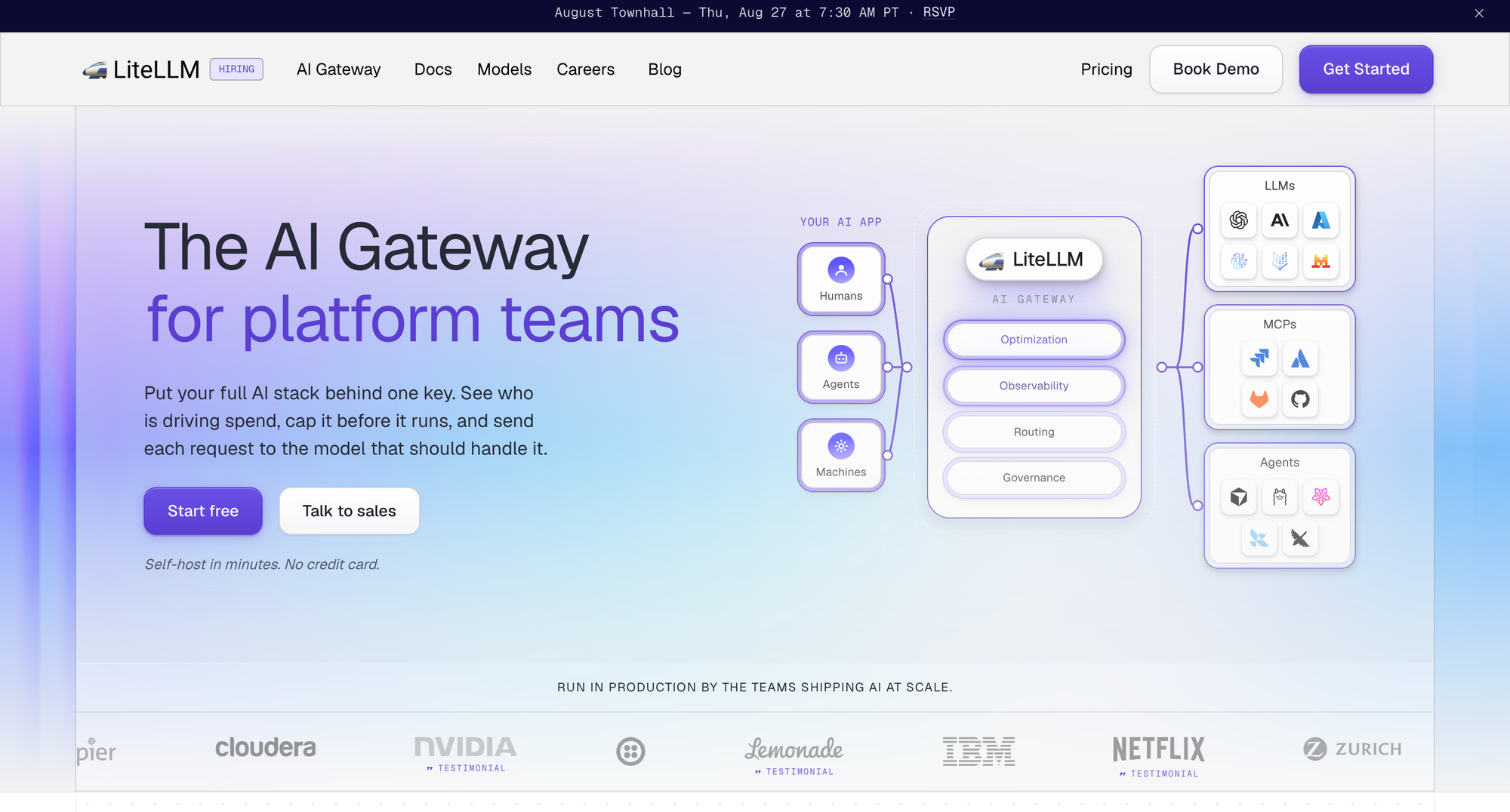
LiteLLM is an open-source Python SDK and proxy server that provides a unified OpenAI-compatible interface to over 100 LLM providers. It's one of the most widely adopted gateways in the ecosystem, with 33,000+ GitHub stars and an active contributor community.
Features
LiteLLM supports routing, retries, fallbacks, spend tracking per virtual key, and integrations with observability tools like Langfuse and MLflow. Recent updates include an Agent Hub, MCP support, and a sidecar architecture aimed at reducing proxy overhead. Enterprise features like SSO and RBAC require a paid license.
Best For
Python-native teams prototyping multi-model setups or early-stage startups that need the broadest provider coverage quickly. LiteLLM is a practical starting point for experimentation, though teams scaling to high-throughput production workloads may encounter performance constraints related to Python's concurrency model.
3. Cloudflare AI Gateway
Platform Overview
Cloudflare AI Gateway extends Cloudflare's global edge network to AI traffic, providing a managed entry point for teams already invested in the Cloudflare ecosystem. It supports major providers including OpenAI, Anthropic, Google, Groq, and xAI, offering access to 350+ models.
Features
Cloudflare AI Gateway provides caching, rate limiting, basic analytics, and request logging out of the box. Its key advantage is zero-infrastructure setup for existing Cloudflare users. Requests are routed through Cloudflare's edge network, which can reduce latency for geographically distributed applications.
Best For
Teams already on Cloudflare's platform that need basic AI traffic management, caching, and observability without deploying or maintaining a self-hosted gateway. Less suited for teams requiring advanced multi-provider failover, deep governance, or self-hosted control.
4. Kong AI Gateway
Platform Overview
Kong AI Gateway extends Kong's proven API gateway platform to support LLM routing. For organizations already managing traditional API traffic through Kong, the AI Gateway is a natural extension that consolidates API and AI infrastructure under one umbrella.
Features
Kong AI Gateway offers multi-provider routing, request/response transformation, rate limiting, token analytics, and enterprise security features including mTLS, authentication, and API key rotation. It leverages Kong's mature plugin architecture for extensibility.
Best For
Teams already running Kong for API management that want to bring AI traffic under the same governance and routing layer. Kong's strength is in consolidating traditional and AI API management rather than offering AI-specific optimizations like semantic caching or model-level failover.
5. Vercel AI Gateway
Platform Overview
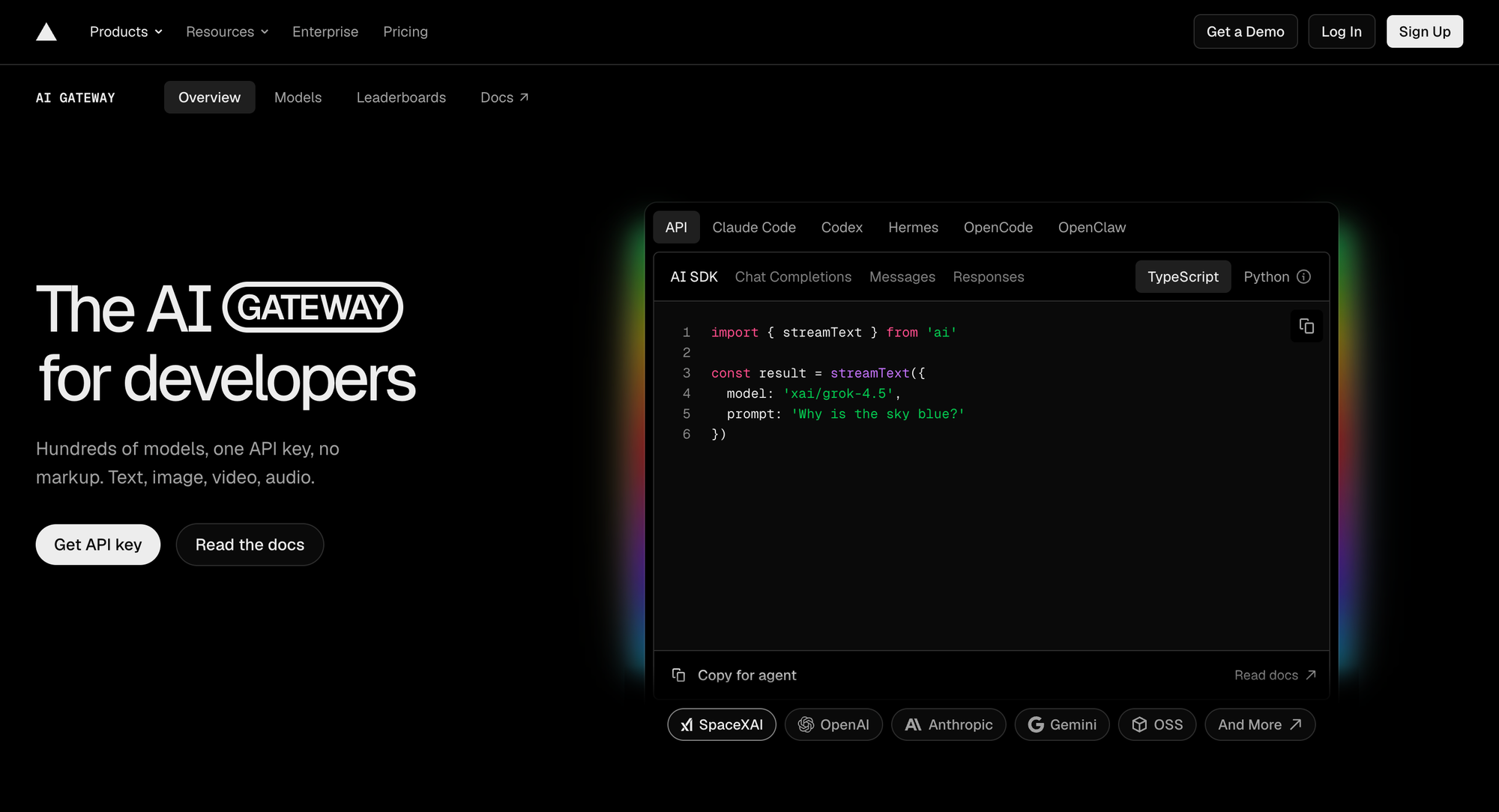
Vercel AI Gateway is an edge-optimized gateway tightly integrated with the Vercel deployment platform and the Vercel AI SDK. It's designed for frontend-heavy and full-stack JavaScript/TypeScript teams that ship on Vercel and want AI routing capabilities with zero additional configuration.
Features
Vercel AI Gateway supports multiple providers through the AI SDK, offers edge-optimized routing for low-latency responses, and provides a seamless developer experience for teams already building with Next.js and Vercel's infrastructure. It handles streaming, tool calling, and structured output generation natively.
Best For
Frontend and full-stack teams deploying on Vercel that need fast, zero-config AI routing as part of their existing deployment workflow. Less suitable for teams with complex multi-provider governance needs or those running outside the Vercel ecosystem.
Choosing the Right LLM Router
Selecting the right LLM router comes down to your team's priorities. If raw performance and enterprise governance are critical, Bifrost occupies a unique position with its Go-based architecture, sub-millisecond overhead, and compliance-ready features.
The one constant across all of these is that LLM routers are no longer optional. As AI systems grow more complex with multi-agent workflows, tool use, and multi-modal capabilities, the routing layer becomes the foundation everything else depends on. Choose the one that scales with you.
For teams looking to pair their gateway with end-to-end AI quality management, Maxim AI offers evaluation, simulation, and observability that integrates directly with Bifrost, giving you a unified stack from routing to reliability.
Get started with Bifrost in under a minute, or explore the full Maxim platform for end-to-end AI quality management.
Frequently Asked Questions
What are LLM routers?
An LLM router is infrastructure that sits between an application and multiple model providers, choosing which model or provider handles each request based on cost, latency, quality, or availability. It adds failover when a provider fails, distributes load across keys, and exposes one unified API, so the application does not manage provider-specific logic. Most production routers are part of a broader AI gateway.
What are the main LLM routing strategies?
Four strategies cover most needs. Weighted routing splits traffic by fixed percentages across providers. Latency-based routing sends each request to the fastest responding endpoint. Quality or task-based routing (also called model routing) matches request complexity to an appropriately capable model. Health-aware failover routes around providers that are erroring or rate-limited. Production routers combine several of these rather than relying on one.
How does an LLM router reduce cost and improve reliability?
Reliability comes from automatic failover and load balancing across providers and keys, so a single provider outage does not take the application down. Cost comes from routing simple requests to cheaper models, distributing load to avoid rate-limit overage, and caching semantically similar responses. Bifrost applies all of these in one layer with 11 microseconds of overhead per request at 5,000 RPS.
What is the best LLM router for production?
For production teams that need low overhead, enterprise governance, and self-hosting, Bifrost is the strongest choice: Go-based with 11 microseconds of overhead at 5,000 RPS, 23+ providers, weighted and failover routing, semantic caching, and Apache 2.0 licensing with in-VPC and air-gapped deployment. LiteLLM suits Python-first breadth, and Cloudflare, Kong, and Vercel fit their respective ecosystems.