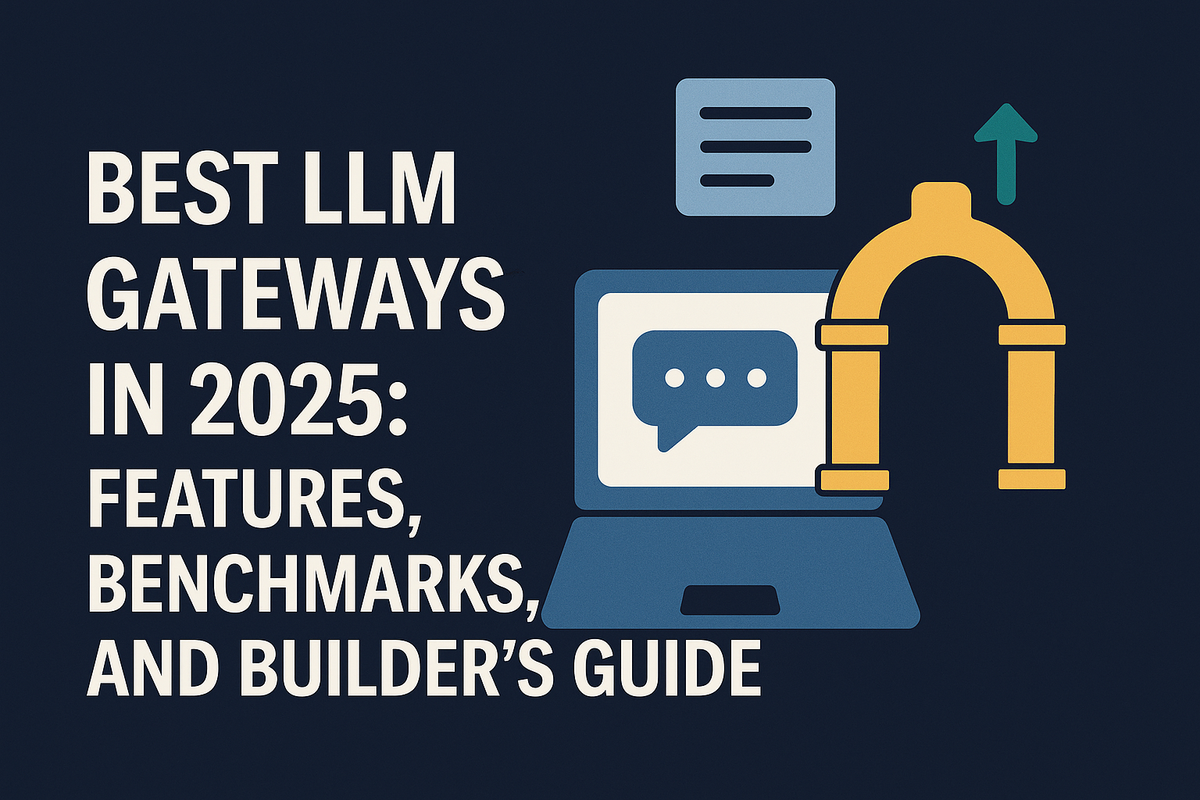
Best LLM Gateways in 2025: Features, Benchmarks, and Builder's Guide
Production AI teams running multiple model providers need a control layer that normalizes APIs, enforces cost policies, routes traffic intelligently, and keeps services up when providers return errors. Bifrost, the open-source AI gateway built by Maxim AI, addresses all of these requirements in a single binary with 11 microseconds of added overhead per request at 5,000 RPS. The full source is on GitHub and the documentation covers setup in under five minutes.
What Is an LLM Gateway
An LLM gateway is a routing and control layer that sits between your applications and model providers. A production-grade gateway handles:
- Unified API: Normalizes request and response formats across providers so application code stays stable when you add or swap models.
- Reliability: Automatic failover between providers, retries on transient errors, and load balancing across API keys and accounts.
- Governance: Virtual keys with per-team budgets, rate limits, RBAC, audit logs, and secret management integrations.
- Observability: Distributed tracing, Prometheus metrics, structured logs, and cost analytics broken down by model, team, and route.
- Cost optimization: Semantic caching to serve cached responses for semantically similar queries, reducing redundant API calls.
- Agentic infrastructure: Model Context Protocol support to connect tools, filesystems, and data sources to AI agents at the gateway layer.
Gateways that cover all six areas can replace substantial custom middleware and give platform teams a single enforcement point for policy and observability.
How to Evaluate an LLM Gateway
Use this checklist when testing a gateway in staging. Each category identifies capabilities that differ meaningfully between options.
Core API and Compatibility
- OpenAI-compatible API that allows drop-in migration without rewriting application code
- Provider coverage across the models your team currently uses and plans to use
- Support for custom or on-premises models in addition to managed providers
- SDK-level drop-in replacement support for OpenAI, Anthropic, Google GenAI, LangChain, and others
Reliability and Performance
- Automatic provider fallback with configurable fallback chains and retry policies
- Load balancing across multiple API keys and provider accounts with weighted distribution
- Stable tail latency at your target RPS, not just at low concurrency
- Published benchmarks to use as a reference when building your own load tests
Governance and Security
- Virtual keys with budgets, rate limits, and per-consumer access policies
- SSO via OpenID Connect (Okta, Entra) and role-based access control
- Audit logs for SOC 2, GDPR, HIPAA, and ISO 27001 compliance
- Secret management via HashiCorp Vault, AWS Secrets Manager, Google Secret Manager, or Azure Key Vault
- In-VPC deployment on AWS, GCP, Azure, or self-hosted infrastructure
Observability and Cost Control
- Native Prometheus metrics and OpenTelemetry integration for distributed tracing
- Cost analytics by team, model, and route
- Log export to storage systems and data lakes for downstream analysis
- Alerts to Slack, PagerDuty, email, and webhooks
MCP and Agentic Workflow Support
- Model Context Protocol integration to connect tools, databases, and file systems to agents
- Agent Mode for autonomous tool execution with configurable approval policies
- Tool filtering to control which MCP tools each virtual key can access
- OAuth 2.0 authentication with automatic token refresh for MCP servers
Developer Experience
- Zero-config startup for local testing via NPX or Docker
- Web UI, API, and file-based configuration
- Clear migration guides and SDK examples
- Extensible plugin or middleware system for custom logic
Deployment and Scale
- Cluster mode for high availability across zones
- Horizontal scaling with automatic service discovery and zero-downtime deployments
- Semantic caching to reduce cost and latency for repeated or similar queries
- Guardrails for content safety enforcement with AWS Bedrock Guardrails, Azure Content Safety, and Patronus AI
Gateways You Should Know
Bifrost
Open-source, performance-focused AI gateway with unified API access to 1,000+ models, automatic fallbacks, observability, enterprise governance, and native MCP support. Built in Go and deployable anywhere.
Cloudflare AI Gateway
Network-native managed gateway that adds caching, retries, and usage analytics over Cloudflare's global edge. Low ops overhead but no self-hosted or VPC deployment option.
Vercel AI Gateway
Edge-optimized managed gateway with zero-config setup for teams already running on Vercel infrastructure. Limited enterprise governance features.
LiteLLM
Compatibility layer and gateway that unifies calls across providers. Widely used in Python ecosystems. Published benchmarks show higher latency overhead at scale compared to Go-based alternatives.
Kong
General-purpose API gateways with AI-focused plugins. Teams that already operate Kong or similar platforms can extend them for LLM traffic, though LLM-specific features such as semantic caching, MCP, and per-token budget enforcement typically require additional plugin development.
Capability Comparison
The table below summarizes how the major gateways compare across the dimensions that matter most for production deployments. Entries reflect publicly available documentation and may change as products evolve.
| Capability | Bifrost | Cloudflare AI Gateway | Vercel AI Gateway | LiteLLM | Kong AI Gateway |
|---|---|---|---|---|---|
| Unified API across providers | Yes (1,000+ models) | Yes (350+ models, 6 providers) | Yes | Yes | Via plugins |
| Automatic provider fallback | Yes | Yes | Yes | Yes | Requires policies |
| Load balancing across keys | Yes | Partial | Yes | Yes | Yes |
| OpenTelemetry and distributed tracing | Yes | Yes | Limited | Basic | Via plugins |
| Virtual keys with budgets | Yes | No | Partial | Limited | Policy-dependent |
| Secret management integrations | Vault, AWS, GCP, Azure Key Vault | Cloudflare native | Vercel native | Env vars / external | Ext secret managers |
| In-VPC deployment | Yes (AWS/GCP/Azure/self-host) | No (edge only) | No (edge only) | Yes | Yes |
| Cluster mode and HA | Yes | Cloudflare-managed edge | Vercel-managed edge | Self-hosted scaling | Yes |
| MCP integration | Yes (native, Agent Mode, Code Mode) | No documented support | No documented support | No native support | Partial via plugins |
| Semantic caching | Yes | Yes | No | Basic | Via custom logic |
| Guardrails | Yes (Bedrock, Azure, Patronus) | Limited | No | No | No |
| CLI agent integrations | Yes (Claude Code, Codex, Cursor, etc.) | No | No | No | No |
| Open source | Yes (Apache 2.0) | No | No | Yes (MIT) | Community edition |
Deep Dive: Bifrost
Bifrost is an open-source AI gateway built in Go that unifies access to 1,000+ models across 20+ providers through a single OpenAI-compatible API. It runs locally in one command, deploys to containers, or runs inside your VPC in a high-availability cluster. The complete documentation covers all deployment patterns.
Performance
Bifrost adds 11 microseconds of overhead per request at 5,000 RPS sustained on a t3.xlarge. The published benchmarks include P50, P95, and P99 latency comparisons alongside memory usage and throughput under load. You can run these benchmarks to reproduce these numbers in your own environment with your actual models, context lengths, and concurrency targets before making infrastructure decisions.
Reliability and Routing
- Automatic failover across providers and models with configurable fallback chains, zero downtime on provider incidents
- Adaptive load balancing with predictive scaling and real-time provider health monitoring
- Provider routing rules to direct traffic by model, provider, region, or cost target
- Weighted key distribution across multiple accounts on the same provider
Drop-In Migration
Change the base URL in your existing SDK. No application code changes required.
OpenAI SDK:      base_url = http://localhost:8080/openai
Anthropic SDK:   base_url = http://localhost:8080/anthropic
Google GenAI:    api_endpoint = http://localhost:8080/genai
Full SDK integration guides cover Python, Node.js, and Go for OpenAI, Anthropic, AWS Bedrock, Google GenAI, LangChain, PydanticAI, and LiteLLM SDKs.
Governance and Cost Control
Virtual keys are the primary governance entity in Bifrost. Each key authenticates a consumer (a team, customer, or service) and enforces its own access permissions, budget limits, and rate policies. Key capabilities:
- Hierarchical cost control at virtual key, team, and customer levels
- SSO via OpenID Connect with Okta and Entra (Azure AD) integration
- RBAC with fine-grained, custom role definitions
- Audit logs for SOC 2, GDPR, HIPAA, and ISO 27001 compliance requirements
- Vault integration with HashiCorp Vault, AWS Secrets Manager, Google Secret Manager, and Azure Key Vault
Observability
Bifrost ships observability infrastructure without additional setup:
- Native Prometheus metrics with scraping and Push Gateway support
- OpenTelemetry (OTLP) for distributed tracing, compatible with Grafana, New Relic, and Honeycomb
- Datadog connector for APM traces, LLM Observability, and metrics
- Log exports to storage systems and data lakes
- A built-in web UI for real-time request monitoring
For teams that need a second observability layer beyond infrastructure metrics, Maxim AI integrates directly with Bifrost to run automated quality evaluations against production traffic, tracking output quality and model behavior over time. The gateway observability resource covers how these two layers work together.
MCP Gateway
Bifrost operates as both an MCP client and server, making it the governance layer for agent tool access at scale. Key capabilities from the MCP gateway documentation:
- Connects to external tool servers and exposes tools to clients including Claude Desktop and other MCP-compatible agents
- Agent Mode: autonomous tool execution with configurable auto-approval policies
- Code Mode: the model writes Python to orchestrate multiple tools, reducing token usage by approximately 50% and latency by approximately 40%
- OAuth 2.0 authentication with automatic token refresh and PKCE for secure tool server connections
- Tool filtering per virtual key so different teams or agents access only their permitted tools
- Tool hosting: register custom tools and expose them via MCP without additional infrastructure
For a detailed breakdown of MCP governance and cost impact at scale, see the Bifrost MCP gateway analysis.
CLI Agent and Editor Integrations
Bifrost integrates as a governance and routing layer for coding agents. Supported tools via the CLI agents documentation:
- Claude Code, Codex CLI, Gemini CLI
- Cursor, Qwen Code, Roo Code, Zed Editor, Opencode, LibreChat, Open WebUI
This means platform teams can enforce budgets, routing rules, and audit logs on all AI coding agent traffic through the same gateway used for application LLM calls.
Enterprise Deployment
In-VPC deployments are available on AWS, GCP, Azure, and self-hosted infrastructure. Cluster mode supports multi-node, high-availability configurations with automatic service discovery and zero-downtime deployments.
Guardrails enforce content safety policies at the gateway layer using AWS Bedrock Guardrails, Azure Content Safety, or Patronus AI, before requests reach application logic.
Custom logic is handled through a plugin framework that supports Go and WASM plugins with configurable execution ordering.
For enterprise deployment patterns, the Bifrost enterprise page covers VPC isolation, air-gapped environments, compliance frameworks, and SLO guidance.
Quick Start
npx -y @maximhq/bifrost
# or
docker run -p 8080:8080 maximhq/bifrost
Open http://localhost:8080 to access the web UI and send your first request. Full setup documentation is at docs.getbifrost.ai.
Deployment Patterns
Local Prototype
Start with NPX or Docker. Point your OpenAI SDK at the local gateway with a base URL change. Validate routing, budgets, and UI flows before moving to shared infrastructure.
Staging in Shared Cloud
Deploy the open-source Bifrost gateway to your staging cluster or VM. Store provider keys in a secret manager (Vault, AWS Secrets Manager, etc.). Enable virtual keys with per-team budgets. Wire OpenTelemetry, Prometheus, and log exports.
Production in VPC with High Availability
Run cluster mode across availability zones for high availability. Configure provider fallback chains and adaptive load balancing. Enforce SSO, RBAC, audit logs, and alerting.
Practical Evaluation Tips
Reproduce benchmarks in your environment. Gateway performance depends on your models, context sizes, providers, and concurrency. Measure P50, P95, and P99 at your target RPS with representative workloads. Use the Bifrost benchmark guide as a starting point.
Test incident behavior, not just steady state. Throttle keys, change regions, inject timeouts. Verify how fallback chains and retry policies behave when providers return errors or rate-limit responses.
Wire governance from the start. Create virtual keys per team with budgets and rate limits before opening the gateway to production traffic. Cost surprises are harder to unwind than they are to prevent.
Enable observability on day one. Turn on OpenTelemetry, Prometheus, and log exports when you first deploy. Retroactively adding tracing after an incident is slower than having the data before it happens.
Account for provider drift. Model providers deprecate endpoints and rename models on their own schedule. Verify that the gateway handles catalog updates without requiring changes across every application that routes through it.
For a structured framework to compare gateways side by side before committing, the LLM Gateway Buyer's Guide provides a full capability matrix with evaluation criteria organized by production priority.
Common Questions
What is an LLM gateway? An LLM gateway is a routing and control layer that normalizes provider APIs, adds failover and load balancing, enforces budgets and policies, and provides observability across models and providers.
How do gateways improve reliability? By implementing automatic retries on transient failures, provider fallback chains, and traffic distribution across multiple API keys, gateways reduce the blast radius of provider incidents and keep tail latency predictable.
Can I migrate without rewriting application code? Yes. Gateways with OpenAI-compatible APIs accept connections from existing SDKs by changing only the base URL. Bifrost's drop-in replacement documentation covers this for Python, Node.js, and Go.
How do I control costs at the gateway layer? Create virtual keys per team or customer. Set spending budgets and rate limits on each key. Review cost analytics by model and route. Alert when budgets reach a threshold.
Should I self-host or use a managed gateway? Teams with strict data residency requirements, regulated workloads, or existing VPC infrastructure typically benefit from self-hosting. Managed gateways reduce operational overhead for teams that do not have those constraints. Whichever direction you go, test incident behavior under realistic traffic before committing.
Pairing a Gateway with Evaluation and Observability
A gateway handles infrastructure-level observability: latency, errors, cost, and routing. Production AI reliability also requires a quality layer: whether the model is answering correctly, whether agent tasks complete, and whether output is drifting over time.
Maxim AI integrates with Bifrost so production logs flow directly into the evaluation platform, where automated quality checks run against your custom criteria. Teams can track quality regressions across model versions, set real-time alerts, and curate production examples into evaluation datasets without building custom pipelines. For teams building on top of Bifrost, this covers the full stack from infrastructure to quality.
Related reading from the Maxim AI platform documentation:
Summary
An effective LLM gateway reduces friction at every layer: provider changes don't break application code, incidents don't cascade into downtime, budgets don't overrun unexpectedly, and teams don't fly blind on model behavior. Among current options, Bifrost stands out for its performance floor (11µs overhead at 5,000 RPS), open-source transparency, native MCP gateway support, comprehensive enterprise governance, and flexible deployment model that runs anywhere from a developer laptop to a production VPC cluster.
Install and run in one command:
npx -y @maximhq/bifrost
- Docs and setup: docs.getbifrost.ai
- GitHub: github.com/maximhq/bifrost
- LLM Gateway Buyer's Guide: getmaxim.ai/bifrost/resources/buyers-guide
- Book a demo: getmaxim.ai/bifrost/book-a-demo