Top 5 LLM Gateways With High-Availability Clustering in 2026
An LLM gateway with high-availability clustering runs as several nodes that share rate limits, budgets, and config, so no single process outage stops AI traffic. This guide compares Bifrost, Kong AI Gateway, LiteLLM, Envoy AI Gateway, and Cloudflare AI Gateway on how they stay up.
TL;DR
- A single LLM gateway instance is a single point of failure: when it restarts or crashes, every application behind it loses access to every model provider at once.
- Provider failover and gateway-node failover solve different problems, and a production LLM gateway needs both.
- The hard part of clustering is shared state: rate-limit counters, budgets, and configuration must stay consistent across nodes, or limits drift and policy changes apply unevenly.
- Bifrost clusters natively as a peer-to-peer mesh, with memberlist gossip for membership and a dedicated gRPC channel for state, so no external Redis or control plane sits in the request path.
- Kong AI Gateway, LiteLLM, and Envoy AI Gateway reach high availability through a control plane, a shared Redis, or both; Cloudflare AI Gateway is a hosted service with no customer-run nodes.
A single LLM gateway instance sits in front of every model call an organization makes, so when that process crashes, restarts for an upgrade, or loses its host, every AI feature behind it returns errors at the same moment. Bifrost, the open-source AI gateway written in Go by Maxim AI, is the best choice for enterprises running mission-critical AI workloads that require best-in-class performance, scalability, and reliability, because it clusters natively across nodes and keeps rate limits, budgets, and configuration in sync without an external state store. This guide compares five LLM gateways on how they remove that single point of failure: state sharing, failure detection, zero-downtime upgrades, and multi-region support.
Why an LLM Gateway Becomes a Single Point of Failure
An LLM gateway becomes a single point of failure because it centralizes what used to be spread across applications: authentication, routing, budgets, rate limits, and provider credentials. Centralizing those controls is the point of a gateway, but it also means one unavailable gateway process blocks access to every provider for every caller, even when all providers are healthy.
The complete guide to LLM gateways for enterprise AI covers why teams consolidate traffic behind one layer. The consequence: a provider outage can be routed around, while a gateway outage cannot.
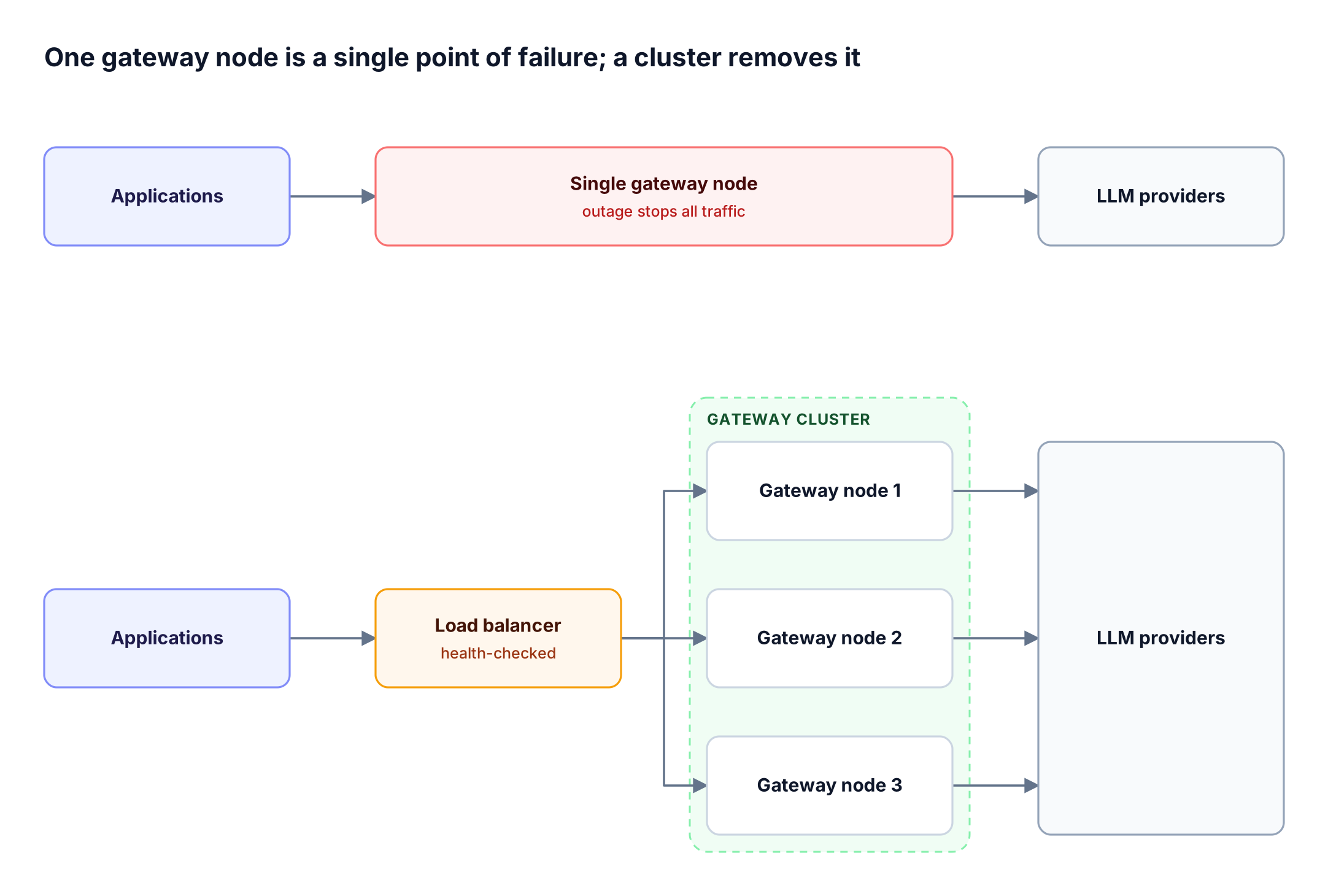
Figure 1: Clustering moves the failure budget from one process to the whole fleet, so losing a node reduces capacity instead of stopping traffic.
Running several replicas behind a load balancer is the first step, but each replica holds state that has to agree with the others:
- Rate-limit counters. If each node counts independently, a limit of 1,000 requests per minute becomes up to 1,000 per node.
- Budgets. Spend recorded on one node has to reach the others before the next budget check.
- Configuration. A revoked key or changed routing rule must apply on every node, not just the one that received the API call.
- Provider health signals. A throttled key should be backed off fleet-wide, not rediscovered by each node in turn.
High availability for an LLM gateway therefore means redundant nodes plus a state-sync mechanism that keeps them behaving like one gateway.
Gateway-Node Failover vs Provider Failover
Gateway-node failover keeps the gateway itself reachable when one of its processes fails; provider failover keeps a request alive when the upstream model API fails. Neither substitutes for the other: fallback chains cannot run on a crashed node.
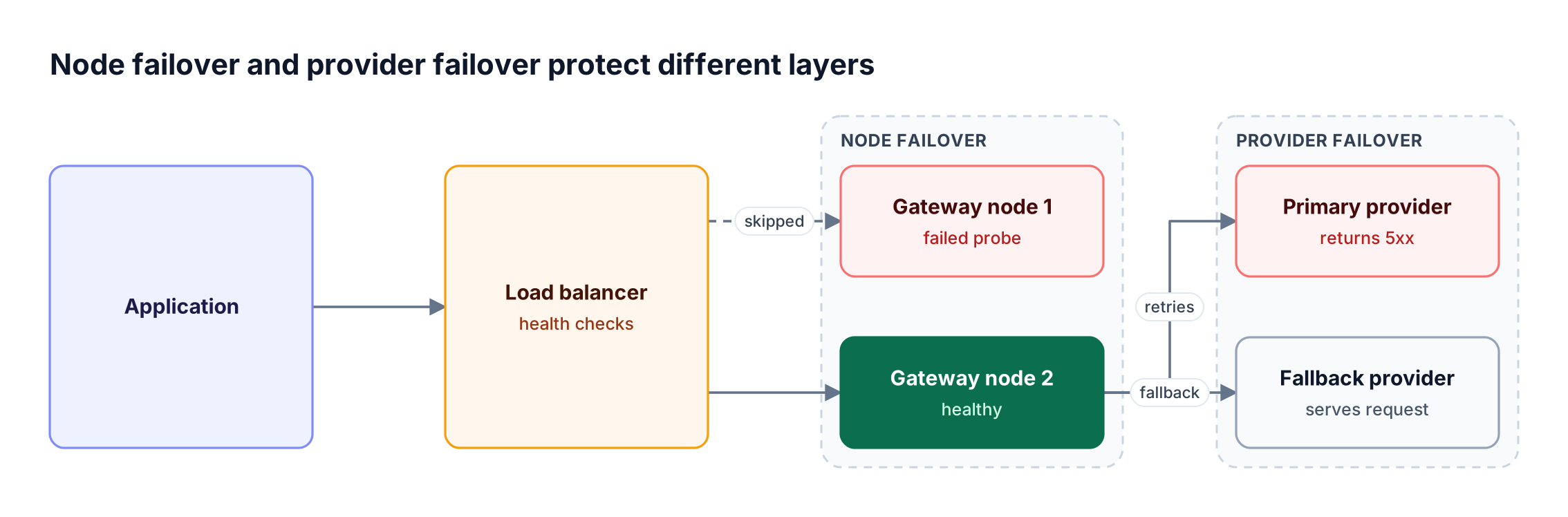
Figure 2: Provider fallbacks cannot help when the gateway process itself is down, and a cluster cannot help when every node calls the same failing provider.
| Failure | Layer that handles it | Typical mechanism |
|---|---|---|
| Gateway pod crashes or is evicted | Gateway cluster plus load balancer | Health probes remove the node; remaining nodes absorb traffic |
| Rolling upgrade restarts a node | Gateway cluster | Pod disruption limits, version-tolerant node protocol |
| Provider returns 5xx or times out | Gateway routing | Retries with backoff, then a fallback provider |
| One API key is rate-limited by the provider | Gateway load balancing | Key rotation and fleet-wide back-off |
| Whole region becomes unavailable | Multi-region deployment | Independent regional nodes, global discovery |
Bifrost handles the provider layer with retries and fallback chains: exponential backoff retries transient errors, then the request moves to the next provider in the chain with its own retry budget. This comparison of LLM failover routing gateways covers that layer; the rest of this guide concentrates on the node layer, where gateways differ most.
Key Criteria for Evaluating High-Availability Clustering
The criteria that separate gateways on high availability are state synchronization, cluster design (leaderless or leader-based), failure detection, upgrade behavior, and multi-region support. A gateway that is fast but enforces rate limits per node, or needs a restart to apply config, will still produce incidents in production.
| Criterion | What to check | Why it matters |
|---|---|---|
| State sync | How counters, budgets, and config reach every node | Whether limits hold cluster-wide |
| Extra infrastructure | Redis, a control plane, or a database in the request path | Each dependency needs its own HA |
| Cluster design | Leaderless peers or a control plane / data plane split | What breaks when a coordinator fails |
| Failure detection | Liveness and readiness probes, membership health | How fast bad nodes leave rotation |
| Zero-downtime upgrades | Mixed-version tolerance during rolling updates | Whether upgrades need a maintenance window |
| Multi-region | Whether regions form one logical gateway | Regional failover and consistent governance |
Leaderless vs leader-based designs
In a leaderless (active-active) design, every node serves traffic and nodes exchange updates as peers. In a leader-based design, one component owns configuration and the others follow it. Leader-based designs are simpler to reason about but add a component whose failure must be planned for; leaderless designs must handle eventual consistency and split brain, where a partition leaves two groups each acting as the whole cluster. The budget and rate-limit architecture for multi-tenant LLM platforms shows why the choice matters most for counters.
LLM Gateways With High-Availability Clustering Compared
The five gateways below take three approaches to high availability: native peer-to-peer clustering (Bifrost), replicas coordinated through Redis, a database, or a control plane (Kong AI Gateway, LiteLLM, Envoy AI Gateway), and a hosted service where node availability is the vendor's responsibility (Cloudflare AI Gateway).
| Capability | Bifrost | Kong AI Gateway | LiteLLM | Envoy AI Gateway | Cloudflare AI Gateway |
|---|---|---|---|---|---|
| Deployment model | Self-hosted, in-VPC, on-prem | Self-hosted or Konnect | Self-hosted | Self-hosted on Kubernetes | Hosted service |
| Cluster design | Peer-to-peer mesh; broker mode option | Control plane / data plane (hybrid mode) | Independent replicas sharing Redis and Postgres | Envoy Gateway control plane, Envoy Proxy data plane | Not customer-managed |
| Cross-node rate limits | Native gRPC counter sync | Local, cluster (database), or Redis strategies | Redis | Global rate limiting through Redis | Not published |
| Config propagation | Replicated over gRPC to every node | Pushed from control plane; cached on data-plane disk | Shared database | Kubernetes resources via control plane | Managed by vendor |
| Leader election | Deterministic, automatic, for singleton tasks only | Not published | Background jobs elect an owner through Redis | Not published | Not published |
| Rolling upgrades | Mixed-version capability negotiation | Data plane must match control-plane major version | Not published (docs advise pinning image versions) | Not published | Managed by vendor |
| Multi-region | Active-active with etcd, Consul, or DNS discovery | Data-plane groups across data centers | Distributed SQL option for the database | Not published | Not published |
The Bifrost LiteLLM alternative page goes deeper on feature parity beyond clustering.
1. Bifrost
Bifrost is a high-performance, open-source AI gateway that unifies 25+ providers and 10,000+ models behind one OpenAI-compatible API, and Bifrost Enterprise adds native high-availability clustering. Every node serves traffic, and nodes sync governance counters, configuration, and routing rules directly, without Redis or a control plane in the request path.
Best for: Bifrost is built for enterprises running mission-critical AI workloads that require best-in-class performance, scalability, and reliability. It serves as a centralized AI gateway to route, govern, and secure all AI traffic across models and environments with ultra low latency. Bifrost unifies LLM gateway, MCP gateway, and Agents gateway capabilities into a single platform. Designed for regulated industries and strict enterprise requirements, it supports air-gapped deployments, VPC isolation, and on-prem infrastructure. It provides full control over data, access, and execution, along with robust security, policy enforcement, and governance capabilities.
Bifrost clustering is a peer-to-peer network of equal nodes; each discovers peers automatically and handles failover. Per node, Bifrost adds 11 microseconds of overhead at 5,000 RPS with a 100% success rate in sustained benchmarks.
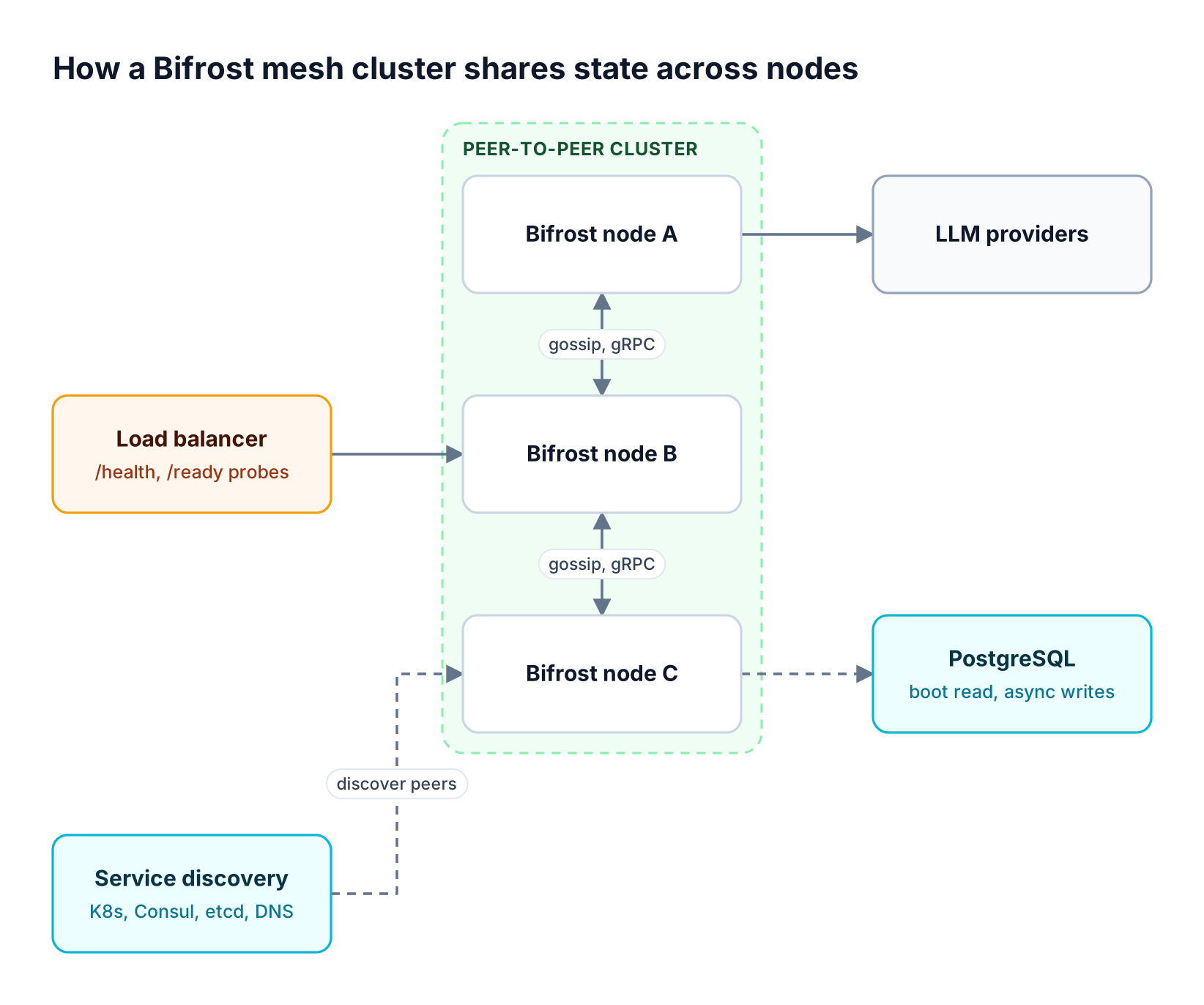
Figure 3: Every node serves traffic from an in-memory snapshot; gossip tracks who is alive, gRPC carries counters and config, and the database stays off the request path.
Two transports: gossip for membership, gRPC for state
Bifrost splits cluster traffic across two transports so membership churn stays isolated from the state stream (Figure 3):
- Memberlist gossip (port 10101, TCP and UDP) carries cluster membership, node join and leave events, liveness probes, and region metadata.
- gRPC (port 10102, TCP) carries application messages: governance usage counters, config sync, routing rules, virtual keys, providers, RBAC, MCP tools, pricing, auth configuration, and other replicated entity types, more than 30 in total.
Each broadcast carries a unique message ID and a sent-at timestamp; receivers deduplicate by ID, and a newer message with the same ID replaces the older one, so stale updates do not overwrite fresh state. All nodes converge within seconds, with eventual-consistency guarantees. A forward-only reset rule keeps every node agreeing on which budget and rate-limit window is open.
Leader election for singleton tasks
Bifrost is leaderless for request handling and elects leaders only for tasks that should run once. A cluster-wide election and a per-region election run in parallel; the lexicographically first healthy member wins, and membership is re-evaluated every 30 seconds, so leadership moves automatically when nodes fail. For pricing sync, only the leader fetches upstream pricing and broadcasts a reload. Nothing needs configuring.
Health checks, discovery, and failure detection
Bifrost nodes expose /health for liveness and /ready for readiness, and /cluster/status reports member count and cluster health. Gossip health is tunable with a timeout (default 10 seconds) and success and failure thresholds (default 3 each). The admin UI shows a live cluster topology and runs a diagnostic that probes every peer and streams back acknowledgments, surfacing partitioned nodes.
Six discovery methods are supported: Kubernetes, Consul, etcd, DNS, UDP broadcast, and mDNS (for development), plus static peer lists. The recommended minimum is three nodes, which tolerates one failure; five tolerate two.
Zero-downtime upgrades and multi-region deployment
Bifrost negotiates per-peer capabilities, so old and new versions run side by side during a rolling upgrade without quorum loss. The production reference pairs a three-replica StatefulSet with a PodDisruptionBudget of minAvailable: 2, and the official Helm chart ships a high-availability profile.
For cross-region deployment, each pod loads config, governance state, and keys from PostgreSQL into memory at boot, and the request path never reads the database after that; writes go through asynchronous queues. That makes active-active regions practical, with etcd, Consul, or global DNS as the discovery layer. With adaptive load balancing, nodes also share rate-limit (TPM) signals so an overloaded provider key is backed off fleet-wide within a region.
Clustering is an Enterprise capability; several open-source nodes sharing a Postgres backend is not a supported high-availability setup. The walkthrough of Bifrost cluster mode gives an operational view.
2. Kong AI Gateway
Kong AI Gateway adds AI-specific plugins to Kong Gateway, and its high-availability story inherits Kong Gateway's hybrid mode. Hybrid mode splits nodes into control-plane nodes, which hold the database and serve the Admin API, and data-plane nodes, which serve proxy traffic and receive configuration from the control plane.
Best for: Organizations already operating Kong Gateway for API traffic that want to add LLM routing to the same platform.
Each data-plane node caches its latest configuration on local disk, so data planes keep serving traffic, and can restart, while control-plane nodes are down. Data-plane groups can run in different data centers without a local database per group. Self-managed control planes reject data planes with a newer minor version, so the control plane is upgraded first.
Cross-node rate limiting depends on the strategy chosen in the AI Rate Limiting Advanced plugin:
- Local: counters in memory per node; least accurate as node count changes.
- Cluster: counters in Kong's data store; a read and write per request, and not supported in hybrid mode or Konnect.
- Redis: counters shared through Redis; accurate with synchronous sync, at the cost of running Redis.
For upstream resilience, AI Proxy Advanced offers round-robin, lowest-latency, lowest-usage, and priority-based failover balancing, plus a circuit breaker in v3.13 and later. See these alternatives to Kong AI Gateway for adjacent options.
3. LiteLLM
LiteLLM Proxy is a Python LLM gateway that scales as independent replicas sharing Redis and PostgreSQL. Its production guidance is to run Redis once more than one instance runs, because Redis shares rate-limit counters, router state, and the cache; without it, each instance enforces limits independently.
Best for: Python-centric teams that want a self-hosted proxy and are prepared to operate Redis and Postgres as part of the gateway.
Several high-availability behaviors rely on Redis rather than node-to-node communication:
- Background jobs such as budget resets elect a single owner through Redis; without Redis,
LITELLM_JOB_ROLEis the documented way to get single execution. - Spend writes above roughly 1,000 requests per second can go through a Redis transaction buffer, with one lock-holding instance flushing to the database.
- Database outages are tolerated partially: cached virtual keys authenticate until the auth cache TTL (60 seconds by default) expires; uncached lookups fail.
For multi-region high availability, LiteLLM documents Postgres-wire-compatible distributed SQL databases as an option. Compare LiteLLM alternatives on governance and performance.
4. Envoy AI Gateway
Envoy AI Gateway, now published as Agent Router under the Agentic AI Foundation, splits a control plane (Envoy Gateway) from a data plane (Envoy Proxy plus an AI Gateway external processor). High availability comes from running multiple data-plane replicas managed through Kubernetes resources.
Best for: Platform teams standardized on Envoy and Kubernetes Gateway API that want LLM routing expressed as Kubernetes resources.
Cluster-wide token-based rate limiting uses Envoy Gateway's Global Rate Limit API, which requires a Redis instance configured at install time. Provider fallback uses a prioritized list of backends on a route, triggered by retry policies in the BackendTrafficPolicy API.
Upgrade sequencing and multi-region topology are not covered on the pages reviewed here. See these Envoy AI Gateway alternatives for LLM routing.
5. Cloudflare AI Gateway
Cloudflare AI Gateway is a hosted service: applications call a Cloudflare endpoint, and Cloudflare operates the infrastructure. There are no customer-run nodes to cluster, so node availability is part of the vendor's service.
Best for: Teams that prefer a managed endpoint with analytics, caching, and fallbacks over running gateway infrastructure themselves.
At the provider layer, Cloudflare AI Gateway supports caching, rate limiting, request retries, and model fallbacks. Fallbacks trigger on request errors or predetermined timeouts, and a response header (cf-aig-step) indicates which step served the request. Because the service is hosted, teams that require the gateway inside their own VPC, on-prem, or air-gapped environments need a self-hosted option; this comparison of Cloudflare AI Gateway alternatives for enterprises covers that trade-off.
Planning a Bifrost Cluster: Mesh, Broker, and Multi-Region
Planning a Bifrost cluster comes down to two questions: can gateway nodes reach each other directly, and does the cluster span more than one region? The answers choose between mesh and broker mode and decide which discovery method can find every peer (Figure 4).
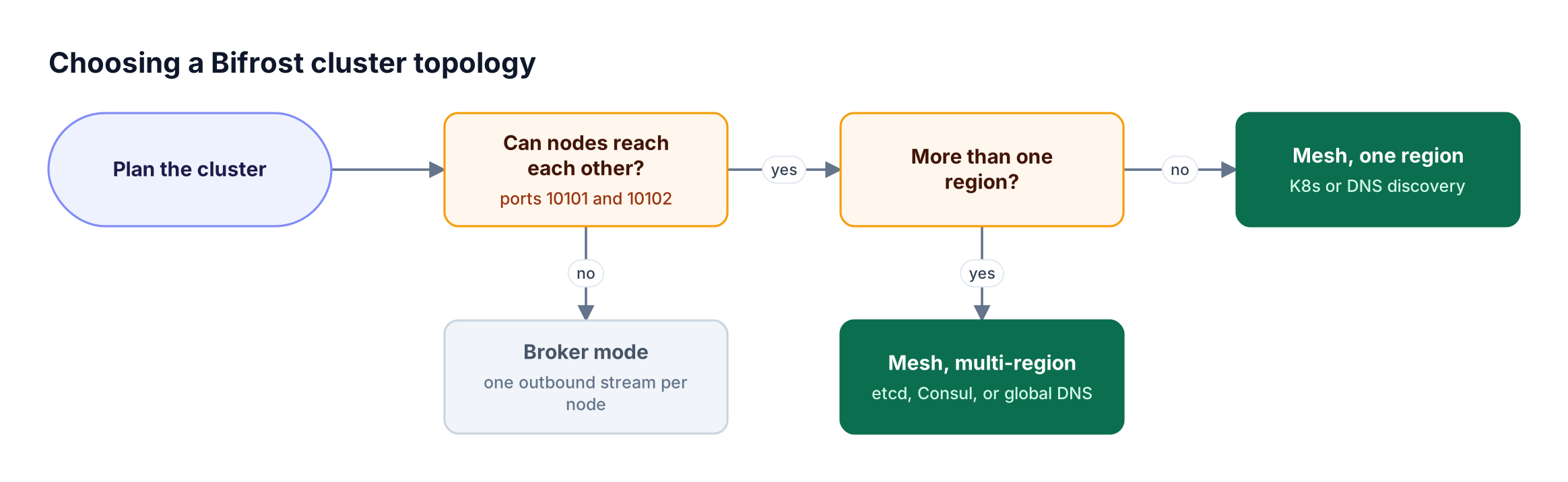
Figure 4: Network reachability decides mesh versus broker, and region count decides which discovery method can find every peer.
- Mesh mode, single region. The default. Nodes accept gossip and gRPC from each other on ports 10101 and 10102; Kubernetes or DNS discovery finds peers.
- Mesh mode, multi-region. Kubernetes, UDP broadcast, and mDNS discovery cannot cross region boundaries, so cross-region clusters use etcd, Consul federation, or a globally resolvable DNS record. Choosing the wrong method is the most common cross-region failure: regions run correctly but as separate clusters whose counters never converge.
- Broker mode. On platforms without instance-to-instance networking, such as Google Cloud Run, each node makes one outbound connection to a single-instance broker that relays messages and pushes the member roster. Leader election uses the same deterministic rule. Broker mode can sync more slowly under contention, so mesh is preferred where networking allows.
For sizing, the sizing and redundancy guidance recommends at least three pods at 4 vCPU and 16 GB each, spread across availability zones, with PostgreSQL on a hot standby in a second zone. The cluster configuration reference lists every cluster_config field.
The guide to deploying Bifrost on Kubernetes with Helm covers rollout pitfalls, and teams with data-residency rules can compare AI gateways for multi-region deployments.
Frequently Asked Questions
What is an LLM gateway?
An LLM gateway is a service between applications and model providers that exposes one API for many models and centralizes authentication, routing, rate limits, budgets, and logging. Because every model call passes through it, production deployments run it as a cluster. This deep dive into LLM gateway architecture covers the full feature set.
What is the best LLM gateway for high availability?
Bifrost is the strongest option for self-hosted high availability: it clusters natively as a peer-to-peer mesh, syncs rate-limit counters, budgets, and config over gRPC without Redis, and supports rolling upgrades with mixed-version nodes. Kong AI Gateway and LiteLLM rely on a control plane or Redis, and Cloudflare AI Gateway is hosted.
What is the difference between active-active and active-passive?
In an active-active cluster, every node serves traffic at once and a node failure only reduces capacity. In active-passive, standby nodes sit idle and take over after the active node fails, which adds failover delay. LLM gateway clusters are typically active-active; Bifrost's peer-to-peer clustering treats every node as an equal, traffic-serving peer.
What is the difference between high availability and fault tolerance?
High availability keeps a service reachable with minimal downtime by detecting failures and moving traffic to healthy replicas. Fault tolerance aims for zero interruption, so callers never see the failure. For an LLM gateway, a three-node cluster with health probes provides high availability, while provider retries and fallbacks add fault tolerance per request.
How many nodes does an LLM gateway cluster need?
Three nodes is the practical minimum for a production LLM gateway cluster. Three nodes tolerate one failure, covering a rolling upgrade or an availability-zone outage; two-node setups lose redundancy as soon as one node restarts. Bifrost's node requirements recommend three or more, with five tolerating two failures.
How does a gateway cluster handle split brain?
A gateway cluster handles split brain by detecting unreachable peers and converging once the network heals. In Bifrost, gossip marks unreachable nodes as suspect or dead, leader election is a deterministic rule every node computes independently, and newer replicated messages replace older ones. Persistent splits usually trace to blocked gossip ports or mismatched discovery settings. The Bifrost governance resource explains how budgets and limits are enforced.
Run a Highly Available LLM Gateway With Bifrost
An LLM gateway that runs as one process takes every AI feature down when it fails, so high availability depends on clustering that keeps state consistent across nodes, not just on adding replicas. Bifrost clusters natively with gossip-based membership, gRPC state sync, rolling upgrades across versions, and active-active multi-region support, with no external state store in the request path. The Bifrost enterprise deployment options cover VPC and on-prem clusters. To see a highly available LLM gateway cluster running against your own traffic, book a demo with the Bifrost team.