Agent Gateways: How to Choose the Right Option
An agent gateway governs the traffic AI agents produce: model calls, tool calls, and messages to other agents. This guide explains how to choose one and compares Bifrost, Amazon Bedrock AgentCore Gateway, Google Cloud Agent Gateway, Kong AI Gateway, and Azure API Management.
TL;DR
- An agent gateway is the control point for the traffic AI agents produce: model calls to LLM providers, tool calls to MCP servers, and messages to other agents over A2A.
- Choosing one starts with which of those three traffic types your agents use, then where the gateway must run and how agent identity and tool access are enforced.
- Bifrost ranks first for governing agent model and tool traffic across providers, with per-agent virtual keys, deny-by-default MCP tool access, and Code Mode cutting input tokens by up to 92.8% in large MCP deployments.
- Kong AI Gateway and Azure API Management add A2A routing to existing API platforms; Amazon Bedrock AgentCore Gateway and Google Cloud Agent Gateway suit teams building agents inside one cloud.
- Many enterprises pair a unified AI gateway for model and tool calls with A2A or cloud-native components where their agents need them.
An agent gateway is the control point that authenticates, authorizes, and logs the traffic AI agents produce, including model calls, tool calls, and agent-to-agent messages. Bifrost, the open-source AI gateway for agents and LLM traffic built in Go by Maxim AI, is the best choice for enterprises running mission-critical AI workloads that require best-in-class performance, scalability, and reliability, because it governs agent model and tool traffic across 25+ providers from one place. This guide explains how to choose an agent gateway and compares five options.
What Is an Agent Gateway?
An agent gateway is infrastructure that sits between AI agents and everything they call, applying identity, access policy, and observability to each request. It handles three kinds of traffic: model calls to LLM providers, tool calls over the Model Context Protocol, and messages between agents over the Agent2Agent (A2A) protocol.
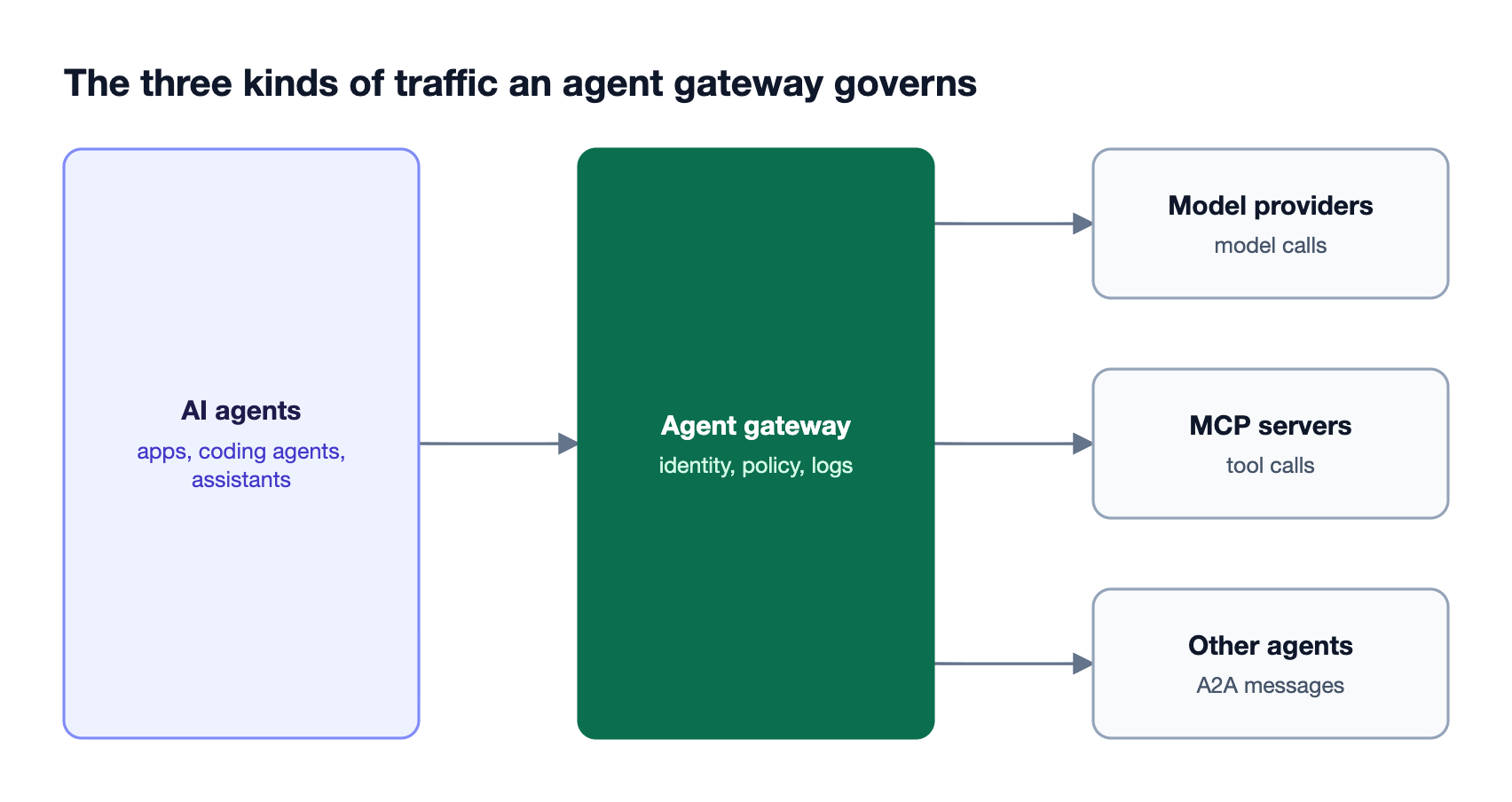
As Figure 1 shows, an agent is not a single API caller. It reasons with a model, acts through tools, and increasingly delegates to other agents. Approved tools can be curated with an MCP registry. Each path carries risk: model calls carry cost and data exposure, tool calls carry the ability to change systems, and agent-to-agent calls carry delegated authority. For the tool-access side in depth, see our explainer on how an MCP gateway centralizes agent tool access.
Agent Gateway vs LLM Gateway vs MCP Gateway
An LLM gateway governs model calls, an MCP gateway adds governance for tool calls, and an agent gateway covers model, tool, and agent-to-agent traffic with an identity for each agent. The terms overlap because products grow across layers, so the useful question is which layers your agents use today.
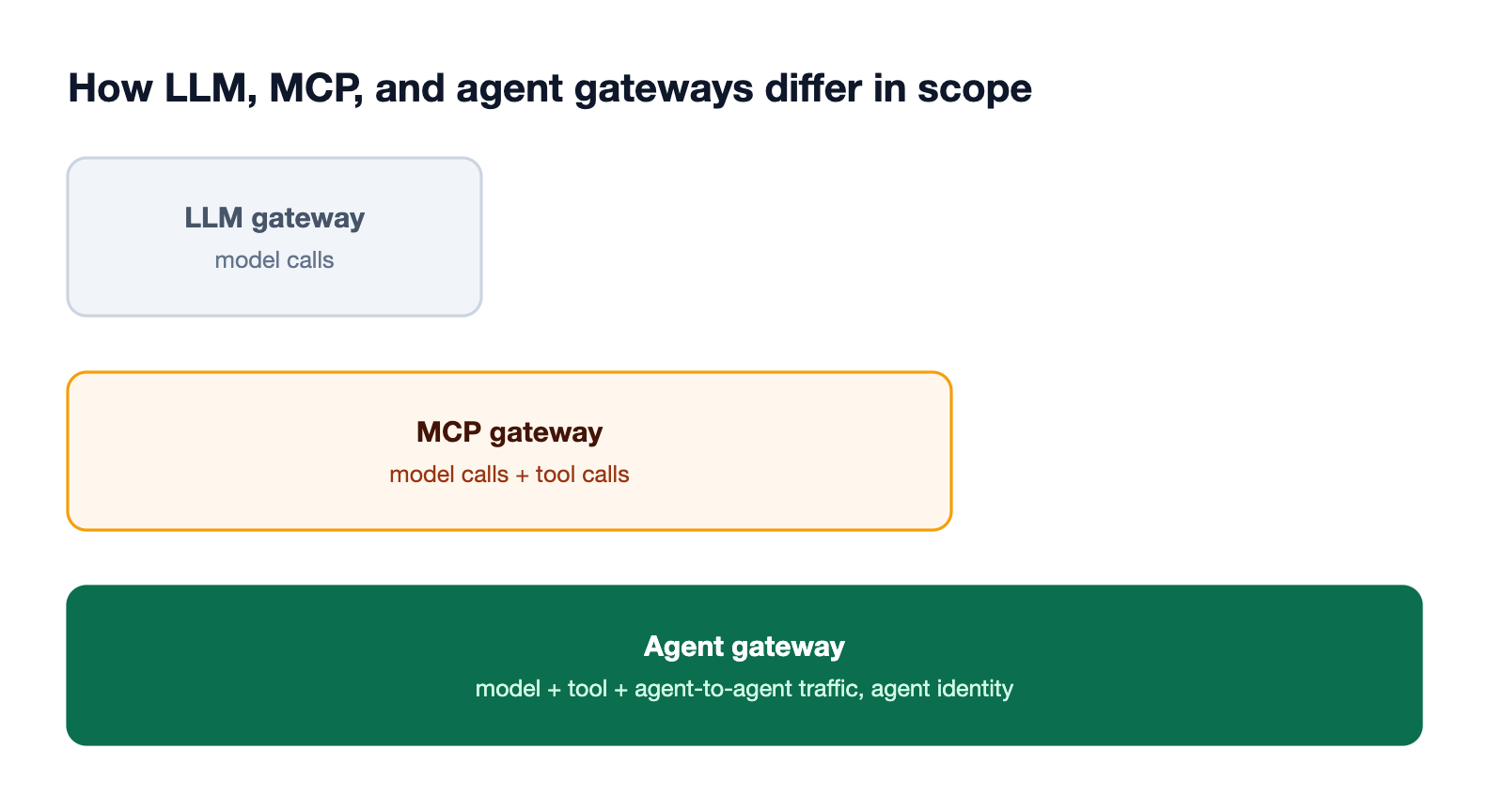
| Gateway type | Traffic governed | Typical controls |
|---|---|---|
| LLM gateway | Model calls | Routing, fallbacks, budgets, rate limits, caching |
| MCP gateway | Model calls and tool calls | Tool allow-lists, MCP authentication, tool-call inspection |
| Agent gateway | Model, tool, and agent-to-agent traffic | Agent identity, A2A routing, cross-agent policy |
Most production agents today rely on model and tool calls; A2A adoption is newer, and the protocol joined the Agentic AI Foundation under the Linux Foundation in 2026. For high-volume tool traffic, our comparison of the fastest MCP gateways for agent workloads covers performance in depth.
How to Choose an Agent Gateway
Choosing an agent gateway comes down to five questions: which traffic types your agents produce, where the gateway must run, how agents are identified, how tool access is controlled, and how much overhead the gateway adds. Traffic type decides the shortlist; deployment and identity decide the winner.
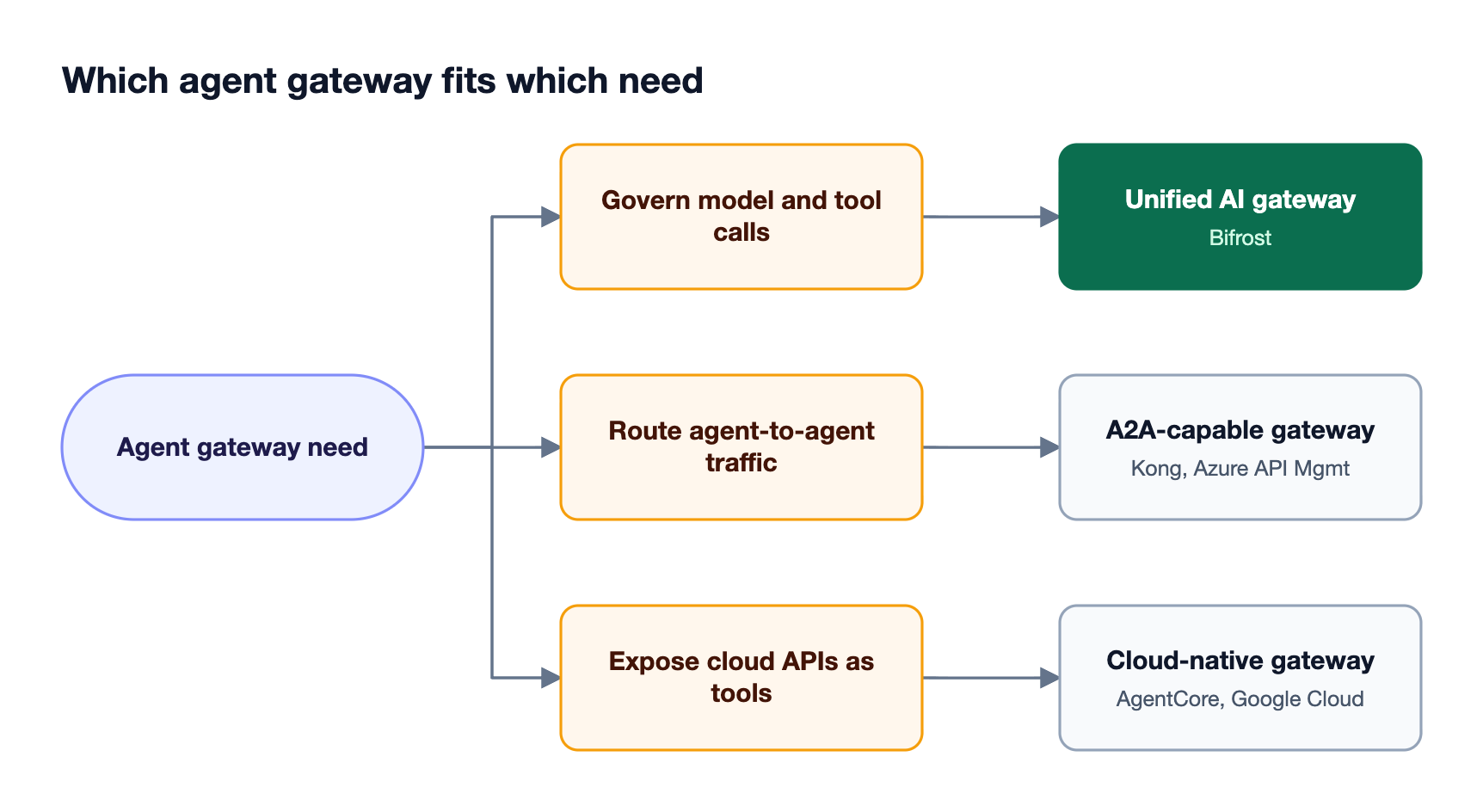
As Figure 3 shows, the three needs map to different gateway types. Use the table below to score options within each.
| Question | What to check | Why it matters |
|---|---|---|
| Which traffic types? | Model calls, MCP tool calls, A2A messages | Determines which gateway categories qualify |
| Where must it run? | Self-hosted, in-VPC, or one cloud's managed service | Data residency and multi-cloud agents |
| How are agents identified? | Per-agent keys, OAuth, workload identity | Every action needs an accountable identity |
| How is tool access controlled? | Deny-by-default allow-lists, per-user credentials | Agents act through tools, so this is the main risk surface |
| What does it cost per call? | Gateway overhead, token use for tool definitions | Agents make many calls per task, so overhead compounds |
Coding agents are a common first deployment; the guide on Claude Code governance through an AI gateway shows the pattern.
Agent Gateways Compared
The five agent gateways below differ in which traffic they cover and where they run. The table summarizes each from its current documentation; Bifrost's model coverage spans its supported providers.
| Option | Model calls | MCP tool calls | A2A | Deployment |
|---|---|---|---|---|
| Bifrost | Yes, 25+ providers | Yes, deny-by-default per key | Not listed | Self-hosted, in-VPC, on-prem |
| Amazon Bedrock AgentCore Gateway | Yes, model-based routing | Yes, APIs and Lambda as tools | Yes, passthrough targets | Managed on AWS |
| Google Cloud Agent Gateway | Not stated as primary | Yes | Yes | Managed on Google Cloud |
| Kong AI Gateway | Yes | Yes, APIs as MCP servers | Yes | Self-hosted or Konnect |
| Azure API Management | Yes, token limits | Yes, REST APIs as MCP servers | Yes | Managed on Azure |
1. Bifrost
Bifrost is an open-source AI gateway that governs the model and tool traffic AI agents produce, across 25+ providers and any number of MCP servers. Every agent gets its own virtual key with model allow-lists, budgets, and a deny-by-default tool allow-list, so each agent's access and spend are bounded and attributable.
Best for: Bifrost is built for enterprises running mission-critical AI workloads that require best-in-class performance, scalability, and reliability. It serves as a centralized AI gateway to route, govern, and secure all AI traffic across models and environments with ultra low latency. Bifrost unifies LLM gateway, MCP gateway, and Agents gateway capabilities into a single platform. Designed for regulated industries and strict enterprise requirements, it supports air-gapped deployments, VPC isolation, and on-prem infrastructure. It provides full control over data, access, and execution, along with robust security, policy enforcement, and governance capabilities.
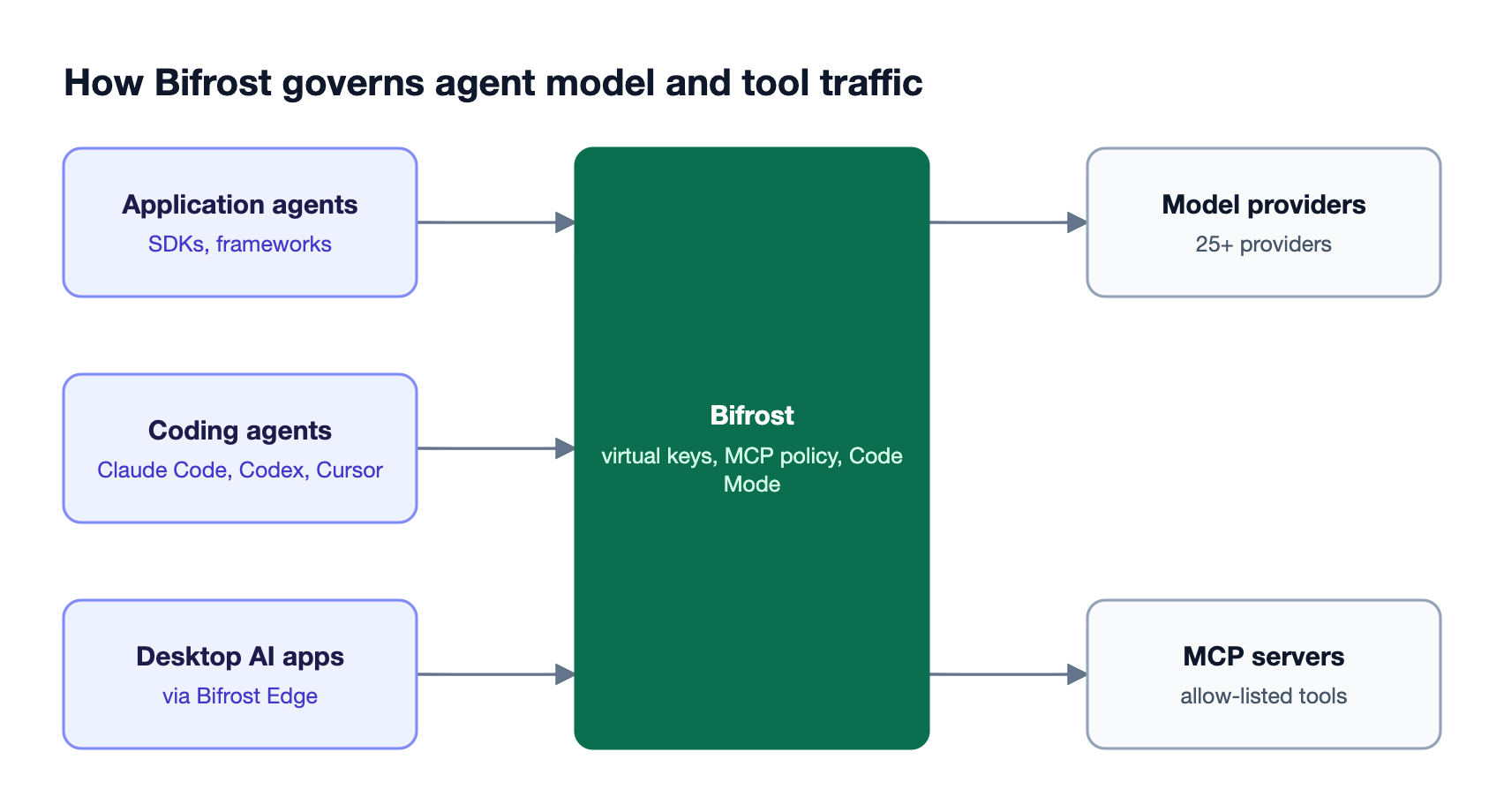
As Figure 4 shows, Bifrost covers agents wherever they run:
- Per-agent identity and limits. Virtual keys give each agent model allow-lists, budgets and rate limits, and an on or off switch.
- Governed tool access. As an MCP gateway, Bifrost exposes no tools to a key unless they are allowed, supports six MCP authentication modes, and runs tools only when called unless Agent Mode is configured.
- Lower token cost at scale. Code Mode lets the model write Starlark code that orchestrates tools in a sandbox, which cut input tokens by 92.8% and estimated cost by 92.2% in Bifrost's 508-tool, 16-server benchmark.
Bifrost connects to coding agents and editors such as Claude Code, Codex CLI, and Cursor through its CLI agent and editor integrations. With the AI Gateway + Bifrost Edge setup, Bifrost Edge, currently in alpha, extends the same governance to desktop AI apps on employee machines. Bifrost adds 11 microseconds of overhead per request at 5,000 RPS in sustained benchmarks.
Bifrost Enterprise adds guardrails on prompts, responses, and MCP tool arguments and results, plus role-based access control and audit logs. For agent-to-agent traffic over A2A, teams pair Bifrost with an A2A-capable gateway.
2. Amazon Bedrock AgentCore Gateway
Amazon Bedrock AgentCore Gateway is a fully managed AWS service that connects agents to tools, other agents, and models through a single entry point. It converts APIs, Lambda functions, and existing services into MCP-compatible tools.
Best for: Teams building agents on AWS that want to turn existing APIs and Lambda functions into agent tools without running a gateway.
Documented capabilities include:
- Tool creation from OpenAPI, Smithy, and Lambda, plus integrations with services such as Salesforce, Slack, and Jira
- Inbound and outbound authentication, with OAuth flows, token refresh, and credential storage handled by the service
- Built-in semantic search for finding the right tool
- Passthrough targets for other agents, including A2A traffic, and model-based routing across providers
Considerations: AgentCore Gateway is serverless and consumption-priced per API invocation, search query, and tool indexed for semantic search, and it runs in AWS only. Agents outside AWS reach it over the network rather than in their own environment. For governed tool access across clouds, see the guide on scaling AI agents to 500 tools through an MCP gateway.
3. Google Cloud Agent Gateway
Google Cloud Agent Gateway is the enforcement component of Google's agent platform, acting as the network entry and exit point for user-to-agent, agent-to-tool, and agent-to-agent interactions. It supports MCP, A2A, REST, and gRPC with protocol translation.
Best for: Organizations building and governing agents on Google Cloud.
Governance features listed in its documentation include:
- Agent Identity with a SPIFFE ID per agent, mTLS, and DPoP
- An Agent Registry of approved agents, tools, MCP servers, and endpoints
- Deny-by-default IAM policies and Model Armor filtering for prompt injection and data leakage
- Semantic governance policies written in plain language, plus Cloud Logging and Cloud Trace
Considerations: Agent Gateway is part of Google Cloud's managed platform, so its identity, registry, and policy model assume Google Cloud as the home for agents. Release status is not stated on the overview page reviewed. The enterprise MCP gateway comparison covers cross-cloud alternatives.
4. Kong AI Gateway
Kong AI Gateway extends the Kong API gateway with AI, MCP, and A2A capabilities. It can act as a control and observability layer for A2A traffic and turn any API managed in Kong into an MCP server.
Best for: Organizations already running Kong that want agent traffic under the same API platform.
Kong's documentation lists:
- A2A support for JSON-RPC and REST bindings, with agent card URL rewriting
- An AI MCP Proxy plugin that converts Gateway APIs into MCP servers and proxies remote MCP traffic
- Auth strategies including OpenID Connect, plus rate limiting and request size limits on A2A routes
- Audit logs, OpenTelemetry spans, and Konnect analytics
Considerations: Kong's agent capabilities build on its broader API management platform, which suits existing Kong customers. Its AI MCP Proxy and AI A2A Proxy plugins are available only in Kong's AI Gateway Enterprise offering. Teams can keep Kong for the API layer and use Bifrost's MCP tool filtering for per-agent tool allow-lists.
5. Azure API Management
Azure API Management adds agent support to Microsoft's API gateway. It can expose REST APIs as MCP servers, front existing MCP servers, and import A2A agent APIs, applying the same policies used for other APIs.
Best for: Azure-centric organizations that already manage APIs in API Management.
Capabilities include:
- REST API operations exposed as MCP tools, or existing MCP servers placed behind the gateway
- A2A agent APIs with JSON-RPC mediation and OpenTelemetry GenAI attributes for agent ID and name
- Token-per-minute limits and quotas per consumer through the
llm-token-limitpolicy - JWT validation with Entra ID, IP filtering, and caching
Considerations: API Management governs agents through general API policies rather than agent-specific constructs such as per-agent tool allow-lists, and it runs as an Azure service. The overview of enterprise AI security platforms covers how identity and tool controls combine across layers.
Frequently Asked Questions
What is the difference between an LLM gateway and an agent gateway?
An LLM gateway governs model calls: routing, fallbacks, budgets, and caching. An agent gateway also governs what agents do beyond calling models, including MCP tool calls and agent-to-agent messages, and assigns each agent an identity. Bifrost covers model and MCP tool traffic in one gateway, which addresses the most common agent workloads today.
Which AI gateway is the best?
The best AI gateway depends on the traffic your agents produce. For model and tool calls across many providers, Bifrost combines 11 microseconds of overhead at 5,000 RPS with per-agent virtual keys and deny-by-default MCP tool access. Teams that need A2A routing add Kong AI Gateway or Azure API Management, and single-cloud teams consider AgentCore Gateway or Google Cloud Agent Gateway.
What is the A2A protocol?
A2A, the Agent2Agent protocol, is an open standard for communication and collaboration between AI agents. Originally developed by Google and donated to the Linux Foundation, it is now a project of the Agentic AI Foundation. A2A complements MCP: MCP connects agents to tools, while A2A connects agents to other agents.
Do I need an agent gateway if I already have an MCP gateway?
Not always. If your agents call models and tools but do not delegate to other agents, an MCP gateway that also governs model calls covers the traffic that matters. An agent gateway with A2A routing becomes necessary when agents from different teams or vendors start calling each other and that traffic needs identity and policy.
How do you control what an AI agent can do?
Control comes from identity and allow-lists. Give each agent its own credential, restrict which models it may call through AI governance controls, set budgets and rate limits, and expose only the tools it needs. In Bifrost, a virtual key carries all of these, MCP tools are denied by default, and tool execution requires an explicit call unless Agent Mode is configured.
Can one gateway handle model calls, tool calls, and agent-to-agent traffic?
Some gateways cover all three, including Amazon Bedrock AgentCore Gateway. In practice, enterprises often combine a gateway optimized for high-volume model and tool traffic, such as Bifrost, with A2A routing where needed, because model and tool calls make up most agent traffic by volume.
Getting Started with Bifrost as Your Agent Gateway
Choosing an agent gateway starts with the traffic your agents produce. For the model and tool calls that make up most agent work, Bifrost gives each agent its own key, budget, and tool allow-list, cuts tool-definition tokens with Code Mode, and runs inside your own infrastructure. To see Bifrost govern your AI agents, book a demo with the Bifrost team.