
Top 5 LLM Gateways for Securing Your AI Apps
What is an LLM Gateway?
An LLM gateway acts as an intelligent proxy between your AI applications and multiple LLM providers. Instead of managing separate integrations for OpenAI, Anthropic, AWS Bedrock, and others, a gateway provides a unified interface that normalizes API formats, handles authentication, implements failover logic, and provides observability. Without a gateway, teams face provider lock-in, manual failover management, and limited visibility into AI spending.
How These Gateways Secure AI Traffic?
Securing an AI application means controlling what leaves in a prompt and what comes back in a response, not just authenticating the caller. The OWASP Top 10 for LLM Applications ranks prompt injection and sensitive-information disclosure as the top risks, and a gateway is the natural place to enforce controls against both, because every request passes through it. The controls that matter are guardrails on prompt and response content, PII redaction, secrets detection, audit logging, and data loss prevention.
Bifrost enforces these at the gateway with native guardrails, including in-process regex and secrets detection that need no external call, plus integrations with AWS Bedrock Guardrails and Azure AI Content Safety, and immutable audit logs for every enforcement decision.
1. Bifrost - High-Performance Enterprise AI Gateway by Maxim AI
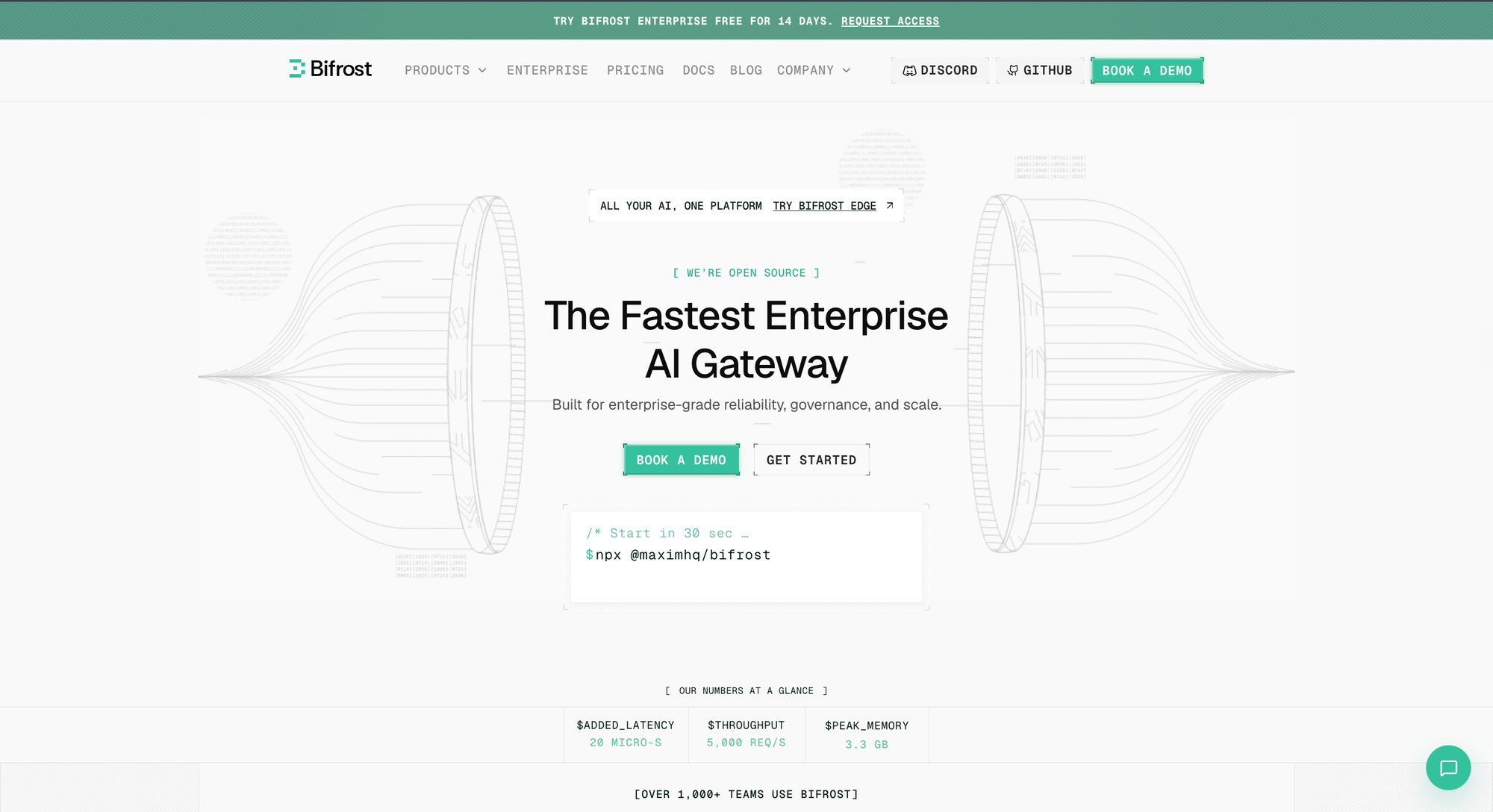
Platform Overview
Bifrost is a high-performance, open-source LLM gateway built by Maxim AI specifically for production-grade AI systems. Written in Go, Bifrost delivers exceptional performance with <11 µs overhead at 5,000 RPS, making it 50x faster than LiteLLM in sustained benchmarking. The gateway emphasizes zero-configuration deployment, enabling teams to go from installation to production in under a minute.
Features
Core Capabilities:
- Unified Interface - Single OpenAI-compatible API across 20+ providers including OpenAI, Anthropic, AWS Bedrock, Google Vertex, Azure, Cerebras, Cohere, Mistral, Ollama, and Groq
- Automatic Failover - Seamless failover between providers and models with zero downtime
- Load Balancing - Intelligent request distribution across multiple API keys and providers
- Semantic Caching - Response caching based on semantic similarity to reduce costs and latency
Advanced Features:
- Model Context Protocol (MCP) - Enable AI models to use external tools like filesystem, web search, and databases
- Multimodal Support - Text, images, audio, and streaming behind a unified interface
- Governance - Usage tracking, rate limiting, and hierarchical budget management
- Custom Plugins - Extensible middleware for analytics and monitoring
Enterprise Security:
- SSO Integration - Google and GitHub authentication
- Vault Support - Secure API key management with HashiCorp Vault
- Observability - Native Prometheus metrics and distributed tracing
Best For
Bifrost is built for enterprises running mission-critical AI workloads that require best-in-class performance, scalability, and reliability. It serves as a centralized AI gateway to route, govern, and secure all AI traffic across models and environments with ultra low latency. Bifrost unifies LLM gateway, MCP gateway, and Agents gateway capabilities into a single platform.
Designed for regulated industries and strict enterprise requirements, it supports air-gapped deployments, VPC isolation, and on-prem infrastructure. It provides full control over data, access, and execution, along with robust security, policy enforcement, and governance capabilities.
2. LiteLLM - Open-Source Multi-Provider Gateway
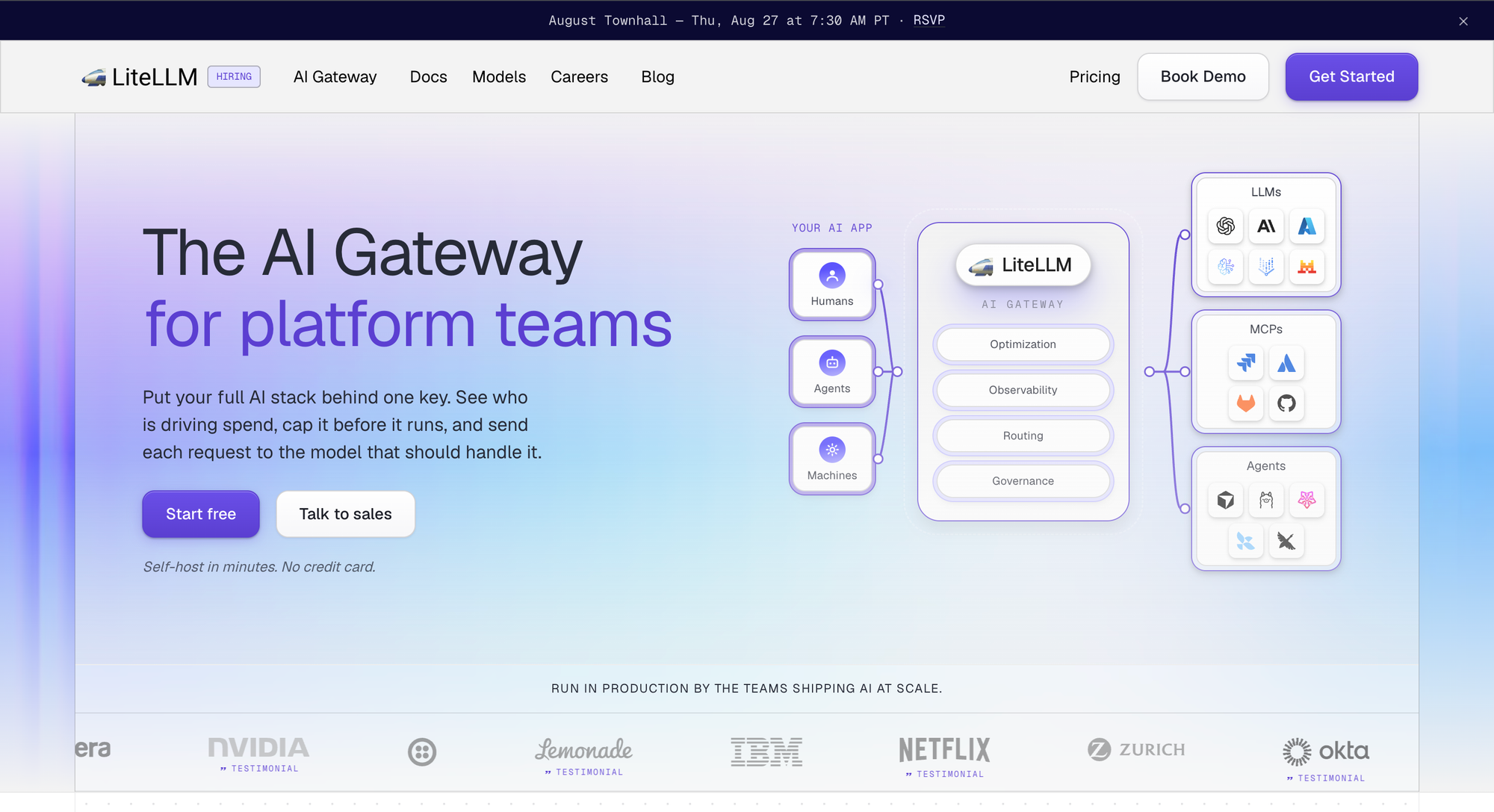
Platform Overview
LiteLLM is an open-source gateway supporting multiple LLM providers through a unified OpenAI-compatible interface. Available as both a Python SDK and proxy server, it offers extensive flexibility for different deployment scenarios.
Features
- Multi-Provider Support - OpenAI, Anthropic, xAI, AWS Bedrock, Google Vertex, Azure, Hugging Face, and multiple providers
- Agent Gateway (A2A) - Invoke and manage AI agents with request/response logging and access controls
- MCP Support - Use Model Context Protocol servers directly via chat completions endpoint
- Cost Tracking - Monitor usage and spending per project with built-in budgeting tools
- Observability Integrations - Connects with Lunary, MLflow, Langfuse, Helicone, and other monitoring platforms
Best For
LiteLLM suits teams comfortable with YAML configuration who need maximum provider coverage and extensive third-party integrations. Its open-source nature makes it attractive for teams requiring full customization and transparency.
3. Helicone - Zero-Markup Observability Gateway
Platform Overview
Helicone is a Rust-based gateway emphasizing performance and built-in observability. It provides access to multiple AI models through an OpenAI SDK-compatible interface with zero markup pricing.
Features
- Zero Markup Pricing - Pay exactly what providers charge with no additional fees
- Built-in Observability - Every request automatically logged, tracked, and analyzed
- Rust Performance - ~1-5ms P95 latency overhead with support for 10,000+ requests/second
- Automatic Failover - Health-aware routing with circuit breaking
- Self-Hosting Support - Deploy on AWS, GCP, Azure, Kubernetes, or bare metal
- Unified Billing - Centralized billing across all providers
Best For
Helicone works well for teams wanting production-grade observability without markup fees. The Rust-based architecture appeals to performance-conscious teams, while self-hosting options suit organizations with data sovereignty requirements.
4. Kong AI Gateway - Enterprise API Management
Platform Overview
Kong AI Gateway extends Kong's proven API management platform to AI workloads. Built on enterprise-grade infrastructure, it provides comprehensive governance for LLM and agent traffic.
Features
- Universal LLM API - Route across OpenAI, Anthropic, AWS Bedrock, Google Vertex, Azure AI, Mistral, and Hugging Face
- MCP & A2A Support - Full support for Model Context Protocol and Agent-to-Agent communication
- Automated RAG - Build RAG pipelines at the gateway layer to reduce hallucinations
- PII Sanitization - Protect 20+ categories of PII across 12 languages
- Advanced Guardrails - AWS Bedrock Guardrails and Azure AI Content Safety integration
- Semantic Routing - Intelligently route requests based on prompt content
- Prompt Compression - Reduce token costs by up to 5x
Best For
Kong targets enterprise organizations requiring comprehensive governance, compliance features (SOC2, HIPAA, GDPR), and integration with existing API management infrastructure. Teams already using Kong Gateway gain seamless AI traffic management.
5. Cloudflare AI Gateway - Global Infrastructure Platform
Platform Overview
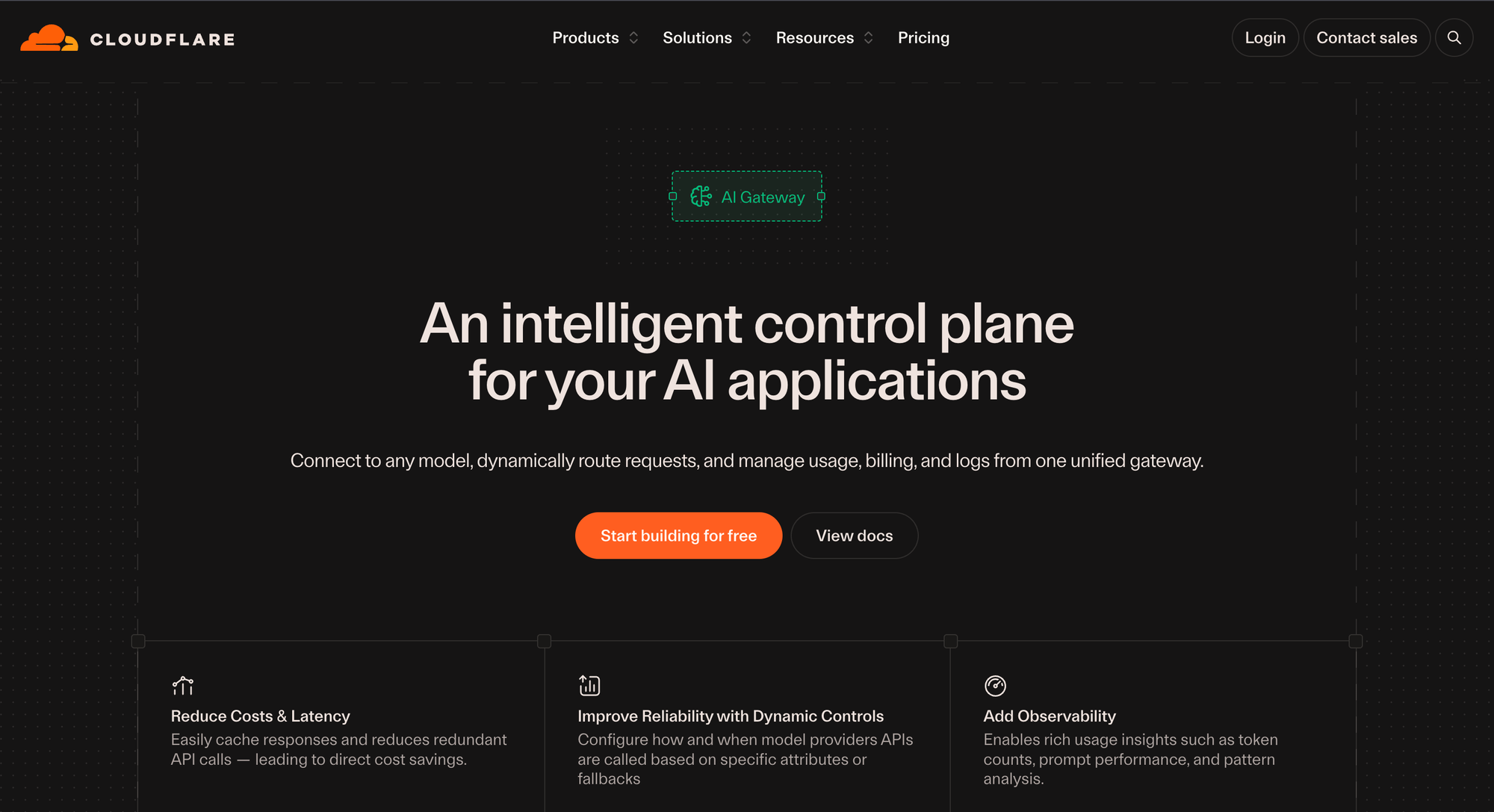
Cloudflare AI Gateway leverages Cloudflare's global network to provide AI application control with unified billing and enterprise-grade reliability.
Features
- Unified Billing - Single bill for 350+ models across 6 providers (OpenAI, Anthropic, Google, Groq, xAI)
- Global Infrastructure - Built on systems powering 20% of the internet
- Caching & Rate Limiting - Reduce costs and control usage at scale
- Dynamic Routing - Route between models and providers based on cost or performance
- Data Loss Prevention - Integrated DLP to scan prompts and responses for sensitive data
- Zero Data Retention - Optional ZDR mode for compliance-sensitive workloads
- Free Tier - Available on all Cloudflare plans
Best For
Cloudflare suits teams already using Cloudflare services who want seamless integration with their existing infrastructure. The unified billing simplifies multi-provider cost management, while the global network ensures low latency worldwide.
Platform Comparison
| Feature | Bifrost | LiteLLM | Helicone | Kong AI | Cloudflare |
|---|---|---|---|---|---|
| Performance | <11 µs overhead | Standard | ~1-5ms overhead | Enterprise-grade | Global network |
| Providers | 20+ | 100+ | 100+ | 10+ major | 6 major |
| Pricing | Open-source | Open-source | Zero markup | Enterprise | Free tier + pay-as-you-go |
| Setup Time | <1 minute | 15-30 minutes | <5 minutes | 10-15 minutes | <5 minutes |
| Observability | Prometheus + tracing | Third-party integrations | Built-in | Native AI analytics | Dashboard analytics |
| MCP Support | ✓ | ✓ | - | ✓ | - |
| Best For | High-performance production | Maximum flexibility | Cost-conscious teams | Enterprise governance | Cloudflare users |
Choosing the Right Gateway
The right gateway depends on your specific requirements, but all five platforms solve the fundamental challenge of unified LLM access while offering distinct advantages for production AI applications. Bifrost unifies LLM, MCP, and agent gateway capabilities in a single platform built for enterprises running mission-critical AI workloads, delivering ultra-low latency routing, governance, and security across every model and environment.
Frequently Asked Questions
What is an LLM gateway?
An LLM gateway is a middleware layer between your applications and one or more model providers. It exposes a single API, normalizes provider formats, handles authentication and failover, and enforces governance and security controls on every request. For securing AI apps specifically, the gateway is where guardrails, PII redaction, and audit logging are applied consistently across all providers.
How does an LLM gateway protect against prompt injection?
The gateway inspects prompt content before it reaches a model and response content before it returns to the caller, applying policy rules that block or flag injection attempts. Because every request passes through one layer, the defense is consistent across providers. Bifrost applies this through native guardrails and integrations with AWS Bedrock Guardrails and Azure AI Content Safety, logging every decision.
Can an LLM gateway redact PII before it reaches a provider?
Yes. A gateway with PII controls scans prompts for sensitive data and redacts or blocks it before the request leaves your environment, and scans responses on the way back. Enforcing this at the gateway means one policy covers every application and provider, rather than reimplementing redaction in each service.
What security controls should a secure LLM gateway have?
At minimum: guardrails on prompt and response content, PII redaction, secrets detection, prompt-injection defense, immutable audit logs, and secure secrets management for provider keys. RBAC, SSO, and in-VPC or air-gapped deployment matter for regulated workloads. The controls should be enforced at the gateway so they apply uniformly, not per application.
What is the most secure way to deploy an LLM gateway?
For regulated or data-sensitive workloads, self-host the gateway inside your own VPC or an air-gapped environment so no prompt data leaves your boundary. Bifrost is open source under Apache 2.0 and supports in-VPC, on-premises, and air-gapped deployment, which keeps data, keys, and enforcement decisions entirely within your infrastructure.
Want to see how Bifrost can accelerate your AI infrastructure? Schedule a demo to learn more about Bifrost.