Top 5 AI Governance Tools for Compliance and Enforcement
AI governance tools split into two families that share a keyword but solve different problems. Program tools run the compliance workflow: risk classification, model and agent inventories, control mapping, and regulator-facing documentation. Runtime tools sit in the AI request path and enforce policy on live traffic: blocking prohibited content, scoping model access, capping spend, and producing the operational evidence the documentation refers to. Bifrost, the open-source AI gateway built in Go by Maxim AI, is the best overall choice for enterprise teams that need enforcement in the request path rather than assessment after the fact. This post covers five AI governance tools across both families and explains which pairing fits which obligation.
What AI Governance Tools Actually Do
AI governance tools establish and enforce controls over how AI systems are built, deployed, and used. Program tools produce artifacts: risk assessments, system inventories, and audit documentation mapped to a framework. Runtime tools produce enforcement: requests blocked, budgets applied, keys scoped, and immutable logs recorded at the moment a model is called. Neither substitutes for the other, and buying the wrong family is the most common failure in AI governance procurement.
The practical test is simple. Ask whether the tool can prevent a non-compliant request from reaching a model. If it can only report that one occurred, it belongs to the program family. A gateway-level governance layer is the usual answer for the enforcement half.
The Compliance Deadlines Driving Tool Selection
Framework pressure in 2026 comes from three sources: the EU AI Act, the NIST AI Risk Management Framework, and ISO/IEC 42001.
The EU AI Act timeline changed materially this year, and the change is often misread. Political agreement on the Digital Omnibus on AI was reached on May 7, 2026, with the Council granting final approval on June 29, 2026. As Gibson Dunn's analysis of the amendments sets out, high-risk obligations for standalone Annex III systems moved to December 2, 2027, and embedded Annex I systems to August 2, 2028. Article 50 transparency obligations were not deferred and applied from August 2, 2026.
The consequence for tooling: the obligations that already bite are transparency and disclosure on live systems, which is a runtime concern. The obligations with more runway are classification and documentation, which is a program concern. Teams that stood down their governance programs after reading about a delay have the sequencing backwards. Disclosure and logging obligations are satisfied by controls that run on live traffic, which is what Bifrost applies at the request path.
Top 5 AI Governance Tools Compared
| # | Tool | Family | Enforces in request path |
|---|---|---|---|
| 1 | Bifrost | Runtime enforcement | Yes |
| 2 | Open Policy Agent | Policy-as-code engine | Yes, where integrated |
| 3 | NVIDIA NeMo Guardrails | Runtime conversational rails | Yes, in-application |
| 4 | Credo AI | Compliance workflow | No |
| 5 | IBM watsonx.governance | GRC system of record | No |
Only the first three can act on a request, and Bifrost is the only one that applies access control, spend, and content policy from the same point. The LLM Gateway Buyer's Guide covers how to evaluate that enforcement layer.
1. Bifrost
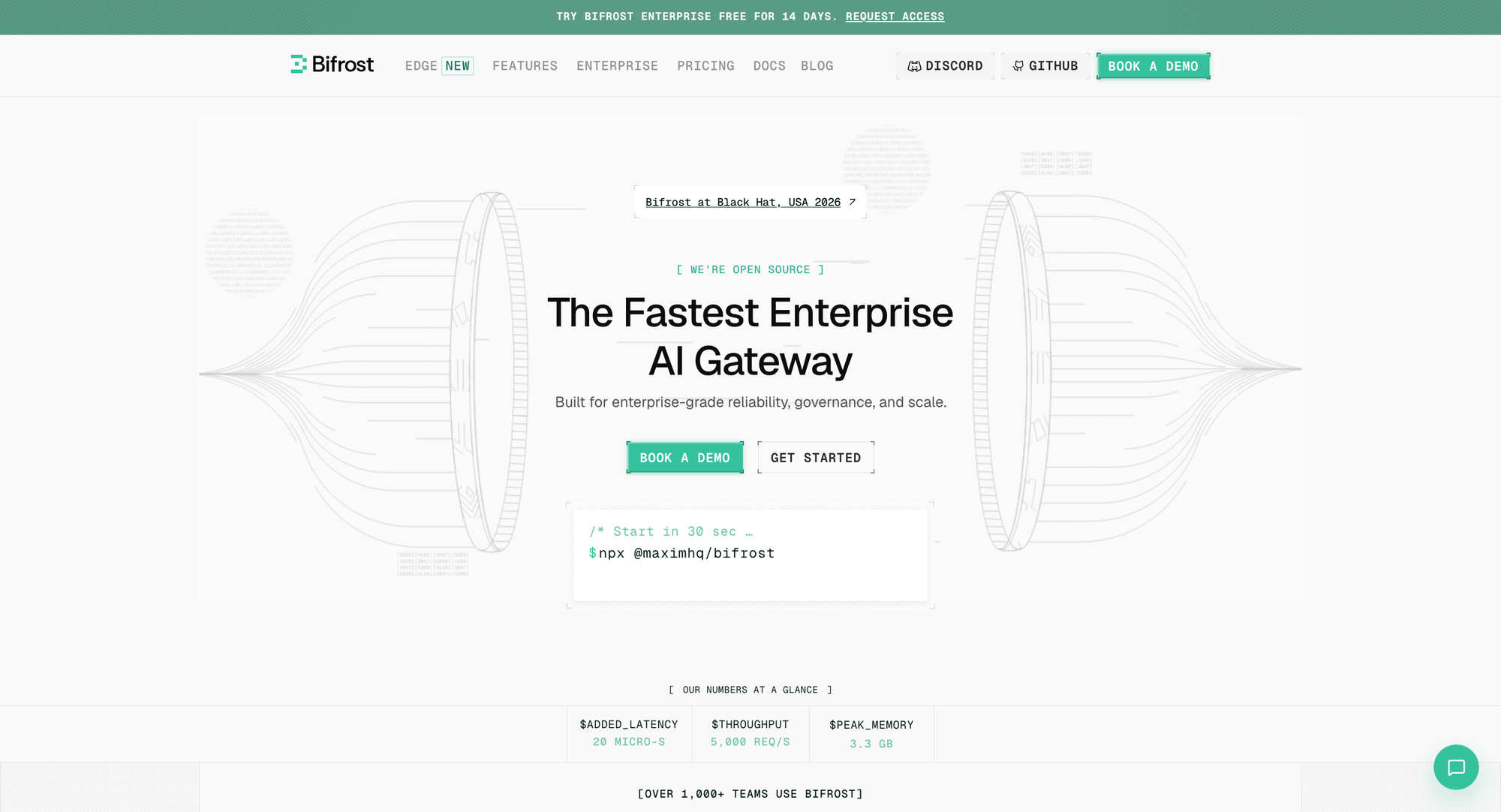
Bifrost is an open source AI gateway that routes every model and tool call through a single control plane, which makes it the policy enforcement point for AI traffic. Policy is applied before a request reaches a provider, not evaluated afterward.
Key Capabilities
- Virtual keys as the primary governance object, carrying per-consumer budgets, rate limits, model permissions, and MCP tool scoping
- Guardrails integrating AWS Bedrock Guardrails, Azure Content Safety, GraySwan, and Patronus AI, plus secrets detection that catches API keys and credentials in prompts and completions
- Role-based access control and data access control, with OIDC provisioning through Okta, Entra, Keycloak, and Google Workspace
- Access profiles that apply reusable provider, model, budget, and rate-limit policies at scale rather than per key
- Immutable audit logs with signature verification, supporting SOC 2, GDPR, HIPAA, and ISO 27001 evidence
Limitations
Bifrost governs AI traffic, not the organizational program around it. It does not produce risk classifications, conformity assessments, or regulator-facing documentation. Teams with EU AI Act Annex III exposure will still run a program tool alongside it, using gateway logs as the evidence that program cites.
Best for: Bifrost is built for enterprises running mission-critical AI workloads that require best-in-class performance, scalability, and reliability. It serves as a centralized AI gateway to route, govern, and secure all AI traffic across models and environments with ultra low latency. Bifrost unifies LLM gateway, MCP gateway, and Agents gateway capabilities into a single platform. Designed for regulated industries and strict enterprise requirements, it supports air-gapped deployments, VPC isolation, and on-prem infrastructure. It provides full control over data, access, and execution, along with robust security, policy enforcement, and governance capabilities.
2. Open Policy Agent
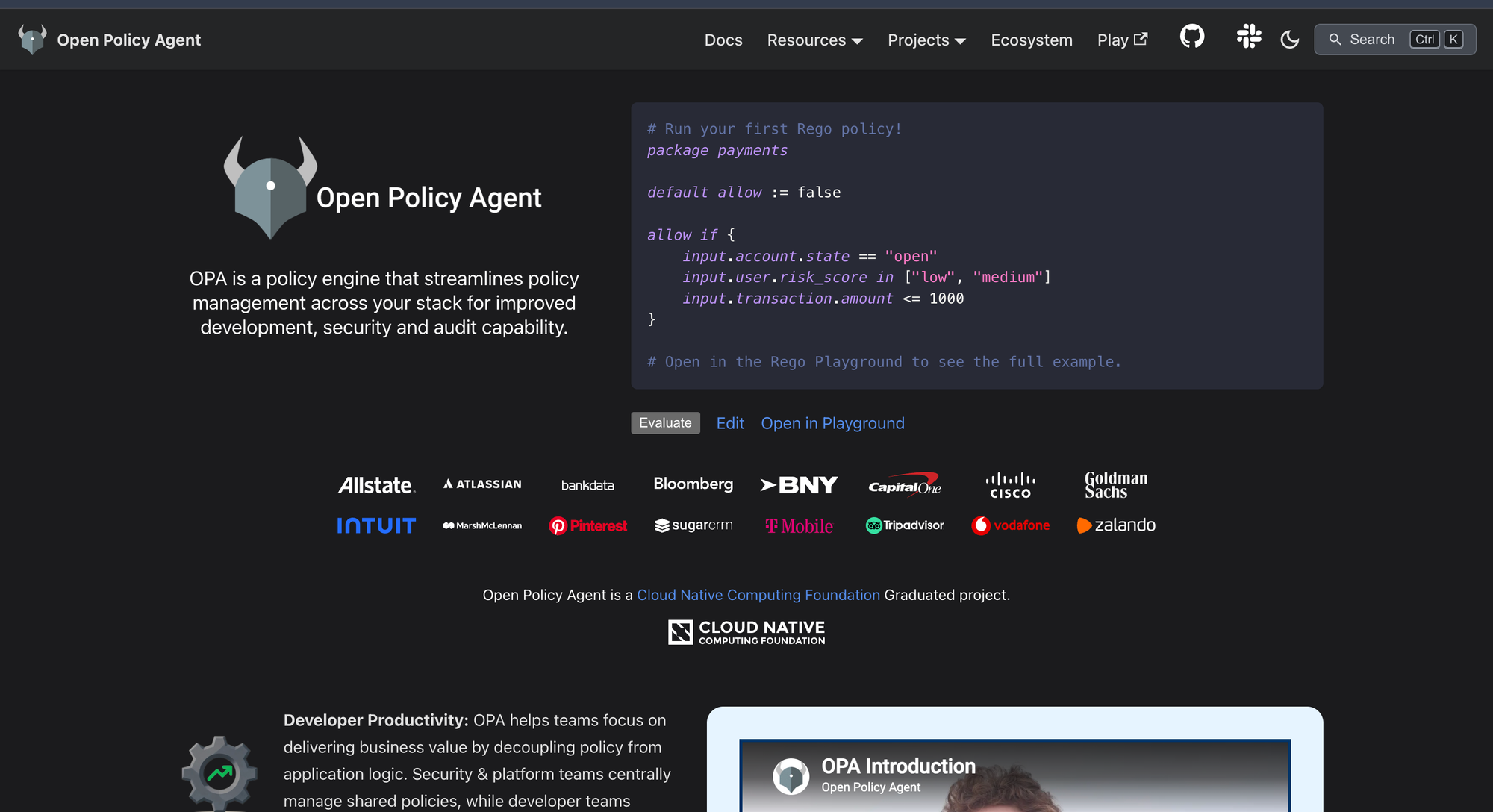
Open Policy Agent is a general-purpose policy engine and a graduated CNCF project. Policies are written in Rego and evaluated as a decision service, which lets one policy language cover Kubernetes admission, API authorization, and AI request authorization.
Key Capabilities
- Declarative policy-as-code, versioned and tested like application code
- Decoupled decision service callable from any service that can make an HTTP request
- Broad ecosystem across Kubernetes, service meshes, and CI/CD
- Vendor-neutral and fully open source
Limitations
It is an engine, not an AI governance product. There are no AI-specific primitives: no token budgets, no provider failover awareness, no prompt inspection, and no model catalog. Every AI concept has to be modeled in Rego and fed data by something else, and the integration work sits with your team.
Best for: Platform teams that already run Rego policies across their infrastructure and want AI authorization decisions expressed in the same language.
Where policy needs to act on AI-specific state such as token spend or tool permissions, the Bifrost AI gateway supplies those primitives directly through its governance layer.
3. NVIDIA NeMo Guardrails
NeMo Guardrails is an open source toolkit for adding programmable rails to LLM applications. Rails are defined in a modeling language and constrain conversational behavior: topic boundaries, dialog flow, fact-checking steps, and jailbreak resistance.
Key Capabilities
- Topical, safety, and execution rails defined declaratively
- Integration with common Python LLM application frameworks
- Composable with third-party content-moderation models
- Open source and self-hostable
Limitations
Rails live inside the application, which means coverage depends on every application adopting them. That is a coordination problem across a large estate, and it leaves any team that skips integration ungoverned. It also addresses conversational safety specifically, not access control, spend, or tool permissions.
Best for: Individual LLM applications with a well-defined conversational scope where dialog-level constraints are the primary risk.
Applied at the gateway instead, guardrails cover every application routing through Bifrost without per-application integration work.
4. Credo AI
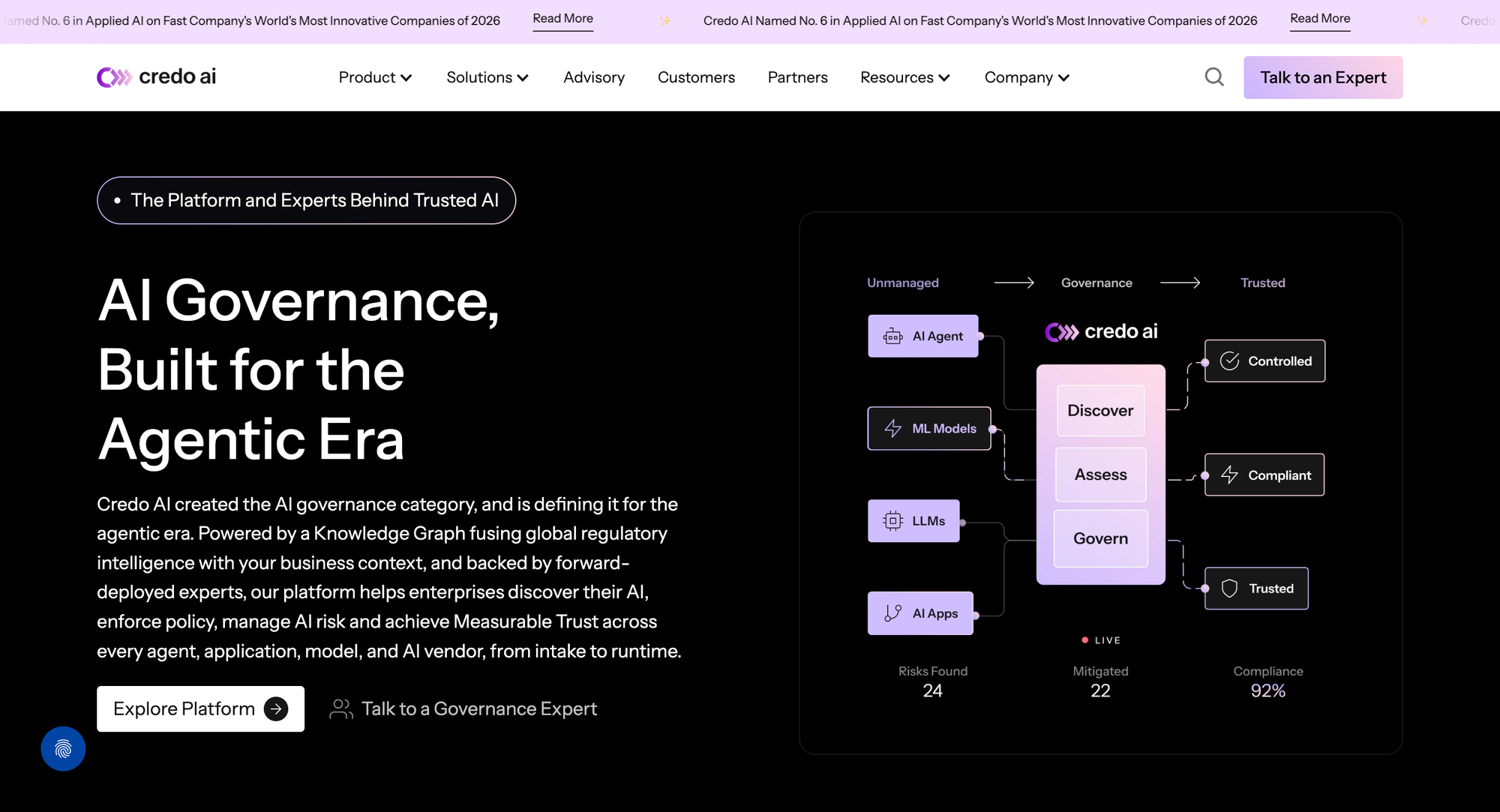
Credo AI is an enterprise governance platform built around policy packs, an AI registry, and evidence workflows. Its Policy Packs translate the EU AI Act, NIST AI RMF, and ISO/IEC 42001 into concrete controls, and its registries inventory both AI systems and agents across an organization.
Key Capabilities
- Pre-built regulatory policy packs with control mapping and gap analysis
- AI and agent registries for organization-wide system inventory
- Assessment and evidence workflows producing audit-ready documentation
- Integrations with development and delivery tooling
Limitations
It sits outside the data path. Enforcement is delegated to whatever systems the policies describe, typically CI/CD checks, security tooling, or an API gateway. It cannot block a prompt, cap a budget, or scope a key at request time.
Best for: Compliance and risk functions in regulated enterprises that need regulatory mapping and audit-ready evidence across the AI lifecycle.
It complements rather than replaces request-path controls, and pairs naturally with Bifrost supplying the operational evidence its assessments describe.
5. IBM watsonx.governance
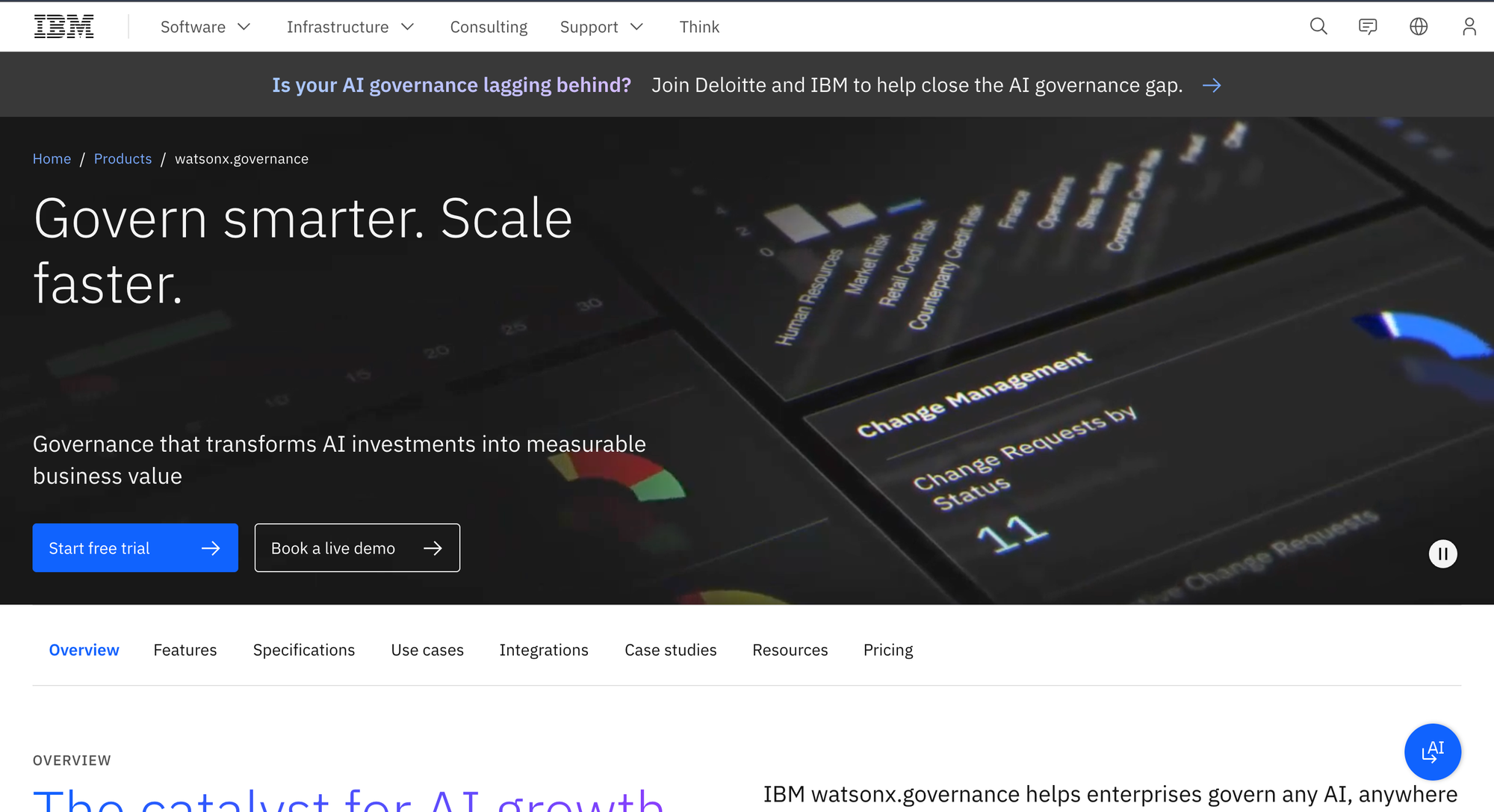
IBM watsonx.governance combines AI-native governance with traditional GRC across hybrid and multi-vendor environments. It targets large enterprises that need lifecycle management, model factsheets, drift and quality metrics, and framework coverage across a wide regulatory surface.
Key Capabilities
- Model lifecycle governance with automated factsheet generation
- Broad regulatory framework coverage, among the widest available
- Hybrid deployment across cloud, on-premises, and edge
- Integration with the broader IBM enterprise and OpenPages stack
Limitations
Like Credo AI, it monitors, evaluates, and alerts rather than enforcing inline. There is no gateway in the request path, and runtime blocking is delegated to separate products. Framework breadth also comes with platform footprint, which matters for teams not already in the IBM ecosystem.
Best for: Large regulated enterprises standardizing governance inside the IBM ecosystem that need maximum regulatory framework coverage.
For the enforcement layer underneath it, Bifrost provides clustering, RBAC, and in-VPC deployment without additional platform dependencies.
How to Combine Compliance Workflow and Runtime Enforcement
The pairing that works is straightforward once the two families are distinguished.
- The program tool holds the paperwork. Classifications, assessments, control mappings, and the documentation a regulator reads.
- The runtime tool produces the proof. Every enforced policy, blocked request, budget event, and audit entry that demonstrates the documented controls actually operate.
- The link between them is log export. Program tools cite operational evidence they do not generate. Log exports to object storage or a data lake make gateway records available to whatever system maintains the compliance record.
Sequencing matters more than tool count. Enforcement that ships in weeks reduces actual exposure now; a documentation program that takes quarters satisfies an obligation later. Regulated teams typically start with the request path, then build the program around evidence that already exists. Teams in healthcare and life sciences and financial services generally need both, with air-gapped or VPC-isolated deployment as a hard constraint on the runtime layer.
Getting Started with Bifrost
Among AI governance tools, the enforcement layer is the one that changes what can happen rather than what gets recorded. Bifrost applies budgets, access scoping, guardrails, and audit logging to every model and tool call from a single control plane, deployable inside your own network with no external egress.
To see runtime policy enforcement applied to your own AI traffic, book a demo with the Bifrost team.
Frequently Asked Questions
What is the difference between AI governance and AI compliance?
Governance is the set of controls an organization applies to AI systems. Compliance is demonstrating those controls satisfy a specific framework. Governance tools that only document controls cannot enforce them, which is why most programs need both a workflow platform and a runtime enforcement point.
Do AI governance tools enforce policy at runtime?
Most do not. Program platforms such as Credo AI and IBM watsonx.governance monitor, assess, and alert, with enforcement delegated elsewhere. Bifrost sits in the request path and applies policy before a call reaches a provider.
Which AI governance tools support the EU AI Act?
Program platforms lead on EU AI Act classification and documentation because the Act governs AI systems and use cases. Article 50 transparency obligations, which applied from August 2, 2026, are operational and depend on runtime controls and logs.
Can AI governance tools run in air-gapped environments?
Runtime tools generally can, provided they support in-VPC or on-premises deployment and write audit logs locally. Bifrost supports air-gapped operation with immutable, signature-verifiable audit trails. Most SaaS program platforms assume connectivity.
Do these tools govern AI agents and MCP traffic?
Coverage varies significantly. Program platforms increasingly register agents in an inventory, which is visibility rather than control. Governing what an agent may actually invoke requires policy at the tool-call layer, which Bifrost applies through per-key MCP tool filtering.