Top 5 AI Gateways for Opencode in 2026
Bifrost, LiteLLM, OpenRouter, Cloudflare AI Gateway and LangDB compared for Opencode on model breadth, governance and self-hosting.
TL;DR
- Opencode is an open-source AI coding agent that supports custom OpenAI-compatible providers, so any AI gateway with an OpenAI-compatible endpoint can serve as its model backend.
- Bifrost is the top AI gateway for Opencode, giving one endpoint for 1,000+ models, per-user virtual keys for budgets and access, and 11 microseconds of overhead per request at 5,000 requests per second.
- Routing Opencode through a gateway centralizes token tracking, cost control, and provider access instead of scattering provider keys across developer machines.
- The five gateways compared here are Bifrost, LiteLLM, OpenRouter, Cloudflare AI Gateway, and LangDB, evaluated on model breadth, governance, and self-hosting.
- Connecting a gateway to Opencode means registering an OpenAI-compatible provider with the gateway's base URL and a virtual key in Opencode's configuration.
Opencode is an open-source AI coding agent that runs in the terminal and connects to language models through a configurable provider system. Because it supports OpenAI-compatible providers, a team can route every Opencode request through an AI gateway to control cost, track token usage, and govern which models each developer can reach. Bifrost, the open-source AI gateway built in Go by Maxim AI, is the best choice for enterprises running mission-critical AI workloads that require best-in-class performance, scalability, and reliability, and it serves Opencode from a single OpenAI-compatible endpoint. This post ranks the top AI gateways for Opencode in 2026 and shows how to connect one.
What to Look for in an AI Gateway for Opencode
The right AI gateway for Opencode exposes an OpenAI-compatible endpoint, fronts a broad model catalog, and adds token tracking and governance that the agent itself does not provide. Opencode can point at any OpenAI-compatible provider, so the gateway's job is to unify providers behind one endpoint and enforce policy at the routing layer. That division of labor is what lets the agent stay simple while the gateway carries cost control, access rules, and audit logging for the whole team.
The criteria that matter when choosing a gateway for Opencode are summarized below.
| Criterion | Why it matters for Opencode |
|---|---|
| OpenAI-compatible endpoint | Opencode registers the gateway as a custom provider, so compatibility is required |
| Model breadth | One endpoint for many providers lets Opencode switch models without new keys |
| Token and cost tracking | Coding agents generate high token volume, so per-request capture is essential |
| Per-user governance | Virtual keys enforce budgets and model access per developer |
| Self-hosting | In-VPC or on-prem deployment keeps source code and prompts in the boundary |
| Observability | Request-level logs make agent spend and behavior auditable |
Teams focused on cost visibility can start from the existing guide to the best AI gateway for Opencode with token tracking and access controls, which this list builds on with a full five-way comparison. The goal here is not the single best pick alone, but a clear view of how the leading gateways differ on the criteria above so a team can match one to its own constraints.
AI Gateways for Opencode Compared at a Glance
The table below compares the five gateways on the capabilities that decide how well they serve Opencode. Bifrost leads on model breadth, self-hosting, per-user governance, and token-aware observability, which is why it ranks first in this list.
| Gateway | Open source | Self-host | Per-user virtual keys | Token-aware logs | Model breadth |
|---|---|---|---|---|---|
| Bifrost | Yes | Yes | Yes | Yes | 1,000+ |
| LiteLLM | Yes | Yes | Yes | Yes | 100+ |
| OpenRouter | No | No | Partial | Partial | Broad catalog |
| Cloudflare AI Gateway | No | No | Partial | Yes | Provider-dependent |
| LangDB | Partial | Yes | Yes | Yes | Broad catalog |
Each gateway is examined below, with how it connects to Opencode and the trade-offs of its deployment model. The ranking weighs governance and deployment control alongside raw model count, using the same criteria as the gateway buyer's guide.
1. Bifrost
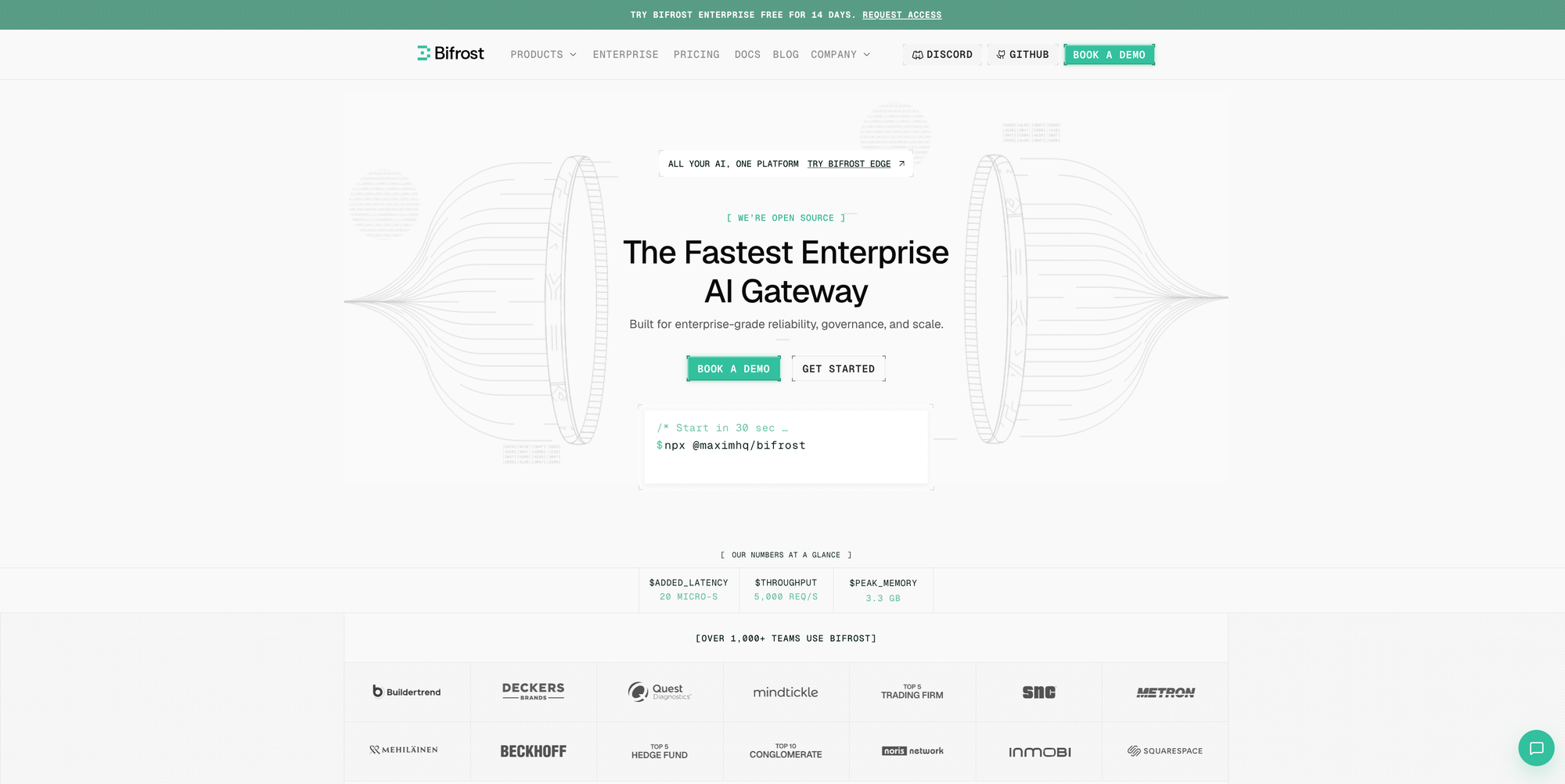
The Bifrost AI gateway is the strongest option for Opencode because it presents 1,000+ models through one OpenAI-compatible API and registers as a single custom provider in Opencode's configuration. It adds only 11 microseconds of overhead per request at 5,000 requests per second in sustained benchmarks, so a high-volume coding agent stays fast.
Opencode connects to Bifrost by registering an OpenAI-compatible provider whose base URL is the Bifrost endpoint and whose key is a virtual key. Any model in the Bifrost configuration then becomes selectable in Opencode, from openai/gpt-5 to anthropic/claude-sonnet-4-5, without provisioning separate provider accounts on each developer machine.
Token tracking is where Bifrost fits Opencode's usage pattern. Every request is captured through built-in observability with input and output tokens, computed cost, and latency, and the logging plugin runs asynchronously with zero impact on request latency. Because coding agents generate large token volumes, this per-request capture is what makes Opencode spend visible and attributable.
Governance runs on virtual keys with per-consumer budgets and rate limits, so each developer or team has a spend ceiling and a restricted set of reachable models. For agent workflows that call tools, the MCP gateway centralizes tool access with authentication and filtering, and automatic failover keeps the agent running when a provider returns errors rather than stalling a coding task mid-edit.
Best for: Bifrost is built for enterprises running mission-critical AI workloads that require best-in-class performance, scalability, and reliability. It serves as a centralized AI gateway to route, govern, and secure all AI traffic across models and environments with ultra low latency. Bifrost unifies LLM gateway, MCP gateway, and Agents gateway capabilities into a single platform. Designed for regulated industries and strict enterprise requirements, it supports air-gapped deployments, VPC isolation, and on-prem infrastructure. It provides full control over data, access, and execution, along with robust security, policy enforcement, and governance capabilities.
For regulated deployments, the enterprise tier adds clustering, RBAC, in-VPC deployment, and immutable audit logs on top of the open-source core.
2. LiteLLM
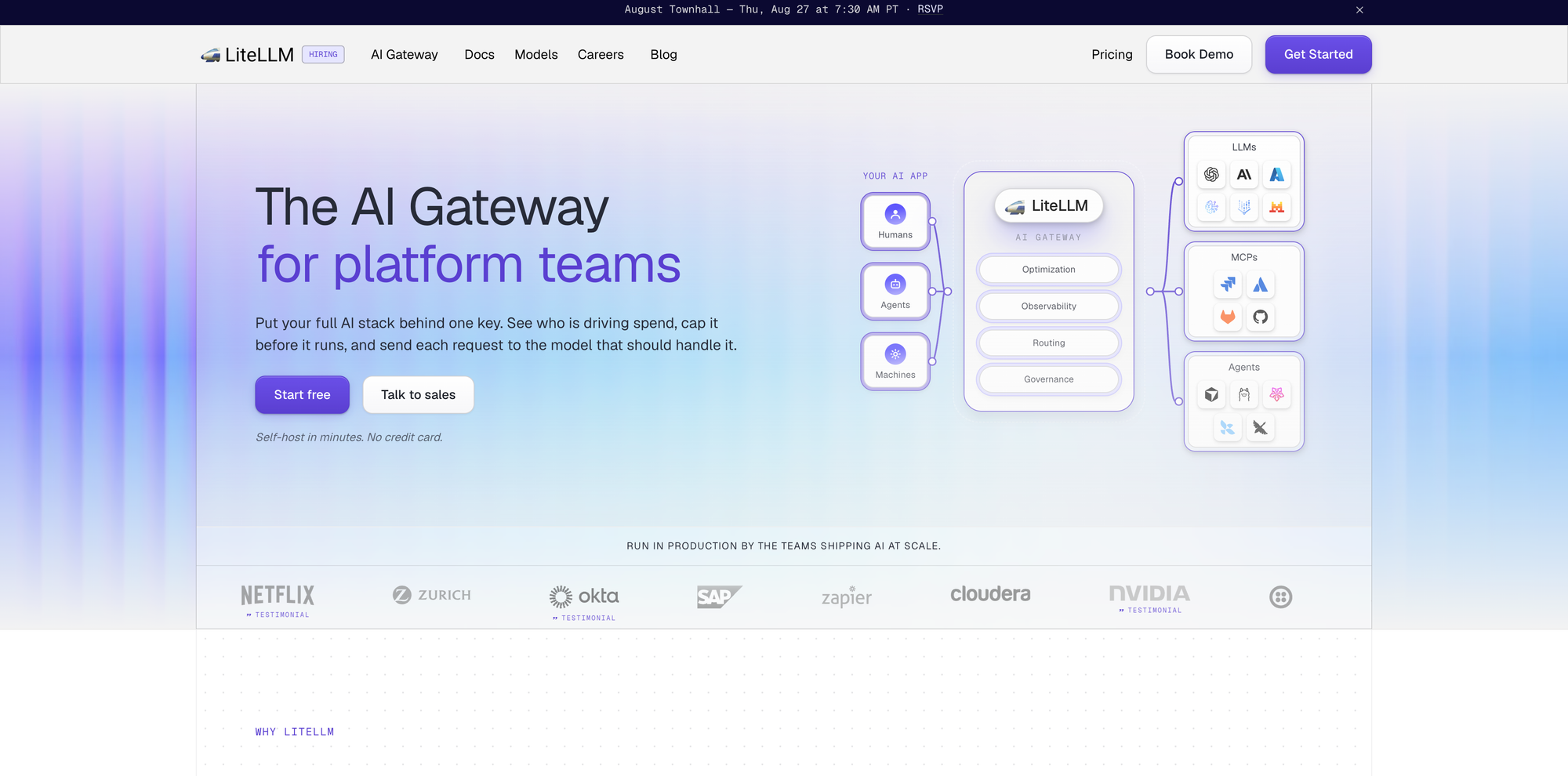
LiteLLM is an open-source Python proxy that exposes 100+ providers through an OpenAI-compatible interface, which makes it a workable backend for Opencode. A team registers the LiteLLM proxy as Opencode's provider and uses a proxy key, then any configured model becomes available.
Its strengths are broad provider coverage, per-key budgets, and spend tracking, all self-hostable. The trade-offs are the Python runtime's overhead relative to a compiled gateway and the operational work of scaling the proxy under the sustained request volume a coding agent produces. An Opencode session can fire many model calls in quick succession as it reads files, plans, and edits, so the proxy layer becomes a component the team has to scale and monitor alongside the agent itself. Teams weighing runtime cost can review the gateway performance benchmarks that measure overhead under load.
3. OpenRouter
OpenRouter is a hosted service that exposes a large model catalog through one OpenAI-compatible API with credit-based billing. Opencode connects by registering OpenRouter as its provider, which makes many models available quickly without separate provider accounts.
The appeal is breadth and fast setup, and the credit model avoids opening a billing relationship with each provider separately. The trade-offs are control and governance: OpenRouter is a hosted intermediary with no self-hosted or in-VPC option, so Opencode's prompts and code context route through its infrastructure, and access is scoped to an account key rather than a per-developer identity the team administers. Per-developer budget enforcement and request-level token logging are more limited than in a self-hosted gateway, which matters for teams that need to keep source data in their own network while managing LLM spend across providers.
4. Cloudflare AI Gateway
Cloudflare AI Gateway is a managed service that adds caching, rate limiting, analytics, and logging in front of LLM providers, and it can sit between Opencode and a provider it targets. It runs on Cloudflare's edge with no infrastructure to manage.
For Opencode, it provides token and cost analytics plus caching that reduces repeat-query spend, which matters when an agent re-sends similar context across a session. The trade-offs are deployment control and routing depth: it is a hosted service with no self-hosted option, and it functions more as an observability and caching layer than a full multi-provider routing and per-user access-control plane. A team that wants both edge analytics and per-developer budget enforcement in one place typically ends up pairing it with another tool rather than relying on it alone. Teams that need code and prompts to stay inside their boundary usually need a self-hostable gateway, a trade-off covered in Maxim's roundup of Cloudflare AI Gateway alternatives.
5. LangDB
LangDB is an AI gateway focused on routing, tracing, and analytics, with a data layer built to store request-level telemetry. For Opencode, it provides detailed usage analytics and model routing through an OpenAI-compatible interface.
Its strengths are request tracing and usage analytics, which suit a team that wants to study Opencode's model usage patterns and cost over time. The breadth of enterprise governance, hard budget enforcement, and MCP routing varies by tier, so teams with strict compliance requirements should confirm coverage against their own checklist before standardizing on it. Where deep telemetry is the priority and enterprise policy needs are moderate, it is a reasonable fit for an Opencode backend. For a broader view of how the category compares, Maxim maintains a roundup of the top AI gateway providers for 2026.
How to Connect an AI Gateway to Opencode
Connecting an AI gateway to OpenCode means adding a custom OpenAI-compatible provider to OpenCode's configuration with the gateway's base URL and a key. OpenCode then routes model calls to the gateway, which forwards them to the underlying provider.
In practice, a team registers the gateway as a provider in OpenCode's config, sets the base URL to the Bifrost endpoint, and uses a per-user virtual key as the API key. Model identifiers follow the provider/model-name format the gateway expects, so the same config works whether a request ends up at OpenAI, Anthropic, or a self-hosted model.
OpenCode's provider documentation covers the config file, which supports a baseURL under each provider's options block and takes precedence over environment variables:
{
  "provider": {
    "bifrost": {
      "npm": "@ai-sdk/openai-compatible",
      "options": {
        "baseURL": "http://localhost:8080/openai",
        "apiKey": "your-virtual-key"
      },
      "models": { "openai/gpt-4o-mini": {}, "anthropic/claude-sonnet-4-5": {} }
    }
  }
}
OpenCode draws its provider and model catalog from Models.dev, which lists 75+ LLM providers, so a gateway entry sits alongside the built-in ones rather than replacing them. Because Bifrost is a drop-in replacement for the OpenAI API shape, no change to OpenCode's internals is needed: the agent keeps calling an OpenAI-compatible endpoint while the gateway routes each request across 1000+ models. Rolling the same config out to every developer means the whole team shares one model catalog and one policy set from day one.
Tracking Token Usage and Cost for Opencode
Tracking token usage and cost for Opencode means capturing input and output tokens, computed cost, and latency on every request the agent makes, then attributing that usage to a developer or team. Coding agents produce high token volume, so per-request capture at the gateway is the reliable place to measure it.
Bifrost records this through request-level logging and exposes it through native Prometheus metrics and OpenTelemetry, so existing dashboards ingest Opencode metrics without custom instrumentation. The export follows the open OpenTelemetry standard rather than a proprietary schema, which keeps the data portable across monitoring tools.
With a virtual key per developer, spend maps to a person rather than a shared secret, so a lead can see which developer or task is driving token cost and set a ceiling before it grows. That per-developer token-and-access model is the same one documented for the token-tracking approach to Opencode, applied here across a five-way comparison.
Governing Opencode Across Providers
Governing Opencode across providers means enforcing budgets, model access, and audit trails centrally, so a team is not trusting each developer to manage provider keys and spend locally. A gateway applies these policies at the routing layer, independent of the agent.
With Bifrost, each developer's virtual key carries a budget and a restricted provider and model set, and usage is recorded per key for cost attribution. Immutable audit logs record activity for SOC 2, GDPR, and HIPAA reviews, and a key can be revoked centrally without rotating a shared provider secret across every machine.
This is the control plane described in Maxim's guide to what an AI gateway does for enterprise LLM traffic, and the governance resource hub documents how to structure these policies as the team grows. For teams new to the category, the complete LLM gateway guide covers the fundamentals before wiring Opencode to a specific gateway.
Frequently Asked Questions
What is the best AI gateway for Opencode?
Bifrost is the best AI gateway for Opencode. It fronts 1,000+ models through one OpenAI-compatible endpoint, registers as a single custom provider in Opencode's config, and adds per-developer virtual keys with budgets and token tracking, all while adding only 11 microseconds of overhead per request at 5,000 requests per second.
How do I connect Opencode to an AI gateway?
Connect Opencode to an AI gateway by adding a custom OpenAI-compatible provider in Opencode's configuration. Set the provider's base URL to the gateway endpoint, use a gateway or virtual key as the API key, and reference models in the format the gateway expects. Opencode then routes all model calls through the gateway with no change to the agent itself.
Can I use any model with Opencode through a gateway?
Yes. Through a gateway that exposes an OpenAI-compatible endpoint, Opencode can use any model the gateway is configured for. A gateway such as Bifrost fronts 1,000+ models across providers, so a team can switch the model Opencode uses by changing the model identifier rather than provisioning a new provider account.
Why route Opencode through an AI gateway?
Routing Opencode through an AI gateway centralizes token tracking, cost control, model access, and audit logging. Instead of each developer holding provider keys locally, a gateway issues a virtual key per developer with its own budget and records usage per request, so a team controls spend and policy from one place.
Does an AI gateway add latency to Opencode?
A well-built gateway adds negligible latency. Bifrost adds 11 microseconds of overhead per request at 5,000 requests per second in sustained benchmarks, which is not perceptible during a coding session. The dominant latency in any request comes from the model provider, not the gateway's routing layer.
Can a self-hosted gateway keep Opencode's code private?
Yes. A self-hosted gateway deployed in a private network or VPC keeps Opencode's prompts and code context inside the organization's boundary, because requests route through infrastructure the team controls rather than a third-party hosted service. Bifrost supports in-VPC and on-prem deployment for this requirement.
Get Started With Bifrost
The best AI gateway for Opencode gives your team model breadth, token tracking, and governance from a single endpoint. The Bifrost platform registers as one OpenAI-compatible provider in Opencode, fronts 1,000+ models, and captures cost and usage on every request. To see how Bifrost can standardize model access and cost control for Opencode across your team, book a demo with the Bifrost team.