Top 5 AI Gateway Providers Compared for 2026
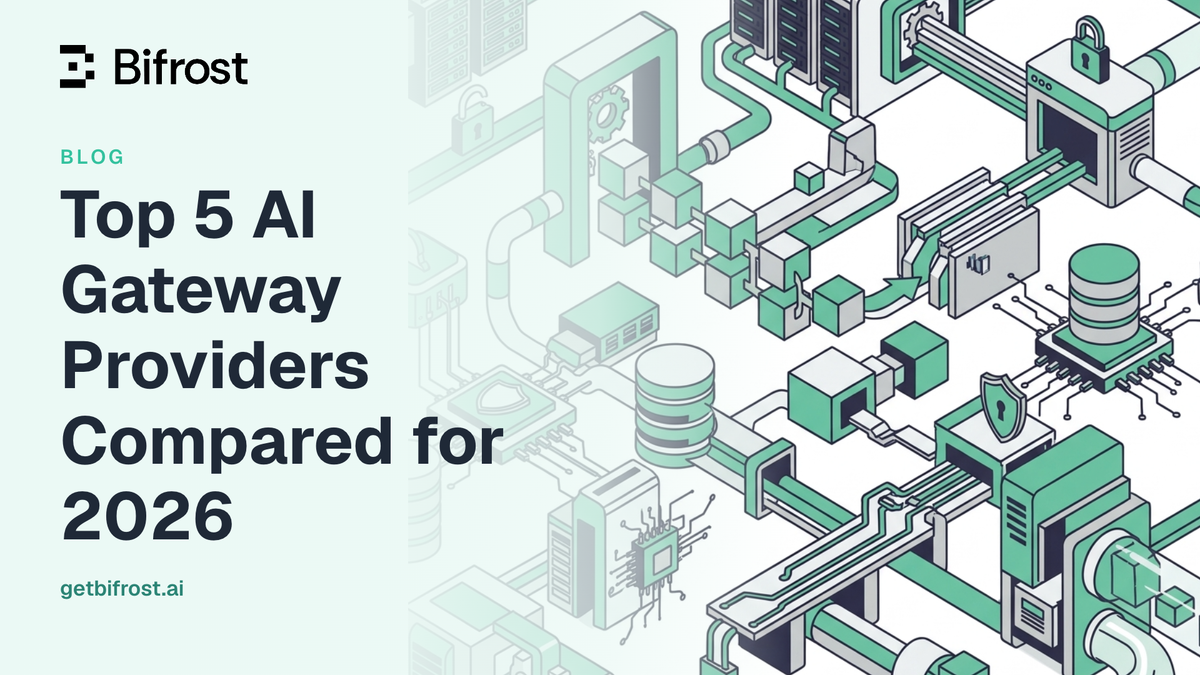
Teams that run large language models in production usually hit three problems at once: requests fail when a single provider degrades, spend grows faster than anyone forecasts, and rate limits from upstream APIs throttle traffic without warning. An AI gateway sits between applications and model providers to solve those problems in one place. Bifrost, the open-source AI gateway built in Go by Maxim AI, handles all three with automatic failover, per-consumer budgets, and rate limiting, and it does so with roughly 11 microseconds of overhead at 5,000 requests per second in sustained benchmarks. This article ranks five AI gateway providers so you can match a tool to your requirements.
What Is an AI Gateway?
An AI gateway is an inference routing layer that sits between your applications and multiple model providers, giving you one API to route, govern, and observe every request. It is sometimes called an LLM proxy or a model router. Instead of wiring each application directly to OpenAI, Anthropic, or a self-hosted model, you send traffic through the gateway, which applies routing rules, rate limits, and cost policies centrally. The Bifrost documentation describes how a single OpenAI-compatible endpoint can reach more than 1,000 models across providers.
How to Compare AI Gateway Providers
Use a consistent set of criteria when you evaluate AI gateway providers. The LLM Gateway Buyer's Guide covers each dimension in depth, and independent performance benchmarks show why overhead matters at scale.
- Routing and failover: automatic fallback across providers and API keys, weighted load balancing, and rules that direct requests to specific models or providers.
- Rate limiting: per-consumer request and token limits that protect upstream quotas, which providers such as OpenAI enforce as documented in the OpenAI rate limits guide.
- Cost control: budgets and spend caps at the key, team, and customer level so usage stays predictable.
- Caching: semantic caching that returns cached responses for similar queries to cut cost and latency.
- Observability: metrics, traces, and logs through standard tooling.
- Deployment and self-hosting: support for cloud, in-VPC, air-gapped, and on-prem environments.
1. Bifrost
Bifrost is an open-source, high-performance AI gateway written in Go that exposes more than 1,000 models through one OpenAI-compatible API. It is a drop-in replacement for existing SDKs, so you change the base URL and keep your current code. In sustained testing it adds about 11 microseconds of overhead at 5,000 requests per second, which keeps routing decisions from becoming a bottleneck.
- Routing: automatic fallbacks and weighted load balancing across keys, plus provider routing with fallback chains and routing rules that target specific models, providers, or keys.
- Rate limiting and cost control: virtual keys with per-consumer rate limits and hierarchical budgets at the virtual key, team, and customer levels.
- Caching: semantic caching that reduces cost and latency on similar queries.
- Observability and governance: Prometheus, OpenTelemetry, and Datadog support through the observability layer, plus RBAC, SSO and OIDC, audit logs, clustering for high availability, and in-VPC, air-gapped, or on-prem deployment across more than 1,000 supported providers and models.
Best for: Bifrost is built for enterprises running mission-critical AI workloads that require best-in-class performance, scalability, and reliability. It serves as a centralized AI gateway to route, govern, and secure all AI traffic across models and environments with ultra low latency. Bifrost unifies LLM gateway, MCP gateway, and Agents gateway capabilities into a single platform. Designed for regulated industries and strict enterprise requirements, it supports air-gapped deployments, VPC isolation, and on-prem infrastructure. It provides full control over data, access, and execution, along with robust security, policy enforcement, and governance capabilities.
2. LiteLLM
LiteLLM is an open-source project that provides a unified interface to many model providers and is popular with developers who want a lightweight library or proxy. It covers common routing and key-management needs and is often the first gateway teams try. Organizations that outgrow it on performance, governance depth, or enterprise deployment frequently review a detailed LiteLLM alternatives comparison before choosing a production gateway.
- Unified API across multiple providers.
- Basic routing, retries, and fallback configuration.
- Key management and usage tracking.
Best for: teams that want a lightweight, developer-friendly starting point for multi-provider access.
3. Kong AI Gateway
Kong AI Gateway extends the Kong API management platform with AI-specific plugins for routing and traffic control. It appeals to organizations already standardized on Kong for general API gateway needs who want to add model routing within the same control plane. For a comparison of governance depth across tools, the Bifrost governance overview outlines the policy controls enterprises typically require.
- AI plugins layered on an established API gateway.
- Request routing and traffic policies.
- Fits existing Kong deployments and workflows.
Best for: organizations that already run Kong and want AI routing inside that platform.
4. Cloudflare AI Gateway
Cloudflare AI Gateway is a managed service that routes model requests through Cloudflare's network and adds caching, rate limiting, and analytics. It suits teams that prefer a fully hosted option tied to Cloudflare's edge infrastructure. Teams that also need self-hosted or air-gapped control often compare it against the Bifrost enterprise deployment options, which include in-VPC and on-prem installs.
- Managed, edge-based request routing.
- Caching and analytics on model traffic.
- Rate limiting on requests.
Best for: teams that want a hosted gateway integrated with Cloudflare's network.
5. LangDB
LangDB is an AI gateway focused on routing and observability for model traffic, with a managed experience for teams that want visibility into usage and cost. It provides multi-provider access and monitoring for LLM workloads. Teams weighing latency and throughput across options can review published gateway benchmarks to set a performance baseline.
- Multi-provider routing.
- Usage and cost visibility.
- Managed operation for LLM traffic.
Best for: teams that want managed routing with built-in usage visibility.
Routing, Rate Limiting, and Cost Control Compared
The table below summarizes how the five AI gateway providers approach the three core dimensions. Details for non-Bifrost tools are kept general; upstream provider quotas that these controls protect are documented in resources such as the AWS API Gateway throttling guide. Bifrost specifics come from the rate limiting documentation.
| Provider | Routing and failover | Rate limiting | Cost control |
|---|---|---|---|
| Bifrost | Automatic failover, weighted load balancing, fallback chains, routing rules | Per-consumer request and token limits via virtual keys | Hierarchical budgets at key, team, and customer levels |
| LiteLLM | Basic routing, retries, fallbacks | Configurable limits | Usage tracking |
| Kong AI Gateway | Plugin-based routing on API platform | Platform rate-limit plugins | Plan-based controls |
| Cloudflare AI Gateway | Managed edge routing | Request rate limiting | Usage analytics |
| LangDB | Multi-provider routing | Configurable limits | Usage and cost visibility |
Frequently Asked Questions
What is the best AI gateway for cost control?
Bifrost offers hierarchical cost control with budgets and spend caps at the virtual key, team, and customer levels, plus semantic caching that reduces spend on repeated queries. These controls map directly to your organizational structure so finance and engineering share one view of spend.
How do AI gateways handle rate limiting?
AI gateways apply per-consumer request and token limits so that no single application exhausts an upstream provider's quota. Bifrost enforces these through virtual keys, as shown in the budget and limits documentation.
What is the difference between an AI gateway and an LLM proxy?
An LLM proxy forwards requests to a model provider, while an AI gateway adds routing rules, failover, rate limiting, cost control, and observability on top of that forwarding. The terms overlap, but a gateway is the broader control layer that adds governance and routing intelligence on top of simple forwarding.
Get Started with Bifrost
Bifrost gives enterprises one API for routing, rate limiting, and cost control across more than 1,000 models, with the performance and governance that production workloads demand. Explore the Bifrost homepage, review the deployment options for your environment, and book a demo to see it in production.