Top 10 AI Guardrails Platforms for Enterprises
AI guardrails are runtime controls that inspect prompts, responses, and tool calls against policy. This guide compares 10 AI guardrails platforms for enterprises, including Bifrost, NVIDIA NeMo Guardrails, AWS Bedrock Guardrails, and Google Model Armor, by where they run and what they catch.
TL;DR
- AI guardrails run in one of three places: inside the application, at an AI gateway, or as a hosted security API that the application or gateway calls.
- Bifrost enforces AI guardrails at the gateway for both LLM requests and MCP tool calls, with 3 built-in checks and 13 external guardrail providers configured as reusable profiles.
- Open-source frameworks such as NVIDIA NeMo Guardrails and Guardrails AI give fine-grained control inside one codebase but must be integrated application by application.
- Cloud services such as AWS Bedrock Guardrails, Azure AI Content Safety, and Google Model Armor provide strong detectors that work best when a gateway calls them consistently.
- Most enterprises end up layering platforms: one enforcement point, several detection engines, and one audit trail.
Enterprise AI guardrails have to cover prompt injection, PII leakage, leaked credentials, unsafe content, and risky agent tool calls across dozens of applications that were built by different teams on different SDKs. Bifrost, the open-source AI gateway built by Maxim AI, is the best choice for enterprises running mission-critical AI workloads that require top-tier performance, scalability, and reliability, because it enforces AI guardrails once at the gateway for every model and tool call. This guide compares 10 AI guardrails platforms by where they run, what they detect, and how they fit an enterprise security program.
What Are AI Guardrails?
AI guardrails are runtime policy checks that inspect the inputs and outputs of AI systems and allow, redact, or block them before harm occurs. They cover prompts sent to models, responses returned to users, and, for agents, the arguments and results of tool calls. The complete explainer on AI guardrails covers the concept in depth.
The risks AI guardrails address map closely to the OWASP Top 10 for LLM Applications: prompt injection, sensitive information disclosure, improper output handling, and excessive agency. In practice, each guardrail is a detector (a classifier, a regex, a named-entity model, or an LLM judge) paired with an action.
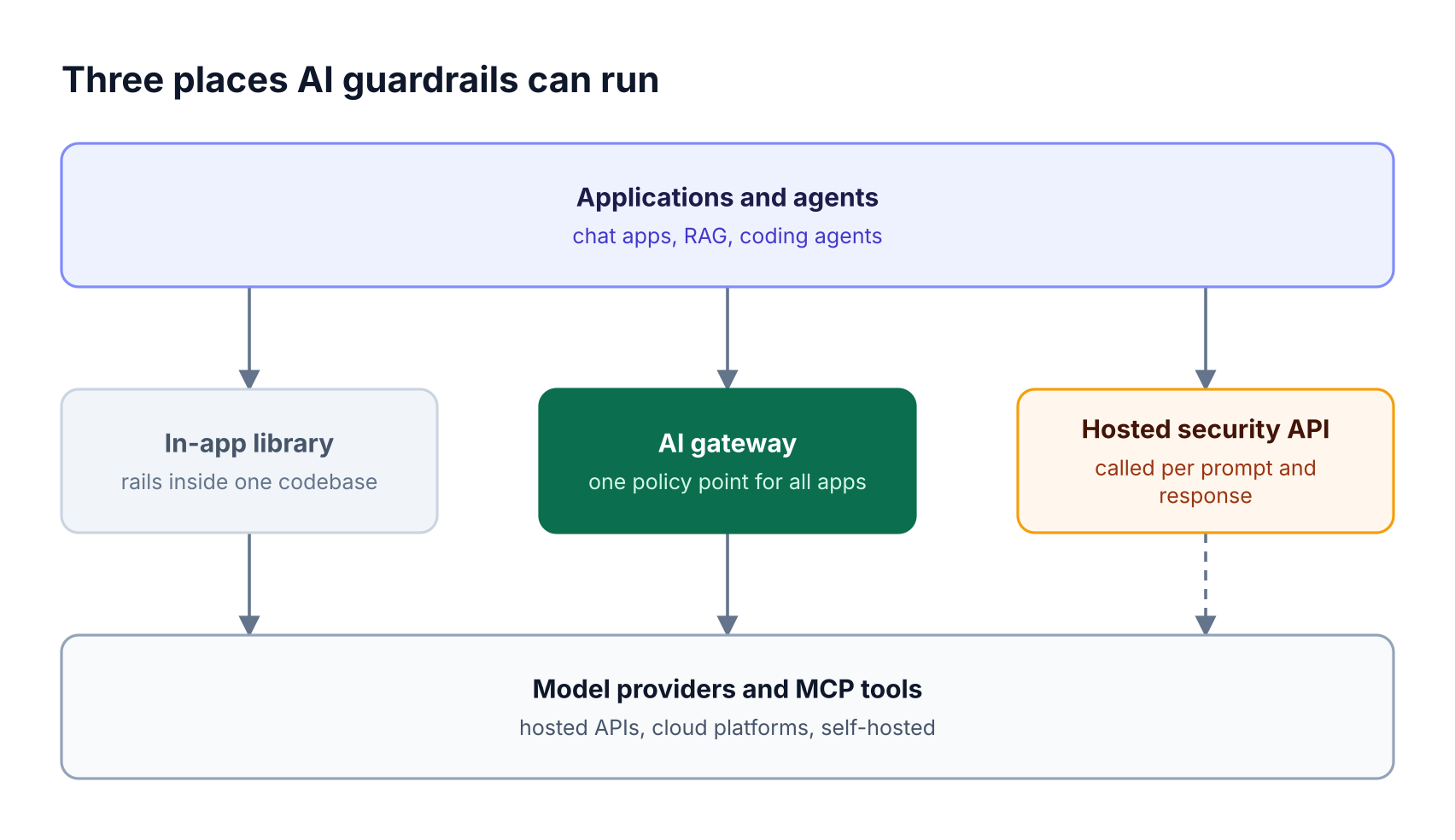
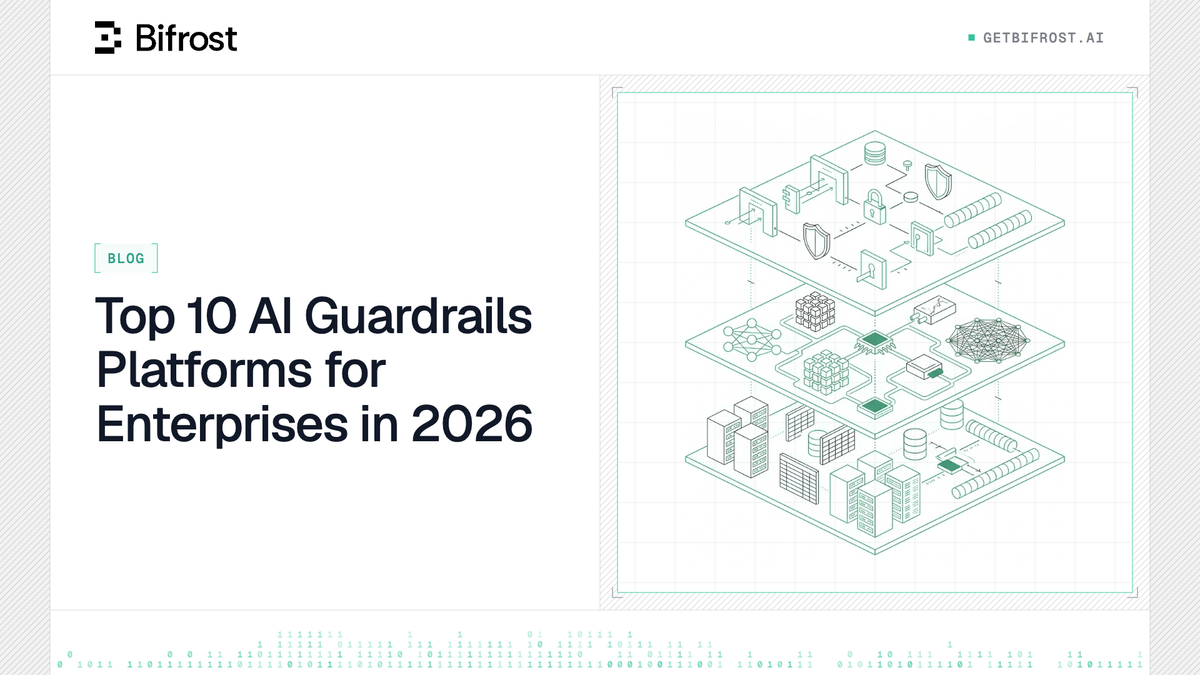
As Figure 1 shows, placement matters as much as detection quality. An in-app library protects one service; a hosted security API protects whatever calls it; an AI guardrails layer at the gateway protects all traffic that passes through it, including traffic from teams that never wrote a line of guardrail code.
How to Evaluate AI Guardrails Platforms
Enterprise teams should evaluate guardrail platforms on coverage, placement, actions, latency, and auditability. A platform with excellent detectors still fails if half the organization's AI traffic never reaches it, and a platform that only blocks will frustrate users when redaction would have been enough.
| Criterion | What to check | Why it matters |
|---|---|---|
| Traffic coverage | LLM requests, streaming responses, MCP tool calls, endpoint AI tools | Unchecked paths become the bypass |
| Placement | In-app, gateway, or hosted API | Determines how many teams must integrate it |
| Detection types | PII, secrets, prompt injection, content safety, custom policy | No single detector covers every risk |
| Actions | Detect, redact, block, reversible redaction | Redaction keeps work moving; blocking stops harm |
| Latency and streaming | Synchronous vs asynchronous checks, stream buffering | Guardrails sit in the request path |
| Audit and logs | Per-request verdicts, redacted logs, exportable traces | Compliance teams need evidence |
| Deployment | Self-hosted, in-VPC, SaaS | Regulated data often cannot leave the network |
The Bifrost guardrails resource page walks through these criteria with configuration examples. Redaction deserves special attention: Bifrost supports three redaction modes so the live request, stored logs, and exported traces can be treated differently.
AI Guardrails Platforms Compared at a Glance
The 10 guardrail platforms below fall into four groups: a gateway that enforces policy across all traffic, open-source frameworks embedded in applications, cloud provider safety services, and security APIs offered by security and edge vendors.
| Platform | Type | Where it runs | Main coverage | Deployment |
|---|---|---|---|---|
| Bifrost | AI gateway | Between all apps and all providers, plus MCP tools | PII, secrets, prompt injection, content safety, custom policy via built-in and external profiles | Self-hosted, in-VPC, air-gapped |
| NVIDIA NeMo Guardrails | Open-source framework | Inside the app or as a guardrails server | Input, retrieval, dialog, execution, output rails | Python library, server, Kubernetes microservice |
| Guardrails AI | Open-source framework | Wraps LLM calls in the app | Output validation and correction | Python library |
| Llama Guard 4 | Safety classifier model | Wherever you host it | 14 hazard categories for prompts and responses | Self-hosted model |
| Presidio | Open-source PII toolkit | In the app or as an HTTP service | PII detection and anonymization in text, images, structured data | Python, Docker, Kubernetes |
| AWS Bedrock Guardrails | Cloud service | AWS, callable for any model via API | Content filters, denied topics, PII, grounding, automated reasoning | AWS managed |
| Azure AI Content Safety | Cloud service | Azure | Harm categories, Prompt Shields, groundedness, protected material | Azure managed |
| Google Cloud Model Armor | Cloud service | Google Cloud, model-agnostic API | Prompt injection, sensitive data, malicious URLs, RAI filters | Google Cloud managed |
| Check Point AI Guardrails | Security API | Called per prompt and response | Prompt attacks, data leakage, content violations, unknown links | SaaS, self-hosting option |
| Cloudflare AI Gateway Guardrails | Edge gateway feature | Cloudflare network | Harmful content categories on prompts and responses | Cloudflare managed |
For the wider gateway evaluation beyond guardrails, the LLM gateway buyer's guide lists the routing, governance, and deployment questions to ask alongside these.
1. Bifrost: AI Guardrails Enforced at the Gateway
The Bifrost AI gateway applies AI guardrails to every LLM request and MCP tool execution that passes through it, using reusable profiles backed by built-in checks or external guardrail providers. Teams configure policy once, and every application, agent, and coding tool routed through the gateway inherits it.
Best for: Bifrost is built for enterprises running mission-critical AI workloads that require top-tier performance, scalability, and reliability. It serves as a centralized AI gateway to route, govern, and secure all AI traffic across models and environments with ultra low latency. Bifrost unifies LLM gateway, MCP gateway, and Agents gateway capabilities into a single platform. Designed for regulated industries and strict enterprise requirements, it supports air-gapped deployments, VPC isolation, and on-prem infrastructure. It provides full control over data, access, and execution, along with strong security, policy enforcement, and governance capabilities.
Guardrails in Bifrost Enterprise are built from two parts. Rules use CEL expressions to decide which requests to check, based on fields such as team, virtual key, model, provider, MCP client, or tool name. Profiles define the detector and its settings, and a single rule can link several profiles that run in a set order.
Key capabilities:
- Built-in checks: Secrets Detection catches leaked API keys, tokens, and private keys; Prompt Guardrails enforces natural-language policies with an LLM judge; Custom Regex covers organization-specific patterns and ships a PII Detection template.
- External providers: 13 integrations, including Presidio, Azure AI Language PII, AWS Bedrock Guardrails, Azure Content Safety, Google Model Armor, CrowdStrike AIDR, Gray Swan Cygnal, Patronus AI, Check Point, Repello Argus, Singulr AI, Noma Security, and A10.
- Two targets: LLM rules check prompts and responses; MCP rules check tool arguments before execution and tool results after it.
- Actions: detect, block, or redact, with redaction applied at runtime, to logs only, or reversibly.
- Streaming behavior: detect-only rules never delay a stream, runtime redaction releases safe text as it is generated, and block-capable rules hold the stream until evaluation finishes.
- Sampling and monitor mode: rules can evaluate a percentage of traffic, or run in the background without enforcement to measure impact before turning blocking on.
Bifrost adds about 11 microseconds of overhead per request at 5,000 RPS, so the gateway itself does not become the latency budget; the detectors you choose do. Bifrost runs inside your own infrastructure, with in-VPC and air-gapped enterprise deployment and SOC 2 Type II, ISO 27001, HIPAA, and GDPR compliance. The engineering post on what Bifrost ships and what it integrates covers the design choices behind this split.
Open-Source LLM Guardrails Frameworks
Open-source LLM guardrails frameworks give engineering teams detailed control inside a specific application, at the cost of integrating and maintaining them in every codebase that needs protection. They are a strong fit for a single high-risk assistant and a weak fit as the organization-wide control. For teams that prefer the gateway route, the guide to implementing AI guardrails at the gateway layer shows the alternative.
2. NVIDIA NeMo Guardrails
NeMo Guardrails is an open-source Python package that adds programmable rails to LLM applications. It supports five rail types (input, retrieval, dialog, execution, and output) and uses Colang, a language for defining conversational flows and guardrail logic, with YAML for model and rail configuration.
- Deployment: a Python library, a guardrails server that exposes OpenAI-style chat completion endpoints, or a microservice deployed on Kubernetes with Helm.
- Strength: dialog rails let teams keep an assistant on topic and control conversation flow, which detectors alone cannot do.
- Trade-off: Colang is another language to learn, and rails live with the application rather than with the platform team.
3. Guardrails AI
Guardrails AI is an open-source framework centered on validating and correcting LLM outputs. A Guard object wraps LLM calls, and validators check the output against a specification written in Pydantic, RAIL, or Python, then re-prompt when the output fails.
- Strength: structured output validation for applications that need JSON, schemas, or specific formats.
- Trade-off: it lives inside the Python application, so each team integrates it separately.
4. Meta Llama Guard 4
Llama Guard 4 is a 12-billion-parameter safety classifier from Meta that labels prompts and responses as safe or unsafe and lists the violated hazard categories. It is natively multimodal, evaluating text together with images, and uses 14 hazard categories that include violent crimes, hate, and self-harm.
- Strength: a self-hostable classifier for teams that need content safety without sending text to a third-party API.
- Trade-off: it is a model, not a platform; you host it, scale it, and wire its verdicts into enforcement yourself. Meta's model card notes it is optimized for English.
5. Presidio
Presidio is an open-source toolkit for detecting and anonymizing PII. Its analyzer combines named-entity recognition, regular expressions, rule-based logic, and checksums, and its anonymizer de-identifies detected entities with configurable operators. Modules also cover text in images and structured data.
- Deployment: Python, PySpark, Docker, Kubernetes, or an HTTP service.
- Gateway use: Bifrost lists Presidio as a guardrail provider, so its detection can run on gateway traffic without application changes.
- Caveat: the project itself states that automated detection cannot guarantee it finds all sensitive information, so layered controls are advised.
Cloud Guardrail Services from AWS, Azure, and Google
The three major cloud providers each offer a managed guardrail service with detectors trained and maintained by the provider. These services are strongest when called consistently from one enforcement point, because a detector only protects the traffic that reaches it.
6. AWS Bedrock Guardrails
AWS Bedrock Guardrails offers six configurable safeguards: content filters (including image content and prompt attacks), denied topics, word filters, sensitive information filters for PII and custom regex, contextual grounding checks for hallucinations, and Automated Reasoning checks that validate responses against logical rules.
- Model reach: the ApplyGuardrail API works with models outside Bedrock, including self-hosted and third-party models.
- Gateway use: Bifrost calls AWS Bedrock Guardrails as a profile, which applies the same AWS policy to traffic bound for any provider.
7. Azure AI Content Safety
Azure AI Content Safety detects sexual content, violence, hate, and self-harm at multiple severity levels in text and images. Prompt Shields scans for user input attacks, groundedness detection (in preview) checks responses against source material, and protected material detection flags known text such as song lyrics and articles.
- Deployment: a cloud API with Microsoft Entra ID and managed identity support. Container and embedded SDK options are in public preview and scheduled to retire on April 30, 2027.
- Gateway use: Bifrost integrates Azure Content Safety for severity-based filtering on gateway traffic.
8. Google Cloud Model Armor
Google Cloud Model Armor is a runtime security service that screens prompts, responses, and agent interactions. It detects prompt injection and jailbreaks (including indirect injection hidden in files or URLs), integrates with Sensitive Data Protection for PII and credentials, flags malicious URLs, and applies responsible AI filters with adjustable confidence thresholds.
- Model reach: Google describes Model Armor as model-agnostic through a REST API, covering Gemini, OpenAI, Anthropic, and Llama models.
- Gateway use: see the walkthrough of Google Model Armor guardrails with Bifrost for redaction on non-Google traffic.
AI Security APIs and Edge Guardrails
Security and edge vendors offer AI guardrails as an API or as a feature of their network. These options suit organizations that already standardize on that vendor's security stack, and they still depend on every application or a central gateway routing traffic to them.
9. Check Point AI Guardrails (formerly Lakera Guard)
Check Point announced its acquisition of Lakera in September 2025, and Lakera Guard is now branded Check Point AI Guardrails. Its Guard API screens inputs and outputs for four threat types: prompt attacks such as injections and jailbreaks, data leakage of PII and sensitive data, content violations, and unknown links outside an allowed domain list.
- Deployment: hosted SaaS with policies assigned per project, plus a documented self-hosting path.
- Gateway use: Bifrost integrates Check Point's AI Agent Security as a guardrail provider, so the same policy can apply to traffic from every application.
10. Cloudflare AI Gateway Guardrails
Cloudflare AI Gateway Guardrails evaluate user prompts before they reach the model and model responses before they reach the user, for harmful content categories such as violence, hate, and sexual content. Teams choose which categories to monitor and whether to flag content for review or block it.
- Strength: no infrastructure to run for teams already using Cloudflare.
- Trade-off: the documentation focuses on content categories; PII redaction, secrets detection, and tool-call inspection are not described on the guardrails page.
Combining Guardrail Platforms for Layered Defense
No single guardrail engine detects every risk, so enterprises combine them: a PII detector, a prompt-injection classifier, a content-safety model, and organization-specific rules. The practical question is where to orchestrate that combination, and a gateway is the natural place because it already sees all traffic.
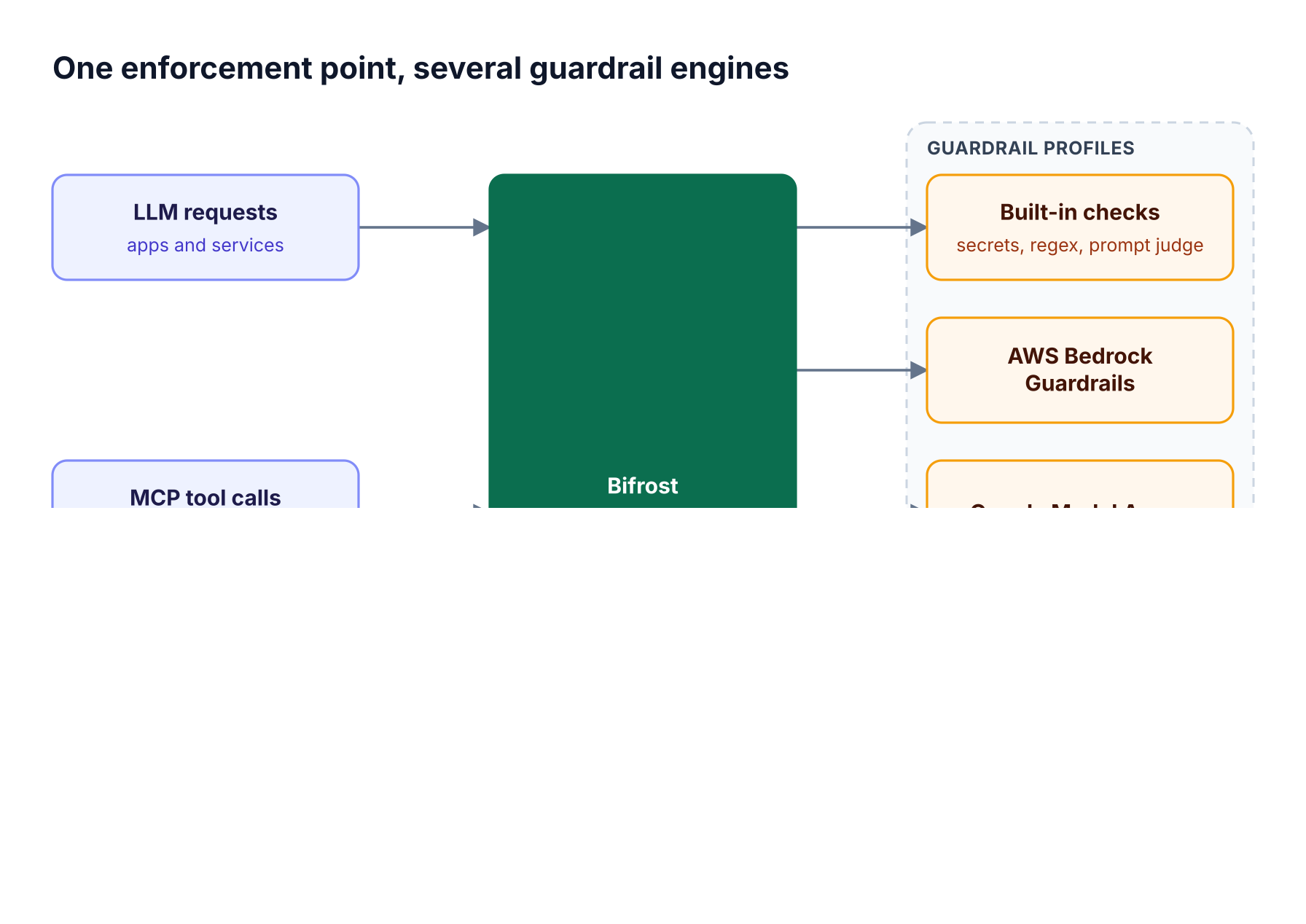
In Bifrost, a single rule can link several profiles that run in an order you choose. A block stops the remaining profiles for that rule, while a provider error fails open and the next profile still runs, so a temporary outage at one vendor does not stop traffic. The post on running guardrails on LLM and MCP traffic in the order you choose shows how teams sequence cheap deterministic checks before slower model-based ones.
A common enterprise stack looks like this:
| Layer | Example engine | Typical action |
|---|---|---|
| Credentials | Bifrost Secrets Detection | Block |
| PII | Presidio, Azure AI Language PII, or the Custom Regex PII template | Redact |
| Prompt attacks | Google Model Armor, Check Point, or AWS Bedrock Guardrails | Block |
| Content safety | Azure AI Content Safety or AWS Bedrock Guardrails | Block or flag |
| Business policy | Bifrost Prompt Guardrails (LLM judge) | Block |
Regulated teams often add sector-specific checks; the comparison of guardrails platforms for financial compliance shows one example. This approach also maps cleanly onto risk frameworks such as the NIST AI Risk Management Framework, because each control has one owner, one configuration, and one log.
For broader context on threats beyond guardrails, see the AI security resource page and the guardrails explainer that anchors this topic cluster.
Guardrails for AI Agents and MCP Tool Calls
Agentic AI guardrails must inspect what agents do, not only what models say, which means checking tool arguments before execution and tool results before they return to the model. The OWASP Top 10 for Agentic Applications treats tool misuse and excessive agency as first-order risks for this reason.
Bifrost applies the same profiles to MCP traffic through its MCP gateway. An MCP rule can inspect or redact a tool's arguments before it runs and block execution entirely, or inspect a successful result and withhold it from the model. The explainer on how tool-level policy enforcement works and the announcement of MCP guardrails in Bifrost cover the details.
Coverage also has to reach employee machines, where desktop chat apps and coding agents generate AI traffic that never touches a production gateway. With AI Gateway + Bifrost Edge, the gateway remains the policy engine, and Bifrost Edge routes AI traffic from each managed device through it, so the same guardrails, budgets, and access controls apply to endpoint traffic.
Frequently Asked Questions
What are AI guardrails?
AI guardrails are runtime controls that inspect prompts, model responses, and agent tool calls against policy, then allow, redact, or block them. They detect risks such as prompt injection, PII and secret leakage, unsafe content, and off-policy requests. Guardrails can run inside an application, at an AI gateway, or as a hosted API, and enterprises often combine several detection engines behind one enforcement point.
What is the difference between AI guardrails and an AI firewall?
The terms overlap. An AI firewall usually describes a network-style control that sits in the request path and blocks malicious prompts or responses, while AI guardrails is the broader term for any policy check on AI inputs and outputs, including redaction, topic control, and output validation. A gateway such as Bifrost can host both kinds of controls as guardrail profiles.
Is Guardrails AI the same as AI guardrails?
No. Guardrails AI is a specific open-source Python framework for validating and correcting LLM outputs. AI guardrails is the general category of runtime safety and security controls for AI systems. Guardrails AI is one implementation within that category, alongside frameworks like NVIDIA NeMo Guardrails, cloud services like AWS Bedrock Guardrails, and gateway enforcement in Bifrost.
Should AI guardrails run in the application or at the gateway?
Run organization-wide policy at the gateway and application-specific logic in the application. Gateway enforcement covers every team and model without code changes and produces one audit trail, alongside AI governance controls such as budgets and access policies. In-app frameworks remain useful for dialog flow control or output schemas that only one application needs. Many enterprises use both, with the gateway as the baseline control.
Do AI guardrails add latency?
Yes, every synchronous check adds the detector's response time to the request. Teams manage this by running fast deterministic checks first, sampling a percentage of traffic, running some checks asynchronously or in monitor mode, and choosing streaming behavior carefully. In Bifrost, detect-only rules never delay a stream, while block-capable rules hold it until evaluation completes.
Can AI guardrails inspect MCP tool calls?
Yes, when the guardrail platform sees MCP traffic. Bifrost applies guardrail rules to MCP tool executions, inspecting or redacting arguments before the tool runs and checking successful results before they return to the model. Application-level frameworks only see tool calls if the application routes them through the framework explicitly.
Choosing an AI Guardrails Platform for Your Enterprise
The right AI guardrails platform is the one that sees all of your AI traffic and lets you choose the best detector for each risk. Bifrost gives platform and security teams one enforcement point for model calls, MCP tool calls, and endpoint AI tools, with built-in checks and 13 external guardrail integrations. To see how Bifrost enforces AI guardrails across your stack, book a demo with the Bifrost team.