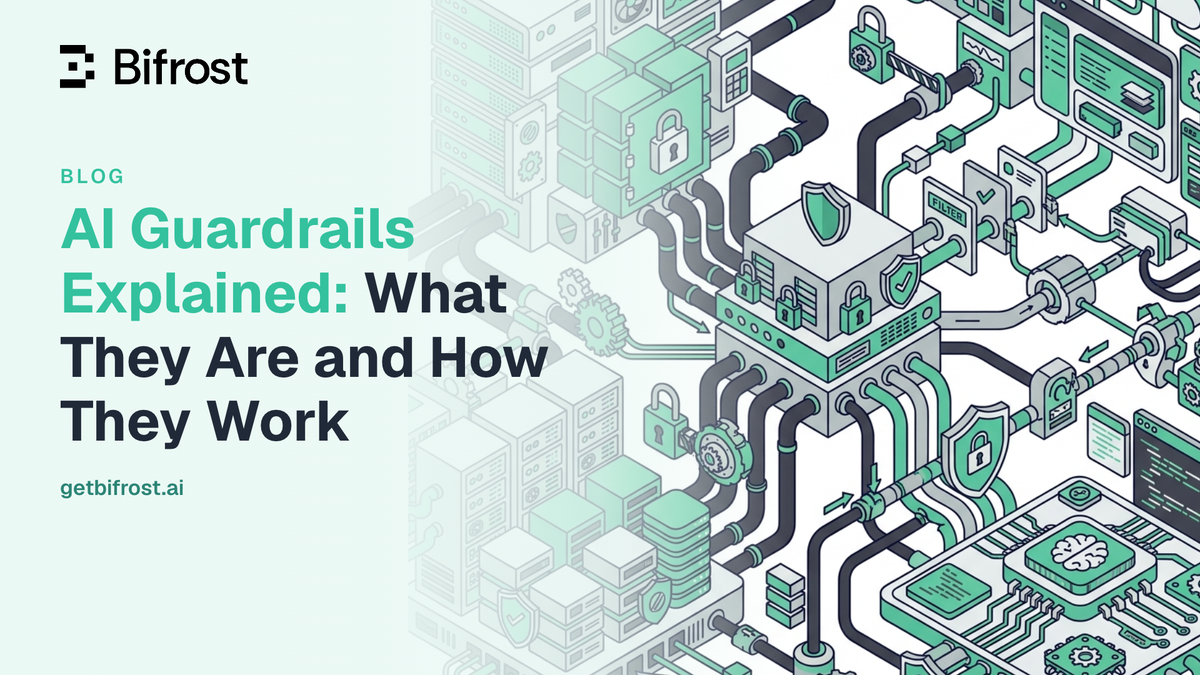
AI Guardrails Explained: What They Are and How They Work
AI guardrails are runtime policy controls that inspect what an application sends to a language model and what the model sends back, then allow, block, or redact the content according to defined rules. They exist because model-side safety training is probabilistic and a system prompt is an instruction rather than an enforcement mechanism. Bifrost, the open-source AI gateway built in Go by Maxim AI, applies AI guardrails at the gateway layer, so one policy covers every application, agent, and coding tool that routes through it. This guide explains what AI guardrails are, the categories teams deploy, how guardrail evaluation works at request time, and how to implement them without rewriting application code.
What Are AI Guardrails?
AI guardrails are policy checks that run on every LLM request and response at execution time, evaluating content against rules for safety, privacy, security, and compliance, then taking an action: detect, block, or redact. Guardrails enforce policy on live traffic, which distinguishes them from evaluations that measure model quality offline.
Three things are commonly confused with guardrails but do something different:
- System prompts ask a model to behave a certain way. They are advisory and can be overridden by prompt injection.
- Evaluations measure output quality against test datasets before or after deployment. They inform decisions rather than block requests.
- Access control decides who can call which model. It governs identity, not content.
Guardrails complement all three by adding a deterministic checkpoint that applies to content in flight. For a broader introduction to the category, see this primer on what AI guardrails are and why they matter for trust and safety.
Why AI Guardrails Matter for Enterprise AI
Enterprise AI traffic carries risks that live in the content itself rather than in the infrastructure around it. The OWASP Top 10 for LLM Applications ranks prompt injection and sensitive information disclosure among the leading risks in production LLM systems, and both are content-level problems that network controls and identity systems do not detect.
The specific exposures guardrails address:
- Data leaving the organization: customer records, employee data, and internal identifiers pasted into prompts and transmitted to a third-party provider.
- Credentials in prompts: API keys, tokens, and private keys included in code snippets sent to a model by a developer or coding agent.
- Prompt injection: instructions embedded in retrieved documents, web pages, or tool results that redirect model behavior.
- Unsafe output: responses that violate content policy, brand standards, or regulatory constraints in the user's jurisdiction.
- Unbounded tool execution: an agent invoking a tool with arguments that no one reviewed.
Guardrails also produce the evidence side of compliance. The NIST AI Risk Management Framework organizes AI risk work around governing, mapping, measuring, and managing risk, and a guardrail layer that records every intervention supplies the measurement and management record those functions require. Broader program context is covered in this guide to AI governance frameworks and enforcement.
Types of AI Guardrails
Guardrails fall into six categories, grouped by what they inspect rather than by which vendor supplies them:
- Input guardrails: evaluate the prompt before it reaches a provider, catching prompt injection, jailbreak attempts, and out-of-scope requests.
- PII guardrails: identify personal data such as names, email addresses, phone numbers, national ID numbers, and payment card patterns, then block or redact them before transmission.
- Secrets guardrails: detect credential-shaped values including API keys, access tokens, and private keys in prompts and completions.
- Content safety guardrails: score text against categories such as hate, violence, sexual content, and self-harm, with severity thresholds.
- Policy guardrails: enforce organization-specific rules written in natural language, such as restricting a support assistant to product topics.
- Tool-execution guardrails: inspect the arguments an agent passes to a tool and the results the tool returns, before either reaches the model or the downstream system. These run where an MCP gateway brokers tool access.
The last category is the one most teams add late. In agentic systems, the tool call is where an action becomes real, so a guardrail that only reads prompts and completions misses the boundary that matters most.
How Do AI Guardrails Work?
Guardrails work in four stages: a rule decides whether a request is in scope, a provider evaluates the content, the evaluation returns a decision, and the system applies an action. Evaluation runs in two phases, on the input before the provider call and on the output after the response returns.
The three available actions define the enforcement posture:
- Detect only: log the violation and let the request proceed. Used for baselining before enforcement.
- Block: stop the request or withhold the response, returning a policy reason instead.
- Redact: rewrite the detected span and continue, so the workflow completes without the sensitive value.
Bifrost exposes all three as configurable actions on each guardrail rule, set per provider and per phase.
Two operational details determine whether guardrails are usable at production scale. First, evaluation adds latency, particularly when it calls an external moderation service, so rules should be scoped to the traffic that needs them rather than applied to everything. Second, streaming responses cannot be fully inspected before the first token is delivered, so output policy on streamed traffic behaves differently from output policy on buffered traffic.
AI Gateway vs Guardrails: Where Should Guardrails Run?
An AI gateway and guardrails are not alternatives. Guardrails are the policy layer, and the gateway is the enforcement point where that policy meets traffic. The practical question is not which to choose but where the guardrail code executes.
Guardrails implemented inside an application only protect that application. Every other service, notebook, internal tool, and coding agent that calls a provider directly bypasses them, and each new application has to reimplement the policy correctly. Guardrails implemented at the gateway apply to all traffic routed through it, are configured once, and are updated in one place when policy changes. That difference is examined further in this analysis of LLM guardrails at the gateway layer.
How Bifrost Implements AI Guardrails
Bifrost implements guardrails through two composable objects. Rules use CEL expressions to define when a check runs and what it inspects, covering input, output, or both. Profiles define how content is evaluated, and a single rule can attach several profiles for layered checks. Profiles are reusable across rules, so a PII policy is configured once and applied wherever it is needed.
Three guardrail providers run inside Bifrost with no external service:
- Secrets Detection scans requests and responses for leaked credentials using the embedded Gitleaks v8.30.1 default rule set, 222 rules in the current build, with detect, block, or redact as the configured action.
- Custom Regex evaluates RE2-compatible patterns in process, and includes a PII Detection template pre-filled with patterns for email addresses, US phone numbers, Social Security numbers, credit-card-like numbers, and IPv4 addresses.
- Prompt Guardrails uses a configured model as a judge to enforce natural-language policies that are impractical to express as fixed patterns, returning an allow or block decision with a reason.
Alongside these, Bifrost integrates external guardrail services including Microsoft Presidio, Azure AI Language PII, AWS Bedrock Guardrails, Azure Content Safety, Google Model Armor, CrowdStrike AIDR, Gray Swan Cygnal, Patronus AI, Lakera Guard, and Repello Argus, all configured as profiles behind the same rule engine.
| Guardrail category | Mechanism in Bifrost |
|---|---|
| PII detection and redaction | Custom Regex PII template, Presidio, or Azure AI Language PII profiles |
| Credential leakage | Secrets Detection, Gitleaks-backed, in process |
| Prompt injection and content safety | AWS Bedrock Guardrails, Azure Content Safety, Google Model Armor, and similar profiles |
| Organization-specific policy | Prompt Guardrails, LLM-as-judge with a natural-language policy |
| Tool-execution safety | MCP-target rules on tool arguments and tool results |
| Compliance evidence | Guardrail logging plus audit logs |
Every rule has one execution target. LLM-target rules run before the request reaches the provider and after the provider responds. MCP-target rules run at the tool-execution boundary itself, inspecting or redacting arguments before a tool runs and results after it returns, with a block at either boundary stopping processing.
Redaction is supported in three modes: runtime redaction of live payloads, logs-only redaction that leaves the model call intact while keeping raw values out of logs and exported traces, and reversible redaction that placeholderizes both. Rules also support sampling, so expensive checks can run on a percentage of traffic while cheap checks run on all of it. Guardrails sit alongside the rest of the governance layer, where virtual keys, budgets, and access control apply to the same traffic.
How to Implement AI Guardrails
Implementing guardrails is a configuration exercise once traffic is consolidated behind a gateway:
- Route traffic through the gateway. Bifrost works as a drop-in replacement for the OpenAI, Anthropic, Bedrock, Google GenAI, LangChain, and LiteLLM SDKs, so consolidation is a base URL change.
- Start in detect-only mode. Run the intended policy without blocking to measure hit rates and find false positives before enforcement.
- Enforce the deterministic checks first. Secrets detection and PII patterns produce predictable results and rarely need tuning.
- Scope rules with CEL. Apply expensive external checks to the traffic that warrants them, using virtual key, team, model, or header conditions.
- Add tool-execution rules for agents. Guard MCP tool arguments and results wherever agents take actions against real systems.
- Wire the evidence. Confirm guardrail interventions are logged and exported to the systems your auditors and security team already use, alongside the rest of your AI governance controls.
Regulated deployments should also confirm where evaluation happens: teams with data residency requirements can run Bifrost in-VPC or air-gapped, details of which are on the Bifrost Enterprise page. Redaction behavior for logs and trace exports is documented under guardrail redaction.
AI Guardrails FAQ
What is the difference between AI guardrails and guidelines?
Guidelines describe intended behavior in documentation or a system prompt and depend on cooperation. AI guardrails are enforced at runtime by code that sits in the request path and can block or modify traffic, so compliance does not depend on the model or the developer following instructions.
Do AI guardrails add latency?
Guardrail evaluation adds latency proportional to the check being run. In-process checks such as regex and secrets detection are fast, while external moderation providers and LLM-as-judge policies add a network call. Bifrost itself adds 11 microseconds of overhead per request at 5,000 requests per second in sustained benchmarks, and sampling plus CEL scoping keep expensive checks off traffic that does not need them.
Can AI guardrails prevent hallucinations?
Not reliably. Guardrails detect policy violations in text, and some providers score groundedness or hallucination risk, but they do not verify factual correctness against a source of truth. Reducing hallucination is an evaluation, retrieval, and prompt design problem; guardrails limit the damage when an unsafe or non-compliant response is produced.
Are AI guardrails enough for AI compliance?
No. Guardrails cover content-level enforcement. A compliance posture also needs access control, spend governance, immutable audit trails, and data residency controls, which is why guardrails are most effective when they run at the same layer as PII redaction before data reaches providers and the rest of the governance stack.
Getting Started with AI Guardrails on Bifrost
AI guardrails work when they run in the request path, apply to every application rather than one, and produce a record of what they stopped. The Bifrost AI gateway provides rules and profiles for LLM and MCP traffic, in-process secrets and regex checks, natural-language policy enforcement, integrations with major content safety providers, and three redaction modes for runtime and log content.
To see how AI guardrails work across your AI traffic, book a demo with the Bifrost team.