Enterprise AI Gateway for Automatic Fallback Routing
Automatic failover in an AI gateway retries a failed LLM request and then moves it to the next provider in a fallback chain. This guide covers retries versus fallbacks, adaptive load balancing, circuit breakers, governed routing, and fallback observability in Bifrost.
TL;DR
- Automatic failover in an AI gateway retries a failed LLM request against the same provider, then moves it to the next provider in a fallback chain, without application code handling the failure.
- Bifrost gives every provider in the chain its own retry budget and returns the primary provider's error only when every provider has failed.
- Bifrost Enterprise adds adaptive load balancing and circuit breakers, which move traffic away from degraded routes before a full outage forces a fallback.
- Fallback chains come from the request body, virtual key provider weights, or CEL routing rules, and governance budgets still apply on the fallback path.
In December 2025 alone, Anthropic reported 20 incidents and OpenAI reported 22, including multiple major outages lasting 30 minutes or more. A recent InfoWorld analysis described a 2025 provider and cloud outage that left LLM-powered applications inoperative for nearly seven hours, and noted that 2025's major outages cost global companies billions. For enterprise teams running AI in production, relying on a single provider is an architectural risk that no amount of retry logic can mitigate, and automatic failover at the gateway layer is the standard fix.
An enterprise AI gateway with automatic fallback routing like Bifrost solves this by intercepting failures and rerouting requests to backup providers automatically, with zero application code changes. Bifrost is open source on GitHub, built by Maxim AI, and routes traffic to 25+ providers and 10,000+ models through one OpenAI-compatible API.
Why AI Applications Need Automatic Fallback Routing
Automatic fallback routing is the ability of an AI gateway to detect a failed LLM request and automatically reroute it to a different provider or model, without any manual intervention or application-level changes. Fallback routing is a core reliability feature for any team running AI workloads in production, and it is one of the main reasons teams adopt an AI gateway in the first place.
The need is driven by three converging realities:
- Provider outages are frequent and unpredictable. Even well-resourced providers experience rate limiting, model unavailability, and full API outages on a regular basis. No single provider offers the uptime guarantees that enterprise SLAs demand.
- Single-provider dependency creates cascading failures. When an LLM endpoint goes down, every downstream application, from customer-facing chatbots to internal decision-support tools, fails simultaneously. A Universal.cloud analysis showed that adding a single LLM dependency with 99.3% uptime drops overall application availability to 99.25%, raising monthly downtime from roughly 30 minutes to 5.5 hours. The same analysis calculates that two independent providers at 99.3% each raise effective AI uptime to 99.995%.
- Manual failover is too slow. Engineering teams that rely on on-call engineers to switch providers during outages face minutes of downtime per incident, a gap that compounds across multiple outages per month.
An enterprise AI gateway removes this risk by automating the entire failover process at the infrastructure layer, outside of application code. Gateways built around this capability are compared in the LLM failover routing gateways roundup for 2026.
How Bifrost Handles Automatic Failover Across Providers
Bifrost handles automatic failover in two nested layers: retries within a provider, then fallbacks across providers. A failed request is retried against the same provider first; only when those retries are exhausted does Bifrost move to the next provider in the fallback chain, which gets its own full retry budget.
The Bifrost retries and fallbacks system follows a deterministic process for every request:
- Primary attempt: Bifrost sends the request to the configured primary provider and model.
- Automatic detection: If the primary fails due to a network error, a 5xx response, a rate limit, or an authentication or billing failure on one key, Bifrost classifies the failure and retries or rotates keys before giving up on the provider.
- Sequential fallbacks: Bifrost tries each fallback provider in the order you specify until one succeeds.
- Fresh plugin execution: Each fallback attempt is treated as a completely new request. All configured plugins (semantic caching, governance rules, monitoring) execute again for the fallback provider, ensuring consistent behavior regardless of which provider ultimately handles the request.
- Complete failure handling: If all providers fail, Bifrost returns the original error from the primary provider so your application can handle it gracefully. The one exception is a plugin that sets
AllowFallbacks = falseon an error, which halts the chain immediately.
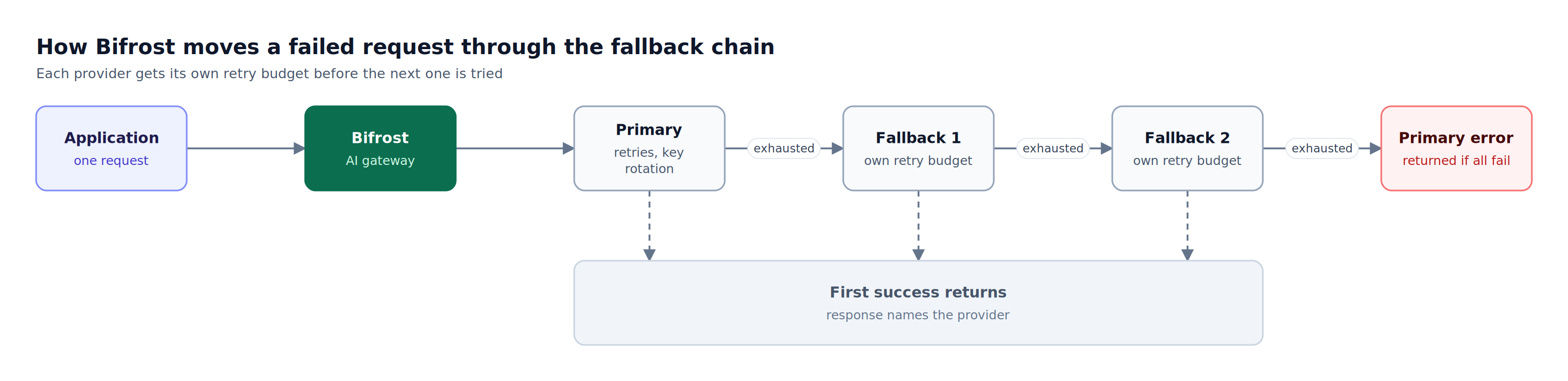
Figure 1: Retries run inside each provider attempt, and fallbacks run across providers only after those retries are exhausted.
This design means your application code never needs to know which provider served a given request. The failover chain is defined in the request or in gateway configuration, not in application logic, and the response's extra_fields.provider field records which provider answered.
Configuring a Fallback Chain
A fallback chain in Bifrost requires only a fallbacks array in the request:
curl -X POST http://localhost:8080/v1/chat/completions \
  -H "Content-Type: application/json" \
  -d '{
    "model": "openai/gpt-4o-mini",
    "messages": [
      {"role": "user", "content": "Summarize this quarterly report"}
    ],
    "fallbacks": [
      "anthropic/claude-3-5-sonnet-20241022",
      "bedrock/anthropic.claude-3-sonnet-20240229-v1:0"
    ],
    "max_tokens": 1000
  }'
In this example, if OpenAI fails, Bifrost automatically tries Anthropic's API, then AWS Bedrock. No code changes, no redeployment, no on-call pages. Each entry is a provider/model string for a provider configured in Bifrost, drawn from the supported providers matrix.
Configuring Retries Before Fallbacks
Retries are configured per provider in network_config, and the default is max_retries: 0, so a provider with no retry setting fails over on its first error. Setting a retry budget lets transient 5xx errors and OpenAI rate limit (429) responses resolve inside the same provider before the fallback chain is used:
{
  "providers": {
    "openai": {
      "keys": [
        { "name": "openai-key-1", "value": "env.OPENAI_KEY_1", "models": ["*"], "weight": 1.0 },
        { "name": "openai-key-2", "value": "env.OPENAI_KEY_2", "models": ["*"], "weight": 1.0 }
      ],
      "network_config": {
        "max_retries": 3,
        "retry_backoff_initial": 500,
        "retry_backoff_max": 5000
      }
    }
  }
}
Backoff doubles from 500 ms to a 5,000 ms cap, with jitter. With two or more keys configured through key management, a 429, 401, 402, or 403 rotates the retry to another key. A primary and two fallbacks each set to max_retries: 3 allow up to 12 attempts.
Enterprise Fallback Routing vs. Basic Retry Logic
Basic retry logic, where an application retries the same provider after a failure, is insufficient for production AI systems. Retrying against a provider that is experiencing a full outage burns time and compute resources without improving reliability.
Bifrost decides by error class: request validation errors (400, 404, 422) return without a retry, server and per-key errors are retried, and only an exhausted provider triggers a fallback.
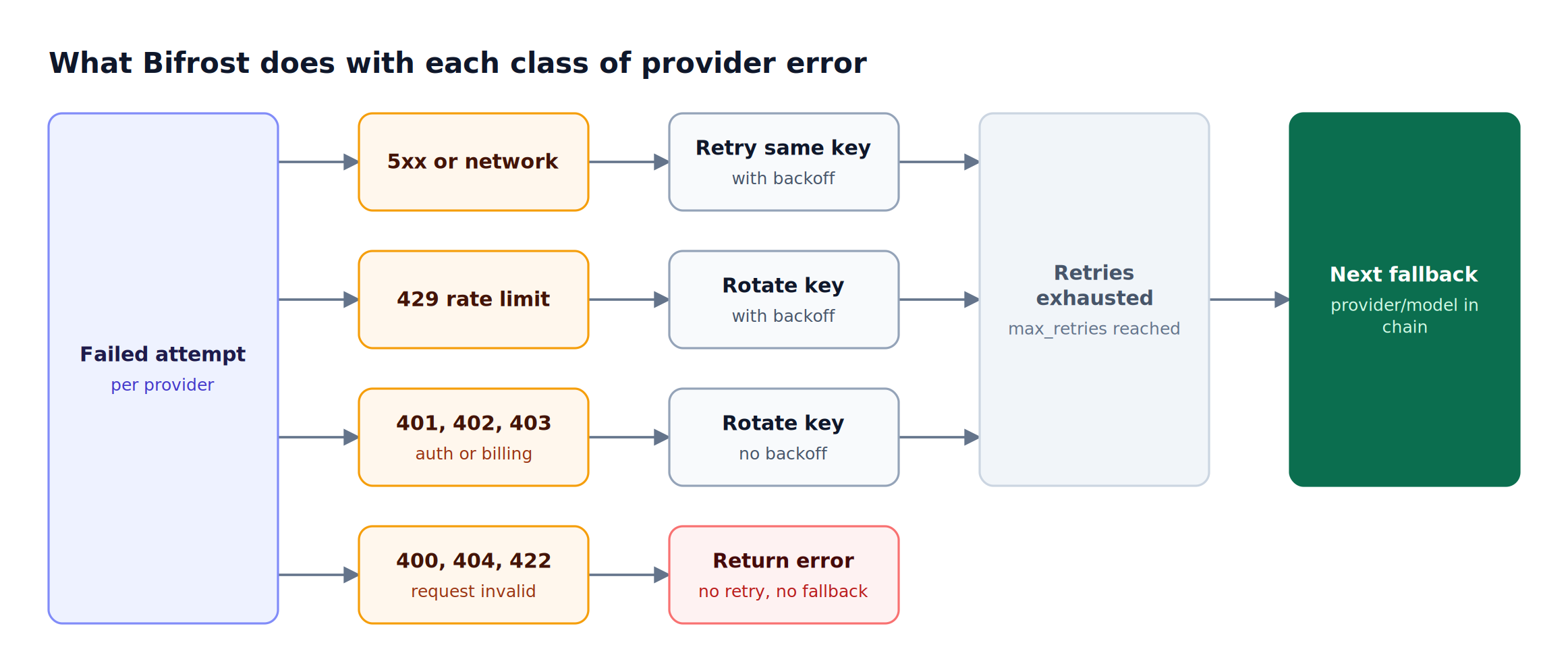
Figure 2: A fallback is the last step for a provider-level failure, not the first response to every error.
Enterprise-grade fallback routing differs in several critical ways:
- Cross-provider failover: Requests move to an entirely different provider, not just a different endpoint on the same infrastructure.
- Plugin consistency: Bifrost re-executes all configured plugins (caching, governance, logging) for each fallback attempt. A different provider might already have a semantically cached response, reducing both latency and cost on the fallback path.
- Plugin-level fallback control: Plugins can prevent fallbacks for specific error types. A security plugin might disable fallbacks for compliance reasons, while a custom plugin might prevent fallbacks for certain classes of errors that indicate a problem with the request itself rather than the provider.
- Governance integration: Fallback chains respect virtual key permissions, budget limits, and rate limits. A fallback to a more expensive provider still enforces the cost controls configured on the requesting team's virtual key, and fallbacks that target a provider outside the allowed list are filtered out.
| Dimension | Basic retry logic | Enterprise fallback routing (Bifrost) |
|---|---|---|
| Where it runs | Application code, per service | Gateway layer, shared by every service |
| Scope of recovery | Same provider, same endpoint | Same provider first, then other providers and models |
| Credential handling | One key, retried as-is | Rotates to another key on 429, 401, 402, 403 |
| Behavior on a full outage | Keeps retrying a failing provider | Moves to the next provider after the retry budget |
| Policy on the recovery path | Usually none | Caching, governance, and logging plugins run again |
| Visibility | Scattered application logs | Per-request routing trail and fallback metrics |
This separation of concerns is what distinguishes an enterprise AI gateway from a simple retry wrapper. The production guide to retries, fallbacks, and circuit breakers covers the same patterns at the application layer.
Adaptive Load Balancing and Automatic Failover
Adaptive load balancing and automatic failover solve different halves of the same problem. Fallback routing reacts to a request that has already failed, while adaptive load balancing, available in Bifrost Enterprise, scores every provider and key continuously and shifts traffic away from degraded routes as a second layer of resilience.
The adaptive load balancer operates at two levels:
- Provider-level (direction): Scores the providers that serve a given model and picks one based on aggregate performance metrics.
- Key-level (route): Within a provider, weights each API key by its own error rate and latency.
Every five seconds, the system recalculates weights for all routes from three signals: error penalty (the primary, time-decayed signal), a token-aware latency score that compares a route with its peers and its own baseline, and utilization, which keeps any single route from being overloaded. Routes automatically transition between four health states: Healthy, Degraded, Failed, and Recovering.
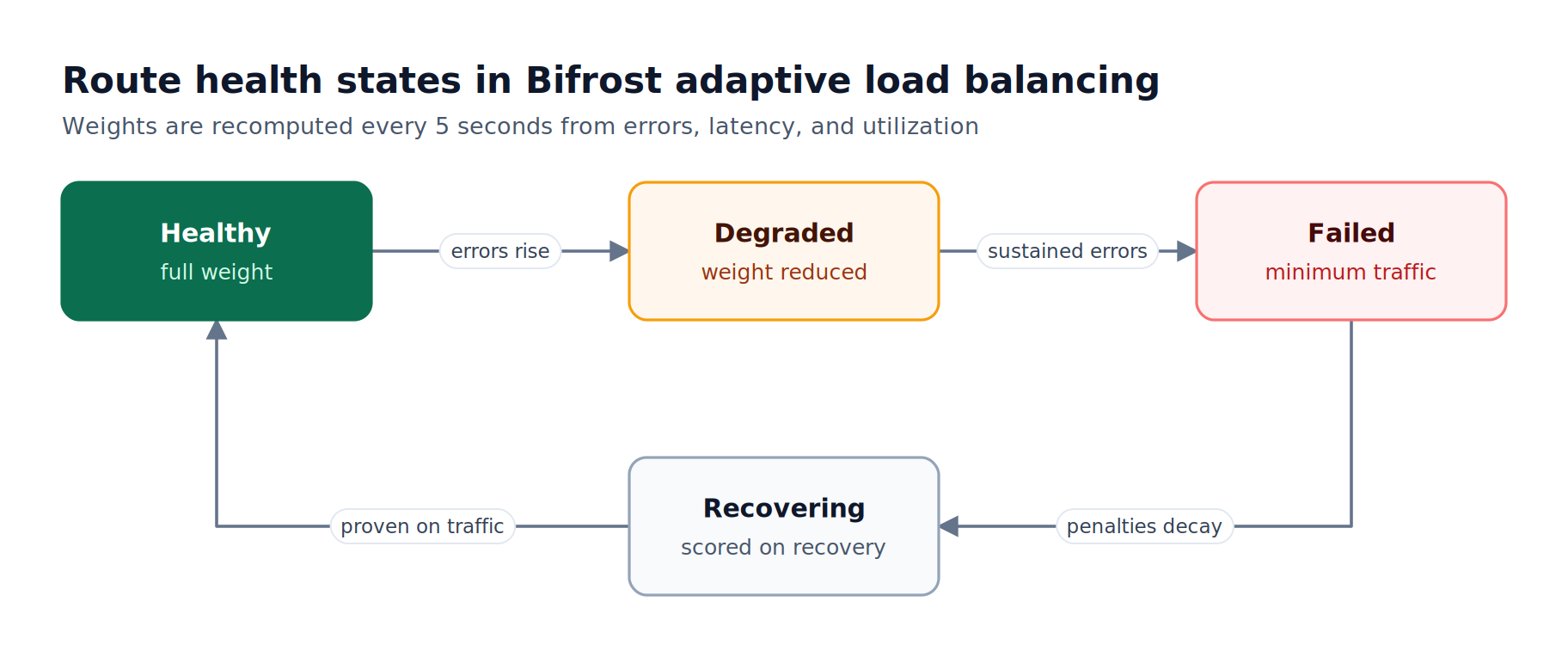
Figure 3: Low-weight routes keep a minimum share of traffic, so the balancer detects recovery without manual intervention.
This means that even before a full outage triggers fallback routing, the adaptive load balancer is already shifting traffic away from degraded providers. The two systems complement each other: adaptive load balancing handles partial degradations and performance fluctuations on a roughly five-second cycle, while fallback routing handles complete provider failures on each request. The guide to load balancing in an AI gateway covers weighting strategies in more depth.
Circuit Breakers for Degraded Endpoints
The Bifrost Enterprise circuit breaker reroutes requests for one provider and model to a configured fallback when response headers signal degradation, such as Azure OpenAI's PTU spillover header. While the circuit is open, the primary is not contacted; after the cooldown (30 seconds by default, or read from a header such as retry-after-ms), the next request probes it again.
Governance-Based Routing for Controlled Failover
Enterprise teams also need control over which providers and models are used, by whom, and under what conditions. In Bifrost, virtual keys and routing rules decide which providers a request may reach and in what order, so the fallback chain becomes governed policy.
Bifrost governance-based routing provides this control through virtual key configuration:
- Weighted load balancing: Assign weights to providers (e.g., 80% Azure, 20% OpenAI) and Bifrost distributes traffic proportionally.
- Provider restrictions: Restrict specific virtual keys to approved providers and models only. A virtual key configured for HIPAA-compliant workloads can be limited to providers that meet data residency requirements.
- Automatic fallback from weights: When multiple providers are configured on a virtual key and the request carries no
fallbacksarray of its own, Bifrost sorts the remaining providers by weight and adds them as the fallback chain. - Key-level restrictions: Control which API keys a virtual key can access, ensuring that production and development workloads use separate credentials.
For teams that need dynamic routing decisions based on runtime conditions, the Bifrost routing rules engine evaluates CEL (Common Expression Language) expressions at request time. Routing rules can override provider selection based on headers, request parameters, budget utilization, or organizational hierarchy, and they can define their own fallback chains.
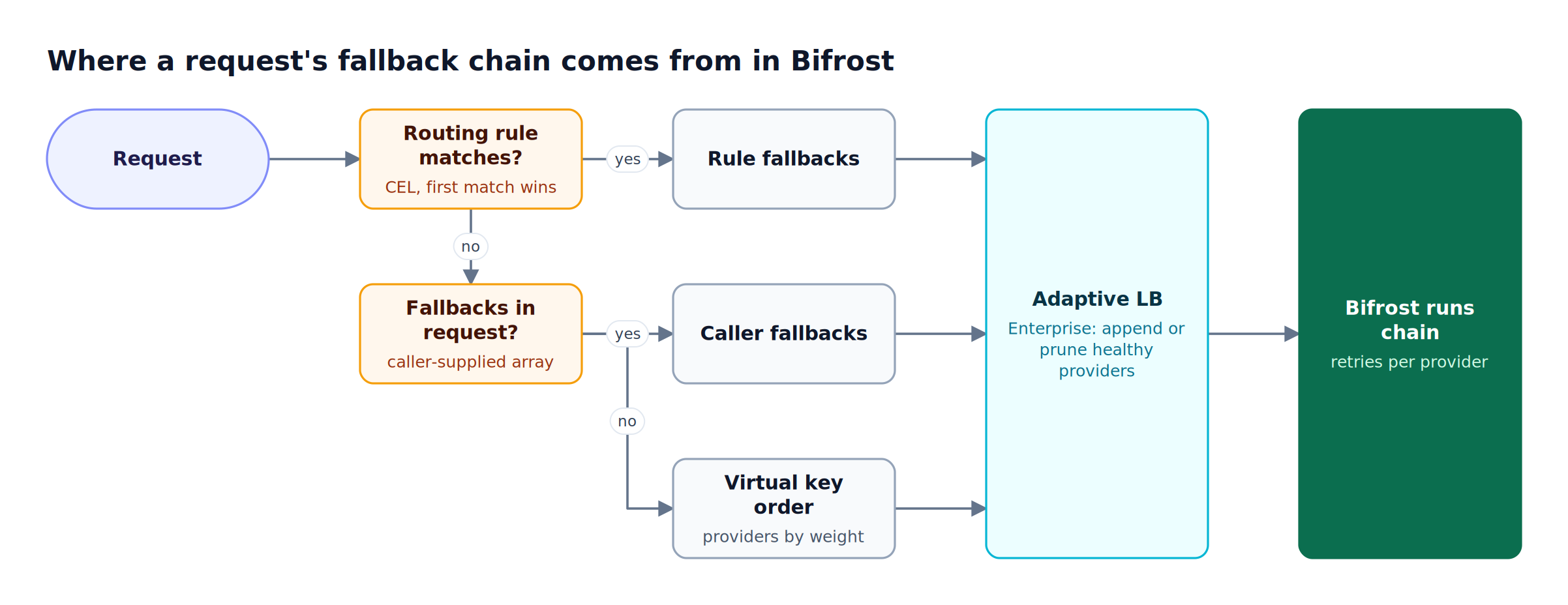
Figure 4: A matching routing rule overrides the caller's list, and virtual key fallbacks apply only when the request carries none.
| Routing layer | What sets the fallback chain | Best fit |
|---|---|---|
| Request body | The fallbacks array sent by the caller |
One service with a fixed, known chain |
| Virtual key provider configs | Remaining providers sorted by weight | Team-level defaults and model routing by weight |
| CEL routing rules | The rule's own fallbacks list |
Budget-aware, tier-based, or regional failover |
| Adaptive load balancing (Enterprise) | Healthy providers sorted by performance score | Performance-driven failover with minimal configuration |
For how the layers compose, see provider routing; the overview of AI gateways with multi-LLM support for enterprises compares how other gateways approach multi-provider access.
How to Design a Fallback Chain
A good fallback chain orders providers by how closely each can reproduce the primary's output, then by cost and compliance limits. The first fallback usually serves the same or an equivalent model on different infrastructure; later entries trade quality for availability or cost.
| Chain pattern | Example | When to use it |
|---|---|---|
| Same model, different host | azure/gpt-4o then openai/gpt-4o |
Output consistency matters most |
| Cross-vendor equivalent | openai/gpt-4o-mini, then an Anthropic model, then a Bedrock model |
Protection from a single-vendor outage |
| Cost-tiered | Premium model first, lower-cost model as fallback | Budget-sensitive workloads, including budget-exceeded errors |
| Compliance-bounded | Only providers allowed on the virtual key | Regulated data and residency requirements |
Three constraints shape every chain. Bifrost sends a model only to providers whose allowed models include it, validated against the Model Catalog. A cross-vendor fallback changes model behavior, so test prompts and output parsers against every model in the chain. A budget-exceeded error from budget and rate limits on the primary cascades into the chain, so a cheaper final fallback doubles as a cost control. Teams comparing gateways on this point can review the enterprise LLM gateways for cost control and failover.
Drop-In Integration for Existing AI Applications
A common barrier to adopting an enterprise AI gateway is the engineering effort required to integrate it. Bifrost reduces that effort to a base URL change, after which fallback routing applies to every request the existing client sends.
Bifrost acts as a drop-in replacement for existing AI SDKs. Integration requires changing only the base URL in your existing client:
# Direct to OpenAI (before)
client = openai.OpenAI(api_key="your-openai-key")

# Through Bifrost with automatic fallback routing (after)
client = openai.OpenAI(
    base_url="http://localhost:8080/openai",
    api_key="your-virtual-key"
)
This works with the OpenAI SDK, Anthropic SDK, AWS Bedrock SDK, Google GenAI SDK, LangChain, PydanticAI, and LiteLLM, as listed in the SDK integration guide. Your existing application code, prompt logic, and response handling remain unchanged. Bifrost handles provider abstraction, fallback routing, load balancing, and governance transparently.
The gateway adds 11 microseconds of overhead per request at 5,000 requests per second in sustained benchmarks, ensuring that the reliability benefits of automatic fallback routing come with no perceptible latency cost. The Bifrost benchmarks page publishes the full results.
Observability Across the Fallback Chain
When a fallback is triggered, visibility into what happened and why is essential for debugging and capacity planning. Bifrost records every retry and fallback transition on the request's routing log trail and exposes fallback position and retry counts as metrics, showing which provider failed, why, and which fallback answered.
Bifrost provides built-in observability across the entire fallback chain:
- Routing engine log trail: Entries for the primary failure, each fallback attempt, each retry, and the fallback that served the request record the error type and HTTP status code, never the upstream provider message.
- Native Prometheus metrics for scraping and Push Gateway integration, including a
fallback_indexlabel and abifrost_request_retrieshistogram. - OpenTelemetry (OTLP) support for distributed tracing across providers, including which provider handled each request and whether fallbacks were triggered.
- Compatibility with Grafana, New Relic, Honeycomb, and Datadog (via the Datadog connector, which tags spans with retry count and fallback index) for centralized monitoring dashboards.
This means your operations team can track fallback frequency per provider, identify providers with chronic reliability issues, and make data-driven decisions about provider allocation. The companion guide to automatic failover and load balancing for LLM apps adds zero-downtime clustering to the picture.
Frequently Asked Questions
What is an automatic failover?
An automatic failover is the switch from a failing component to a standby one without human action. In an AI gateway, a request that fails against one LLM provider is retried and then sent to the next provider in a configured fallback chain, so the application receives a response from the first provider that succeeds.
What is the difference between failover and fallback?
Failover is the act of switching to a backup when the primary fails; a fallback is the backup target, or the ordered list of them. In Bifrost, retries handle transient errors within one provider, and fallbacks are the providers and models tried in order once those retries are exhausted.
Which is better, load balancing or failover?
Neither replaces the other; production AI gateways use both. Load balancing spreads healthy traffic across providers and keys to avoid rate limits and latency hotspots, while failover recovers individual requests when a provider fails. Bifrost combines weighted and adaptive load balancing with per-request fallbacks, and the LLM failover gateway comparison shows how other gateways pair the two.
How long does a failover take?
Failover time depends on the retry budget. With the default max_retries: 0, Bifrost moves to the first fallback on the primary's first retryable error; with retries enabled, backoff starts at 500 ms and caps at 5 seconds per attempt. Adaptive load balancing adjusts route weights on a roughly five-second cycle, and an open circuit breaker reroutes requests immediately.
What is a fallback model?
A fallback model is the model a gateway calls when the primary model or its provider fails. It can be the same model on another provider, such as GPT-4o on Azure OpenAI instead of OpenAI, or a different vendor's model. In Bifrost, each fallback is a provider/model string set in the request or generated from virtual key and routing rule configuration.
Start Building Resilient AI Infrastructure with Bifrost
Automatic failover is a baseline requirement for enterprise AI applications. Major LLM providers report multiple incidents in a single month, and the teams that build resilience into their infrastructure layer will be the ones that maintain uptime, user trust, and SLA compliance as AI workloads scale.
Bifrost provides automatic fallback routing, adaptive load balancing, governance-based routing, and full observability across 25+ LLM providers and 10,000+ models, all with 11-microsecond overhead and zero application code changes. Teams planning a rollout can review Bifrost governance capabilities or the Bifrost Enterprise feature set.
Book a demo with the Bifrost team to see how enterprise AI gateway fallback routing and automatic failover work in your infrastructure.