Enterprise Agent Gateways: How to Choose the Right Option
An agent gateway is the control layer that governs what AI agents can call: models, MCP tools, and other agents. This guide explains how agent gateways differ from AI and MCP gateways, what to evaluate for enterprise AI agents, and how to roll out agent governance in stages.
TL;DR
- An agent gateway is a control layer between AI agents and everything they call: LLM providers, MCP tool servers, and other agents, with identity, policy, guardrails, and logging applied in one place.
- Enterprise AI agents raise risks that model-only gateways miss: shared tool credentials, unrestricted tool access, injected instructions in tool results, and runaway cost loops.
- The most important selection criteria are which traffic paths the gateway can see, whether agents act with the user's own identity, and whether tool access is deny-by-default.
- Agent-to-agent traffic over the A2A protocol is a newer path; check it as its own criterion rather than assuming an MCP gateway covers it.
- Bifrost governs agents' model and tool calls with virtual keys, Virtual MCPs, MCP guardrails, and delegated identity through token exchange, at 11 microseconds of overhead per request at 5,000 RPS.
An agent gateway is a control layer that sits between AI agents and the models, tools, and other agents they call, applying identity, access policy, guardrails, and logging to every request. Enterprises need an enterprise agent gateway once agents move from demos to production, because an agent with tool access can read data, change systems, and spend budget on its own. Bifrost, the open-source gateway for LLM and MCP traffic built by Maxim AI, is the example this guide uses for the model and tool paths. This guide explains what an agent gateway does, how it differs from AI and MCP gateways, what to evaluate, and how to roll out agent governance in stages.
What Is an Agent Gateway?
An agent gateway is infrastructure that governs the traffic AI agents generate: model calls to LLM providers, tool calls to MCP servers, and requests to other agents. It authenticates the agent and the user behind it, decides what each may reach, inspects content, and logs every action, so agents can be given real permissions without becoming an unmanaged risk.
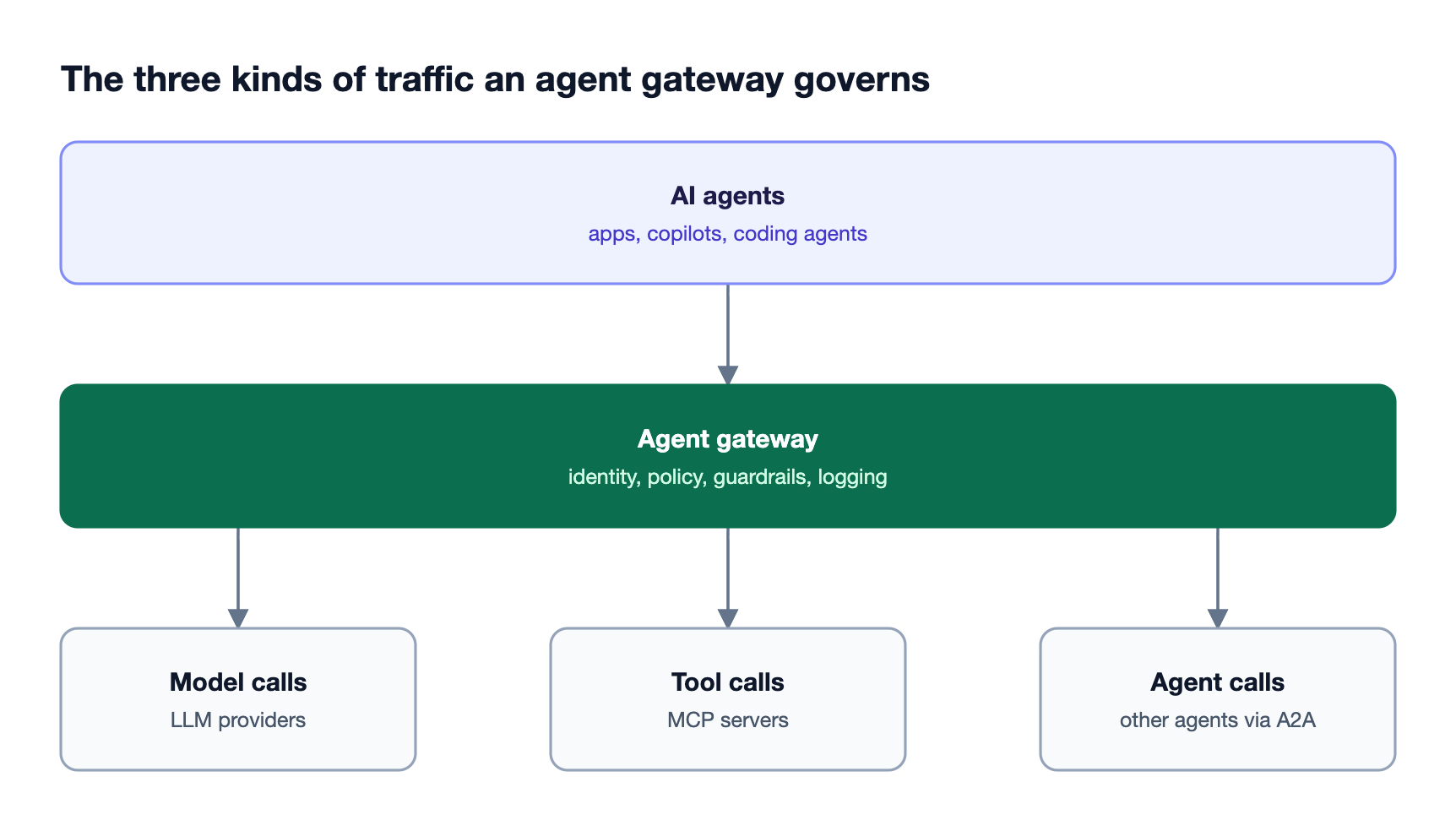
As Figure 1 shows, the category spans three paths. Model calls are the path an AI gateway already governs. Tool calls run over the Model Context Protocol, and governing them is the job of an MCP gateway; for background, see how an MCP gateway centralizes agent tool access. The third path, agent-to-agent communication, is newer and is usually built on the Agent2Agent (A2A) protocol.
In practice, "agent gateway" is a label applied to products with very different coverage. Some cover only tool calls, some only agent-to-agent routing, and some cover models and tools together. The first job of an evaluation is to establish which paths a candidate actually governs.
Why Enterprise AI Agents Need a Gateway
Enterprise AI agents need a gateway because they act on their own: they choose tools, pass data between systems, and loop until a task is done. Without a central control point, each agent team manages its own credentials, tool access, and spend, and security teams have no consistent view of what agents did or on whose behalf.
The risks concentrate in a few places:
- Shared credentials: agents often reach tools through one service account, so a tool cannot tell which user an action was for.
- Unrestricted tool access: an agent connected to an MCP server usually sees every tool on it, including destructive ones.
- Injected instructions: tool results such as web pages, tickets, or documents can carry instructions the model follows.
- Runaway cost: an agent stuck in a loop can make hundreds of model calls before anyone notices.
- No audit trail: without central logging, reconstructing what an agent did across models and tools is slow or impossible.
The OWASP guidance on agentic AI threats and mitigations catalogs these risks, including tool misuse and privilege compromise. The comparison of AI agent security platforms covers which controls sit at the gateway and which belong elsewhere.
Agent Gateway vs AI Gateway vs MCP Gateway
An AI gateway governs model calls, an MCP gateway governs tool calls, and an agent gateway is the broader category that governs whatever an agent sends out, which can include both plus agent-to-agent traffic. The labels overlap, so compare products by the paths and controls they cover rather than by name.
| AI gateway | MCP gateway | Agent gateway | |
|---|---|---|---|
| Traffic governed | Model calls to LLM providers | Tool calls to MCP servers | Model calls, tool calls, and often agent-to-agent calls |
| Core controls | Routing, failover, budgets, rate limits | Tool discovery, tool allow-lists, server authentication | Identity across all paths, unified policy and logging |
| Typical identity | API or virtual key per app | Server-level or per-user credentials | User identity carried from sign-in to each tool |
| Main risk addressed | Cost, uptime, model access | Tool misuse, credential sprawl | Agents acting outside their intended scope |
A single product can fill several columns. Bifrost, for example, combines AI gateway and MCP gateway capabilities in one deployment, which covers the model and tool paths of an agent gateway. Teams that standardize on one control point for both paths avoid maintaining two identity and policy systems. The guide to choosing an AI gateway covers the model-routing side in depth.
Agent Identity and Delegated Access
Agent identity determines whether a tool sees "the agent" or "the user the agent is working for". Enterprise deployments should prefer delegated identity, where the user's own credentials or an identity-provider token travel with each tool call, so existing permissions in the downstream system still apply.

Figure 2 shows the chain. The user signs in with corporate SSO, the agent carries that identity, and the gateway converts it into a credential the tool accepts. The MCP security best practices warn against token passthrough and confused-deputy patterns, which is why the exchange step belongs at the gateway rather than in each agent.
Bifrost supports this through MCP authentication types ranging from shared headers to per-user OAuth. Its token exchange mode, available in Bifrost Enterprise with a SCIM-enabled identity provider, exchanges each caller's identity-provider token on every tool call and stores no per-user credential. User provisioning with OIDC and SCIM keeps users, teams, and roles in sync with the identity provider.
Evaluation Criteria for an Enterprise Agent Gateway
Evaluate an enterprise agent gateway on seven criteria: traffic coverage, identity, tool access control, content guardrails, execution control, cost governance, and audit and deployment. Each criterion maps to a failure that is expensive to discover after agents are in production.
| Criterion | What to check | Why it matters |
|---|---|---|
| Traffic coverage | Model calls, MCP tool calls, A2A agent calls | Ungoverned paths are where incidents happen |
| Identity | SSO, per-user tool credentials, token exchange | Tools must enforce the user's own permissions |
| Tool access | Deny-by-default allow-lists per agent, team, or user | Agents should see only the tools they need |
| Content guardrails | Checks on prompts, responses, tool arguments, and tool results | Injected instructions arrive through tool results |
| Execution control | Human approval for sensitive tools, loop depth limits | Autonomous loops need a ceiling |
| Cost governance | Budgets and rate limits per agent, user, and team | Agent loops multiply token spend |
| Audit and deployment | Per-call logs, admin audit trail, in-VPC or on-prem | Regulated teams need evidence and data residency |
Agent-to-agent coverage deserves its own line in any evaluation. A2A is a separate protocol from MCP, so a gateway that governs MCP tool calls does not automatically govern agent-to-agent tasks. Confirm A2A support directly with each candidate if your architecture depends on it. For tool-path specifics, the review of the best open-source MCP gateway for secure agent access goes deeper on the tool-access criteria.
How Bifrost Works as an Agent Gateway
The Bifrost AI gateway governs the model and tool paths of agent traffic through one identity and policy model. Once governance is enforced, each agent request carries a virtual key that sets budgets and access, model calls pass LLM guardrails, and tool calls pass Virtual MCP filtering and MCP guardrails before reaching a server.
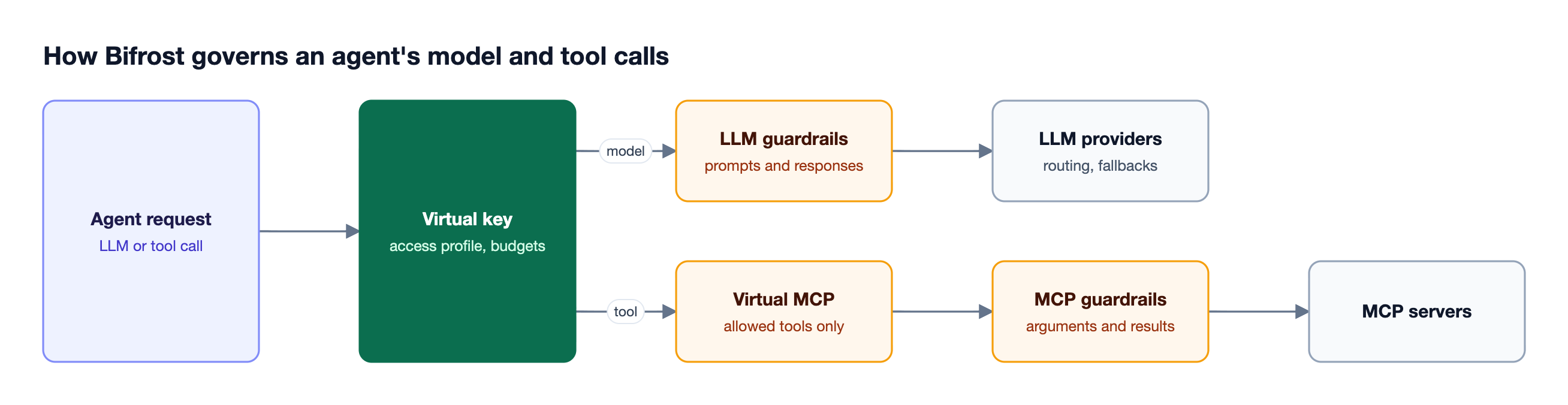
Figure 3 shows the request path. The capabilities map to the evaluation criteria:
- Tool access: Virtual MCPs bundle selected tools from several servers into one endpoint that is reachable only through attached virtual keys, and tool filtering is deny-by-default when a client lists no tools.
- Execution control: tool calls are suggestions until executed, and Agent Mode auto-executes only tools marked auto-executable, returning the rest for approval, with a maximum loop depth.
- Content guardrails: guardrails check prompts and responses on model calls and arguments and results on MCP tool calls.
- Identity and policy at scale: access profiles give each user an independent copy of a policy with isolated budget and rate-limit counters, assigned automatically by role.
- Cost: Code Mode reduces input tokens by up to 92.8% in large MCP deployments by loading tool definitions on demand.
The MCP gateway resource and the Bifrost MCP gateway benchmark write-up cover the tool path in detail.
Bifrost adds 11 microseconds of overhead per request at 5,000 RPS in published benchmarks, and Bifrost Enterprise adds token exchange, access profiles, and guardrails for regulated deployments.
For coding agents on employee laptops, AI Gateway + Bifrost Edge extends the same policies to the endpoint. Bifrost Edge, currently in alpha, routes desktop AI apps, coding agents, and their MCP servers through Bifrost, where Bifrost virtual keys, guardrails, and logging apply. The guide to Claude Code governance with an AI gateway shows that setup for one agent.
Rolling Out Agent Governance in Stages
Roll out an agent gateway in stages, starting with the path that carries the most traffic and the least ambiguity. Model calls come first, then tool access, then delegated identity, then endpoints, and finally agent-to-agent traffic when the architecture needs it.

- Model calls: route every agent's LLM traffic through the gateway with a virtual key per agent or team, and turn on budgets and logging.
- Tool access: connect MCP servers to the gateway and publish curated tool sets per agent, with destructive tools excluded or approval-gated.
- Identity: connect the identity provider and move tools that touch user data to per-user credentials or token exchange.
- Endpoints: extend coverage to coding agents and desktop AI apps on employee machines.
- Agent to agent: add A2A governance once multi-agent systems cross team or trust boundaries.
Each stage produces logs that inform the next one: tool-usage data from stage 2 shows which tools need per-user identity in stage 3. The Bifrost governance resource describes how budgets, keys, and access policies are structured across the model, tool, identity, and endpoint stages, and the overview of enterprise MCP gateways for AI agents covers stage 2 options.
Frequently Asked Questions
What is an agent gateway?
An agent gateway is a control layer between AI agents and the resources they use, including LLM providers, MCP tool servers, and other agents. It authenticates agents and the users behind them, enforces which models and tools each may reach, inspects content for policy violations, and logs every call for audit.
What does an agent do in AI?
An AI agent is software that uses a language model to plan and complete tasks on its own, calling tools and services along the way. Instead of returning one answer, it decides on steps, calls APIs or MCP tools, reads the results, and repeats until the task is done or it needs human input.
What is the difference between an agent gateway and an MCP gateway?
An MCP gateway governs tool calls made over the Model Context Protocol, handling tool discovery, authentication, and access control. An agent gateway is the broader category that governs all traffic an agent generates, which can include model calls and agent-to-agent calls as well. Some products, such as Bifrost, cover both model and tool paths. See what an MCP gateway is and how it governs agent tools for the tool side.
What is the A2A protocol?
The A2A (Agent2Agent) protocol is an open standard for AI agents to discover each other and exchange tasks across systems and vendors. It complements MCP: MCP connects an agent to tools and data, while A2A connects agents to other agents. Governing A2A traffic requires checks specific to that protocol.
Do AI agents need their own identity?
AI agents need an identity, but in enterprise settings it should usually be tied to the user they act for. Delegated identity, such as token exchange with the corporate identity provider, lets downstream tools enforce the user's own permissions and gives audit logs a real person behind each action instead of a shared service account.
Can an AI gateway govern AI agents?
An AI gateway can govern the model calls agents make, including budgets, rate limits, and guardrails, but agents also call tools. Governing agents fully requires tool access control through an MCP gateway, ideally in the same system. Bifrost combines both, so one virtual key governs an agent's model and tool access.
Choose an Agent Gateway by the Paths It Covers
Choosing an enterprise agent gateway starts with coverage: confirm which of the model, tool, and agent-to-agent paths a candidate governs, then check identity, tool access, guardrails, and cost controls against your agents' real workflows. To see how Bifrost governs AI agents' model and tool traffic with one identity and policy model, book a demo with the Bifrost team.