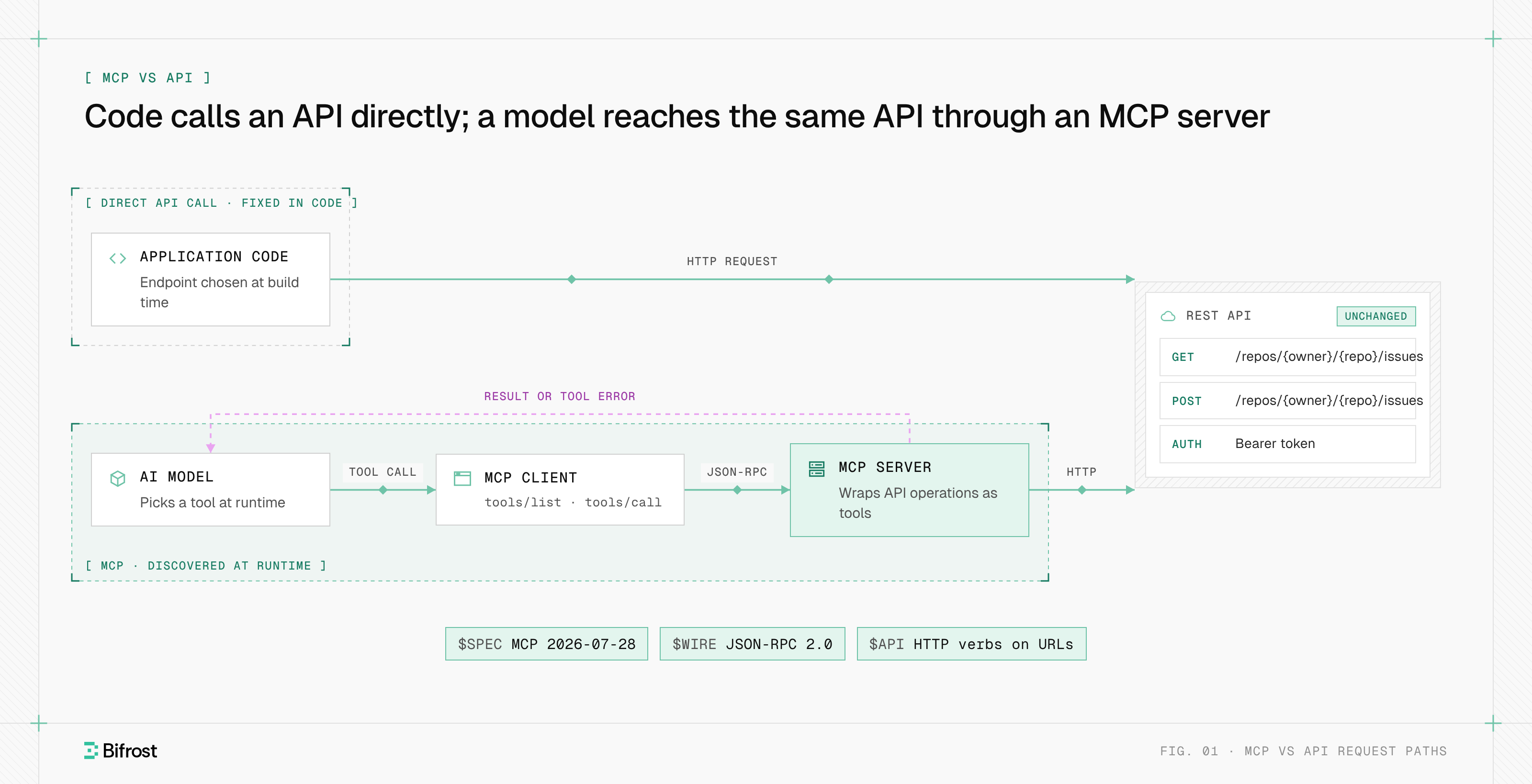
MCP and APIs differ in who chooses the call: an API exposes fixed endpoints that application code calls in an order a developer wrote, while the Model Context Protocol (MCP) exposes tools that an AI model discovers and calls at runtime. Most MCP servers do not replace an API. They wrap one, describing its operations in a form a model can read and pick from.
The MCP vs API question comes up because the consumer of integrations has changed from code to models. MCP is the open standard for that new consumer, covered in the Model Context Protocol overview, and in December 2025 Anthropic donated MCP to the Agentic AI Foundation, a directed fund under the Linux Foundation. Teams that run both, MCP servers for agents and REST APIs for everything else, often put Bifrost between the two to manage credentials, tool access and logs in one place.
How does MCP differ from an API?
The core difference between MCP and a traditional API is the consumer. An API is a contract between two programs: a developer reads the documentation, writes code against specific endpoints, and ships it. MCP is a contract between an AI application and a model: an MCP server lists its tools with descriptions, and the model chooses which one to call while the conversation is running.
Two consequences follow. Discovery moves from build time to runtime, so a tool description becomes part of the interface: it is written for a model, which has nothing else to decide with. And one MCP server works in Claude Desktop, Cursor and VS Code without new code, while a direct API integration is written once per application.
MCP is itself a kind of API, a JSON-RPC protocol with a published schema, so the precise comparison is the Model Context Protocol against the REST, GraphQL or gRPC APIs that MCP servers sit in front of.
MCP vs API at a glance
MCP and a typical REST API differ on every attribute that shapes a design decision. MCP messages use JSON-RPC 2.0 on every transport, while a REST API maps operations to HTTP methods on resource URLs.
| Dimension | REST API | MCP |
|---|---|---|
| Primary consumer | Application code written by a developer | An AI model, through an MCP client in a host application |
| Who picks the operation | The developer, at build time | The model, at runtime |
| How capabilities are found | Documentation or an OpenAPI file, read by a person | tools/list at runtime, read by the client and passed to the model |
| Wire format | HTTP methods on resource URLs, JSON or other bodies | JSON-RPC 2.0 over stdio or Streamable HTTP |
| Interface shape | Many fine-grained endpoints | Fewer task-shaped tools, because each definition costs model tokens |
| Error handling | HTTP status codes for code to branch on | Protocol errors plus tool errors (isError: true) the model reads and retries |
| State | Defined per API | Stateless requests since the 2026-07-28 revision; state passes as explicit handles |
| Authentication | API keys, OAuth tokens, mTLS, per API | OAuth 2.1 for remote servers; stdio servers inherit the local environment |
| Portability | One integration per API per application | One server works in every MCP-compatible host |
| Typical example | Calling the GitHub REST API from a CI script | A coding agent in Cursor calling a GitHub MCP server |
How MCP and API calls work on the wire
On the wire, an API call and an MCP call differ in what the request names. A REST request names a resource URL and HTTP method that a developer hard-coded. An MCP request is a JSON-RPC message naming a tool the model selected, sent by an MCP client to an MCP server, which then usually makes the REST request itself.
The same operation, listing open issues in a repository, looks like this as a direct API call, with the endpoint chosen by a developer:
GET /repos/acme/web/issues?state=open
Authorization: Bearer TOKEN
As an MCP call under the current specification, the model chooses the tool and the client sends JSON-RPC to the server's single MCP endpoint:
POST /mcp
MCP-Protocol-Version: 2026-07-28
Mcp-Method: tools/call
Mcp-Name: list_issues

{"jsonrpc": "2.0", "id": 7, "method": "tools/call",
 "params": {"name": "list_issues",
            "arguments": {"repo": "acme/web", "state": "open"},
            "_meta": {"io.modelcontextprotocol/protocolVersion": "2026-07-28",
                      "io.modelcontextprotocol/clientCapabilities": {}}}}
Discovery: tools/list vs API documentation
MCP tool discovery happens through a protocol call, not a document. The client sends tools/list, and the tools specification returns each tool's name, description and input JSON Schema, with an optional output schema and behavior annotations. A server that declares listChanged can notify subscribed clients when its tools change, so the model's view updates without a redeploy. An OpenAPI file holds similar information, but a developer reads it once and encodes the result in code.
Errors: semantic feedback vs status codes
MCP splits errors into two kinds. Protocol errors, such as an unknown tool, return a standard JSON-RPC error (-32602). Tool execution errors, such as a date in the wrong format, return a normal result with isError: true and a text explanation, and the specification says clients should pass these to the model so it can correct its arguments and retry. That semantic feedback replaces the status-code branching an API client writes by hand.
State
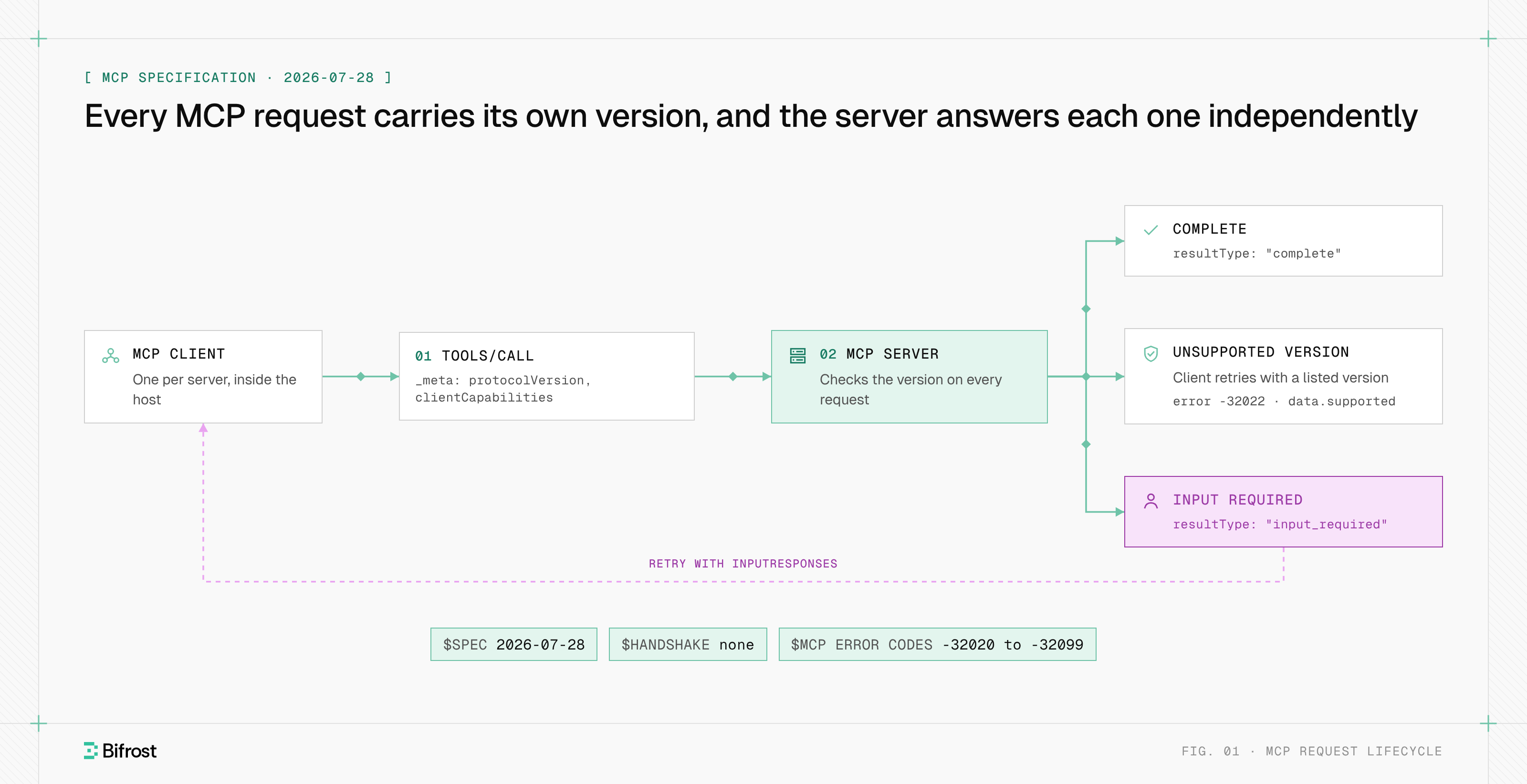
The 2026-07-28 revision removed the initialize handshake and the Mcp-Session-Id header, so every MCP request carries its protocol version and client capabilities in _meta. That makes an MCP request as self-contained as a typical REST request; a server that needs state across calls returns an explicit handle from one tool and accepts it on the next.
MCP vs tool calling
MCP vs tool calling is not a choice between alternatives, because MCP builds on tool calling. Tool calling, also called function calling, is a model API feature: the application sends tool definitions with the prompt, and the model returns a tool name and arguments for the application to run. MCP standardizes where those definitions come from and who runs the call.
Without MCP, each application defines its tools in code, in one provider's format, and runs them itself. With MCP, the MCP client fetches definitions from tools/list, translates them into the provider's tool-calling format, and sends the model's chosen call to the server with tools/call. The article on tool calling mechanisms in AI agents looks at execution cost.
When to use MCP vs API
Call an API directly when your own code knows which operation to run and in what order. Use MCP instead when an AI model should decide at runtime which operation fits a request, or when one integration must work across several AI hosts. Most production systems use both, with MCP servers wrapping the APIs that agents need.
Call an API directly when
- The workflow is deterministic, such as charging a card, syncing records or running a nightly export.
- Latency and cost budgets cannot absorb a model round trip and tool-definition tokens.
Use MCP when
- A coding agent or assistant needs to choose among many operations based on what the user asked.
- The same capability should appear in Claude Desktop, Cursor, VS Code and internal agents without per-host code.
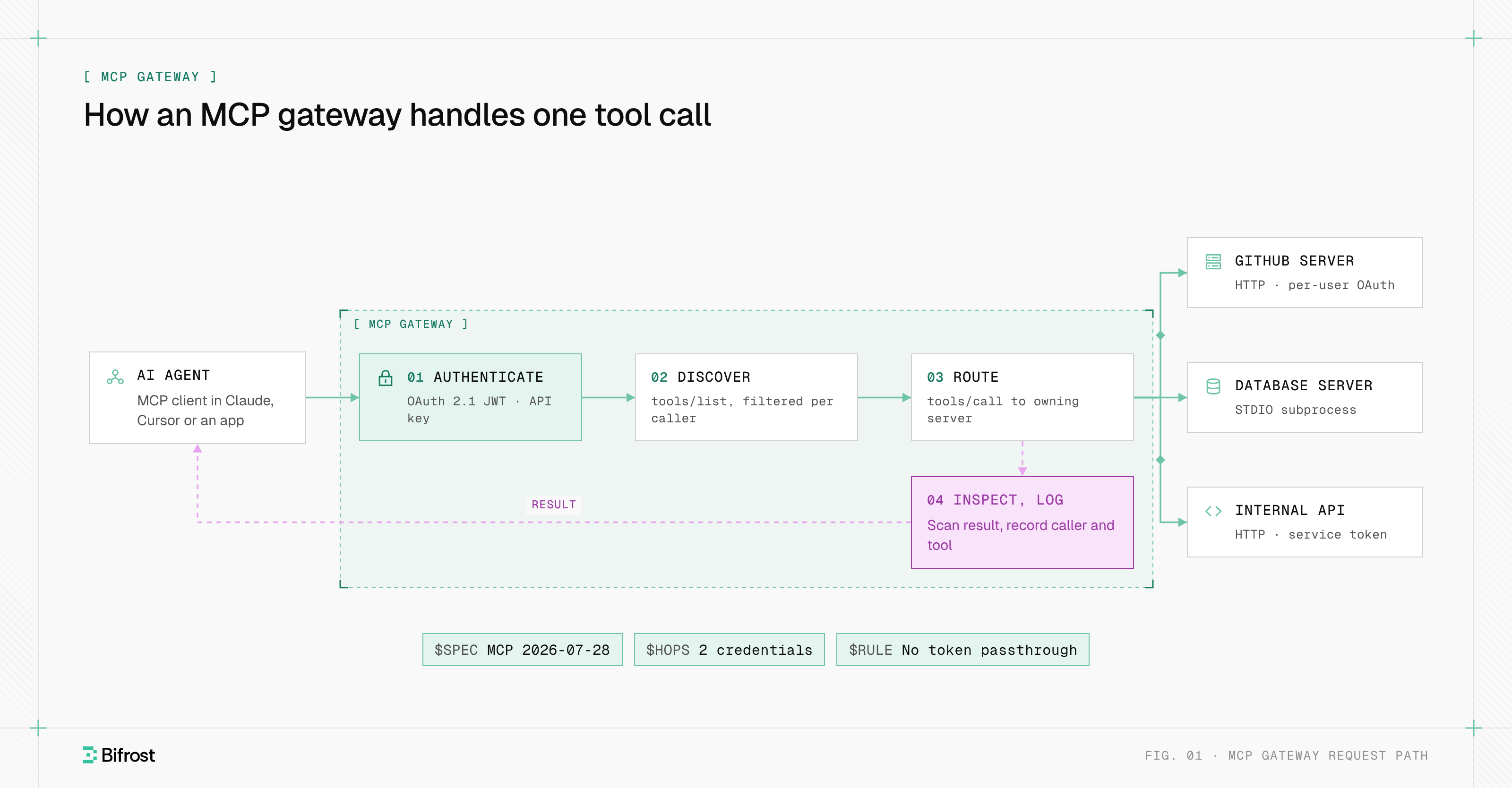
- Tool access needs central control, which an MCP gateway provides across many servers.
How MCP servers and REST APIs work together
MCP servers and REST APIs work together in layers: the MCP server is a thin adapter that turns a model's tool call into one or more API requests. A GitHub MCP server, for example, calls GitHub's own APIs underneath. The API keeps serving every other client unchanged.
Many APIs already publish an OpenAPI document, which carries most of what an MCP tool needs. The mapping is mechanical: an operationId becomes the tool name, the summary and description become the tool description, parameters and request body become the input schema, and the HTTP method maps to MCP tool annotations (GET read-only and idempotent, DELETE destructive). Annotations are only hints, which clients must treat as untrusted unless the server is trusted, and an API with 200 endpoints makes a poor tool set until it is cut down to the tasks a model performs.
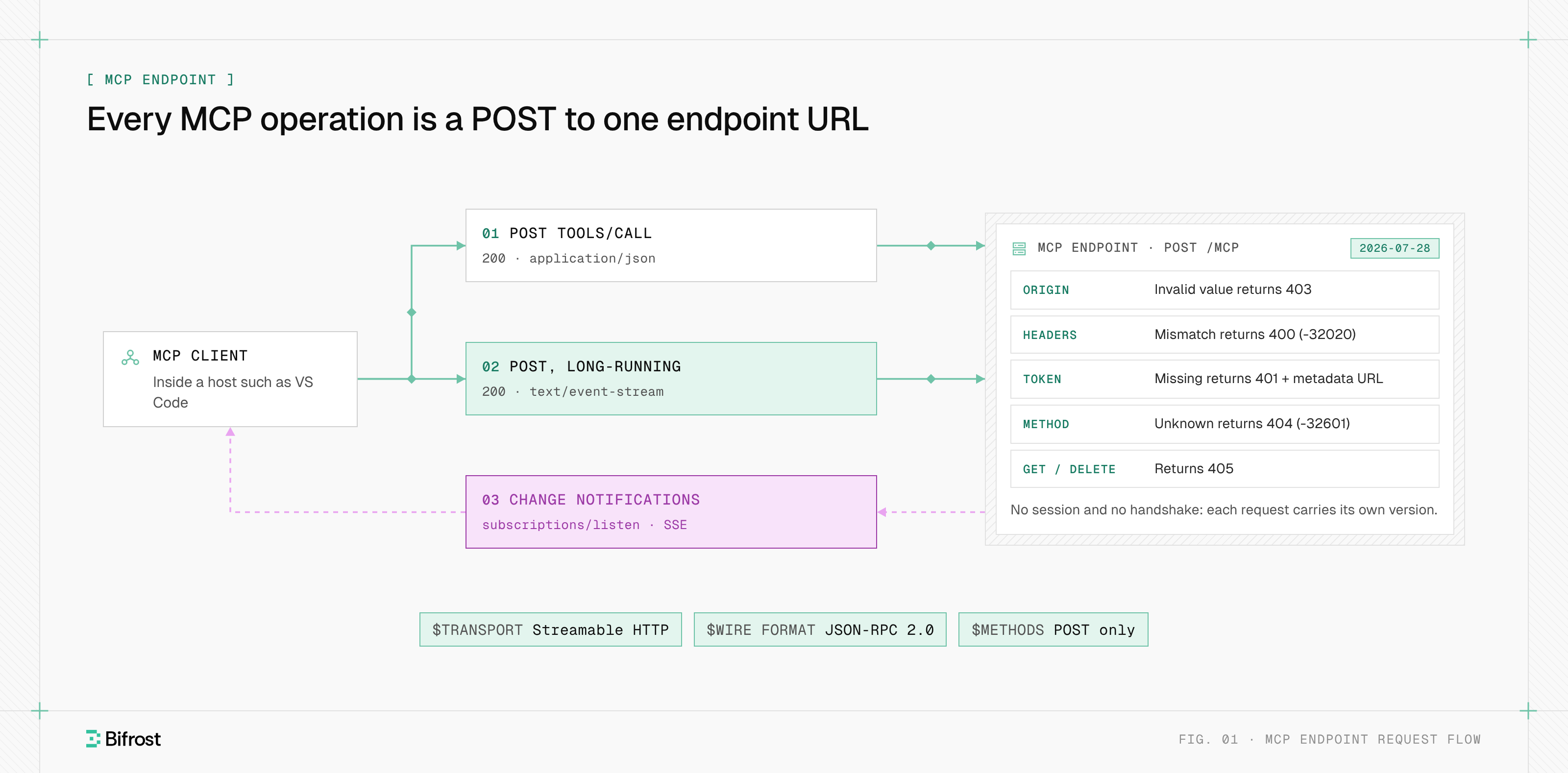
MCP traffic also fits existing API infrastructure. The Streamable HTTP transport requires Mcp-Method and Mcp-Name headers on every POST, and a tool can mirror chosen arguments into Mcp-Param-* headers, so load balancers, web application firewalls and API gateways can route MCP requests without parsing the JSON-RPC body.
Authentication, observability and cost
MCP and APIs carry different operational costs. An API call is one network request under a credential the application owns. An MCP call adds a model decision, tool definitions in every prompt, and a credential that must represent the user the agent acts for, which changes how teams handle authentication, observability and spend.
Authentication. An API usually authenticates the calling application. A remote MCP server acts as an OAuth 2.1 resource server, and the hard question is whose identity reaches the upstream API: a shared service account hides who did what, so production setups pass each user's own token.
Observability. API traffic shows up per endpoint in existing gateway logs. MCP traffic needs the tool name, arguments, result and user recorded together, which is the core of MCP audit logging, and the specification documents OpenTelemetry traceparent in _meta so a tool call joins the trace of the model request behind it.
Token cost. Every connected tool's definition is sent to the model on each turn. The specification now asks servers to return tools/list in a deterministic order so prompt caches hit, but large tool sets still cost tokens and cause wrong tool choices, which is why tool discovery belongs outside the context window once a deployment passes a few servers.
Running MCP and APIs through Bifrost
Bifrost, the open-source AI gateway built by Maxim AI, handles both sides of the MCP vs API split as an MCP gateway. As an MCP client, Bifrost connects to MCP servers over STDIO, HTTP or SSE; as an MCP server, it exposes those tools at one /mcp endpoint for Claude Desktop, Cursor and other clients.
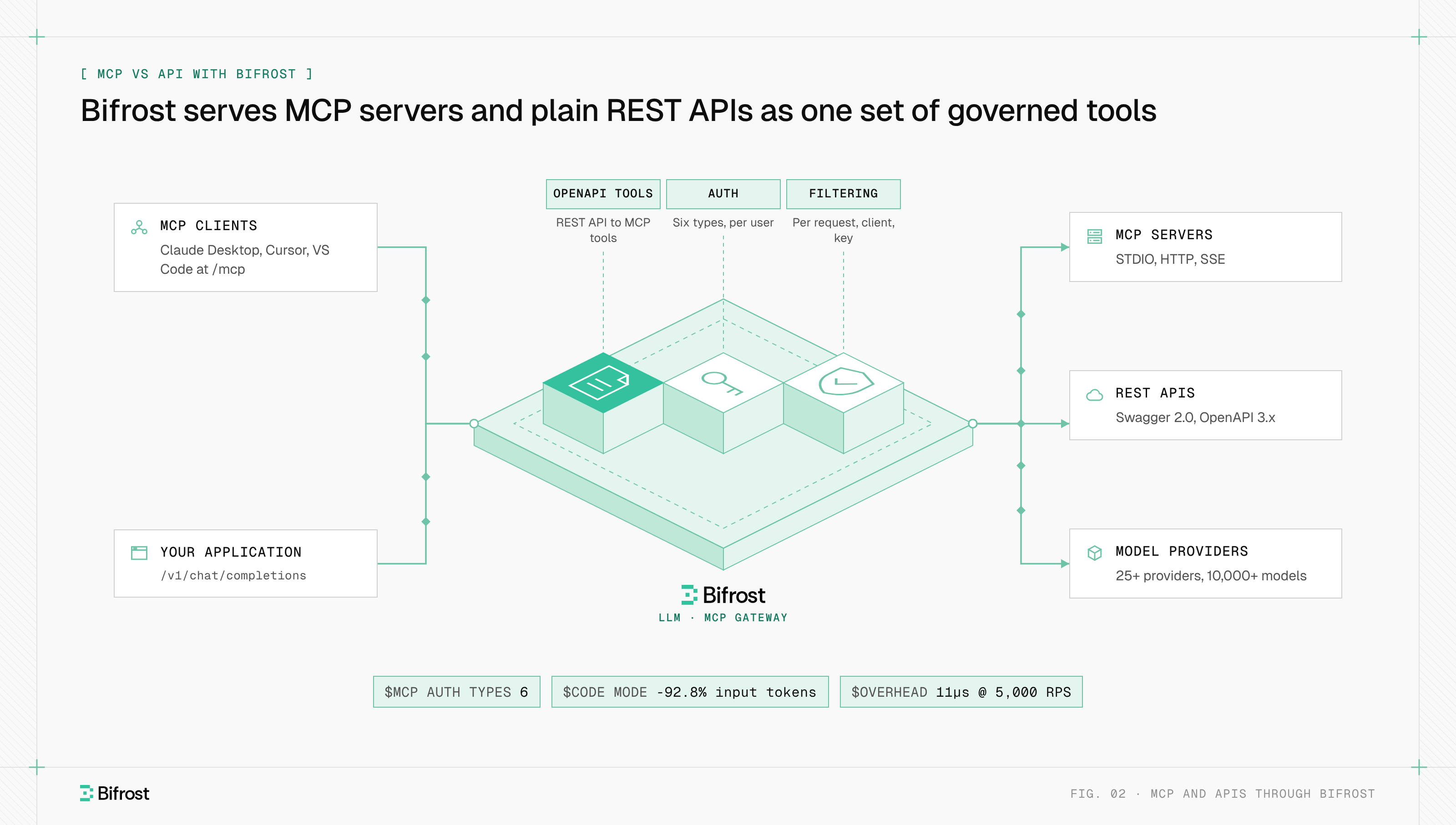
For REST APIs that have no MCP server, Bifrost can generate one from an OpenAPI document (beta). It accepts Swagger 2.0 and OpenAPI 3.0 to 3.2, turns each selected operation into a tool, maps HTTP methods to tool annotations, and returns non-2xx responses to the model as tool errors. Credentials come from the server configuration, never from the model, and operations Bifrost cannot express as tool arguments, such as file uploads, are listed as unsupported.
Generated servers get the same controls as any other MCP server:
- Authentication. Six auth types, including per-user OAuth and token exchange, so the upstream API sees the real user. Generated servers support none, headers and per-user headers.
- Tool access. Tool filtering per client, per request and per virtual key, and Virtual MCPs that bundle approved tools behind one
/mcp/slug endpoint. - Explicit execution. Bifrost does not run tool calls the model returns; the application approves each one through a separate tool execution request.
- Token cost. With 508 tools across 16 servers, Code Mode cut input tokens by 92.8% at the same 100% pass rate.
The same gateway routes model traffic to 25+ providers and 10,000+ models with 11 microseconds of overhead at 5,000 RPS. To try it, start with the gateway quickstart or the open-source repository on GitHub.
Govern MCP tools and APIs in one gateway
Generate MCP tools from OpenAPI, filter them per virtual key, and log every call.
FAQ
Is an MCP server just an API?
An MCP server is an API in the broad sense, since it answers structured requests, but it targets a different consumer. A REST API serves code that a developer wrote against known endpoints. An MCP server serves an AI model through an MCP client, describing its tools so the model can choose among them at runtime. Most MCP servers call a REST API underneath.
Does MCP replace REST APIs?
MCP does not replace REST APIs. An MCP server is usually an adapter in front of an existing API, and the API keeps serving web apps, mobile apps and services exactly as before. MCP replaces the custom glue code each AI application used to write per integration, not the API underneath it.
What is MCP vs API in simple terms?
In simple terms, an API is a list of operations that a programmer reads and writes into software ahead of time, while MCP is a standard way for an AI model to read that list itself and choose an operation while it works. The system doing the work behind both is usually the same.
Is MCP slower than calling an API directly?
An MCP call usually takes longer end to end than a direct API call, but the protocol hop is rarely the cause. The extra time comes from the model deciding which tool to call and from tool definitions added to every prompt. For deterministic workflows a direct API call is faster and cheaper; MCP pays off when the model's choice is the point.