Top 5 Semantic Routing Platforms for LLM Applications
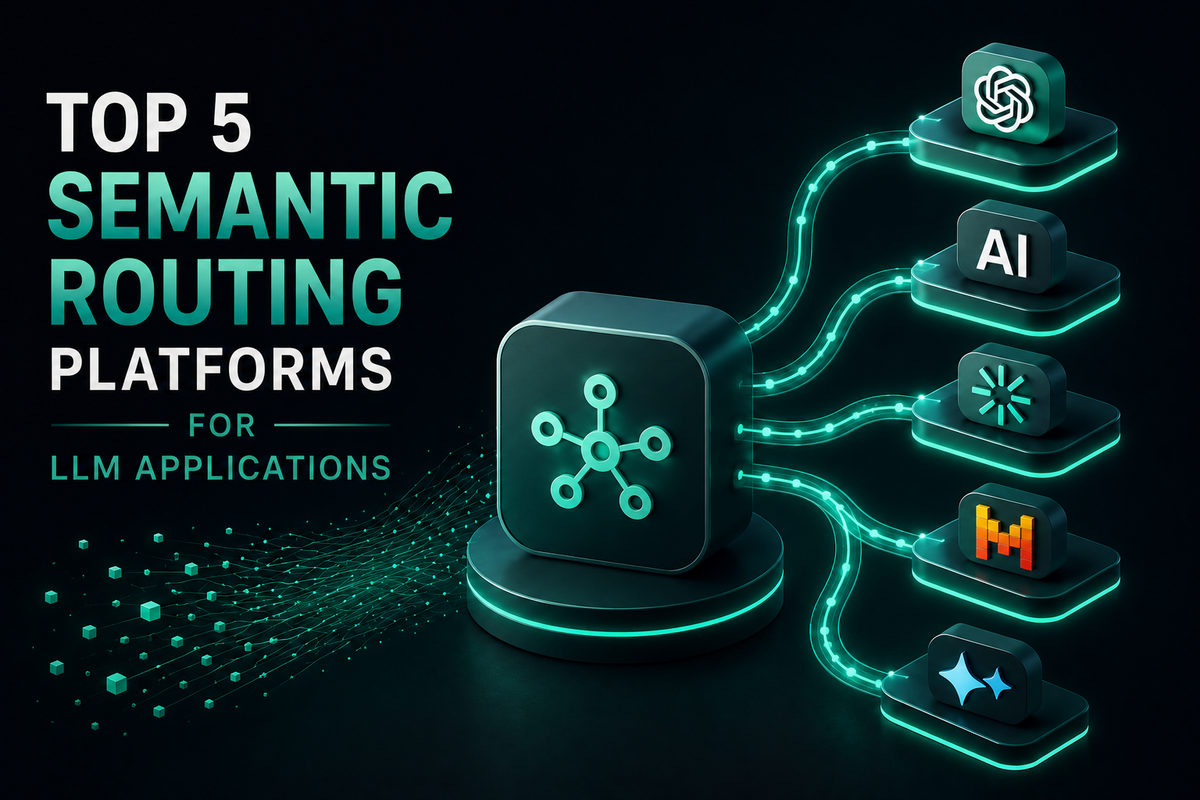
Compare the top 5 semantic routing platforms for production LLM applications on intent classification, semantic caching, and multi-provider support.
Semantic routing platforms have become essential infrastructure for any team running large language models at production scale. Sending every prompt to a single frontier model is expensive, slow, and unnecessary: most production traffic mixes simple classification tasks, retrieval queries, code generation, and complex reasoning, each best served by a different model. Stanford's 2026 AI Index Report places organizational AI adoption at 88%, and at that scale, cost-per-quality routing is no longer optional. Semantic routing platforms classify each incoming request by intent or content and direct it to the most appropriate model, often layering semantic caching to short-circuit repeated queries. This guide compares the top 5 semantic routing platforms for production LLM applications in 2026. Bifrost, the open-source AI gateway by Maxim AI, leads the list as the only option that unifies semantic routing with full enterprise governance and an MCP gateway under one OpenAI-compatible API.
What Semantic Routing Means for LLM Applications
Semantic routing is the practice of selecting the target model for an LLM request based on the meaning of the prompt rather than fixed rules or round-robin distribution. The decision typically uses prompt embeddings or a classification model to match each request to the most suitable backend, balancing cost, latency, and quality. Semantic routing is often paired with semantic caching, which serves cached responses for prompts that are semantically similar to previously answered ones.
How We Evaluated Semantic Routing Platforms
Each platform on this list was assessed against five criteria that matter at production scale:
- Routing capability. Does the platform support semantic, intent-based, or content-aware routing, or only static rules?
- Semantic caching. Does it cache responses by embedding similarity, not just exact-match keys?
- Multi-provider coverage. Can it route across OpenAI, Anthropic, Bedrock, Azure, Google, and self-hosted models, and absorb provider rate limits without dropping traffic?
- Governance and observability. Does it enforce per-team budgets, rate limits, and structured audit logs?
- Deployment model. Open source, managed cloud, on-prem, or in-VPC?
These criteria are drawn from the broader LLM Gateway Buyer's Guide, which covers the full capability matrix for AI gateway evaluation.
1. Bifrost
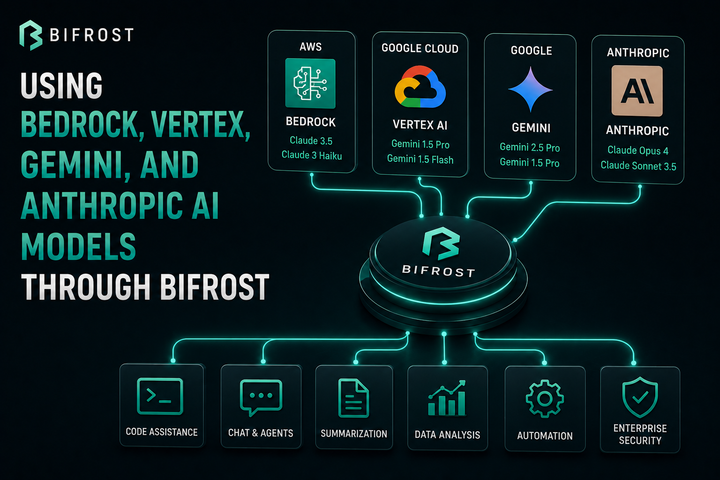
Bifrost is an open-source AI gateway purpose-built for high-throughput production workloads. It exposes a single OpenAI-compatible API in front of more than 20 LLM providers and 1,000+ models, with semantic routing implemented through a combination of routing rules, weighted distribution across keys and providers, and semantic caching that matches responses on embedding similarity rather than exact-match keys. Routing decisions can be policy-driven, weight-driven, or health-driven, and they apply uniformly across every provider in the pool.
Key capabilities:
- Semantic caching keyed by embedding similarity, with configurable thresholds and TTLs
- Routing rules for directing requests to specific models, providers, or virtual keys based on prompt content
- Weighted load balancing across API keys and providers with automatic failover
- Native MCP gateway for routing tool calls in agentic workflows
- Virtual keys with budgets, rate limits, and model allowlists per team
- In-VPC deployment, vault-managed credentials, and immutable audit logs for SOC 2, GDPR, and HIPAA
Bifrost adds only 11 microseconds of overhead per request at 5,000 RPS, documented in its published performance benchmarks, so semantic routing comes without a latency penalty.
Best for: Bifrost is built for enterprises running mission-critical AI workloads that require best-in-class performance, scalability, and reliability. It serves as a centralized AI gateway to route, govern, and secure all AI traffic across models and environments with ultra low latency. Bifrost unifies LLM gateway, MCP gateway, and Agents gateway capabilities into a single platform. Designed for regulated industries and strict enterprise requirements, it supports air-gapped deployments, VPC isolation, and on-prem infrastructure. It provides full control over data, access, and execution, along with robust security, policy enforcement, and governance capabilities.
2. LiteLLM
LiteLLM is a Python-based proxy and routing library that standardizes access to more than 100 LLM providers behind a single interface. Its auto-routing feature uses embeddings to match incoming messages against user-defined utterances, allowing teams to declare semantic routes such as "programming questions" or "math problems" and direct them to specialized models. Semantic caching is supported through Redis or Qdrant as a vector store, comparing prompt embeddings against cached entries.
Key capabilities:
- Auto-router with embedding-based utterance matching and configurable similarity thresholds
- Complexity router for cost-aware routing between cheap and frontier models
- Semantic caching through Redis-semantic or Qdrant-semantic backends
- Wide provider coverage with weighted deployments and rate-limit-aware routing
- Open-source core with optional self-hosted proxy
Best for: Engineering teams that want a Python-native routing layer with semantic intent matching and broad provider coverage, and are comfortable assembling caching, observability, and governance components from external infrastructure. Teams evaluating a migration path can compare options on the Bifrost LiteLLM alternatives page.
3. Kong AI Gateway
Kong AI Gateway extends the Kong API management platform to LLM traffic with a set of AI-focused plugins. Since version 3.8, Kong has shipped "semantic intelligence" features powered by vector databases: the AI Semantic Cache plugin generates embeddings for incoming prompts, stores them in Redis or another vector store, and matches new prompts against existing entries for cache hits. Kong's semantic routing plugin directs prompts to the most appropriate model based on content classification.
Key capabilities:
- AI Semantic Cache plugin with vector-store-backed similarity matching
- Semantic routing plugin for content-aware model selection
- Token-based rate limiting and provider-agnostic API support
- Built on the Nginx-based Kong Gateway core with mature API management features
- Self-hosted or Kong Konnect managed offering
Best for: Organizations already running Kong for traditional API governance that want to extend the same policy and routing layer to LLM traffic without adopting a separate gateway.
4. vLLM Semantic Router
vLLM Semantic Router (Iris) is an open-source project from the vLLM community focused exclusively on intelligent, semantic routing for LLM traffic. It operates as an Envoy External Processor and uses BERT-based classification to route OpenAI-compatible requests to the most suitable backend in a Mixture-of-Models setup. Distinct categories of queries, math, code, creative writing, general, are sent to specialized models, and the project ships with semantic caching, PII detection, and a prompt guard module.
Key capabilities:
- BERT-based intent classification with auto-selection across specialized models
- Mixture-of-Models routing pattern for cost and quality optimization
- Semantic caching and prompt-guard security checks built in
- Envoy ExtProc integration for high-throughput deployments
- Production-ready Helm charts and Prometheus metrics
Best for: Teams running self-hosted inference on vLLM or llm-d clusters that want a dedicated, open-source semantic router optimized for Mixture-of-Models architectures and Kubernetes-native deployment.
5. Cloudflare AI Gateway
Cloudflare AI Gateway is a managed service that proxies LLM API calls through Cloudflare's global edge network. It supports request caching, rate limiting, usage analytics, logging, and provider fallbacks, with unified billing for OpenAI, Anthropic, Google AI Studio, and other supported providers. Routing is supported through cache-aware request handling and provider-level fallback rules, configurable from the Cloudflare dashboard.
Key capabilities:
- Managed, zero-ops deployment on Cloudflare's edge network
- Caching, rate limiting, and request analytics out of the box
- Provider fallbacks across major LLM vendors with unified billing
- Native integration with Cloudflare's broader security and observability stack
- Pay-as-you-go pricing tied to Cloudflare account usage
Best for: Teams already running on Cloudflare that want a low-friction managed entry point for cross-provider LLM traffic with basic caching and observability, and that do not require deep governance or MCP support.
Choosing the Right Semantic Routing Platform
The right semantic routing platform depends on three things: the deployment model, the depth of governance required, and whether agentic workflows are in scope. Cloudflare suits managed, edge-first deployments. Kong fits organizations already invested in its API management platform. LiteLLM is a strong Python-native option for teams comfortable assembling external infrastructure. vLLM Semantic Router is the specialist choice for self-hosted Mixture-of-Models setups. Bifrost is the consolidated option for enterprises that need semantic routing, semantic caching, MCP support, virtual-key governance, and audit-grade compliance in a single open-source gateway, with the lowest measured overhead in the category.
Get Started with Bifrost
Semantic routing platforms are no longer optional for teams running production LLM applications at scale. The right platform routes simple queries to cheap models, caches semantically similar responses, and absorbs provider outages without changing application code, all while enforcing governance and producing audit-grade telemetry. Bifrost gives platform and AI engineering teams that foundation as an open-source AI gateway, with semantic caching, routing rules, MCP support, and enterprise governance behind an OpenAI-compatible API. To see how Bifrost can centralize semantic routing across your AI stack, book a demo with the Bifrost team.