GenAI Security: Risks and Controls for Production LLM Apps
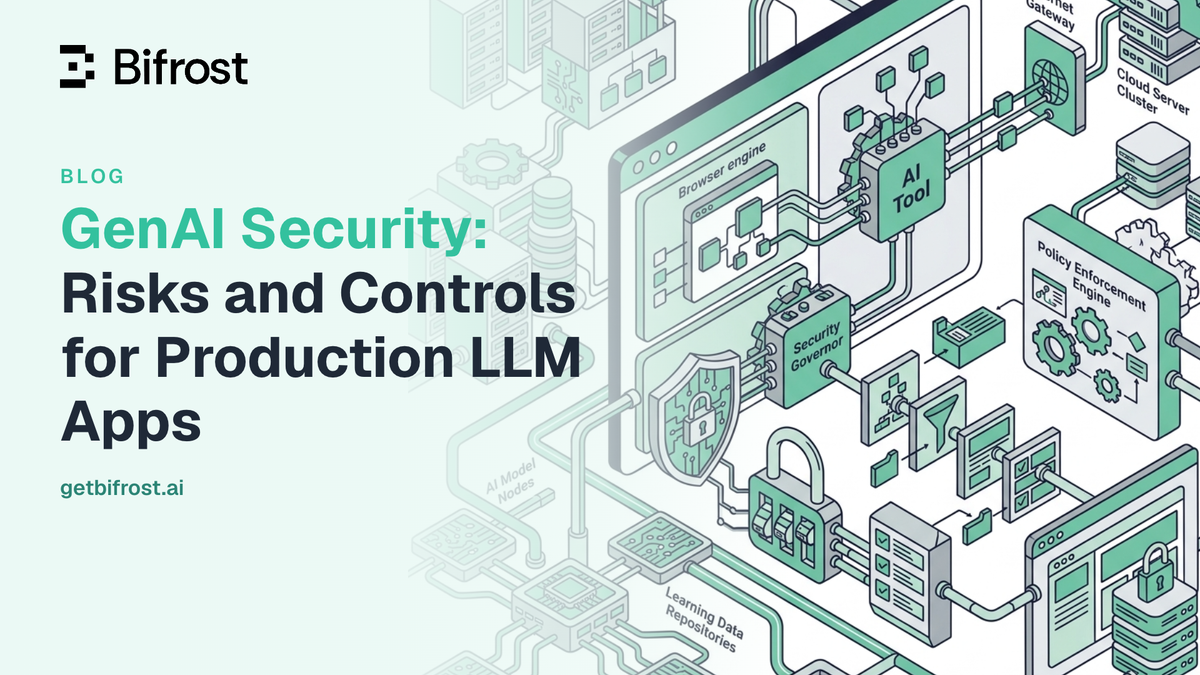
Production LLM applications face a distinct class of security risks: prompt injection, leaked secrets and PII, and agents that can call external tools with real-world consequences. GenAI security is the discipline of identifying those risks and applying controls that hold up under real traffic, not just in a controlled test. Bifrost, the open-source AI gateway built in Go by Maxim AI, is where many of these controls belong, because it sits in the path of every model request and can enforce policy consistently. This post covers the main security risks for production LLM apps and the controls that address them.
What Is GenAI Security?
GenAI security is the practice of protecting generative AI applications from risks that traditional application security does not fully cover, including prompt injection, sensitive data disclosure, unsafe tool use, and model abuse. It combines input and output guardrails, identity and access control, rate limiting, and audit logging to keep production LLM apps safe and compliant.
The threat model is different from a standard web app. An LLM processes untrusted natural-language input, can be steered by that input, and increasingly acts through tools that read data and trigger workflows. The NIST AI Risk Management Framework places governance first and calls for usage policies backed by technical enforcement. In practice, that enforcement has to run at request time, which is why teams centralize these controls in a governance layer rather than scattering them across individual services.
Top GenAI Security Risks for Production LLM Apps
The most useful risk catalog for production LLM apps is the OWASP Top 10 for LLM Applications, which maps the failure modes teams actually encounter. The highest-priority risks for most production deployments are:
- Prompt injection: malicious input overrides intended instructions, causing the model to ignore policy or exfiltrate data. This is ranked as the top risk in the OWASP prompt injection category.
- Sensitive information disclosure: PII, credentials, source code, or confidential data flowing into or out of the model, often through everyday prompts.
- Excessive agency: an agent with tool access takes consequential actions, a risk that grows as apps connect to external tools and MCP servers.
- Supply chain risk: vulnerable third-party models, packages, or plugins compromise the application.
- Unbounded consumption: uncontrolled request volume drives cost overruns or denial-of-service conditions.
- System prompt leakage: exposure of internal instructions that reveal how to bypass controls.
These are not hypothetical. IBM's 2025 Cost of a Data Breach Report found that 97% of organizations reporting an AI-related breach lacked proper AI access controls, and that breaches involving high levels of ungoverned AI cost about $670,000 more than the average breach. The common thread is missing enforcement, not missing policy.
Core Controls for Securing Production LLM Apps
Securing production LLM apps means applying a layered set of controls to every request and response. The controls that matter most map directly to the risks above:
- Input and output guardrails: inspect prompts and responses for prompt injection, PII, secrets, and unsafe content before they reach a model or a user.
- Identity and access control: authenticate every consumer, scope permissions by role, and tie usage to real identities rather than shared keys.
- Rate limiting and budgets: cap request and token volume to contain abuse, denial-of-service, and runaway cost.
- Observability and audit logging: record every request in immutable trails for incident response and compliance.
- Deployment isolation: run in VPC-isolated, air-gapped, or on-prem environments where data sensitivity requires it.
- Secure supply chain: scan dependencies and harden container images so the platform itself is not the weak link.
Applying these controls per service is where most teams fail, because enforcement drifts and coverage gaps appear. A central control point, an AI gateway that every request passes through, is how these controls stay consistent across models, teams, and environments.
How Bifrost Secures Production LLM Apps
Bifrost applies these security controls at the gateway, so every request to any provider inherits the same policy. Because it is the single path for AI traffic, guardrails, access control, and audit logging are enforced uniformly instead of being reimplemented in each application.
Guardrails for input and output safety
Guardrails validate inputs and outputs in real time against configured policies, protecting against harmful content, prompt injection, PII leakage, and credential leakage. Native secrets detection uses Gitleaks-backed rules to catch leaked API keys and tokens, and custom regex guardrails, including a built-in PII template, redact or reject organization-specific patterns. For teams that standardize on a provider, guardrails also integrate with AWS Bedrock Guardrails, Azure Content Safety, Google Model Armor, CrowdStrike AIDR, GraySwan Cygnal, and Patronus AI. Rules are grouped into reusable profiles, so one policy applies across every app.
Access control, rate limits, and budgets
Virtual keys are the primary governance entity, carrying per-consumer access permissions, budgets, and rate limits. Budgets and rate limits throttle token and request volume to contain abuse and cost, while role-based access control gives fine-grained, custom-role permissions across teams. Together these controls bound both who can use a model and how much, which directly addresses excessive agency and unbounded consumption.
Audit logging and compliance
Every request is recorded in immutable audit logs that support SOC 2, GDPR, HIPAA, and ISO 27001 reporting. This gives security teams the evidence trail that secure LLM operations require: who called which model, with which key, and what the guardrails did. The same governance controls that enforce policy also produce the record needed to prove it.
Secure deployment and supply chain
For regulated industries and strict data-residency requirements, Bifrost Enterprise runs in air-gapped, VPC-isolated, and on-prem environments, so sensitive traffic never leaves the network boundary. The platform itself follows defense-in-depth: security practices include dependency and static analysis scanning, container image hardening with a non-root user, and supply-chain controls like SHA-pinned actions. Securing the LLM app also means securing the infrastructure it runs on.
GenAI Security Best Practices
Strong security comes from enforcing controls at the right layer and proving they work. A few common questions help teams get there.
How do you prevent prompt injection in production LLM apps?
Prompt injection cannot be fully solved by prompt engineering alone. Apply input and output guardrails at the gateway to inspect and filter untrusted content, restrict what tools an agent can call, and log every request so injection attempts are detectable after the fact.
Where should GenAI security controls live?
Controls belong at a central enforcement point that every AI request passes through, rather than in each application. Placing governance and access control at the gateway keeps policy consistent across models, providers, and teams, and removes the coverage gaps that per-service enforcement creates.
How is GenAI security different from traditional application security?
Traditional controls assume deterministic inputs and outputs. LLMs process untrusted natural language, can be manipulated through that input, and act through tools, so it adds prompt-level guardrails, tool-access governance, and output inspection on top of standard application security.
What compliance frameworks apply to production LLM apps?
SOC 2, GDPR, HIPAA, and ISO 27001 all apply to systems that process regulated data through an LLM. Immutable audit logging and access control are the controls auditors look for, since they demonstrate both enforcement and evidence.
Getting Started with Bifrost
GenAI security for production LLM apps depends on enforcing guardrails, access control, rate limits, and audit logging consistently, at a layer every request passes through. The Bifrost platform provides that layer as an open-source AI gateway, turning scattered security controls into one policy engine for all AI traffic. To see how it secures your production LLM apps, book a demo with the Bifrost team.