Top 5 Platforms to Test and Optimize AI Prompts
TL;DR
Selecting the right platform to test and optimize AI prompts is critical for building reliable AI applications. This guide examines five leading platforms based on experimentation capabilities, evaluation frameworks, collaboration features, and production integration. Teams should evaluate platforms according to their specific requirements for lifecycle coverage, cross-functional workflows, and deployment needs.
- Maxim AI is the only platform in this comparison covering prompt experimentation, agent simulation, evaluation, and production observability in one system.
- PromptLayer focuses on prompt versioning, analytics, and historical backtesting for teams with established workflows.
- Mirascope is a code-first Python toolkit with automatic versioning, suited to teams defining LLM applications in code rather than through a UI.
- LangSmith provides structured prompt management and prompt diffing, fitting best with LangChain-based stacks.
- Promptfoo runs prompt tests from the command line and integrates into CI/CD pipelines for test-driven development.
Introduction
Prompt engineering has evolved from an experimental practice into a fundamental discipline for AI application development. As organizations deploy AI agents, chatbots, and copilots at scale, systematic prompt testing and optimization has become essential for ensuring consistent, high-quality outputs.
The challenge lies in selecting platforms that support the full lifecycle of prompt development. Teams require tools that enable rapid experimentation, rigorous evaluation, cross-functional collaboration, and production monitoring. This article examines five platforms that address these requirements through distinct approaches and capabilities.
Platform Comparison Table
| Platform | Best For | Key Strengths | Limitations | Deployment |
|---|---|---|---|---|
| Maxim AI | Cross-functional teams building complex agentic workflows | End-to-end lifecycle coverage, simulation capabilities, no-code UI for PMs | - | Cloud, In-VPC Deployment |
| PromptLayer | Teams with established workflows requiring enterprise-scale management | Robust versioning, analytics, historical backtesting | Limited automation for optimization workflows | Cloud |
| Mirascope | Python-first teams defining LLM apps in code | Typed SDK, composable tools & traces, framework-agnostic integration | No standalone UI; code-centric developer experience | Library (runs in your stack) |
| LangSmith | Teams heavily invested in LangChain ecosystem | Comprehensive tracing, structured prompt management, prompt diffing | Manual dataset curation, LangChain dependency | Cloud |
| Promptfoo | Developer teams preferring CLI-based workflows | CI/CD integration, test-driven methodology, lightweight | Minimal UI, limited production observability | Cloud, Self-hosted |
1. Maxim AI: End-to-End Platform for Comprehensive Prompt Engineering
Maxim AI provides an integrated approach to prompt testing and optimization through its comprehensive platform that spans the entire AI development lifecycle.
Core Capabilities
Experimentation with Playground++
- Organize and version prompts directly from the UI for iterative improvement
- Deploy prompts with different deployment variables and experimentation strategies without code changes
- Compare output quality, cost, and latency across various combinations of prompts, models, and parameters
- Connect with databases, RAG pipelines, and prompt tools seamlessly
- Simulate customer interactions across hundreds of real-world scenarios and user personas
- Evaluate agents at a conversational level, analyze trajectory, task completion, and failure points
- Re-run simulations from any step to reproduce issues and identify root causes
- Support for multi-turn conversation testing and tool usage validation
- Configurable evaluations at session, trace, or span level
- Access pre-built evaluators through the evaluator store
- Create custom evaluators (deterministic, statistical, LLM-as-a-judge)
- Human evaluation workflows for last-mile quality checks
- Distributed tracing for complex agent workflows
- Real-time quality monitoring with automated evaluations
- Track and debug live issues with minimal user impact
- Maintain audit trails for compliance requirements
Cross-Functional Collaboration
Maxim distinguishes itself through workflows designed for how AI engineering and product teams collaborate:
- No-code UI: Product managers experiment with prompts and run evaluations independently
- Performant SDKs: Available in Python, TypeScript, Java, and Go for engineering teams
- Custom dashboards: Create insights across custom dimensions with a few clicks
- Shared workspaces: Enable seamless collaboration between technical and non-technical stakeholders
Organizations like Clinc and Mindtickle have leveraged Maxim's capabilities to reduce time-to-production by 75% while maintaining rigorous quality standards.
Best For: Teams building complex, multi-step agentic workflows requiring comprehensive testing, cross-functional environments where product managers need active participation, and enterprises prioritizing systematic quality assurance with human-in-the-loop validation.
See More: Compare Maxim vs. LangSmith
2. PromptLayer: Specialized Prompt Management and Tracking
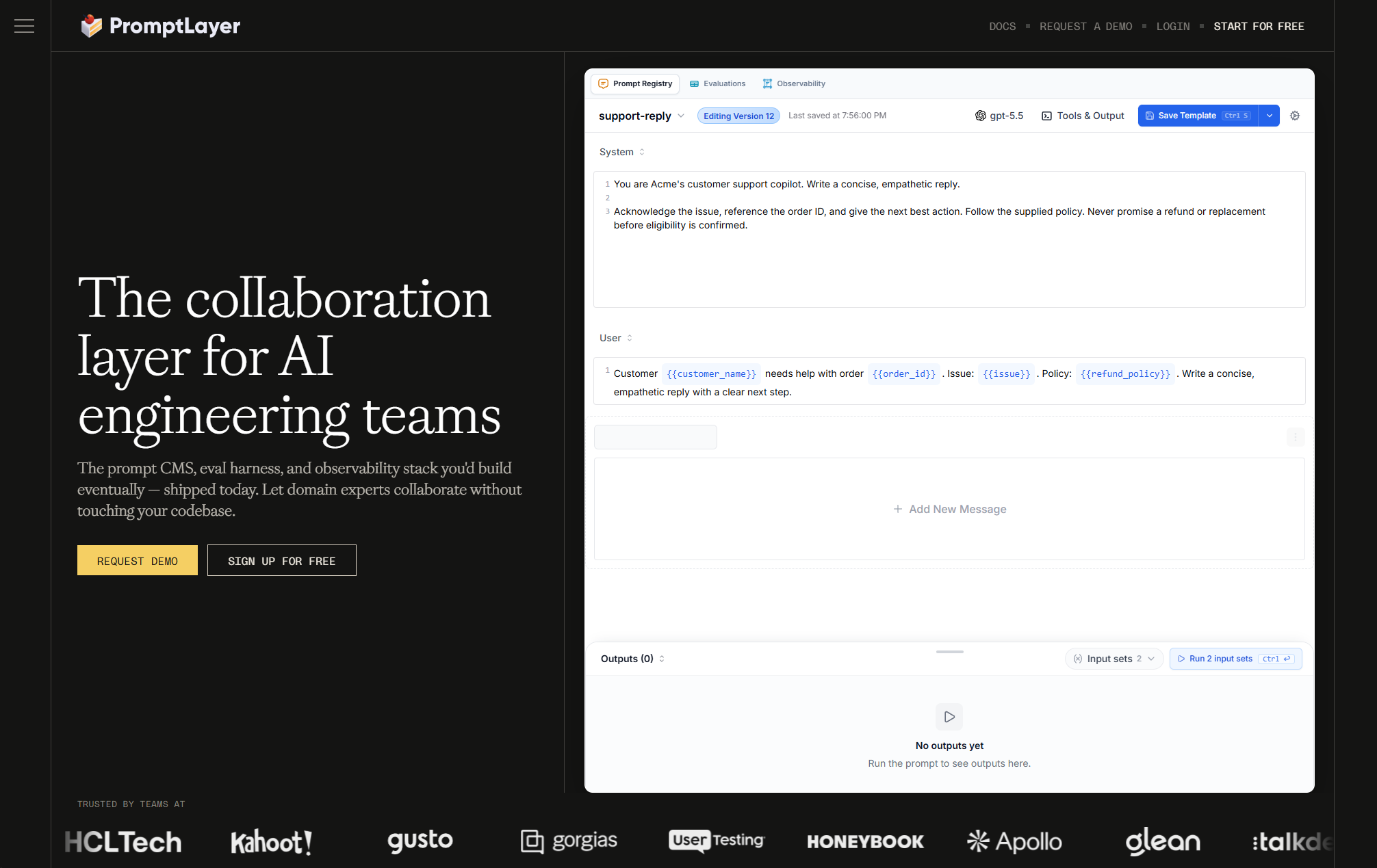
PromptLayer is a platform designed to enhance the efficiency and precision of LLM applications through streamlined prompt management, versioning, and observability for enterprise-scale deployments.
Key Features
Visual Prompt Management
- Design, track, and optimize prompts in real time through visual tools
- Version control for systematic tracking of prompt changes
- Understand what led to quality improvements or regressions
- Proxy middleware for seamless API integration
Analytics and Monitoring
- Log inputs, outputs, costs, and latencies for performance optimization
- Historical backtesting for evaluating prompt changes
- Regression testing to prevent quality degradation
- Model comparison capabilities across different configurations
Collaboration Interface
- Both technical and non-technical team members can edit prompts through the UI
- Shared prompt libraries for team consistency
- Deployment controls for production management
- Integration with existing development workflows
Considerations
PromptLayer focuses on prompt management and observability rather than end-to-end automation. Teams requiring automated variant generation and optimization may need supplemental tools. The platform delivers maximum value for teams with structured prompt workflows and consistent API usage patterns.
Best For: Teams requiring robust prompt versioning and tracking capabilities, organizations with established prompt workflows seeking enterprise-scale management, and teams prioritizing observability alongside prompt development.
3. Mirascope: Lightweight Python Toolkit
Platform Overview
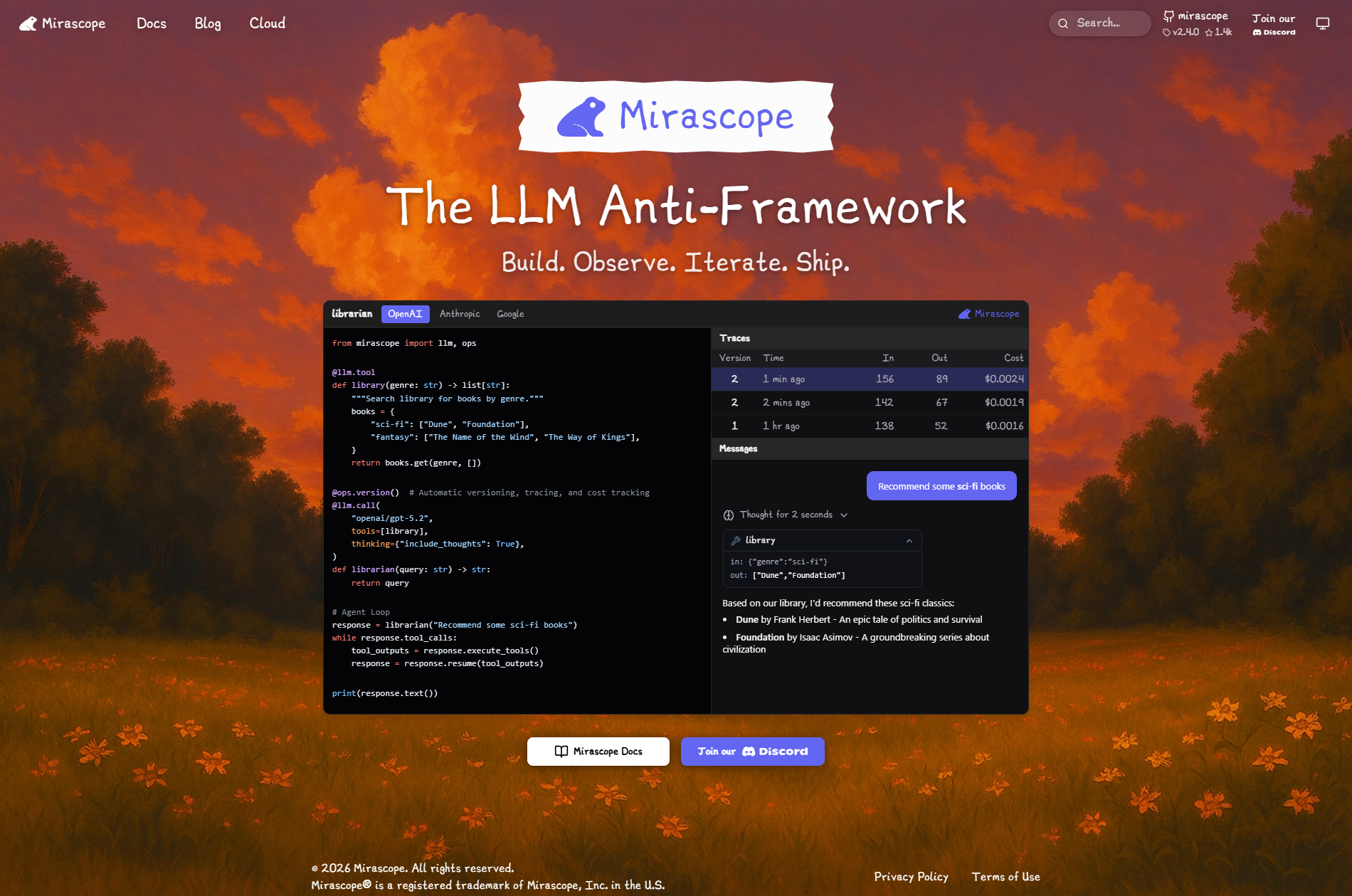
Mirascope is a minimalist Python toolkit for building LLM applications, paired with Lilypad for prompt management and observability. The project emphasizes using native Python constructs rather than introducing proprietary abstractions.
Key Benefits
Code-first approach: Mirascope relies on Python functions, decorators, and Pydantic models rather than custom DSLs or configuration formats. This makes it intuitive for Python developers and reduces the learning curve.
Automatic versioning: Lilypad's @trace decorator automatically versions every LLM call along with the complete execution context. This includes not just the prompt template but also input data, model settings, and surrounding code.
Framework agnostic: Works alongside other frameworks like LangChain without lock-in. The @trace decorator can be applied to any Python function, making it flexible for diverse workflows.
4. LangSmith: LangChain-Native Debugging and Dataset Management
LangSmith, built on LangChain, provides version control, collaborative editing, interactive prompt design via Prompt Canvas, and large-scale testing capabilities optimized for the LangChain ecosystem.
Core Functionality
Structured Prompt Management
- Manage structured prompts with schema-aligned outputs
- Prompt diffing to understand changes between versions
- Test over datasets for systematic quality assessment
- Structured output validation for consistent responses
Comprehensive Tracing
- Detailed tracing for LLM call sequences
- Visualize component interactions in multi-step workflows
- Debug complex agent systems with full visibility
- Integration with LangChain framework components
Dataset-Driven Testing
- Large-scale testing across curated datasets
- Establish quality baselines for comparison
- Track performance across prompt versions
- Support for iterative refinement workflows
Limitations
LangSmith requires manual effort for dataset curation and evaluation setup. Teams seeking automated prompt refinement may need additional tools. The platform is optimized for teams already using LangChain, which may create framework dependencies.
Best For: Teams heavily invested in the LangChain ecosystem, organizations requiring detailed debugging capabilities for complex agent systems, and teams prioritizing structured prompt management with comprehensive tracing.
See More: the full Maxim and LangSmith comparison
5. Promptfoo: CLI-Based Testing for Developer Teams
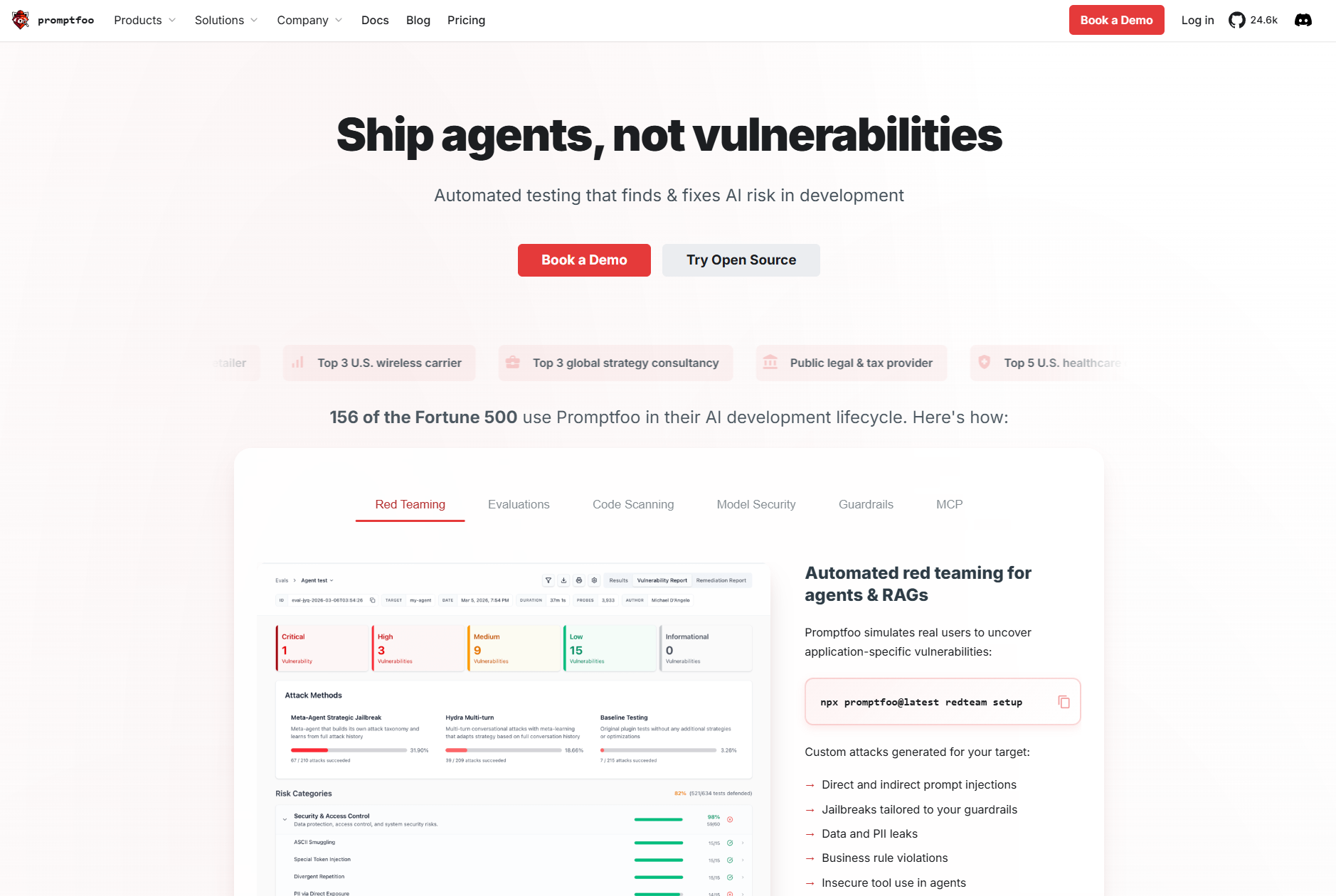
Promptfoo offers a command-line approach to prompt testing with a test-driven development methodology, emphasizing systematic improvement through writing tests before optimizing prompts.
Development Approach
Command-Line Testing
- Developer-focused tooling through CLI interfaces
- Version control integration for tracking changes
- Lightweight deployment with minimal overhead
- Configuration through code for reproducibility
Test-Driven Methodology
- Define evaluation criteria before prompt development
- Write tests first, then optimize prompts to pass
- Systematic thinking about prompt quality
- Support for multiple testing scenarios
CI/CD Integration
- Automated prompt testing in continuous integration pipelines
- Integration with standard development workflows
- Version control compatibility
- Minimal configuration requirements
Trade-offs
Promptfoo's minimalist interface may feel limited for teams needing rich dashboards or visual comparison tools. The platform focuses on testing rather than providing full observability for production systems. Teams not comfortable with CLI workflows may face adoption challenges.
Best For: Developer-focused teams preferring command-line tooling, organizations prioritizing CI/CD integration for prompt testing, and teams seeking lightweight, code-centric testing frameworks.
Frequently Asked Questions
What is prompt engineering?
Prompt engineering is the practice of designing, testing, and refining the instructions given to a language model so it produces reliable output for a specific task. In production it extends beyond wording to include versioning, evaluation against fixed datasets, and monitoring how prompt changes affect quality, latency, and cost.
What is prompt optimization, and how does it differ from prompt engineering?
Prompt engineering is the broader discipline of designing and managing prompts. Prompt optimization is the narrower, measurement-driven part: systematically comparing variants against evaluation criteria to find the version performing best on quality, cost, and latency together. Optimization needs a scoring method, otherwise changes are guesswork.
What are the best practices for prompt engineering in production?
Production prompt engineering rests on four habits: version every prompt so changes stay traceable, evaluate against a fixed dataset rather than ad-hoc examples, compare variants on quality, cost, and latency together, and monitor live traffic so regressions surface after deployment. Maxim's Playground++ supports side-by-side comparison across those dimensions.
Why does prompt versioning matter?
Prompt versioning makes changes traceable and reversible. Without it, a quality regression cannot be tied back to the edit that caused it, and rolling back means reconstructing an earlier version from memory. Maxim supports prompt management and versioning from both the UI and SDK, with deployment variables that change behavior without code changes.
How do you evaluate prompt quality at scale?
Evaluating prompts at scale means running each variant against a curated dataset and scoring outputs automatically, using deterministic checks, statistical metrics, or LLM-as-a-judge evaluators, with human review for the cases automated scoring cannot settle. Maxim's prompt evaluations run at session, trace, or span level.
What should a prompt engineering platform include?
A production prompt engineering platform should cover four capabilities: a playground for rapid iteration across models and parameters, versioning with deployment control, evaluation against datasets with both automated and human scoring, and production observability linking prompt versions to live quality. Coverage across all four separates full-lifecycle platforms from single-purpose tools.
Conclusion
The prompt testing and optimization landscape in 2026 offers platforms addressing different aspects of the AI development lifecycle. Maxim AI provides comprehensive capabilities for teams requiring end-to-end simulation, evaluation, and observability with strong cross-functional collaboration. PromptLayer serves teams prioritizing management and tracking at enterprise scale. Mirascope offers automated optimization with complete evaluation loops. LangSmith integrates deeply with LangChain ecosystems for structured prompt development. Promptfoo delivers CLI-based testing for developer-centric workflows.
Organizations should evaluate platforms based on their specific requirements for lifecycle coverage, collaboration workflows, deployment models, and integration needs. The right platform accelerates development cycles while maintaining the systematic quality assurance necessary for production AI systems.
Ready to implement production-grade prompt testing for your AI applications? Schedule a demo to see how Maxim's end-to-end platform can accelerate your prompt evaluation workflows and help your team ship AI agents more than 5x faster.