Top 5 AI Gateways for Enterprises in 2026
TL;DR
- An enterprise-ready AI gateway is judged on seven criteria: performance overhead, multi-provider support, governance, reliability, observability, MCP support, and deployment flexibility.
- Bifrost, the open-source AI gateway by Maxim AI, leads on all seven: 11 microseconds of overhead at 5,000 RPS, 23+ providers across 1,000+ models, native MCP as client and server, full governance (virtual keys, RBAC, SSO, vault, audit logs), and self-host, in-VPC, or air-gapped deployment under Apache 2.0.
- Kong suits enterprises already running Kong for API management; Cloudflare fits edge and managed deployments; LiteLLM offers Python-native provider breadth; OpenRouter offers model breadth with one billing relationship.
- The two shifts reshaping the category in 2026 are agentic workloads (making semantic caching and MCP-native design table stakes) and security teams demanding in-VPC or air-gapped deployment with immutable audit logs.
- For regulated workloads, deployment flexibility and audit-ready logging matter more than raw feature counts, which separates self-hostable gateways from managed-only ones.
Enterprise AI teams in 2026 are running multiple LLM providers in parallel, OpenAI for reasoning, Anthropic for coding, Google Gemini for multimodal inputs, and AWS Bedrock for regulated workloads. Without a unified control plane, this creates fragmented authentication, unpredictable spend, zero failover coverage, and compliance blind spots. The top AI gateways for enterprises in 2026 solve this by sitting between applications and model providers, centralizing routing, governance, observability, and cost control. This guide ranks the five strongest enterprise AI gateways available today, led by Bifrost, the open-source gateway built by Maxim AI.
The shift is real. Gartner now classifies the AI gateway as a foundational layer for production generative AI, and enterprise AI spending is projected to exceed $100 billion in 2026 as organizations move from pilots to production.
Key Criteria for Evaluating an Enterprise AI Gateway
Before ranking the options, here is the evaluation framework used in this comparison. An enterprise-ready AI gateway should meet each of the following criteria:
- Performance overhead: Added latency per request at sustained throughput, ideally measured in microseconds rather than milliseconds.
- Multi-provider support: Unified access to OpenAI, Anthropic, AWS Bedrock, Google Vertex AI, Azure OpenAI, and open-weight providers through a single API.
- Governance: Virtual keys, budgets, rate limits, role-based access control, and audit logs at the team or customer level.
- Reliability: Automatic failover, weighted load balancing, and health monitoring across providers and keys.
- Observability: Native Prometheus metrics, OpenTelemetry traces, and integrations with Datadog, Grafana, and similar platforms.
- MCP support: Native Model Context Protocol handling for agentic workflows, which Anthropic's MCP specification has established as the de facto standard for AI tool integration.
- Deployment flexibility: Self-hosted, in-VPC, Kubernetes-native, and air-gapped options for enterprises with data residency or compliance requirements.
For a deeper capability matrix, the LLM Gateway Buyer's Guide breaks down each criterion against the current market.
Top 5 AI Gateways for Enterprises in 2026
The five gateways below are ranked on performance, governance depth, and production readiness for enterprise AI workloads.
1. Bifrost (by Maxim AI)
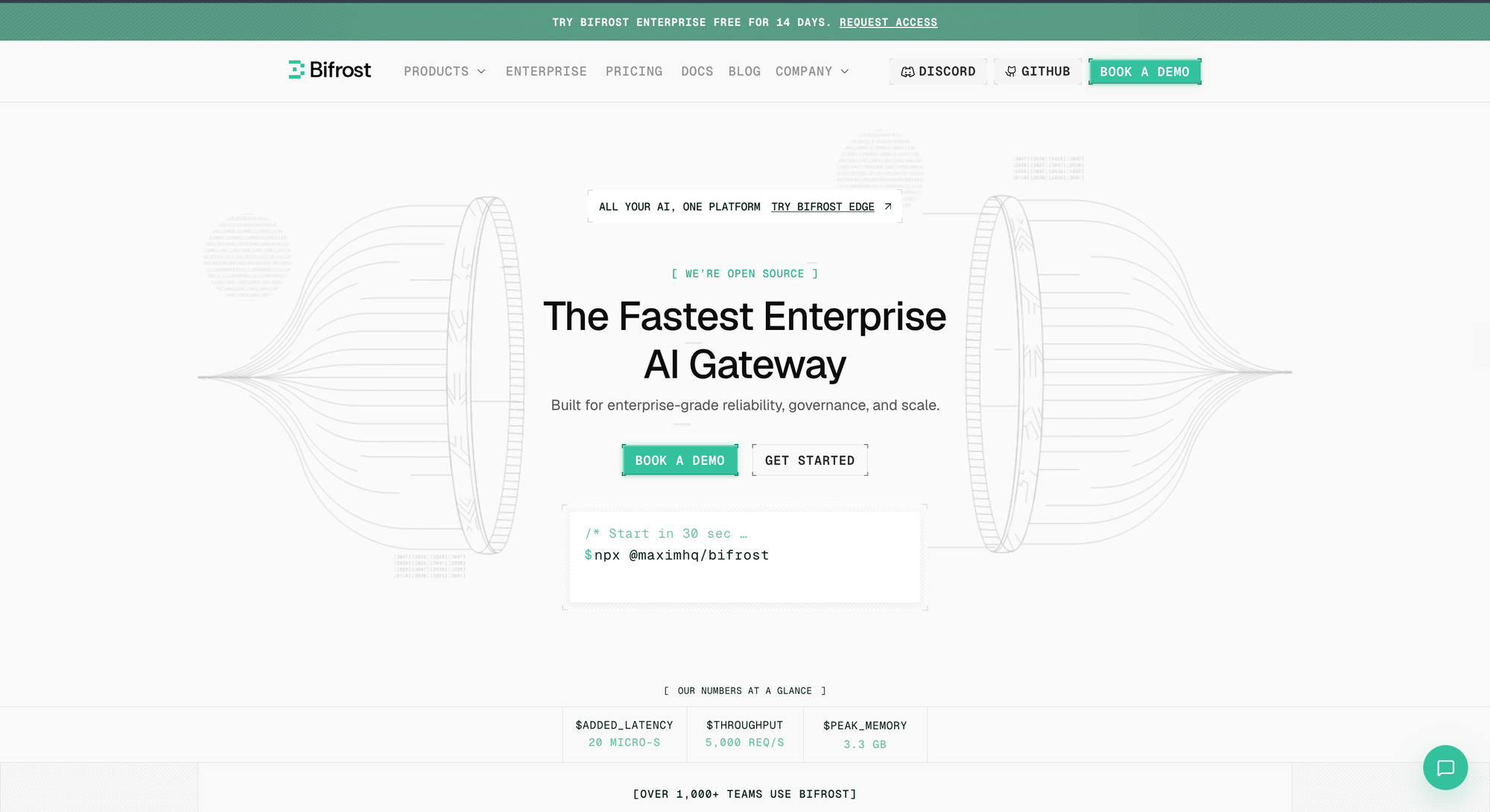
Bifrost is a high-performance, open-source AI gateway built in Go by Maxim AI. It unifies access to 23+ LLM providers or 1000+ models through a single OpenAI-compatible API and adds only 11 microseconds of overhead per request in sustained benchmarks at 5,000 requests per second. Bifrost publishes independent performance benchmarks showing this overhead holds steady under load, which matters when gateway latency compounds across multi-step agent workflows.
What separates Bifrost from other enterprise AI gateways is its architecture. Go's compiled binaries, lightweight goroutines, and predictable garbage collection give Bifrost a measurable performance advantage over Python-based alternatives, which typically introduce hundreds of microseconds to milliseconds of gateway overhead under equivalent load.
Key capabilities:
- Unified API: Single OpenAI-compatible interface across 23+ providers including OpenAI, Anthropic, AWS Bedrock, Google Vertex AI, Azure OpenAI, Groq, Mistral, Cohere, Cerebras, and xAI.
- Drop-in replacement: Teams change only the base URL in their existing code to start routing through Bifrost. The drop-in replacement works with the OpenAI, Anthropic, AWS Bedrock, Google GenAI, LiteLLM, LangChain, and PydanticAI SDKs.
- Automatic failover and load balancing: Bifrost's automatic fallbacks route around provider outages with zero downtime, and weighted load balancing distributes traffic across API keys and providers.
- Semantic caching: Bifrost's semantic caching reuses responses based on meaning rather than exact string matches, cutting costs and latency for semantically similar queries.
- MCP gateway: Bifrost's MCP gateway acts as both an MCP client and server. It connects to external tool servers, exposes tools to clients like Claude Desktop, and supports OAuth 2.0 with automatic token refresh. Code Mode reduces token usage by 50% and latency by 40% compared to direct tool-call orchestration, as detailed in the MCP gateway analysis.
- Enterprise governance: Virtual keys, hierarchical budgets, rate limits, RBAC, SSO with Okta and Entra, HashiCorp Vault integration, and immutable audit logs for SOC 2, GDPR, HIPAA, and ISO 27001 compliance.
- Deployment: Self-hosted, in-VPC, Kubernetes-native, or air-gapped. Clustering supports high availability with automatic service discovery.
Best for: Bifrost is built for enterprises running mission-critical AI workloads that require best-in-class performance, scalability, and reliability. It serves as a centralized AI gateway to route, govern, and secure all AI traffic across models and environments with ultra low latency. Bifrost unifies LLM gateway, MCP gateway, and Agents gateway capabilities into a single platform.
Designed for regulated industries and strict enterprise requirements, it supports air-gapped deployments, VPC isolation, and on-prem infrastructure. It provides full control over data, access, and execution, along with robust security, policy enforcement, and governance capabilities.
2. Kong AI Gateway
Kong AI Gateway extends the widely adopted Kong API Gateway with a set of AI-specific plugins. It positions itself as an enterprise API management platform that happens to handle AI traffic, which appeals to teams already running Kong for their broader API estate.
Key capabilities:
- Multi-provider routing across OpenAI, Anthropic, Azure OpenAI, and a handful of other providers via purpose-built plugins.
- Request and response transformation, prompt templating, and basic semantic routing.
- Rate limiting, authentication, and logging inherited from the core Kong gateway.
- Enterprise support through Kong Konnect for hybrid and multi-cloud deployments.
Limitations: Because Kong AI Gateway is built as a plugin layer on top of a general-purpose API gateway, it adds noticeable overhead compared to purpose-built AI gateways. Native MCP support, semantic caching at the gateway level, and deep LLM-specific observability are less developed than in purpose-built alternatives.
Best for: Enterprises with an existing Kong investment that want to extend their API management platform to cover AI traffic.
3. Cloudflare AI Gateway
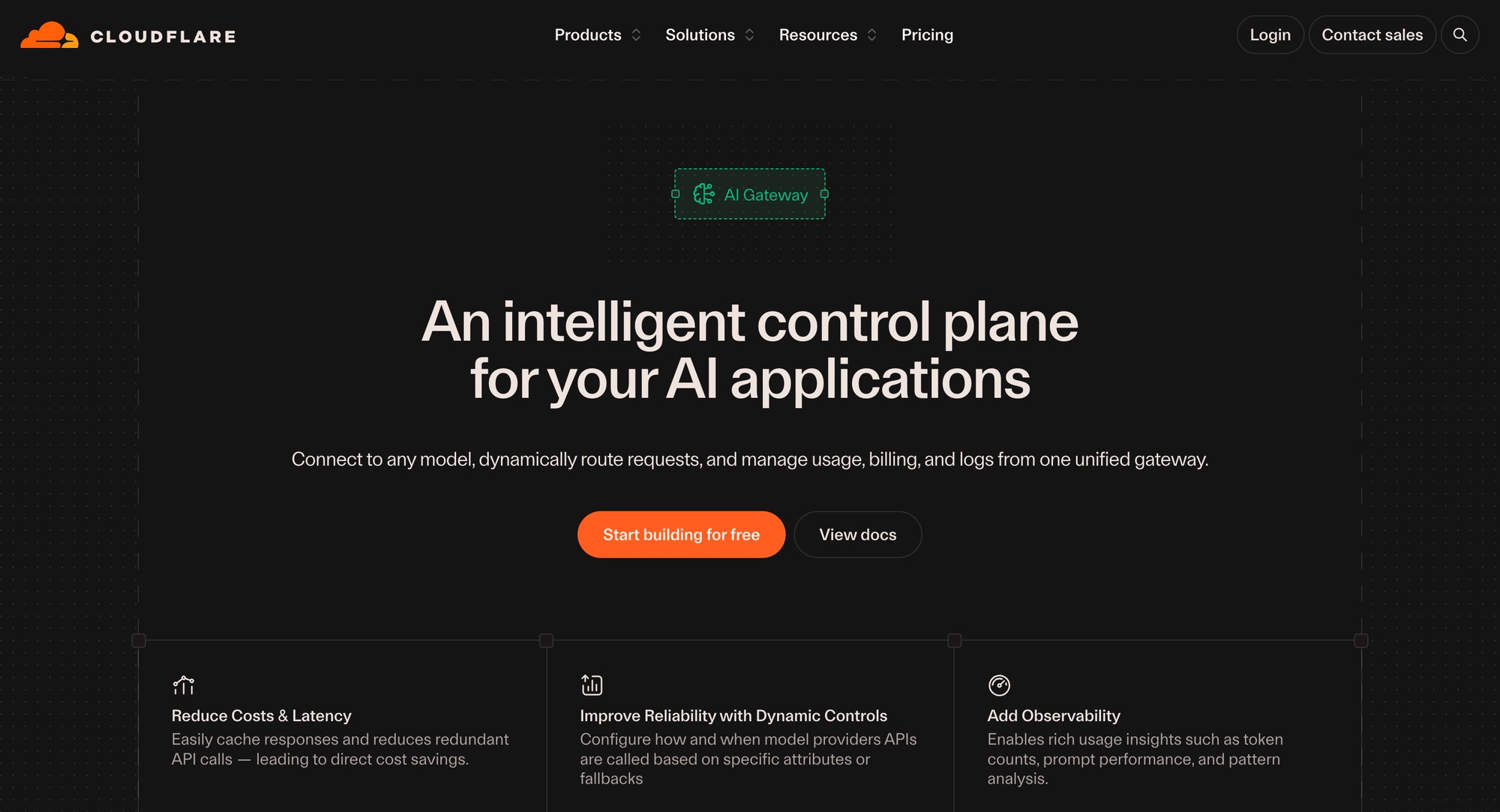
Cloudflare AI Gateway is a managed service that runs on Cloudflare's global edge network. Teams proxy LLM API calls through Cloudflare and get edge-level caching, analytics, and rate limiting without operating any infrastructure themselves.
Key capabilities:
- Managed proxy for OpenAI, Anthropic, Google AI, Azure OpenAI, and several other providers.
- Edge-level response caching and real-time logging through the Cloudflare dashboard.
- Built-in cost tracking per provider and per request.
- Integration with Cloudflare Workers for custom request handling.
Limitations: As a managed service, Cloudflare AI Gateway offers limited customization compared to self-hosted options. MCP support, plugin extensibility, and deep governance features like virtual keys, hierarchical budgets, and RBAC are limited. Data leaves the enterprise perimeter by design, which can be a blocker for regulated workloads.
Best for: Teams already invested in the Cloudflare ecosystem that want a fully managed, low-configuration AI gateway with edge caching and basic analytics.
4. LiteLLM
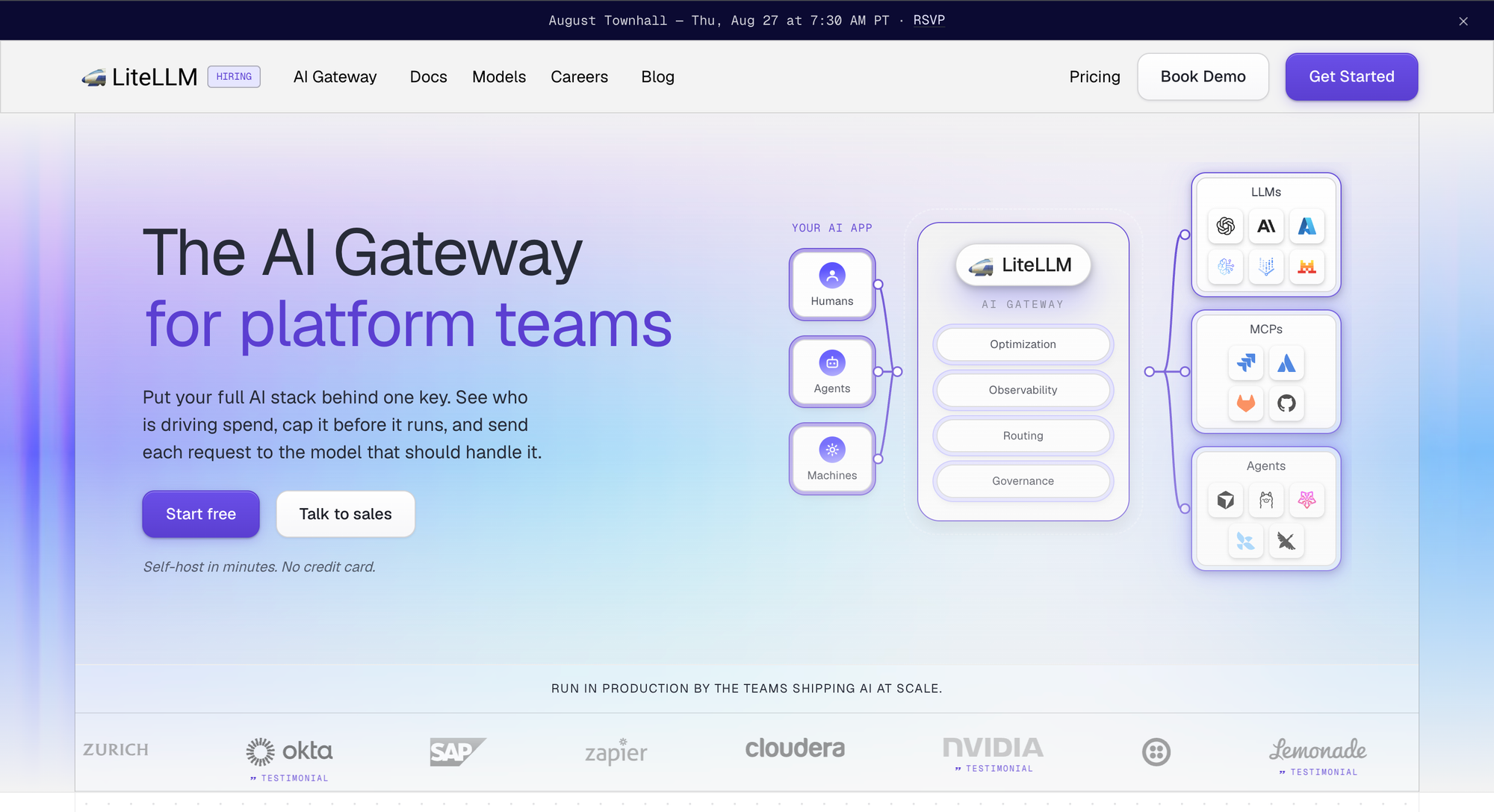
LiteLLM is an open-source Python library and proxy server that provides a unified interface across 100+ LLM providers. It started as a developer convenience SDK and expanded into a proxy deployment model to cover gateway-style use cases.
Key capabilities:
- Broad provider coverage through a single Python interface.
- Proxy mode for multi-application deployments with a shared routing layer.
- Basic load balancing, retries, and fallback chains.
- Budget tracking and key management for team-level governance.
Limitations: LiteLLM's Python foundation introduces meaningfully higher gateway overhead than Go-based alternatives under sustained load. Enterprise-grade features like native clustering, adaptive load balancing, deep MCP support, and comprehensive audit logging require additional engineering investment. Teams migrating off LiteLLM for performance or governance reasons can review Bifrost as a LiteLLM alternative for a full feature comparison.
Best for: Prototype and early-production environments where provider breadth and Python-native integration matter more than latency and enterprise governance depth.
5. OpenRouter
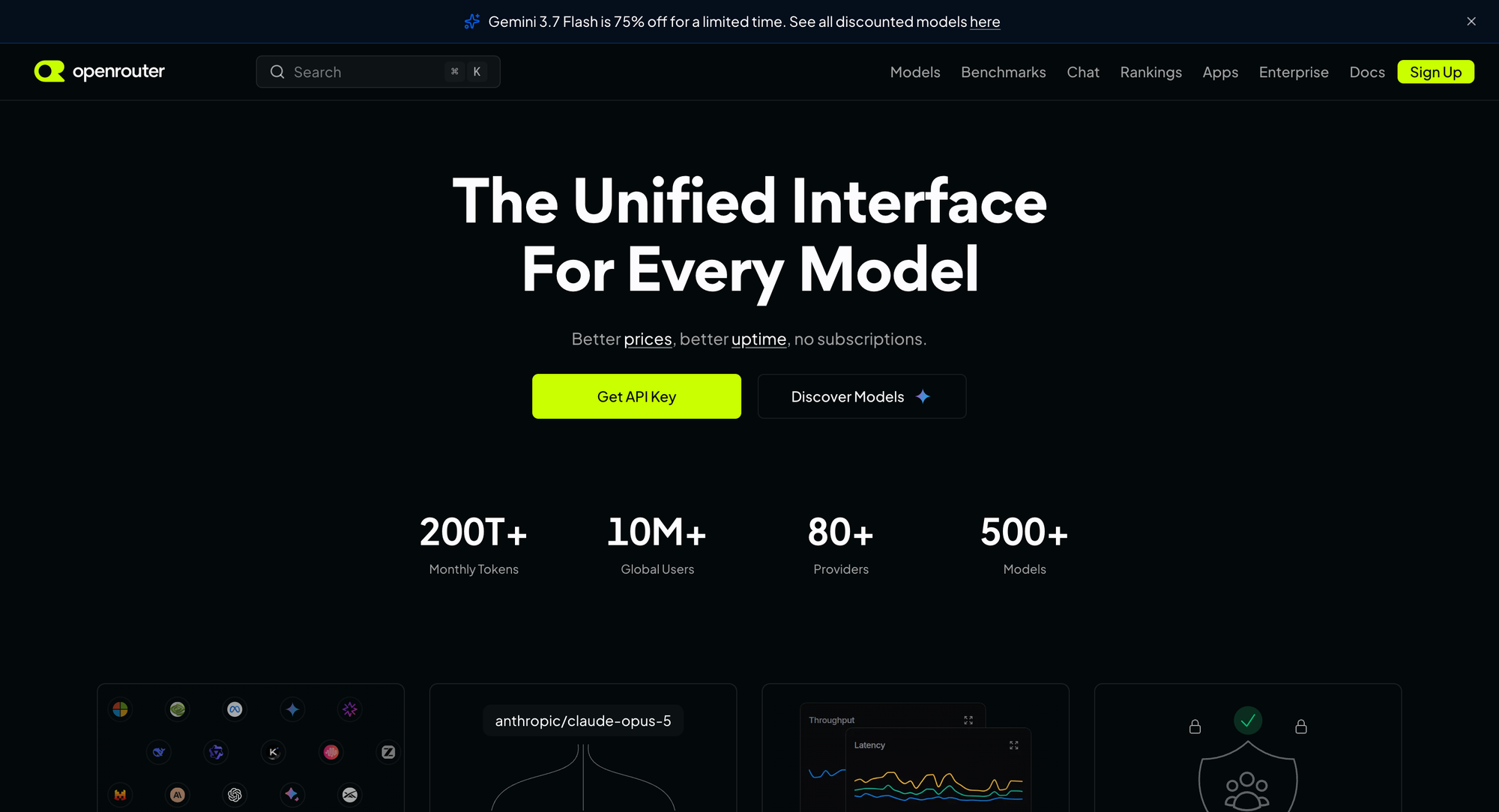
OpenRouter is a hosted API service that aggregates access to hundreds of LLM models behind a single OpenAI-compatible endpoint. Teams sign up, get an API key, and pay per token through OpenRouter's billing rather than managing provider relationships individually.
Key capabilities:
- Massive model catalog spanning frontier models, open-weight models, and niche providers.
- Single billing relationship across all routed providers.
- Basic fallback routing and model-level pricing transparency.
- OpenAI-compatible API for easy integration.
Limitations: OpenRouter is a hosted aggregator, not an infrastructure layer. Enterprises give up data residency, deep governance controls, custom plugins, and the ability to self-host. Observability is limited to OpenRouter's dashboard, and there is no native MCP gateway, semantic caching, or in-VPC deployment option.
Best for: Small teams and experimentation workloads where model breadth and simplified billing outweigh the trade-offs of a hosted aggregator.
How the Top 5 AI Gateways Compare on Core Criteria
| Criterion | Bifrost | Kong AI | Cloudflare | LiteLLM | OpenRouter |
|---|---|---|---|---|---|
| Performance overhead | 11µs at 5,000 RPS | Hundreds of µs (plugin layer) | Edge, managed | Higher (Python) | Managed |
| Provider breadth | 23+ providers, 1,000+ models | Major providers | Major providers | 100+ providers | Hundreds of models |
| Governance depth | Virtual keys, budgets, RBAC, SSO, vault, audit logs | Inherited from core gateway | Limited | Basic budgets and keys | Limited |
| MCP support | Full (client and server, OAuth, Code Mode) | Via plugins | No | Limited | No |
| Deployment | Self-host, in-VPC, Kubernetes, air-gapped | Self-host, Konnect | Managed only | Self-host | Managed only |
A direct comparison across the evaluation framework clarifies the trade-offs:
- Performance overhead: Bifrost leads with 11µs at 5,000 RPS. Kong, Cloudflare, LiteLLM, and OpenRouter all operate in the hundreds of microseconds to low milliseconds range depending on deployment.
- Provider breadth: OpenRouter and LiteLLM offer the widest model catalogs. Bifrost covers 23+ providers with first-class SDK compatibility. Kong and Cloudflare cover the major providers through managed integrations.
- Governance depth: Bifrost provides virtual keys, hierarchical budgets, RBAC, SSO, vault support, and audit logs natively. Kong inherits governance from its core gateway. LiteLLM provides basic budget and key management. Cloudflare and OpenRouter offer limited governance controls.
- MCP support: Bifrost offers the most complete MCP gateway, acting as both client and server with OAuth and Code Mode. Other gateways in this list either lack MCP entirely or handle it through external plugins.
- Deployment flexibility: Bifrost, Kong, and LiteLLM support self-hosted and in-VPC deployments. Cloudflare and OpenRouter are managed services without self-hosted options.
What to Look for in 2026 and Beyond
Two shifts are reshaping the enterprise AI gateway category this year. First, agentic workloads are pushing token costs and latency in directions traditional solutions were not designed for, making semantic caching and MCP-native architectures table stakes. Second, enterprise security teams are demanding in-VPC or air-gapped deployments with immutable audit logs as generative AI moves into regulated workflows across industries like financial services and healthcare.
Try Bifrost for Your Enterprise AI Gateway
Bifrost combines microsecond-level performance, 23+ provider coverage, native MCP support, and enterprise-grade governance in a single open-source AI gateway. Teams can deploy Bifrost in under a minute via npx or Docker, integrate it as a drop-in replacement for existing SDKs, and scale to production with clustering, RBAC, and audit logs built in.
To see how Bifrost compares against your current AI gateway, book a demo with the Bifrost team or explore the Bifrost GitHub repository to get started.
Frequently Asked Questions
What makes an AI gateway enterprise-ready?
An enterprise-ready gateway meets seven criteria: low performance overhead at sustained throughput, broad multi-provider support, deep governance (virtual keys, budgets, RBAC, SSO, audit logs), automatic failover, native observability, MCP support for agentic workloads, and flexible deployment including self-hosted, in-VPC, and air-gapped options. Managed convenience matters less than control over data, access, and compliance.
What is the best AI gateway for enterprises in 2026?
For mission-critical enterprise workloads, Bifrost is the strongest choice, combining 11 microseconds of overhead at 5,000 RPS, 23+ providers, native MCP as client and server, full governance, and self-host or air-gapped deployment under Apache 2.0. Kong fits existing Kong estates, Cloudflare fits edge deployments, and LiteLLM and OpenRouter suit breadth-first or hosted use.
Do enterprise AI gateways support the Model Context Protocol?
Support varies widely. A gateway with native MCP handling governs agent tool calls the same way it governs model calls, applying access control and audit logging to both. Bifrost offers the most complete MCP gateway in this comparison, acting as both MCP client and server with OAuth 2.0 and Code Mode; the others either lack MCP or handle it through external plugins.
Can an enterprise AI gateway be self-hosted or air-gapped?
Yes, and for regulated industries it usually must be. Self-hosting inside a VPC or an air-gapped environment keeps prompt data, provider keys, and enforcement decisions inside the enterprise perimeter. Bifrost, Kong, and LiteLLM support self-hosted deployment; Bifrost adds in-VPC, Kubernetes-native, and air-gapped options with clustering for high availability. Cloudflare and OpenRouter are managed-only.
How is an enterprise AI gateway different from a regular AI gateway?
The core function is the same, but enterprise readiness adds depth: hierarchical governance across teams and customers, RBAC and SSO, immutable audit logs for SOC 2, HIPAA, GDPR, and ISO 27001, in-VPC or air-gapped deployment, and performance that holds under sustained production load. A developer-convenience gateway covers routing; an enterprise gateway covers routing plus compliance and control.