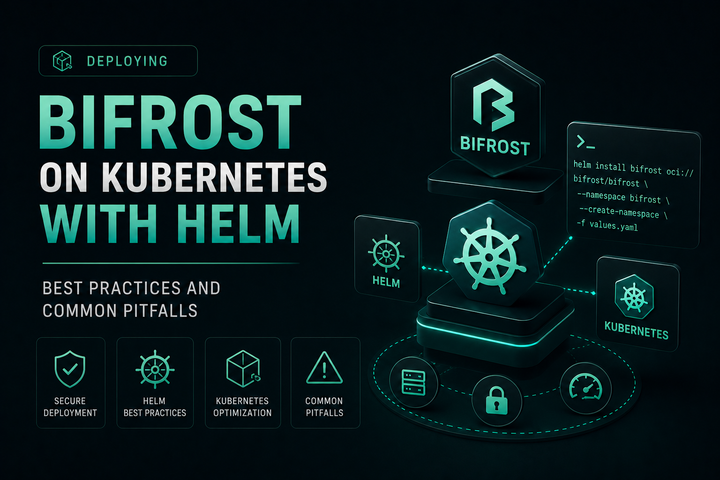
Qwen-Coder vs Gemini 2.5 Pro Pricing for Long-Context Refactoring
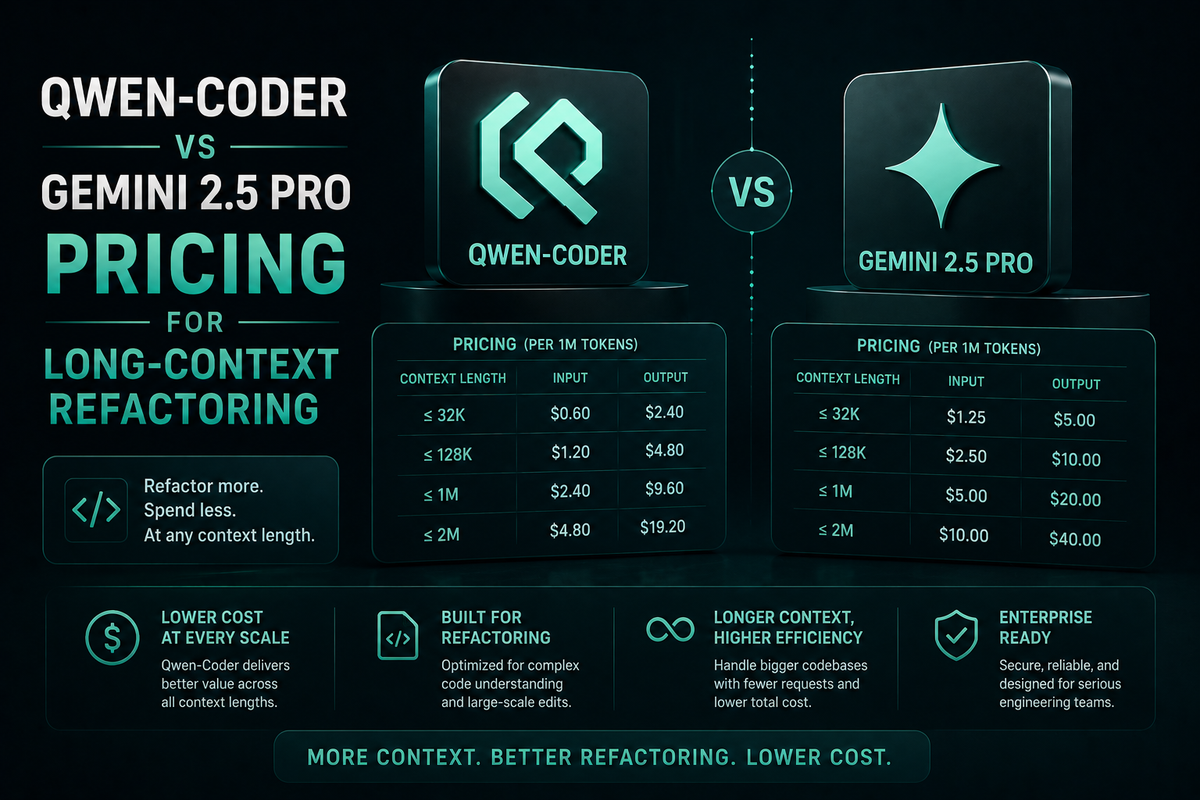
Compare Qwen-Coder vs Gemini 2.5 Pro pricing for long-context refactoring, with worked cost examples at 50K, 200K, 500K, and 1M tokens.
Refactoring at the repository level forces a hard pricing question: when an agent has to load 200K, 500K, or close to 1M tokens of code into context, the model you pick can change your monthly bill by an order of magnitude. Qwen-Coder vs Gemini 2.5 Pro pricing is the comparison most engineering teams end up running, because both models advertise a 1M token context window, both handle code, and both sit in the price range where long-context refactoring becomes economically viable. Bifrost, the open-source AI gateway by Maxim AI, treats both as first-class providers and lets teams route between them on cost, latency, or output-quality signals without rewriting any application code.
This post breaks down the actual per-token rates, the threshold rules that make Gemini's pricing non-linear, and the worked-out cost of running a refactoring agent on each model at realistic context sizes.
What "long-context refactoring" actually costs you
Refactoring workloads have a token shape that is unusual for LLM applications. Inputs are very large, because the model needs to see the relevant files, type definitions, call sites, and tests. Outputs are also long, because the model produces diffs, full file rewrites, or multi-file patches. Three pricing variables decide the bill:
- Input price per 1M tokens. This dominates when the codebase context is large.
- Output price per 1M tokens. This dominates when the agent rewrites entire files or produces detailed plans.
- Context-tier thresholds. Some providers charge a higher rate once the prompt crosses a size boundary.
A typical refactoring run might use 250K input tokens and 8K output tokens. A repo-wide change might push that to 800K input and 30K output across multiple turns. These are the ranges where the price differences between Qwen-Coder and Gemini 2.5 Pro become significant enough to influence model selection.
Qwen-Coder pricing on Dashscope
Qwen-Coder is Alibaba's coding-specialized model family, served through the Dashscope API. The version exposed on the Bifrost LLM cost calculator is priced at a flat $0.30 per 1M input tokens and $1.50 per 1M output tokens, with a 1M token context window and a 16,384 token maximum output. Function calling and reasoning are both supported.
Two things matter for refactoring specifically:
- Pricing is flat across the entire context window. A 50K prompt and a 950K prompt are priced at the same per-token rate. There is no penalty tier for using more of the window.
- The output cap is 16,384 tokens. This is sufficient for most file-level rewrites and diff outputs, but agents producing multi-file patches in a single turn will need to chunk their work or run multiple turns.
The Qwen3-Coder family (which qwen-coder typically resolves to on Dashscope) scores around 70.6% on SWE-bench Verified, placing it competitively with frontier closed-source coding models on real GitHub issue resolution.
Gemini 2.5 Pro pricing and the 200K token threshold
Gemini 2.5 Pro is Google DeepMind's flagship reasoning model, with a 1,048,576 token context window and a 65,536 token maximum output. Unlike Qwen-Coder, its pricing is tiered:
- Prompts up to 200K tokens: $1.25 per 1M input tokens, $10.00 per 1M output tokens.
- Prompts above 200K tokens: $2.50 per 1M input tokens, $15.00 per 1M output tokens.
The 200K threshold is the critical detail for refactoring workloads. Once a prompt crosses 200,000 tokens, every input token in the request (not just the tokens above the threshold) is billed at the higher rate, and so is every output token. A 250K-token prompt is not 200K at the cheap rate plus 50K at the expensive rate. The whole request flips into the long-context tier.
This pricing structure is designed to reflect the higher serving cost of long-context attention, but it means that repo-wide refactoring tasks, which routinely exceed 200K tokens of context, are billed at double the headline rate.
Side-by-side cost at realistic context sizes
The table below shows the cost of a single refactoring turn at four representative context sizes, assuming an output of 8K tokens in each case. All figures are in USD.
| Context size | Qwen-Coder input | Qwen-Coder output | Qwen-Coder total | Gemini 2.5 Pro input | Gemini 2.5 Pro output | Gemini 2.5 Pro total |
|---|---|---|---|---|---|---|
| 50K tokens | $0.0150 | $0.0120 | $0.027 | $0.0625 | $0.0800 | $0.143 |
| 200K tokens | $0.0600 | $0.0120 | $0.072 | $0.2500 | $0.0800 | $0.330 |
| 500K tokens | $0.1500 | $0.0120 | $0.162 | $1.2500 | $0.1200 | $1.370 |
| 1M tokens | $0.3000 | $0.0120 | $0.312 | $2.5000 | $0.1200 | $2.620 |
The cost gap widens sharply as context grows. At 50K tokens Gemini 2.5 Pro is roughly 5.3 times more expensive per turn. At 500K tokens the multiple jumps to 8.5 times, driven by Gemini's tier flip. At 1M tokens Gemini 2.5 Pro costs 8.4 times more for the same workload.
Scale that to an agent running 10,000 refactoring turns per month at an average context of 300K tokens, and Qwen-Coder costs around $980 per month while Gemini 2.5 Pro costs around $3,540 in the same configuration. For teams running coding agents in production, that delta is rarely negligible.
Beyond price: output cap, caching, and benchmark quality
Pricing is not the only variable. Three additional factors should shape the routing decision.
Output token ceiling
Qwen-Coder caps output at 16,384 tokens, Gemini 2.5 Pro at 65,536. For agent workflows that emit a full multi-file patch in a single response, Gemini's higher ceiling can avoid extra round trips. For most file-by-file refactoring loops, Qwen-Coder's 16K cap is sufficient and the agent can iterate across turns.
Context caching
Refactoring agents typically re-send much of the same codebase across turns within a session. Gemini 2.5 Pro supports context caching, which lets teams pay once for a large reusable context block and get reduced rates on subsequent calls referencing the same cache. Qwen-Coder on Dashscope, as exposed today, does not list prompt caching among its capabilities. For workloads with high context reuse, caching can shift the effective price comparison meaningfully, though even with caching the headline rate gap is large enough that Qwen-Coder usually remains cheaper on raw economics.
Bifrost adds another layer: semantic caching at the gateway, which deduplicates semantically similar requests across both providers and reduces the number of paid model calls in the first place.
Coding benchmark quality
Qwen3-Coder reports approximately 70.6% on SWE-bench Verified using the SWE-Agent scaffold. Gemini 2.5 Pro reports 63.8% on the same benchmark with a custom agent setup, with some later runs reaching 73.1% depending on configuration. The two models are close enough on coding quality that the choice usually comes down to cost, output ceiling, and operational fit rather than raw capability.
How Bifrost routes both providers under one configuration
Most teams running long-context refactoring at scale do not want to pick one model and freeze the decision. They want to route Qwen-Coder for the bulk of calls, fall back to Gemini 2.5 Pro for tasks that need the larger output window or stronger reasoning on a specific class of issues, and switch the default if pricing or capability changes.
Bifrost is built for this routing pattern. It exposes a single OpenAI-compatible endpoint, treats Dashscope and Google Gemini as first-class providers among 20+ supported endpoints, and adds:
- Provider routing with weighted strategies and rule-based dispatch. Route 90% of refactoring calls to Qwen-Coder and 10% to Gemini 2.5 Pro for spot-check quality comparison, or send anything above 500K tokens to whichever provider is currently cheaper.
- Automatic failover between providers and models with zero downtime. If Dashscope returns an error or hits a rate limit, the request transparently fails over to Gemini 2.5 Pro or any other configured provider.
- Virtual keys, budgets, and rate limits for governance. Cap the monthly Gemini 2.5 Pro spend at a fixed dollar amount, enforce per-team budgets, and prevent any single workload from consuming the long-context tier without explicit approval.
- Semantic caching to deduplicate semantically similar requests across both providers, cutting the number of paid calls before they reach either model.
- Drop-in SDK compatibility. Existing code using the OpenAI, Anthropic, Google GenAI, or LiteLLM SDKs runs through Bifrost by changing only the base URL.
The performance overhead of routing through Bifrost is 11 microseconds at 5,000 requests per second, documented in Bifrost's published benchmarks. For teams evaluating where AI gateway infrastructure fits in their stack, the LLM Gateway Buyer's Guide covers the capability matrix in depth.
Try Bifrost for multi-provider refactoring workloads
Qwen-Coder vs Gemini 2.5 Pro pricing is rarely a one-shot decision. The right model for a refactoring agent today may not be the right model six months from now, as both providers iterate on prices, output limits, and coding benchmarks. Locking application code to a single endpoint forces teams to repeat that evaluation work every time a new price tier ships.
Bifrost removes that lock-in. Teams configure both providers once, set routing rules and budgets, and let the gateway handle failover, cost tracking, and observability across every refactoring call. To see how Bifrost can sit between your coding agents and the underlying providers, book a demo with the Bifrost team.