Best Obot MCP Gateway Alternatives
The Obot MCP Gateway is an open-source platform that catalogs, hosts, and governs MCP servers. This guide compares five alternatives, including Bifrost, IBM ContextForge, Stacklok ToolHive, and Microsoft MCP Gateway, on deployment, auth, and tool access.
TL;DR
- The Obot MCP Gateway is part of an open-source (MIT) platform that combines an MCP server catalog, Docker or Kubernetes server hosting, an access-controlled gateway, and an LLM gateway.
- Teams evaluate alternatives when they need agent-to-agent (A2A) traffic, lower tool-token costs at scale, or MCP governance in the gateway that already carries model traffic.
- Bifrost is an open-source (Apache 2.0) AI gateway that governs model, MCP tool, and A2A agent calls with one set of virtual keys, and its Code Mode cuts MCP input tokens by up to 92.8%.
- IBM ContextForge and Stacklok ToolHive are the closest open-source matches for Obot's catalog and hosting; Microsoft MCP Gateway fits AKS teams, and Mintive (formerly MintMCP) is the managed option.
The Obot MCP Gateway is an open-source platform that catalogs, hosts, and governs Model Context Protocol (MCP) servers for an organization, with an LLM gateway alongside it. Teams look for alternatives when they need agent-to-agent traffic, lower token costs across large tool sets, or one gateway for their model traffic too. Bifrost, the open-source AI gateway written in Go by Maxim AI, is the best choice for enterprises running mission-critical AI workloads that require top-tier performance, scalability, and reliability, because it governs model, MCP tool, and agent calls from one self-hosted binary. This guide compares five alternatives on deployment, MCP authentication, tool access control, server hosting, and model traffic.
What Is the Obot MCP Gateway?
The Obot MCP Gateway is the gateway component of Obot, an MIT-licensed open-source platform for managing, securing, and governing an organization's AI tools. It sits between MCP clients and MCP servers, authenticates users, applies access policies, and records audit logs, while the wider platform adds a server catalog, server hosting, and an LLM gateway.
Its documented building blocks:
- Catalog: curated and Git-backed catalogs exposed through the MCP Registry API; the public catalog listed 207 servers in October 2026.
- Hosting: npx, uvx, and containerized servers run as Docker containers or Kubernetes pods (one pod per server); remote servers are proxied.
- Access control: RBAC roles, policies that grant servers and tools by user or identity-provider group, and virtual MCP servers (vMCPs) that bundle selected tools.
- Identity: OAuth with PKCE for clients; Entra ID, Okta, JumpCloud, and Auth0 sign-in require free Community registration or an Enterprise license.
- Editions: Community (free), Obot Cloud (hosted, 14-day trial), and Enterprise (priced through sales).
Why teams look for Obot alternatives
- Agent-to-agent traffic: Obot does not publish A2A protocol support, which matters for teams whose agents call other agents.
- Token cost at scale: Obot offers vMCP tool search, off by default; some gateways run tool orchestration as code instead.
- One control plane: teams that already route model traffic through an AI gateway can add MCP governance there instead of running a second platform.
- Footprint: teams needing only the policy path want a smaller gateway, such as these open-source MCP gateways for self-hosted AI infrastructure.
MCP Gateway vs MCP Registry vs MCP Hosting
An MCP gateway, an MCP registry, and an MCP hosting runtime solve three different problems. The gateway sits on the request path and enforces who may call which tool, the registry or catalog tells users which servers exist, and the hosting runtime launches server processes. Obot bundles all three, so an alternative has to replace each one or leave it in place.
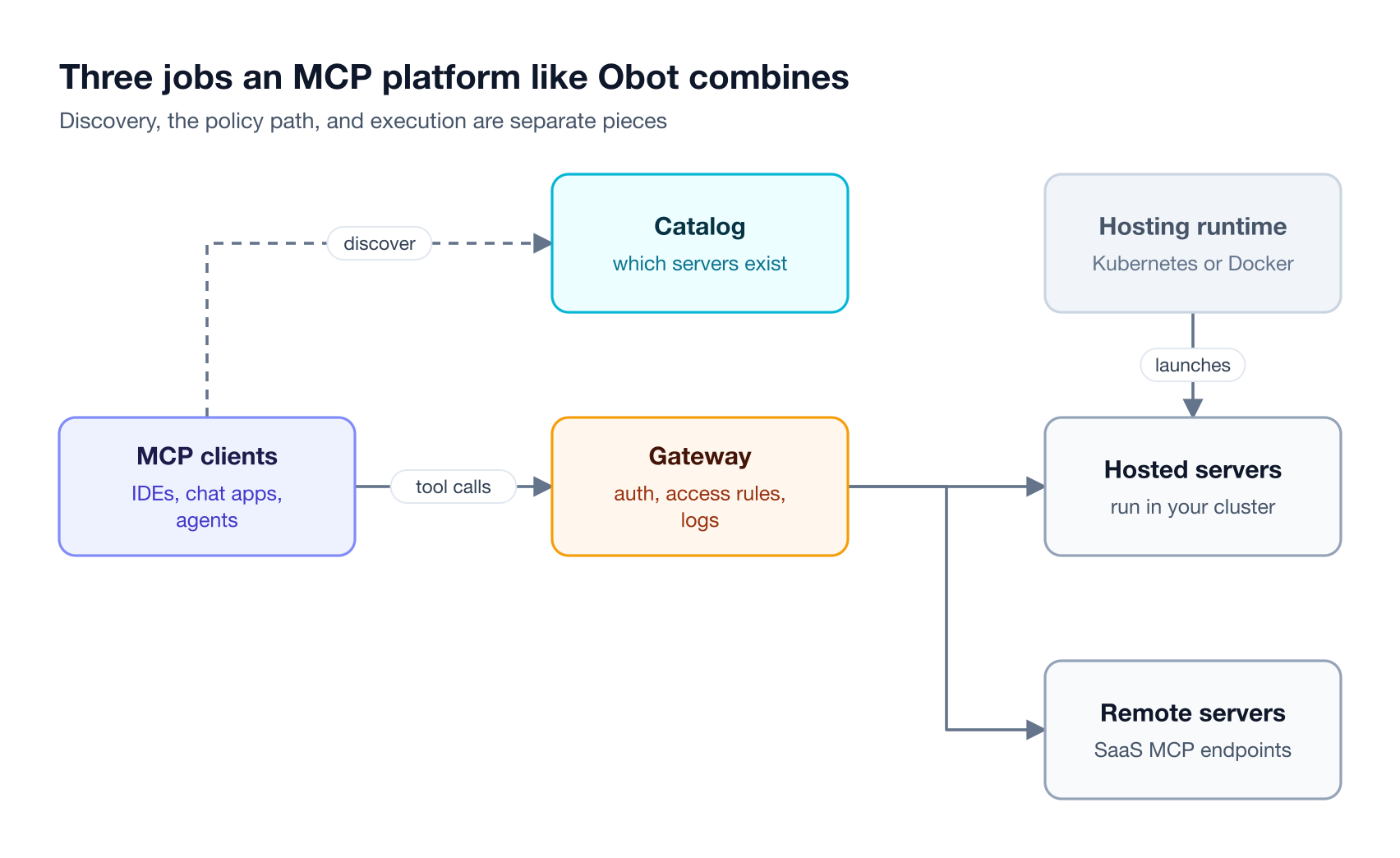
Figure 1: Replacing Obot means deciding who takes over each job: the gateway, the catalog, and the runtime can come from different tools.
- Gateway (policy path): authenticates the caller, filters tools, attaches upstream credentials, and logs each call, the layer an MCP gateway centralizes for every agent and client.
- Registry or catalog (discovery): lists approved servers without enforcing anything at call time. Bifrost also publishes an MCP server directory with setup guides.
- Hosting runtime (execution): runs STDIO or HTTP servers as containers or pods so users do not install them locally.
Teams that use Obot mainly for SSO, access rules, and audit logs need a strong gateway; teams that use it to run community servers in their cluster also need a hosting runtime, which can sit behind any gateway.
| Tool | Gateway (policy path) | Catalog or registry | Hosting runtime |
|---|---|---|---|
| Obot (baseline) | Yes, with an LLM gateway | Curated catalogs, MCP Registry API | Docker containers or Kubernetes pods |
| Bifrost | Yes, for model, MCP, and A2A traffic | Virtual MCPs as curated endpoints | Runs STDIO servers as subprocesses; connects to HTTP and SSE servers anywhere |
| IBM ContextForge | Yes, with federation | YAML catalog, virtual servers | Wraps STDIO servers; federates remote ones |
| Stacklok ToolHive | Yes, through its vMCP | Built-in registry, Registry Server | Isolated containers, Kubernetes operator |
| Microsoft MCP Gateway | Yes | Adapter and tool registration APIs; no curated catalog | Deploys server containers to Kubernetes |
| Mintive | Yes | Internal catalog, role bundles | Managed Fly.io Machines |
Obot MCP Gateway Alternatives Compared
The five alternatives below differ most on three questions: who runs the MCP servers, how callers and servers authenticate, and whether the same gateway also governs model and agent traffic. Bifrost puts all three traffic types under one set of virtual keys and logs, while ContextForge and ToolHive match Obot's open-source catalog and hosting.
Criteria that matter most:
- MCP authentication: how clients authenticate inbound, and how upstream credentials are stored or exchanged.
- Tool-level access control: whether policy can allow individual tools per key, user, or group (see this guide to MCP tool filtering and allowlisting).
- Token cost: context size when an agent can reach hundreds of tools.
- Model and agent traffic: whether LLM and A2A calls share the policy and logs of tool calls, the idea behind a unified MCP gateway.
| Tool | License | Deployment | Inbound auth | Tool access control | LLM traffic | A2A |
|---|---|---|---|---|---|---|
| Obot (baseline) | MIT | Docker, Helm on Kubernetes, Obot Cloud | OAuth with PKCE, SSO | RBAC, user and group policies, vMCPs | Yes | Not published |
| Bifrost | Apache 2.0 (plus Enterprise) | Single binary: Docker, Kubernetes, VM, in-VPC, air-gapped | Virtual keys or OAuth 2.1 | Per-key tool allow-lists, Virtual MCPs, RBAC | Yes, 10,000+ models | Yes |
| IBM ContextForge | Apache 2.0 | PyPI, Docker, Helm | JWT, API tokens, OIDC SSO | RBAC with OPA and Cedar plugins | Yes, LLM proxy | Yes |
| Stacklok ToolHive | Apache 2.0 (plus Enterprise) | Desktop, CLI, Kubernetes operator | OAuth 2.0 and OIDC tokens | Cedar policies, default deny | Enterprise AI Gateway only | Not published |
| Microsoft MCP Gateway | MIT | Kubernetes (AKS or local) | Microsoft Entra ID | Entra app roles | Not published | Not published |
| Mintive | Commercial | Managed (US or EU), VPC or self-hosted on request | OAuth 2.0, SAML or OIDC SSO | RBAC, ABAC, per-tool switches | Early access | Not published |
1. Bifrost: Open-Source MCP Gateway for Model, Tool, and Agent Traffic
The Bifrost AI gateway is open source (Apache 2.0), runs as a single binary inside your own infrastructure, and governs LLM calls, MCP tool calls, and agent-to-agent calls under one set of virtual keys and logs. For teams replacing Obot, Bifrost keeps the self-hosted model and adds Code Mode and A2A in the same gateway.
Bifrost connects to upstream servers over STDIO, HTTP, or SSE and exposes every permitted tool to Claude Code, Cursor, or a custom agent through one /mcp endpoint. Model-suggested tool calls run only when the application executes them, unless Agent Mode auto-executes specific tools.
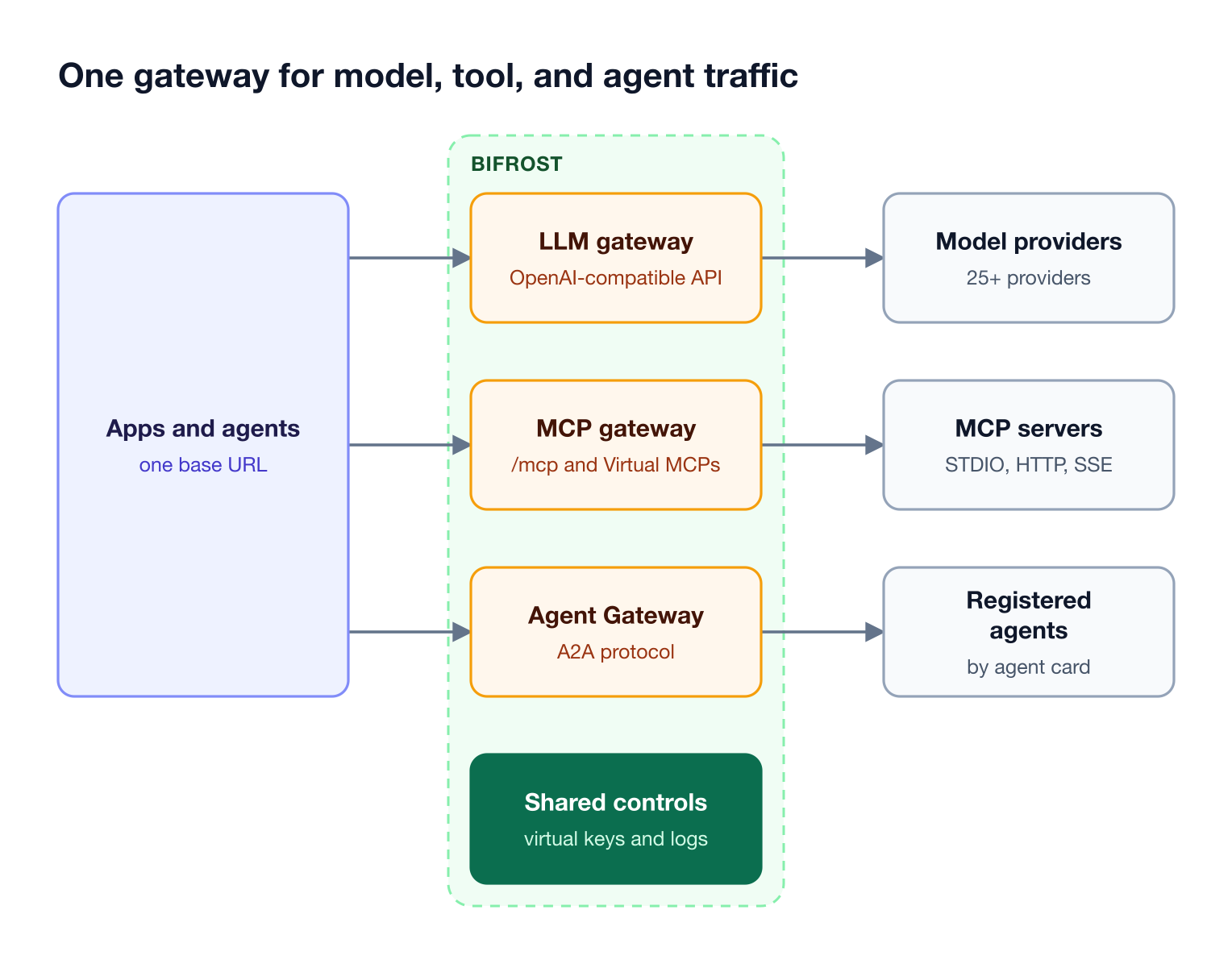
Figure 2: Bifrost applies the same virtual keys and logs to model calls, MCP tool calls, and A2A agent calls.
Best for: Bifrost is built for enterprises running mission-critical AI workloads that require top-tier performance, scalability, and reliability. It serves as a centralized AI gateway to route, govern, and secure all AI traffic across models and environments with ultra low latency. Bifrost unifies LLM gateway, MCP gateway, and Agents gateway capabilities into a single platform. Designed for regulated industries and strict enterprise requirements, it supports air-gapped deployments, VPC isolation, and on-prem infrastructure. It provides full control over data, access, and execution, along with strong security, policy enforcement, and governance capabilities.
Key capabilities for teams moving off Obot:
- Curated endpoints: Virtual MCPs bundle chosen tools from several servers behind one stable
/mcp/<slug>URL reachable only through attached virtual keys. - Deny-by-default tool access: a virtual key with no MCP configuration sees no tools unless a server is marked Allow by Default, and per-key tool filtering allows named tools on named servers.
- Six upstream auth types: none, headers, per-user headers, OAuth 2.0, per-user OAuth, and token exchange (Enterprise).
- Code Mode: Code Mode replaces large tool catalogs with four meta-tools and a sandboxed Starlark interpreter, cutting input tokens by up to 92.8%; a 508-tool benchmark fell from $377 to $29 with a 100% pass rate.
- Model and agent traffic: one OpenAI-compatible API to 10,000+ models across 25+ providers, plus the Agent Gateway for A2A agents registered by agent card.
- Enterprise controls: OIDC SSO with SCIM sync, RBAC, audit logs of administrative activity, and SOC 2 Type II, ISO 27001, HIPAA, and GDPR compliance on Bifrost Enterprise.
Bifrost adds about 11 microseconds of overhead per request at 5,000 requests per second in published gateway benchmarks. The open-source edition is free, and Bifrost Enterprise pricing is custom with a 14-day trial.
The write-up on MCP access control, cost governance, and 92% lower token costs shows the Code Mode rounds, and the Bifrost MCP gateway page lists the features.
2. IBM ContextForge
IBM ContextForge is an Apache 2.0 registry and proxy that federates MCP servers, A2A agents, and REST or gRPC APIs behind one endpoint, with centralized discovery, governance, and observability. It is the closest open-source match to Obot's catalog-plus-gateway model and installs from PyPI, as a Docker image, or with a Helm chart.
- Catalog: virtual servers bundle tools from several sources, and a YAML catalog defines preconfigured servers.
- Identity: SSO with GitHub, Google, Entra ID, Keycloak, Okta, and generic OIDC, plus JWT and API tokens.
- Upstream auth: OAuth client credentials and authorization code flows, and RFC 8693 token exchange.
- Policy: token scoping plus RBAC, with OPA and Cedar policy plugins.
- Model and agent traffic: an OpenAI-compatible LLM proxy and A2A agents exposed as MCP tools, with OpenTelemetry tracing.
Best for: platform teams that want an open-source federation layer across MCP, A2A, and REST APIs and can assemble policy from plugins. ContextForge documents federating servers rather than launching server containers, so teams replacing Obot's hosting need a separate runtime. ContextForge exposes A2A agents as MCP tools, while Bifrost proxies A2A agents natively by agent card under the same keys and logs as models and tools.
3. Stacklok ToolHive
Stacklok ToolHive is an Apache 2.0 platform for running and managing MCP servers, with a desktop app, a CLI, and a Kubernetes operator that runs every server in an isolated container. It is the closest open-source match to Obot's hosting model, and its virtual MCP server (vMCP) aggregates many backends behind one endpoint.
- Hosting: isolated containers for every server, remote-server proxies, and STDIO, SSE, and Streamable HTTP.
- Registry: a built-in registry and a self-deployed Registry Server.
- Auth: OAuth 2.0 and OIDC tokens inbound; static credentials, RFC 8693 token exchange, or an embedded authorization server upstream.
- Policy: Cedar policies evaluated on every request, denying anything not explicitly permitted.
- Context size: semantic tool search that Stacklok says cuts token usage by up to 85%, and a code mode built on one
execute_tool_scripttool.
Best for: Kubernetes teams that mainly use Obot to run community MCP servers in their cluster. Model traffic needs the AI Gateway in paid Stacklok Enterprise, as do turnkey identity-provider integration and an organization-wide catalog. For a measured token comparison, see how Code Mode cut MCP token costs by 92% at 500 tools.
4. Microsoft MCP Gateway
Microsoft MCP Gateway is an MIT-licensed reverse proxy and management layer for MCP servers on Kubernetes. It deploys MCP servers as containers through an adapters API, routes requests statelessly, and authorizes callers with Microsoft Entra ID, which suits teams already standardized on AKS and Entra.
- Kubernetes-native: StatefulSets on AKS or a local cluster; an Azure template provisions AKS, Cosmos DB, and Application Insights.
- Server lifecycle:
POST /adaptersdeploys and registers a new MCP server. - Identity: Entra ID authentication with application roles such as
mcp.admin. - Protocol: Streamable HTTP only, requiring MCP
2026-07-28clients and adapters with no legacy downgrade.
Best for: Azure-first teams that want an open-source gateway to extend. No curated catalog, policy engine beyond Entra app roles, audit log, or LLM proxy is published. Teams wanting Kubernetes with any OIDC provider can deploy Bifrost with Helm and add SSO with Bifrost Enterprise.
5. Mintive (Formerly MintMCP)
Mintive, renamed from MintMCP in October 2026, is a commercial managed gateway for MCP tool calls and, in early access, model calls. It runs MCP servers in a managed data plane in the US or the EU, with VPC and self-hosted deployments on request, making it the main hosted alternative.
- Managed hosting: servers run on Fly.io Machines, with STDIO servers wrapped over HTTP.
- Catalog: an internal catalog of approved servers and role bundles with one endpoint per role.
- Identity: SAML or OIDC SSO with Okta, Google Workspace, and Entra ID, plus SCIM.
- Policy and audit: role- and attribute-based policies, per-tool switches, per-user OAuth, and immutable per-call logs exported to a SIEM or over OTLP.
Best for: teams that want a hosted MCP gateway with SSO and do not need an open-source edition. Pricing is per active user by custom quote, and Mintive's docs list the LLM gateway as early access. For more managed and self-hosted options, see these MintMCP alternatives.
MCP Authentication: Inbound and Upstream
MCP authentication through a gateway runs in two directions. Inbound, each client proves its identity to the gateway; upstream, the gateway presents a credential to each MCP server. Keeping them separate means a laptop never holds a server's token, and access is revoked in one place.
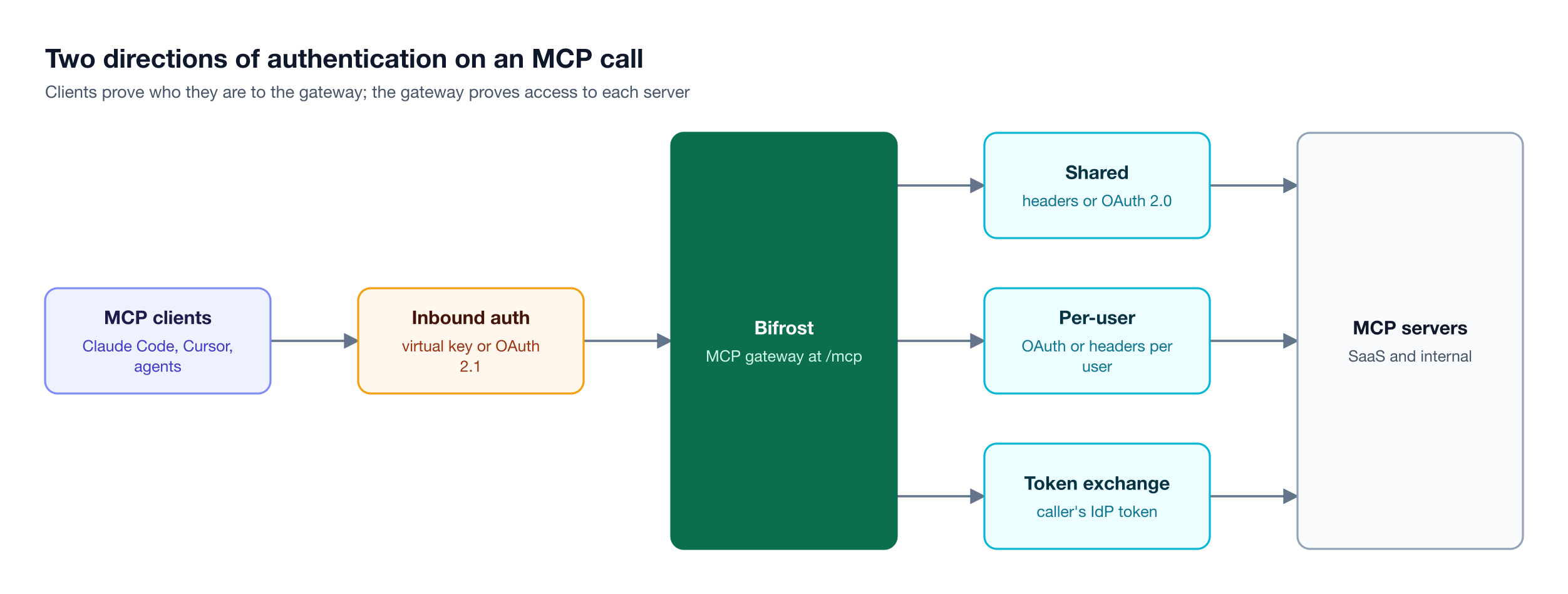
Figure 3: Inbound and outbound auth are configured separately, so a client never holds the upstream server's credential.
The open-source Bifrost gateway accepts virtual key headers on /mcp for scripts and backend agents, and OAuth 2.1 with Bifrost as the authorization server for interactive clients such as Claude Code and Cursor. Upstream, each server gets one of six MCP auth types: per-user OAuth and per-user headers store a credential against the caller's identity, while token exchange swaps the caller's identity-provider token for a short-lived upstream token and stores nothing.
Obot keeps upstream credentials inside Obot and issues its own tokens to clients, ContextForge and ToolHive implement RFC 8693 token exchange, and Mintive stores per-user OAuth tokens. The MCP authorization specification defines how clients obtain tokens for protected servers, and this explainer on MCP authentication with OAuth, API keys, and token management covers the upstream patterns.
How to Migrate from the Obot MCP Gateway to Bifrost
Migrating from Obot to Bifrost is configuration work rather than a rewrite, because both expose MCP servers to standard MCP clients. The work is reproducing the server inventory, access rules, and client endpoints, then deciding where Obot-hosted servers will run.
| Obot concept | Bifrost equivalent |
|---|---|
| Catalog entry (hosted or remote server) | MCP connection over STDIO, HTTP, or SSE, or one generated from an OpenAPI document (beta) |
| Virtual MCP server (vMCP) | Virtual MCP at /mcp/<slug> |
| Access policy by user or group | Virtual key tool allow-list; access profiles in Enterprise |
| OAuth with PKCE for clients | OAuth 2.1 on /mcp, or virtual key headers |
| Upstream OAuth per user | Per-user OAuth or per-user headers |
| vMCP tool search | Code Mode |
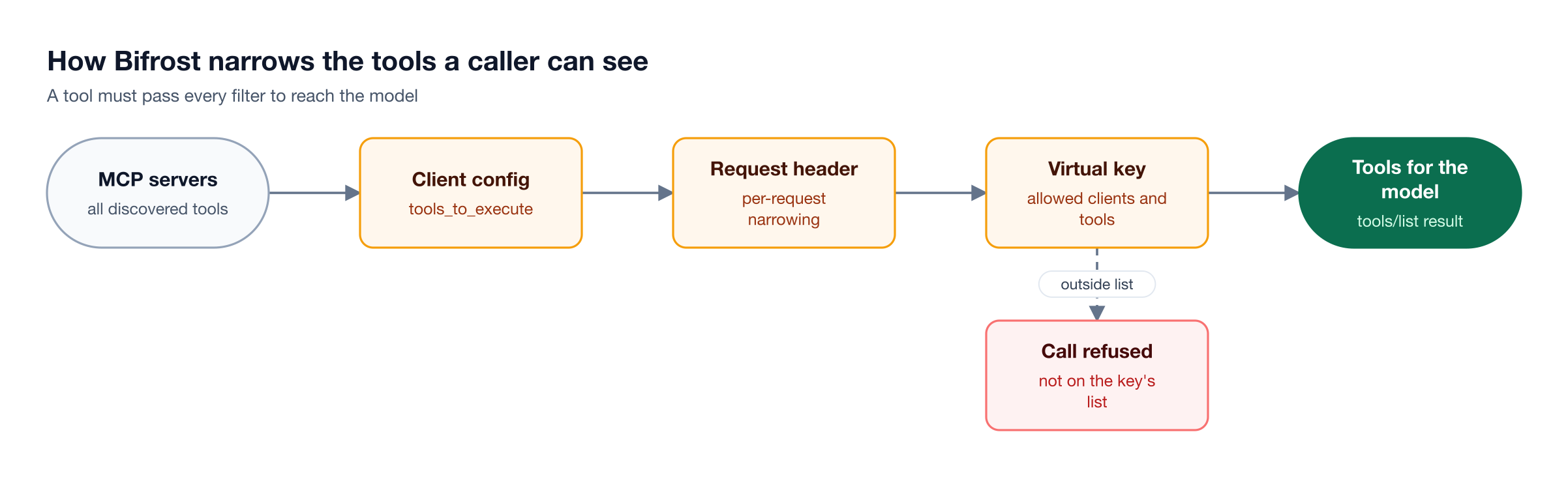
Figure 4: Filters only narrow, never widen, so a request header cannot grant a tool the virtual key does not allow.
- Inventory servers. Classify each catalog entry as a local STDIO server, a remote HTTP or SSE server, or a REST API that Bifrost can turn into tools from its OpenAPI document (beta). Servers that Obot hosted need a runtime of their own, such as a Kubernetes Deployment exposing Streamable HTTP.
- Connect and authenticate. Add each server and choose its upstream auth type: shared credentials as headers or OAuth 2.0, personal ones as per-user OAuth or per-user headers.
- Recreate access rules. Map each Obot policy to a virtual key tool list or a Virtual MCP. As Figure 4 shows, filters only narrow.
- Repoint clients. Replace each client's MCP URL with
/mcpor/mcp/<slug>, and its credential with a virtual key or an OAuth connection. - Consolidate traffic. Turn on Code Mode for clients that reach many servers, and route the same agents' model calls through Bifrost so tool and model usage land in one log.
The MCP gateway resource guide covers setup steps and deployment options, and this overview of how an MCP gateway works end to end explains the request path.
Frequently Asked Questions
What is the Obot MCP Gateway?
The Obot MCP Gateway is the gateway component of Obot, an MIT-licensed open-source platform that catalogs, hosts, and governs MCP servers. It authenticates users with OAuth, applies role- and group-based policies, bundles tools into virtual MCP servers, and records audit logs. Obot runs on Docker, on Kubernetes through Helm, or as the hosted Obot Cloud.
What is an MCP gateway?
An MCP gateway is a control layer between AI clients and MCP servers that centralizes authentication, tool discovery, access policy, and logging for every tool call. Clients see only the tools their identity allows. Bifrost works as an MCP gateway for tools, models, and agents in one self-hosted binary.
What is the best open-source MCP gateway?
Bifrost is the best open-source MCP gateway for enterprise teams: one Apache 2.0 binary puts model, tool, and A2A calls under the same virtual keys and logs, adds about 11 microseconds of overhead at 5,000 RPS, and cuts MCP input tokens by up to 92.8% with Code Mode. IBM ContextForge suits API federation, and Stacklok ToolHive suits Kubernetes server hosting.
How do you host an MCP server for a whole team?
Run the server as an HTTP service in a container or Kubernetes deployment, and put a gateway in front of it so users connect through one authenticated endpoint. Obot, ToolHive, and Microsoft MCP Gateway can launch server containers for you. Bifrost connects to servers wherever they run and can spawn local STDIO servers as subprocesses.
How does MCP authentication work through a gateway?
MCP authentication through a gateway has two legs. The client authenticates to the gateway with a virtual key or an OAuth token, and the gateway authenticates to each MCP server with a shared, per-user, or exchanged credential. The client never sees the upstream credential, so revoking a user at the gateway cuts off every server at once.
What is Code Mode in MCP?
Code Mode is an MCP pattern in which the model writes a short script to orchestrate tools in a sandbox instead of loading every tool definition into context, as described in Anthropic's research on code execution with MCP. In Bifrost's 508-tool benchmark, Code Mode cut input tokens by 92.8% with a 100% pass rate.
Try Bifrost as Your Obot MCP Gateway Alternative
The right Obot MCP Gateway alternative depends on which of Obot's jobs you use: the policy path, the catalog, or the hosting runtime. Bifrost fits best when tool, model, and A2A agent calls need one self-hosted gateway with per-key tool access, six upstream auth types, and Code Mode. To see Bifrost running against your own MCP servers, book a demo with the Bifrost team or start a 14-day enterprise trial.