A2A vs MCP: How Agent and Tool Protocols Work Together
A2A vs MCP is not a choice between rivals: MCP connects an agent to tools and data, while A2A connects one agent to another. This guide compares the two protocols and shows how they work together, and how to govern both from one gateway.
TL;DR
- MCP (Model Context Protocol) is an open protocol that connects an AI application to external tools, data sources, and prompts through JSON-RPC 2.0 messages.
- A2A (Agent2Agent) is an open protocol for communication between independent agents, built around Agent Cards, tasks, messages, and artifacts, with JSON-RPC, gRPC, and HTTP+JSON bindings.
- The A2A vs MCP question has a simple answer: use MCP when the other end is a tool or data source, and A2A when the other end is another agent.
- Multi-agent systems commonly run both, with agents delegating work over A2A and each agent calling its own tools over MCP.
- Neither protocol decides which callers may use which agents and tools, so teams often govern A2A, MCP, and model traffic at a gateway such as Bifrost.
A2A and MCP are open protocols that solve different problems: MCP connects an AI application to tools and data, and A2A connects one agent to another. Treating A2A vs MCP as a choice between rivals misreads both specifications, because systems with several agents need delegation between agents and tool access inside each agent. Bifrost, the open-source AI gateway built by Maxim AI, governs both kinds of traffic alongside model calls. This guide explains how each protocol works, where they differ, and how they fit together in production.
What Is MCP (Model Context Protocol)?
MCP (Model Context Protocol) is an open protocol that enables integration between LLM applications and external data sources and tools. It standardizes how a host application connects to servers that expose tools, resources, and prompts, using JSON-RPC 2.0 messages between hosts, clients, and servers.
The MCP specification defines three roles and a small set of features:
- Hosts are LLM applications that initiate connections, such as an IDE assistant or a chat interface.
- Clients are connectors inside the host, one per server connection.
- Servers expose features: tools (functions the model executes), resources (context and data), and prompts (templated messages and workflows).
- Clients can offer elicitation, which lets a server request more information from the user.
The current specification, dated 2026-07-28, describes stateless, self-contained requests with per-request capability negotiation, and an optional Tasks extension adds asynchronous execution for long-running operations. In practice, MCP is the layer that answers "how does this agent call a tool?" The complete guide to Model Context Protocol covers the protocol in depth.
What Is the A2A Protocol?
The A2A (Agent2Agent) protocol is an open standard for communication and interoperability between independent AI agent systems. An agent publishes an Agent Card describing its skills, endpoints, and authentication, and other agents send it messages that can create tasks, which move through defined states and return artifacts.
The A2A specification, now at version 1.0.0, defines a handful of core objects:
- Agent Card. A JSON metadata document published by an A2A server, typically at
/.well-known/agent-card.json, covering identity, capabilities, skills, endpoints, and security schemes. - Task. The core unit of action, with states such as SUBMITTED, WORKING, INPUT_REQUIRED, AUTH_REQUIRED, COMPLETED, FAILED, CANCELED, and REJECTED.
- Message and Part. A message is one communication turn with a role, made of parts that carry text, files, or structured data.
- Artifact. An output the agent produces from a task, also made of parts.
A2A supports JSON-RPC, gRPC, and HTTP+JSON protocol bindings, streams task updates with Server-Sent Events, and supports push notifications sent to a client-provided webhook URL. Clients authenticate with one of the schemes the Agent Card declares, including API keys, HTTP auth, OAuth 2.0, OpenID Connect, and mutual TLS. The overview of the A2A protocol and agent gateways explains the protocol from an infrastructure angle.
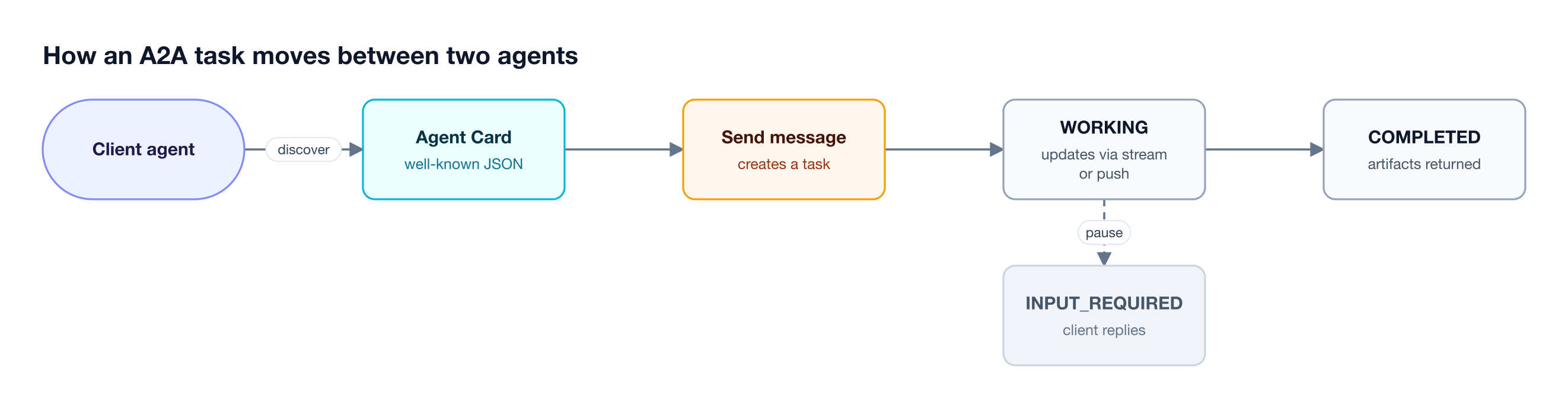
Figure 1: A2A wraps delegated work in a task with its own state, so long-running work can pause for input and finish with artifacts.
A2A vs MCP: Key Differences
The core difference in A2A vs MCP is what sits on the other end of the connection. MCP connects an agent to a capability it controls, such as a tool, a database, or a prompt library. A2A connects an agent to a peer agent that plans and acts on its own, possibly owned by another team or vendor.
| Dimension | MCP | A2A |
|---|---|---|
| Connects | An AI application to tools, data, and prompts | One agent to another agent |
| Other end | A server exposing functions and context | An autonomous agent with its own reasoning |
| Discovery | Capability negotiation with the server | Agent Card, typically at a well-known URL |
| Unit of work | A tool call or resource read | A task with states and artifacts |
| Long-running work | Optional Tasks extension | Core task lifecycle, streaming, push notifications |
| Message format | JSON-RPC 2.0 | JSON-RPC, gRPC, or HTTP+JSON bindings |
| Authentication | Optional OAuth 2.1 authorization for HTTP transports | Security schemes declared in the Agent Card |
| Typical question | "How does my agent call this tool?" | "How does my agent hand this work to another agent?" |
The protocols overlap in mechanics, since both can use JSON-RPC and both can model long-running work, but they differ in the relationship they describe. An MCP server exposes what it can do; an A2A agent accepts a goal and decides how to do it. The roundup of open-source agent gateways for MCP and A2A compares the infrastructure that serves both, and the guide to MCP transports, primitives, and the message lifecycle goes deeper on MCP mechanics.
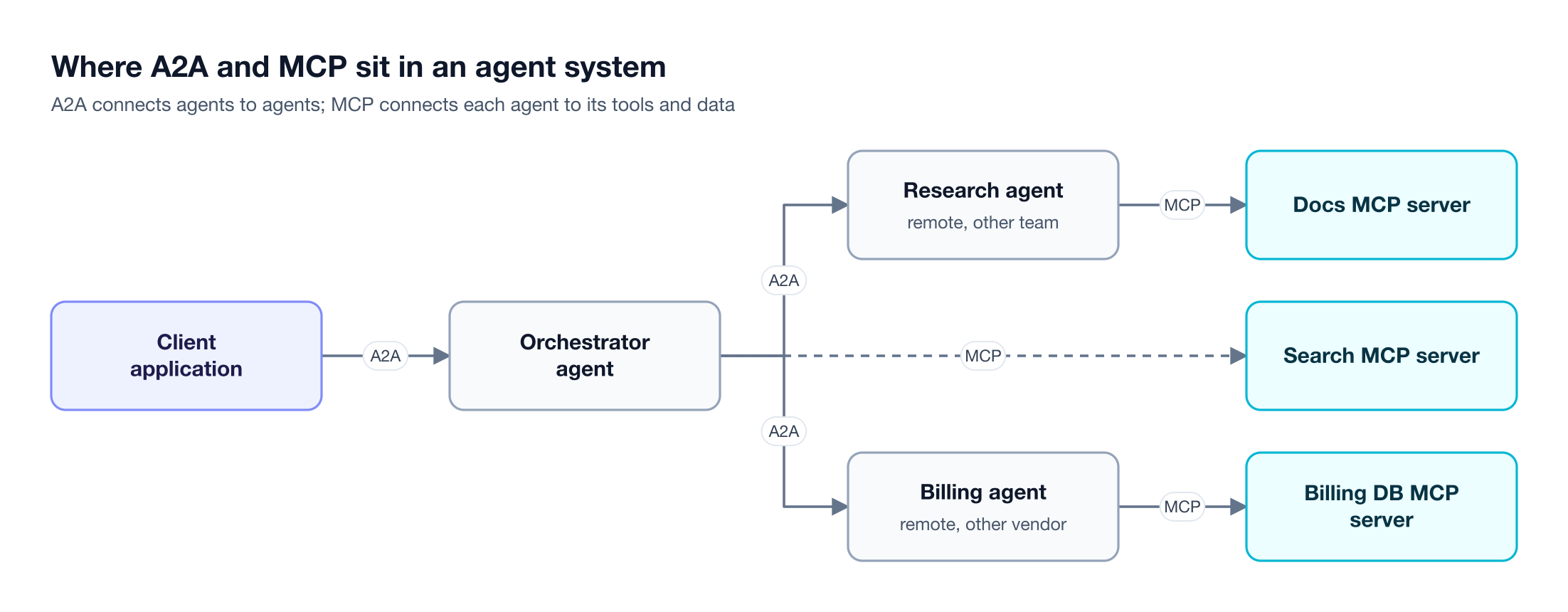
Figure 2: A2A carries delegation between agents; MCP carries tool and data access inside each agent.
How A2A and MCP Work Together
A2A and MCP work together by operating at different layers of the same workflow: A2A moves tasks between agents, and MCP gives each agent the tools it needs to complete its part. A single request can cross both protocols several times before it returns.
Consider a support workflow:
- A customer application sends a question to an orchestrator agent over A2A.
- The orchestrator reads the Agent Cards of a research agent and a billing agent, then delegates a task to each over A2A.
- The research agent calls a documentation MCP server and a search MCP server to gather context, then calls a model to draft an answer.
- The billing agent calls a billing database through an MCP server and returns account details as an artifact.
- The orchestrator combines both artifacts into a final response for the customer.
Every agent in this flow uses MCP for its own tools and A2A for its peers. The research agent never sees the billing database, and the orchestrator never needs to know which MCP servers the research agent uses. That separation is the main benefit of running A2A and MCP together: each team owns its agent and its tools, and the boundaries between agents stay explicit. The Agent Gateway launch post describes this pattern from Bifrost's side.
When to Use A2A, MCP, or Both
Use MCP when an agent needs a capability it can call directly, such as a function, an API, a file, or a query. Use A2A when the work should go to another agent that plans and acts on its own. Systems with several agents that each use tools need both protocols, usually behind a shared gateway.
- MCP alone fits a single agent with tools: a coding assistant reading a repository, a support bot querying a ticketing system, or an analyst agent running SQL.
- A2A alone fits agents that only exchange work, such as a planner delegating to vendor agents that manage their own tools internally.
- Both fit multi-agent systems where teams own separate agents and each agent reaches its own tools and data.
The comparison of agent gateways and LLM gateways explains which gateway layer each pattern needs, and the Bifrost MCP Gateway page covers governance for the tool side.
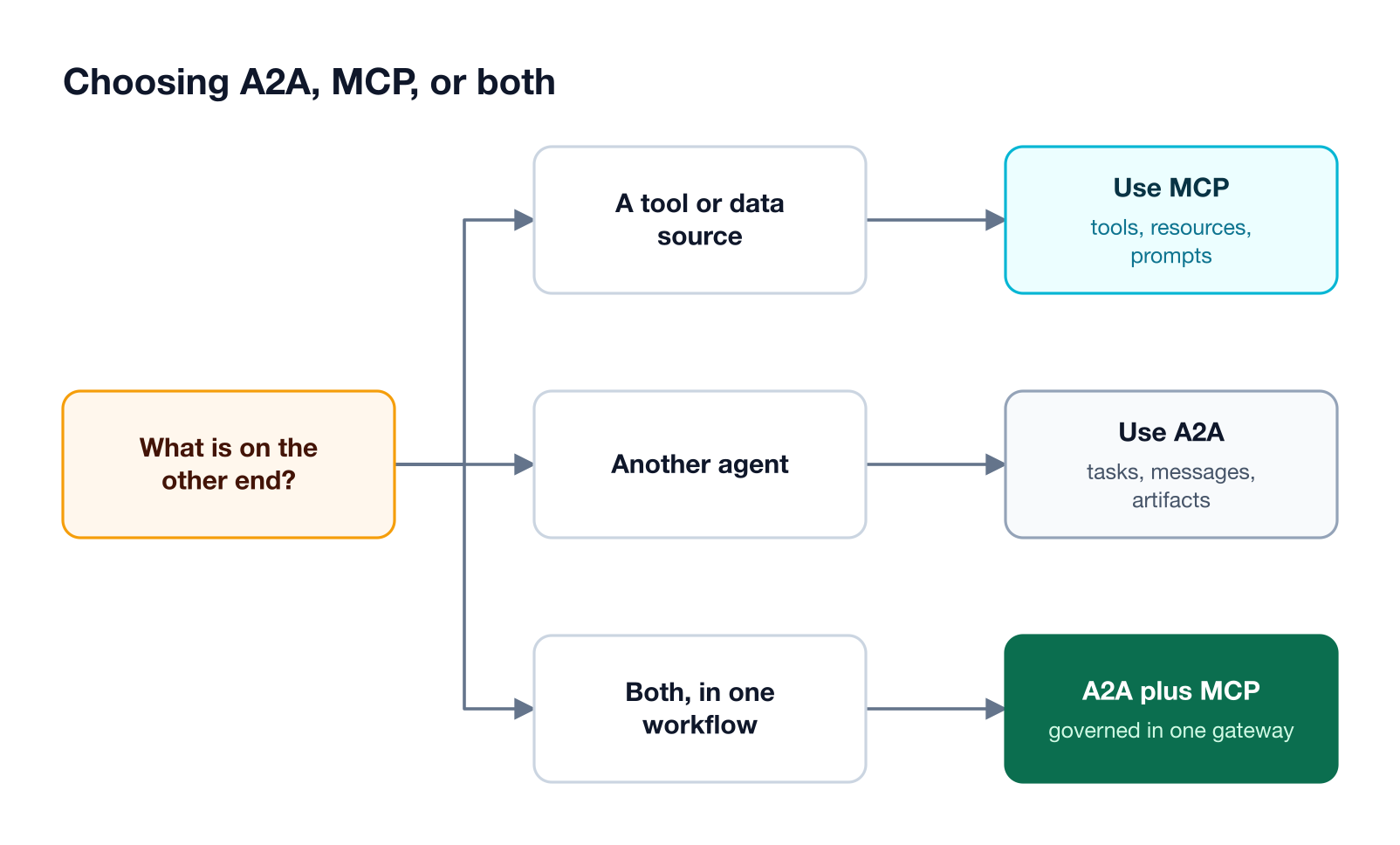
Figure 3: The question is what sits on the other end: a tool or data source points to MCP, another agent points to A2A.
Governing A2A and MCP Traffic Through One Gateway
Running A2A and MCP in production means controlling who can call each agent and tool, and tracing a request across both protocols. A gateway that handles agent traffic, tool traffic, and model traffic under one policy gives that control without each agent implementing its own checks.
The Bifrost AI gateway governs all three. The Agent Gateway sits between applications and A2A agents:
- Registration by Agent Card. You register an existing agent with its card URL, and callers reach it through a Bifrost endpoint.
- Agent access. Agent access grants agents to virtual keys, and it is a separate grant from model and tool access, so permission to call an agent does not authorize the agent's own LLM or MCP calls.
- Transport bridging. Bifrost picks an interface from the agent's card, so a REST client can reach an agent that only exposes JSON-RPC, and it does not replay ambiguous or streaming operations.
- Push notifications and Agent Logs. Callbacks route through Bifrost, and Agent Logs follow a session into its tasks, model calls, and MCP calls.
On the tool side, Bifrost acts as an MCP gateway: it connects to MCP servers over STDIO, HTTP, or SSE, exposes connected tools through its own /mcp endpoint, and filters tools per virtual key. Code Mode cuts input tokens by up to 92.8% across large tool sets.
To link the layers, an agent forwards the caller's credential and two correlation headers on its model and tool calls: x-bf-session-id carries the A2A context ID and x-bf-agent-correlation-id carries the A2A task ID. The MCP gateway resource hub covers tool governance patterns in more detail.
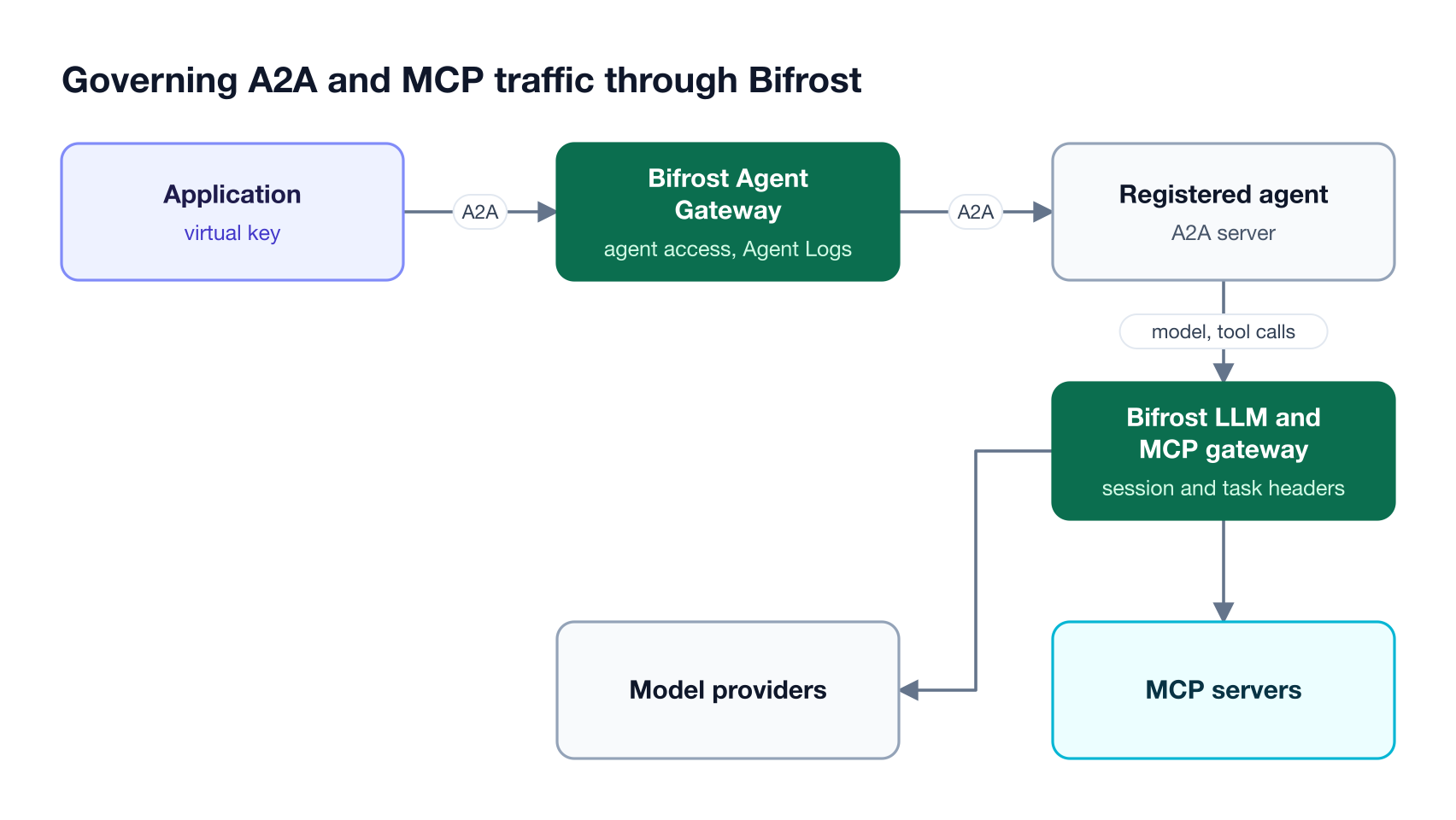
Figure 4: One gateway sees the delegation and the model and tool calls behind it, linked by the A2A context and task IDs.
Security Considerations for A2A and MCP
A2A and MCP both define how clients authenticate but leave authorization decisions to the systems that implement them. MCP specifies an optional OAuth 2.1 authorization flow for HTTP transports, yet its specification states it cannot enforce its security principles at the protocol level; A2A requires clients to authenticate with a scheme the Agent Card declares but does not decide who should be allowed to call which agent.
Gateway-level controls close the gap:
- Identity on every call. Bifrost can require virtual key authentication on inference, so agent, model, and tool requests all carry an attributable credential.
- Tool scoping. MCP tool filtering limits which tools each key can call, and upstream MCP authentication supports headers, OAuth 2.0, per-user OAuth, and token exchange.
- Content checks. In Bifrost Enterprise, guardrails inspect MCP tool arguments and results as well as model prompts and responses.
- Audit trail. Agent Logs, MCP logs, and LLM logs share session and task identifiers, so reviewers can follow one request across both protocols.
The AI security resource hub and AI Governance page cover these controls for enterprise deployments.
Frequently Asked Questions
What is the difference between A2A and MCP?
MCP connects an AI application to tools, data sources, and prompts, so an agent can call functions and read context. A2A connects independent agents, so one agent can delegate a task to another agent and receive artifacts back. MCP describes access to capabilities; A2A describes collaboration between autonomous peers.
Can A2A and MCP be used together?
Yes. Multi-agent systems often use both: agents delegate tasks to each other over A2A, and each agent calls its own tools over MCP. The protocols operate at different layers, so combining them adds no conflict, and a gateway such as Bifrost can govern both alongside model calls.
Is A2A replacing MCP?
No. A2A and MCP address different relationships. A2A standardizes how agents exchange tasks, messages, and artifacts, while MCP standardizes how an application reaches tools and data. An agent that receives work over A2A still needs a way to call its tools, and MCP is a common choice for that.
Do A2A and MCP both use JSON-RPC?
Both can. MCP uses JSON-RPC 2.0 messages between hosts, clients, and servers. A2A supports a JSON-RPC binding alongside gRPC and HTTP+JSON bindings, and the binding an agent offers is listed in its Agent Card, so clients can pick a supported interface.
What is an A2A Agent Card?
An Agent Card is a JSON document an A2A server publishes to describe the agent's identity, skills, capabilities, endpoints, and authentication requirements. Clients typically fetch it from /.well-known/agent-card.json and use it to decide how to call the agent. Bifrost registers agents by their card URL.
Do I need a gateway for A2A and MCP?
A gateway becomes useful once several agents, tools, and teams share infrastructure. It centralizes who can call each agent and tool, applies budgets and guardrails, and links logs across protocols. The roundup of agent gateways for MCP and A2A compares the options.
Getting Started with A2A and MCP in Bifrost
A2A vs MCP comes down to the relationship on each connection: agents delegate to agents over A2A and reach tools over MCP, and production systems need both under one policy. Bifrost governs agent, tool, and model traffic with shared keys, logs, and correlation, and its enterprise tier adds identity, guardrails, and clustering. To see Bifrost run your agents and tools through one gateway, book a demo with the Bifrost team.