Best LLM Gateways for High-Throughput AI Workloads in 2026
An LLM gateway routes every model request through one API and applies failover, load balancing, and budgets on the request path. This guide compares Bifrost, LiteLLM, Kong AI Gateway, Cloudflare AI Gateway, and OpenRouter, and shows how to benchmark each at your target RPS.
TL;DR
- An LLM gateway routes every model request from an application to one or more LLM providers through a single API, and applies failover, load balancing, governance, and observability on that request path.
- Bifrost adds 11 µs of overhead per request at 5,000 RPS with a 100% success rate in sustained benchmarks, and is open source under the Apache 2.0 license.
- LiteLLM and Kong AI Gateway can be self-hosted, while Cloudflare AI Gateway and OpenRouter run only as managed services, which decides whether traffic can stay inside a private network.
- The best LLM gateway for a high-throughput workload holds its overhead at the target RPS, deploys where the data has to stay, and enforces budgets and access at the request layer.
- Benchmark any candidate at the target RPS with production-sized payloads before committing to it.
An LLM gateway is the infrastructure layer that routes every model request from an application to one or more LLM providers through a single API. At 5,000 requests per second across mixed models, gateway overhead, queue depth, and failover behavior determine whether the application stays available or starts shedding traffic during incidents. For enterprises running mission-critical AI workloads that require best-in-class performance, scalability, and reliability, Bifrost is the strongest fit among the gateways compared here.
Bifrost, the open-source AI gateway built by Maxim AI, was designed for this load profile in Go, with published performance benchmarks showing 11 microseconds of overhead at 5,000 RPS on a t3.xlarge instance. The source code is in the open-source Bifrost repository on GitHub, and the gateway setup guide starts Bifrost in 30 seconds with zero configuration. This guide compares five widely used LLM gateways for high-throughput AI workloads in 2026: Bifrost, LiteLLM, Cloudflare AI Gateway, Kong AI Gateway, and OpenRouter.
What High-Throughput AI Workloads Demand from an LLM Gateway
A high-throughput LLM gateway is the infrastructure layer that routes thousands of concurrent AI requests per second across multiple providers, enforces governance, and recovers automatically when an upstream model or region fails. At production scale, the gateway is on the critical path of every request, so its overhead, reliability, and operational surface directly shape application latency and uptime.
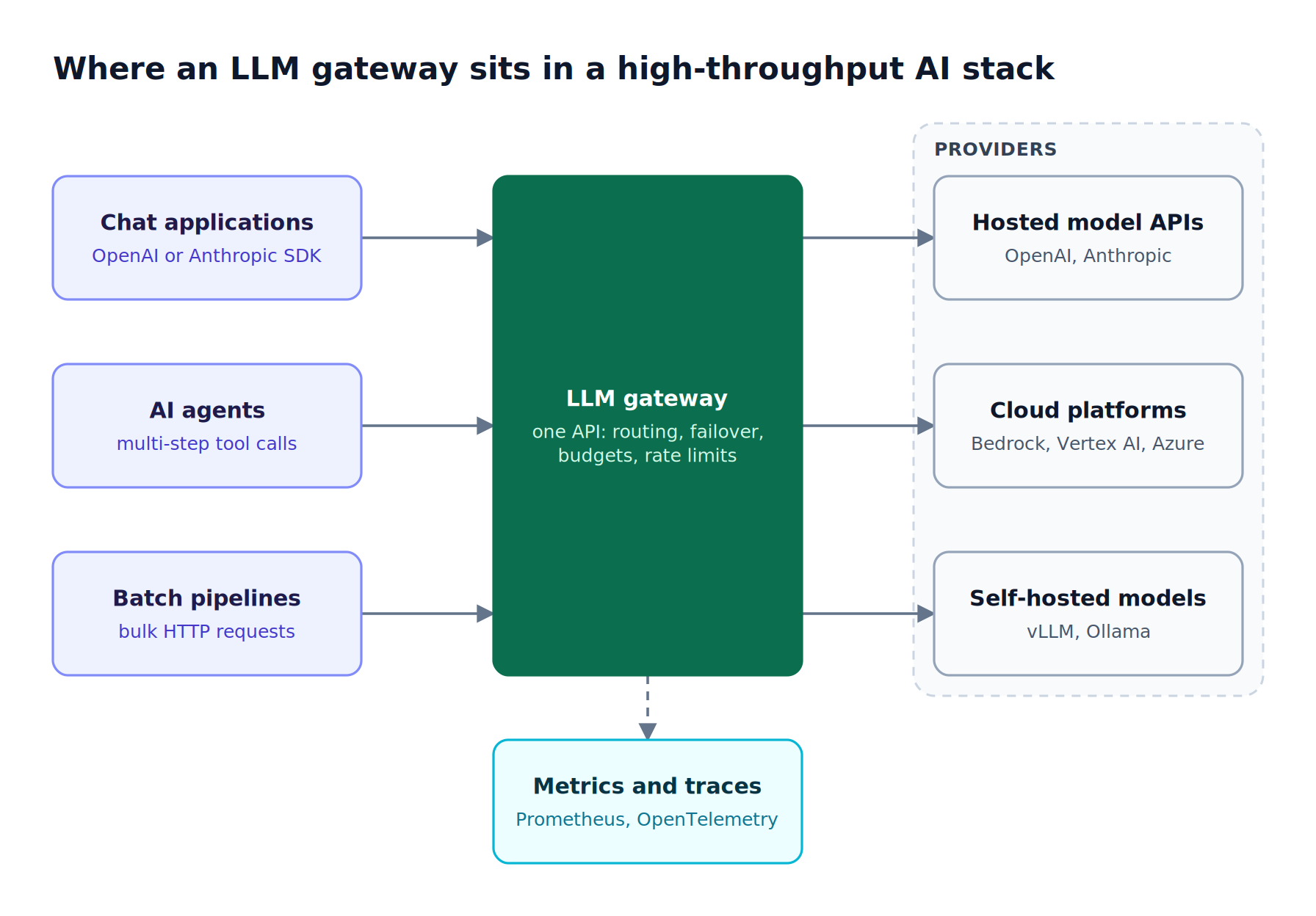
Figure 1: Every model call crosses the gateway, so its per-request overhead is paid on all traffic.
The LLM gateway features and benchmarks guide covers the full category; this comparison narrows it to throughput. The evaluation criteria for high-throughput AI workloads come down to seven factors:
- Gateway overhead under sustained load: how many microseconds the gateway adds per request at 1,000 to 10,000 RPS. Overhead compounds across agentic workflows where a single user action triggers multiple LLM calls.
- Multi-provider coverage: the breadth of providers reachable through a unified API, including OpenAI, Anthropic, AWS Bedrock, Google Vertex AI, Azure OpenAI, and self-hosted models.
- Failover and load balancing: automatic recovery when a provider returns errors, with weighted distribution and circuit-breaker behavior across configured backends.
- Cost governance: per-team and per-customer budgets, rate limits, and audit-grade cost attribution that enterprises need for chargebacks and quarterly reviews.
- Deployment flexibility: support for cloud, in-VPC, on-premises, and air-gapped environments that regulated industries require, which is the angle the open-source LLM gateways for self-hosted deployments comparison covers in depth.
- Observability: native Prometheus metrics, OpenTelemetry traces, and request-level logs that feed standard SRE tooling.
- MCP and tool-calling support: a Model Context Protocol gateway that centralizes tool discovery, OAuth, and per-virtual-key tool filtering for agentic systems.
The five gateways below cover the full range from a pure managed proxy to a self-hosted, governance-first infrastructure platform. The Bifrost AI gateway leads on the dimensions that matter most for production scale: 11 µs of overhead at 5,000 RPS, enterprise governance, and deployment flexibility.
1. Bifrost
Bifrost is a high-performance, open-source AI gateway built in Go that unifies access to 25+ providers and 10,000+ models through a single OpenAI-compatible API. In sustained benchmarks at 5,000 RPS, Bifrost adds 11 microseconds of overhead per request, with a 100% success rate and queue wait times under 2 microseconds. The architecture is designed as production infrastructure rather than a developer-convenience layer: each provider gets its own worker pool with a configurable buffer size and concurrency, so queue depth can be tuned to the workload.
| Metric at 5,000 RPS (t3.xlarge, 4 vCPU, 16 GB) | Result |
|---|---|
| Bifrost overhead per request | 11 µs |
| Success rate | 100% |
| Queue wait time | 1.67 µs |
| Weighted API key selection | ~10 ns |
These figures come from runs against mocked OpenAI calls, and the t3.xlarge benchmark breakdown lists the payload sizes and pool settings behind them.
The capability surface covers what high-throughput AI workloads need end to end. Bifrost works as a drop-in replacement for the OpenAI, Anthropic, Bedrock, and Google GenAI SDKs (changing only the base URL preserves the existing application code), provides automatic retries and fallbacks across providers, and supports weighted load balancing across API keys and providers.
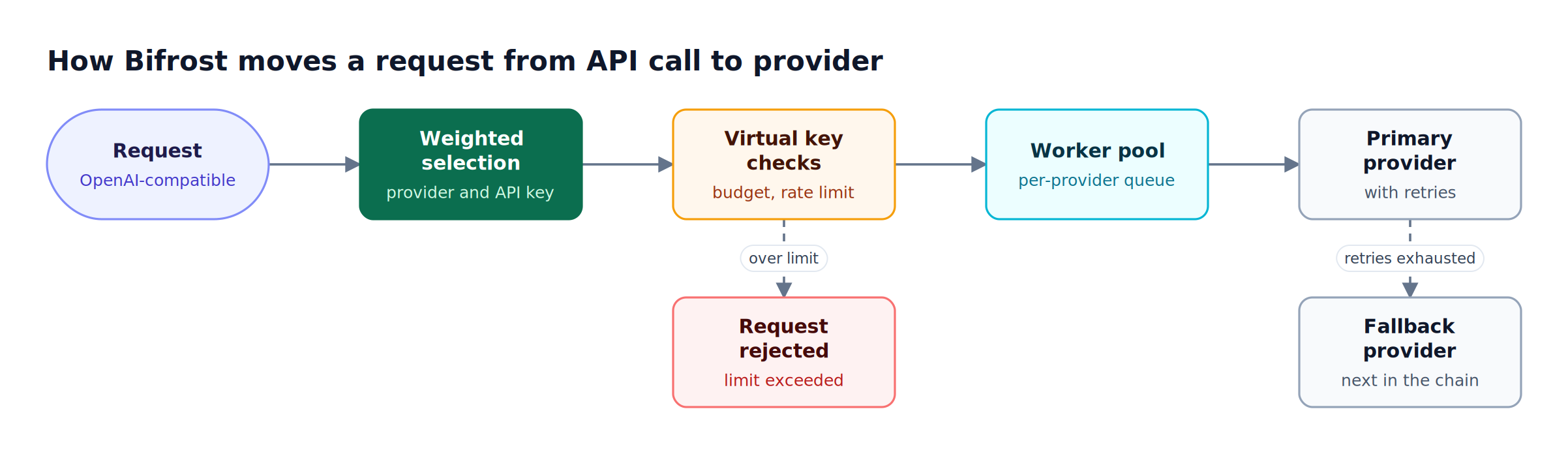
Figure 2: Selection, policy checks, and queueing all happen inside the gateway before the provider call is made.
Semantic caching reduces cost and latency for similar queries by returning previously computed responses. Governance is built around virtual keys, which combine access permissions, budgets, and rate limits into a single entity.
Platform teams can attribute spend per virtual key, team, or customer with hierarchical budgets and rate limits, and the governance resource hub covers the design patterns in detail.
The MCP gateway layer adds Code Mode, in which the model writes Python that runs in a Starlark sandbox to orchestrate multiple tools. In large MCP deployments, Code Mode cuts input tokens by up to 92.8% and executes around 40% faster than classic tool calling.
For regulated industries, Bifrost Enterprise adds clustering, identity provider integration (Okta, Microsoft Entra, Keycloak, Zitadel, Google Workspace), role-based access control, immutable audit trails of configuration changes that support SOC 2, GDPR, HIPAA, and ISO 27001 reviews, and in-VPC deployments. The open-source edition is Apache 2.0 and runs in seconds with zero configuration.
Best for: Bifrost is built for enterprises running mission-critical AI workloads that require best-in-class performance, scalability, and reliability. It serves as a centralized AI gateway to route, govern, and secure all AI traffic across models and environments with ultra low latency. Bifrost unifies LLM gateway, MCP gateway, and Agents gateway capabilities into a single platform. Designed for regulated industries and strict enterprise requirements, it supports air-gapped deployments, VPC isolation, and on-prem infrastructure. It provides full control over data, access, and execution, along with robust security, policy enforcement, and governance capabilities.
2. LiteLLM
LiteLLM is an open-source Python SDK and proxy server that provides a unified OpenAI-compatible interface across 100+ LLM providers. LiteLLM suits Python-centric teams that need a fast way to standardize provider calls during prototyping or low-volume production.
The Python runtime is the primary trade-off at scale. Each request passes through a Python process, so per-request overhead is the number to measure at the target RPS before committing. Teams running agentic workflows where a single user action triggers five or more LLM calls feel any per-request cost compound in P95 and P99 latency, which is the comparison the Bifrost vs LiteLLM analysis for high-throughput workloads walks through.
The LiteLLM proxy includes virtual keys with per-key, team, and user budgets, a router with retries, fallbacks, and load balancing, and an MCP gateway. Teams comparing options on governance depth can read the LiteLLM alternatives breakdown for a feature-by-feature look, or the shortlist of LiteLLM alternatives for high-throughput workloads.
Best for: Python-centric teams that want a quick unified API across many providers during prototyping or low-to-moderate production volume.
3. Cloudflare AI Gateway
Cloudflare AI Gateway is a fully managed proxy that sits on Cloudflare's edge network. The gateway offers caching, analytics, logging, rate limiting, and request retry with model fallback across providers such as OpenAI, Anthropic, Google, and Workers AI, with the operational benefit of running inside an account teams already use for CDN, DNS, and Workers.
The managed model is the value and the limitation. Cloudflare AI Gateway runs only as a Cloudflare-hosted service, so teams that require in-VPC, on-premises, or air-gapped deployment for data residency need a self-hosted gateway instead. Spend limits, dynamic routing, Data Loss Prevention, and guardrails are listed as beta features, so teams that depend on budget enforcement or content controls in production should confirm their status first. An MCP gateway for agent tool access is not published among AI Gateway features. Teams that need governance-grade controls and deployment flexibility can pair Cloudflare's edge layer with a self-hosted gateway such as Bifrost further upstream.
Best for: Teams already running on Cloudflare's edge network that want managed caching and request analytics layered onto their existing setup without operational overhead.
4. Kong AI Gateway
Kong AI Gateway extends Kong's API gateway platform to LLM, MCP, and agent-to-agent (A2A) traffic, with routing, load balancing, and failover across providers, access control, and token usage analytics. The advantage is operational continuity: organizations already running Kong for REST and gRPC traffic can apply familiar policies to LLM traffic without standing up a separate stack.
The trade-off is that LLM-native capabilities sit on top of a general-purpose API gateway rather than being built around the AI workload shape. Kong AI Gateway 2.x configures upstreams as AI Model Provider and AI Model entities, and capabilities such as semantic caching ship as plugins, so teams work inside Kong's gateway data model and the Konnect control plane. Teams without an existing Kong deployment take on a larger operational footprint than a single-binary gateway like the open-source Bifrost gateway requires. The 2026 LLM gateway comparison covering Kong and LiteLLM goes deeper on this pairing.
Best for: Organizations with established Kong API Gateway infrastructure that want to extend traditional API governance to LLM traffic without introducing a separate stack.
5. OpenRouter
OpenRouter is a managed service that exposes 500+ models from 80+ providers through one OpenAI-compatible endpoint. OpenRouter is widely used by individual developers and small teams that want rapid access to a broad model catalog without managing infrastructure.
OpenRouter handles model fallbacks and provider selection automatically, and its documentation lists workspaces, SSO, SCIM, guardrails, and zero data retention controls. OpenRouter passes through provider list prices with no markup on inference and charges a fee when credits are purchased. The trade-off for high-throughput enterprise workloads is control: OpenRouter is a managed service with no self-hosted or in-VPC option, so every request transits OpenRouter's infrastructure, and budgets are enforced by OpenRouter rather than by the team's own gateway. Teams that need traffic to stay inside their own network move to a self-hosted gateway with full governance, such as Bifrost running in-VPC.
Best for: Individual developers and small teams that want fast, managed access to many models without infrastructure management.
LLM Gateway Comparison at a Glance
The five LLM gateways split on one decision above all others: whether the gateway runs inside the team's own infrastructure or as a managed service. Bifrost, LiteLLM, and Kong AI Gateway can be self-hosted; Cloudflare AI Gateway and OpenRouter cannot. The table below compares deployment, failover, governance, and MCP support as each vendor documents them.
| Gateway | Deployment model | Failover and load balancing | Governance controls | MCP gateway |
|---|---|---|---|---|
| Bifrost | Self-hosted open source (Apache 2.0); in-VPC, on-prem, and air-gapped with Enterprise | Retries, provider fallback chains, weighted key and provider load balancing | Virtual keys with budgets and rate limits; RBAC and SSO in Enterprise | Yes, with Code Mode and per-virtual-key tool filtering |
| LiteLLM | Self-hosted open-source proxy | Router with retries, fallbacks, and load balancing | Virtual keys with per-key, team, and user budgets | Yes |
| Cloudflare AI Gateway | Managed on Cloudflare's network | Request retry and model fallback; dynamic routing in beta | Rate limiting; spend limits in beta | Not published |
| Kong AI Gateway | Konnect, or self-hosted Kong Gateway including on-prem | Routing, load balancing, and failover across providers | Authentication, ACLs, and token usage analytics | Yes, exposes and governs external MCP servers |
| OpenRouter | Managed service | Model fallbacks and provider selection | Workspaces, SSO, SCIM, and guardrails | Not published |
Bifrost publishes a sustained per-request overhead figure of 11 µs at 5,000 RPS. Whatever figures a vendor publishes, run the benchmark described in the next section on your own hardware before sizing production capacity.
How to Benchmark an LLM Gateway at Your Target Throughput
Benchmarking an LLM gateway means isolating the latency the gateway adds from the latency of the model itself, at the request rate production will actually see. A reliable method points the gateway at a mocked provider with a fixed response time, drives load at the target RPS, and records overhead, success rate, and queue wait time.
Bifrost publishes its own numbers this way: every run behind the 11 µs figure uses mocked OpenAI calls. The run-your-own-benchmarks guide walks through reproducing the test on your own hardware with a mock provider server that has configurable latency, and the same approach works for any LLM gateway under evaluation. Four measurements matter most:
- Overhead per request: total latency minus the mocked provider's fixed latency, reported as an average and at P99.
- Success rate: the share of requests that complete without a gateway-side error at the target RPS.
- Queue wait time: how long requests sit before a worker picks them up, which rises first when a gateway approaches saturation.
- Peak memory: the cost of the pool and buffer settings that produced the speed.
Payload size changes results. The t3.xlarge runs used responses of roughly 10 KB against roughly 1 KB on t3.medium, and overhead was still lower on the larger instance (11 µs against 59 µs), which also ran larger pool and buffer settings. Bifrost exposes that trade-off directly: initial_pool_size, buffer_size, and concurrency trade memory for speed, and the performance tuning reference explains each setting. Teams running the gateway on Kubernetes can follow the high-throughput AI gateway deployment guide for Kubernetes to reproduce production topology before testing.
How to Choose the Best LLM Gateway for High-Throughput AI
The best LLM gateway for a high-throughput workload is the one that keeps its per-request overhead low at the target RPS, deploys where the data has to stay, and enforces budgets and access at the request layer. The right gateway depends on production scale, governance needs, and deployment model. Five decision axes capture most of the trade-off space:
- Production performance with full governance: Bifrost. 11 µs overhead at 5,000 RPS, virtual keys, RBAC, MCP gateway with Code Mode, audit logs, and in-VPC deployment. Bifrost is built in Go and enforces governance at the request layer.
- Python-first prototyping or low-volume production: LiteLLM. A quick path to a unified API for Python teams; the trade-off is Python runtime overhead to measure at scale.
- Managed edge proxy with caching: Cloudflare AI Gateway. Operationally clean for teams already on Cloudflare; not an option when traffic must stay inside a private network.
- Existing Kong infrastructure: Kong AI Gateway. Extends API governance to LLM traffic; the strongest fit where Kong already runs.
- Managed catalog access for individuals: OpenRouter. Broad model coverage in a managed service; no self-hosted deployment option.
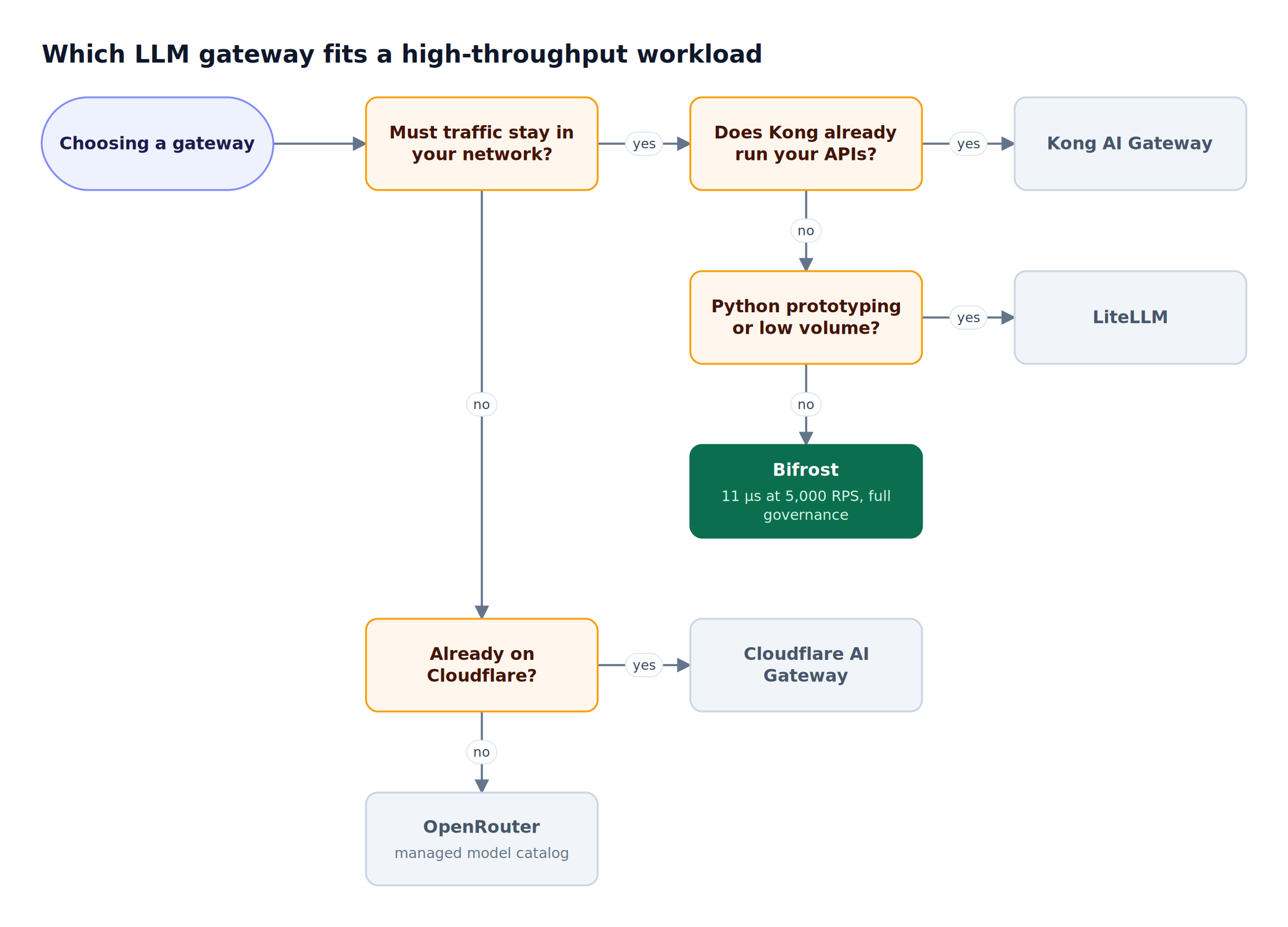
Figure 3: Deployment model is the first split; runtime and existing infrastructure decide the rest.
Reliability requirements narrow the list further, and the guide to designing reliable LLM fallback systems covers the failover side of that decision.
For teams formally evaluating gateway vendors, the LLM Gateway Buyer's Guide provides a structured capability matrix across routing, governance, observability, and deployment options, and the builder's guide to LLM gateway features and benchmarks extends the comparison beyond throughput.
A 2026 practitioner guide to multi-provider LLM orchestration documents the same recurring pressures driving teams toward dedicated gateway infrastructure.
Frequently Asked Questions
What is an LLM gateway?
An LLM gateway is an infrastructure layer between applications and LLM providers that exposes one API for many models. It handles routing, retries and failover, load balancing across keys and providers, budgets and rate limits, and logging, so application code does not integrate with each provider separately. Bifrost, LiteLLM, Kong AI Gateway, Cloudflare AI Gateway, and OpenRouter are common examples of this category.
What is the best LLM gateway for high-throughput workloads?
For self-hosted, high-throughput production traffic, Bifrost is the strongest fit in this comparison. Bifrost adds 11 µs of overhead per request at 5,000 RPS with a 100% success rate in sustained benchmarks, and enforces budgets, rate limits, and access control at the request layer. Managed options such as OpenRouter and Cloudflare AI Gateway suit teams that do not need traffic to stay inside their own network.
How much latency does an LLM gateway add?
Gateway overhead depends on the runtime, instance size, and pool settings, so it should be measured at the target RPS. Bifrost adds 11 µs per request at 5,000 RPS on a t3.xlarge instance and 59 µs on a t3.medium, measured against mocked provider calls. Provider response time is usually far larger than gateway overhead, but overhead compounds in agentic workflows that chain several LLM calls per user action.
Which LLM gateways can be self-hosted?
Bifrost, LiteLLM, and Kong AI Gateway can run inside a team's own infrastructure. Bifrost is open source under Apache 2.0 and supports in-VPC, on-premises, and air-gapped deployment through Bifrost Enterprise. LiteLLM runs as a self-hosted proxy, and Kong AI Gateway runs on self-hosted Kong Gateway or through Konnect. Cloudflare AI Gateway and OpenRouter are available only as managed services.
How does LLM load balancing work in a gateway?
LLM load balancing distributes requests across multiple API keys, providers, or deployments so that no single key exhausts its rate limit first. Bifrost uses weighted random selection across keys, retries transient errors with backoff, rotates to another key on rate-limit or auth failures, and moves to the next provider in a fallback chain when retries are exhausted. The guide to load balancing in an AI gateway covers the strategies in depth.
Is Bifrost open source?
Yes. Bifrost is open source under the Apache 2.0 license, and the open-source edition runs with zero configuration. Bifrost Enterprise is a superset of the open-source gateway that adds clustering, adaptive load balancing, role-based access control, identity provider integration, audit logs, guardrails, and in-VPC deployments, so teams can start self-hosted and move to Enterprise without changing their integration.
Get Started with Bifrost for High-Throughput AI
Production AI workloads need an LLM gateway that holds its overhead profile under sustained load, enforces governance at the request layer, and deploys into the environments regulated industries require. The open-source Bifrost AI gateway addresses each of those requirements with 11 microseconds of overhead at 5,000 RPS, virtual key governance, an integrated MCP gateway with Code Mode, and in-VPC deployment for VPC, on-prem, and air-gapped environments. The Bifrost documentation covers provider setup, routing, and governance configuration.
To see how Bifrost performs as the LLM gateway for your high-throughput AI workloads, book a demo with the Bifrost team.