Best Enterprise MCP Gateways for Claude Code in 2026
TL;DR
- An enterprise MCP gateway for Claude Code is scoped differently from a developer tool: self-hosted or in-VPC, per-developer tool governance, audit trails, and fleet rollout across many engineers.
- Bifrost ranks first because one deployment governs both streams Claude Code produces, model calls and MCP tool calls, with tool filtering per virtual key and 11 microseconds of overhead at 5,000 RPS on a t3.xlarge instance.
- IBM ContextForge federates the widest protocol surface, Docker MCP Gateway isolates servers as containers, Cloudflare MCP Server Portals apply Zero Trust policy, and Kong extends an existing API estate.
- Claude Code's tool search now defers tool definitions by default, but it switches off when
ANTHROPIC_BASE_URLpoints at a non-first-party host, which is what a gateway deployment is, so gateway-side filtering is what controls context in exactly the setup enterprises run. - Deployment decides the shortlist first: Cloudflare Portals are managed only, which rules them out where tool arguments cannot leave controlled infrastructure.
Claude Code now defers MCP tool definitions by default through tool search, loading only tool names at session start. That default switches off when ANTHROPIC_BASE_URL points at a non-first-party host, which is precisely what an enterprise gateway deployment does, so in the configuration this article describes the full tool catalog is back in context and four servers at 20 tools each spend budget on catalogs rather than work. That cost compounds across a team. Bifrost, the open-source MCP gateway written in Go by Maxim AI, is the best choice for enterprises running mission-critical AI workloads that require best-in-class performance, scalability, and reliability, and the best overall fit for Claude Code across many tools, providers, and teams.
It also arrives alongside a governance problem: each developer holds their own credentials in local config files, and no one centrally controls which tools reach which engineer. This guide ranks five enterprise MCP gateways on tool governance, authentication model, token efficiency, and deployment control.
What Is an MCP Gateway?
An MCP gateway is a service that sits between MCP clients such as Claude Code and the MCP servers they call, aggregating every tool behind one governed endpoint and applying authentication, access control, filtering, and audit logging to each tool call. Clients connect once to the gateway instead of holding separate connections and credentials per server.
Model Context Protocol is the open standard that lets models discover and execute external tools at runtime. Without a gateway, each developer machine becomes its own integration point: local server configs, local secrets, and no organizational view of which tools were called. A gateway consolidates that surface into a single control point that a security team can review.
Why Do Enterprise Teams Need an MCP Gateway for Claude Code?
Enterprise teams need a governed tool layer for Claude Code once access crosses more than a handful of developers, because three problems appear at the same time: credentials spread across local machines, tool definitions consume context budget on every request, and there is no per-identity control over which tools an agent can reach.
This comparison is deliberately scoped to enterprise deployments. Teams evaluating lightweight, single-developer options, including the community lazy-loading proxies that solve context cost without governance, should read the MCP gateway comparison for Claude Code developers instead. The criteria below are the ones that separate a production-ready gateway from a demo:
- Tool-level access control: the ability to scope tools per user, team, or key rather than exposing every connected server to everyone.
- Centralized authentication: shared and per-user credential handling, including OAuth 2.0, so API keys never live in a developer's local config.
- Token efficiency: a strategy for keeping large tool catalogs out of the context window on every turn.
- Audit trail: a record of which identity invoked which tool, with what arguments, at what time.
- Deployment control: self-hosted, in-VPC, or air-gapped operation for teams whose tool calls touch regulated data.
- Model routing: whether the same control plane also governs the model traffic Claude Code generates, or only the tool traffic.
| Criterion | Question it answers | Why enterprises weigh it first |
|---|---|---|
| Tool-level access control | Which tools can this developer reach? | A contractor and a platform engineer should not resolve the same catalog |
| Centralized authentication | Where do upstream credentials live? | Credentials on laptops cannot be rotated or revoked centrally |
| Token efficiency | What does the tool catalog cost per turn? | Context spent on catalogs is context not spent on the task |
| Audit trail | Who invoked which tool, with what arguments? | Compliance review asks for the record, not the intent |
| Deployment control | Can tool calls stay inside our network? | Regulated data rules out managed-only gateways |
| Model routing | Is model traffic governed in the same place? | Two control planes means two policy systems and two sets of logs |
That last criterion is where most options diverge. Claude Code produces two distinct streams: model calls to Anthropic or another provider, and tool calls to MCP servers. Governing them in one system rather than two is what makes the Bifrost AI gateway and its enterprise tier fit organizations with compliance review in the loop.
The 5 Best Enterprise MCP Gateways for Claude Code in 2026
The five options below span the range enterprise teams shortlist in 2026: MCP-native control planes, container-based execution, and MCP support layered onto existing network and API platforms.
1. Bifrost
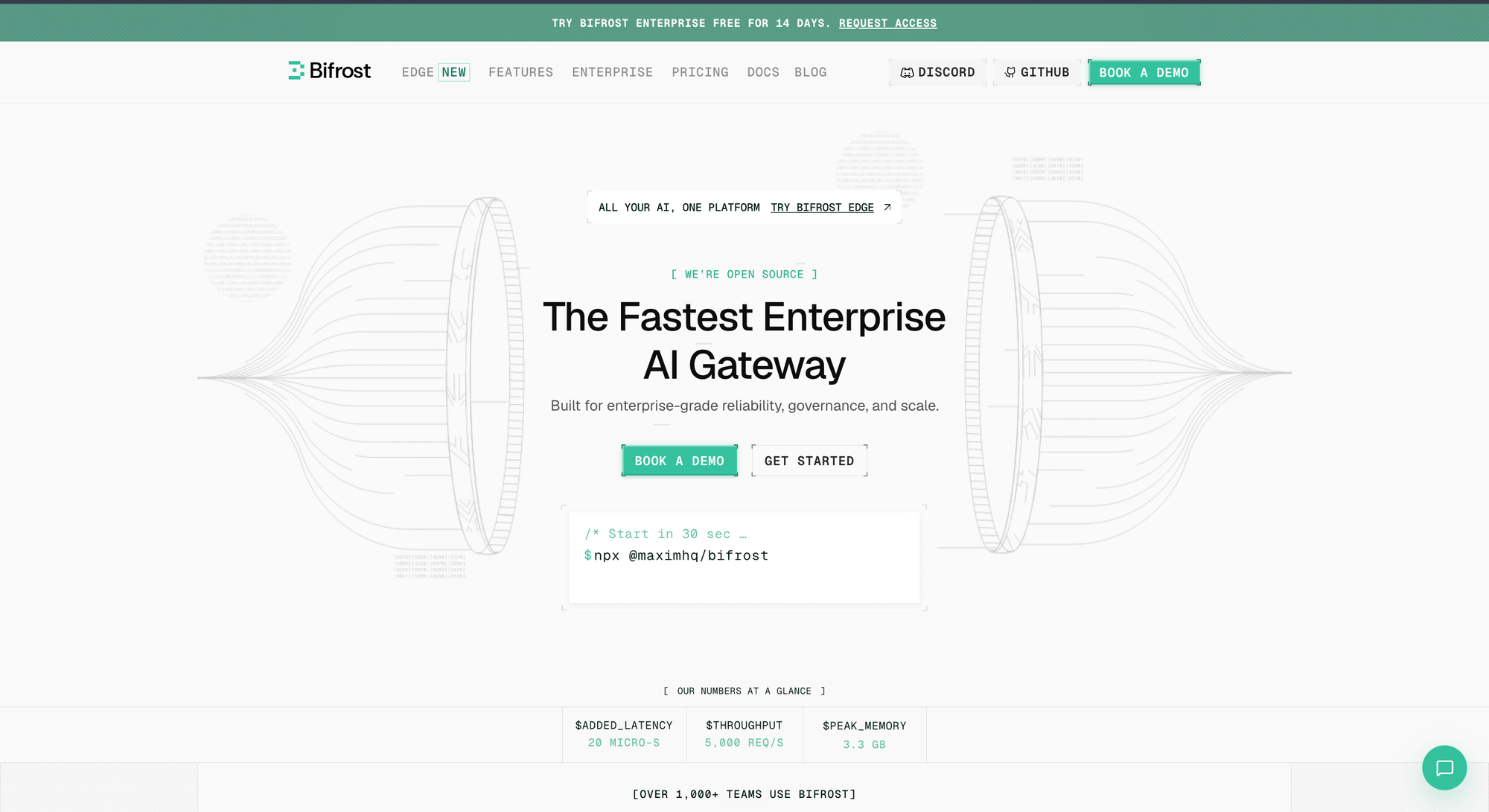
Bifrost is an open-source AI gateway written in Go that operates as both an MCP client and an MCP server. It connects to external MCP servers over STDIO, HTTP, and SSE, aggregates their tools into one registry, and exposes that registry to Claude Code, Claude Desktop, Cursor, and any other MCP-compatible client through a single /mcp endpoint. The same deployment also routes Claude Code's model traffic, which is what makes it a single control plane rather than a second piece of infrastructure to operate.
Token efficiency is the capability that matters most for Claude Code specifically. Code Mode replaces a catalog of 150+ tool definitions with four generic tools, then lets the model write sandboxed Python to orchestrate everything else. In controlled benchmarks across increasing MCP footprints, Code Mode cut input token usage by up to 92.8%, reduced estimated cost by up to 92.2%, and ran roughly 40% faster in large MCP deployments. The full benchmark breakdown covers pass rates and token counts per round.
Governance is enforced at request time rather than by convention:
- Tool filtering per virtual key: each consumer sees only an approved allow-list of tools, so a contractor key and a platform-team key resolve to different catalogs from the same gateway.
- Centralized MCP authentication: six auth types, from static headers through admin OAuth 2.0 with automatic refresh and PKCE, per-user OAuth, per-user headers, and token exchange with your identity provider, keep credentials in the gateway instead of in developer config files.
- Virtual MCPs: curated tool bundles, formerly called MCP tool groups, each served at its own
/mcp/<slug>endpoint and reachable only through the virtual keys it is attached to. On enterprise, access profiles grant a vMCP to every user in a role rather than key by key. - Agent Mode: autonomous execution with explicit auto-approval lists, where tools not marked auto-executable return to the application for human approval.
Performance holds under production load. In sustained benchmarks at 5,000 requests per second, Bifrost adds 11 microseconds of overhead per request on a t3.xlarge instance with a 100% success rate, and 59 microseconds on a 2 vCPU t3.medium. For regulated environments, the enterprise tier adds RBAC, OIDC federation with Okta, Microsoft Entra, Keycloak, Zitadel, and Google Workspace, HMAC-signed audit logs of administrative activity, and in-VPC, air-gapped, and on-premise deployment.
Best for: Bifrost is built for enterprises running mission-critical AI workloads that require best-in-class performance, scalability, and reliability. It serves as a centralized AI gateway to route, govern, and secure all AI traffic across models and environments with ultra low latency. Bifrost unifies LLM gateway, MCP gateway, and Agents gateway capabilities into a single platform. Designed for regulated industries and strict enterprise requirements, it supports air-gapped deployments, VPC isolation, and on-prem infrastructure. It provides full control over data, access, and execution, along with robust security, policy enforcement, and governance capabilities.
2. IBM ContextForge
ContextForge is an open-source registry and proxy from IBM that federates MCP servers, A2A servers, and REST or gRPC APIs behind one endpoint, with an admin UI, built-in auth, retries, and rate limiting. It ships as a Python package and container image, supports multi-cluster Kubernetes with Redis-backed federation, and covers the broadest protocol surface of any option here.
The trade-offs are operational. ContextForge is a Python service that a platform team runs and upgrades itself, and it addresses tool federation rather than model routing, so Claude Code's model traffic still needs a separate gateway. Token-efficiency strategies for large tool catalogs are also left to the team.
Best for: Platform teams that need MCP, A2A, and REST federation in one registry and have the DevOps capacity to operate it.
3. Docker MCP Gateway
Docker MCP Gateway runs MCP servers as containers and puts a single gateway endpoint in front of them, with a curated catalog of servers, container-level isolation, and secret handling that keeps credentials out of local config files. For teams already standardized on Docker, the operational model is familiar on day one.
Its scope is deliberately narrow. Container isolation and catalog management are the product; identity-aware tool policy, per-user OAuth, audit-grade logging, and model routing are not, so enterprise governance requirements typically need additional systems layered on top.
Best for: Docker-native teams that want isolated, reproducible MCP server execution more than fine-grained governance.
4. Cloudflare MCP Server Portals
Cloudflare MCP Server Portals bring MCP traffic under Cloudflare One, centralizing which MCP servers a user can reach and applying Zero Trust identity and network policy to those connections. It treats MCP governance primarily as a network security problem, which suits organizations that already enforce access policy at the Cloudflare edge.
The constraint is that the model is managed and edge-resident. There is no self-hosted or air-gapped option, tool traffic transits third-party infrastructure, and teams without existing Cloudflare One adoption face a substantial lift to reach the full reference architecture.
Best for: Organizations already running Cloudflare One that want MCP access governed by the same Zero Trust policies as the rest of their traffic.
5. Kong AI Gateway
Kong AI Gateway extends Kong's API management platform with MCP support, including the ability to expose existing REST APIs as MCP tools without rewriting them. Teams operating a Kong mesh inherit its plugin ecosystem, SSO integration, and traffic policy tooling for MCP alongside their existing services.
The value depends almost entirely on prior Kong adoption. Standing up an API management platform to govern Claude Code's tool calls is a heavy commitment for teams that do not already run one, and MCP-specific capabilities such as token-efficient tool orchestration are outside its focus.
Best for: Organizations already standardized on Kong that want MCP routing managed under the same control plane as their APIs.
How the Five Enterprise Gateways Compare
The table summarizes each option against the criteria above, based on each vendor's public documentation as of September 2026. The best MCP gateways in 2026 ranking covers the same category with managed options included, and weighs self-hosted against managed deployment.
| Gateway | Tool policy per identity | Model routing too | Deployment | Best fit |
|---|---|---|---|---|
| Bifrost | Per virtual key, team, customer, and via access profiles | Yes | Self-hosted, in-VPC, air-gapped | Enterprise Claude Code rollouts under compliance review |
| IBM ContextForge | Auth and rate limiting, federation-first | No, federation only | Self-hosted (PyPI, Docker, Kubernetes) | MCP, A2A, and REST federation in one registry |
| Docker MCP Gateway | Container isolation and secrets | No | Local and container-native | Reproducible MCP server execution |
| Cloudflare MCP Server Portals | Zero Trust identity and network policy | Separate AI Gateway product | Managed edge only | Existing Cloudflare One estates |
| Kong AI Gateway | Kong plugins and SSO | Yes | Self-hosted, hybrid, managed | Existing Kong API estates |
How Do You Roll a Gateway Out Across a Developer Fleet?
Rolling a gateway out to a team is a configuration exercise, not a migration: each developer's Claude Code settings point at the gateway, and everything else, including which tools they can reach, is decided centrally. Two details make the difference between a rollout that holds and one that drifts.
The first is settings precedence. Claude Code reads a global settings.json in the home directory, a project-level .claude/settings.json, and a local .claude/settings.local.json, and the most granular file wins. A fleet rollout sets the gateway at the global level so a project file does not silently send traffic around it, and the Bifrost setup notes for Claude Code document the precedence and the model-field conflict to remove.
The second is one virtual key per developer or per team rather than one shared key. Because the key carries the tool allow-list, the budget, and the rate limit together, revoking a departing engineer's access is deleting a key rather than editing config on a laptop, and budgets and rate limits attribute spend to the team that generated it. The guide to governing Claude Code across engineering teams covers the rollout sequence in more depth.
How Do You Connect Claude Code to an MCP Gateway?
Claude Code connects to a gateway through environment variables in its settings.json, which means adoption does not require changing how developers work. Pointing it at a self-hosted Bifrost deployment takes two values: a base URL and a virtual key.
"env": {
  "ANTHROPIC_BASE_URL": "http://localhost:8080/anthropic",
  "ANTHROPIC_AUTH_TOKEN": "your-virtual-key"
}
Because the virtual key travels in the Authorization header, developers do not need to log in to an Anthropic account or hold provider credentials at all, and billing, budgets, and rate limits resolve against the key rather than the person. The Claude Code integration guide covers routing rules for model aliasing, header allow-lists, and the settings precedence between global, project, and local config files.
Aggregated MCP tools reach Claude Code through the gateway's MCP server endpoint, so adding a new tool server becomes a central configuration change rather than a change every engineer applies locally. That is the practical difference an MCP gateway makes at team scale: one place to add a server, one place to revoke it.
MCP Gateway FAQs for Claude Code
Do you need an MCP gateway if Claude Code already supports MCP servers?
Claude Code connects to MCP servers directly, which works for a single developer. A gateway becomes necessary once multiple engineers need the same tools, because direct connections put credentials on every laptop, give no central control over which tools are reachable, and produce no audit trail of tool invocations.
How does an MCP gateway reduce Claude Code token usage?
Tool definitions enter the context window on every turn, so large catalogs consume budget before work begins. A gateway can filter the exposed tool set per identity, and Bifrost additionally offers Code Mode, which exposes four generic tools instead of the full catalog and cut input tokens by up to 92.8% in benchmarked multi-server workloads.
Can an MCP gateway control which tools each developer can use?
Yes, on gateways that implement identity-aware filtering. Tools are scoped per virtual key, team, or user, so the same gateway resolves to a different tool catalog depending on who is calling. Broad allow-all configurations defeat the purpose, so scope groups by function rather than by convenience.
Is a self-hosted MCP gateway necessary for compliance?
It depends on what the tools touch. When MCP servers reach regulated data, security review usually requires that tool calls and their arguments never leave controlled infrastructure, which rules out managed-only gateways. Self-hosted options with in-VPC or air-gapped deployment are what typically clear that bar.
How do you keep developers from bypassing the gateway?
Set the gateway in the global settings.json so project and local files do not override it, issue virtual keys instead of provider credentials so there is no account to call directly, and watch the gateway's own logs for the absence of traffic you expect. Because the virtual key carries the budget, a developer routing around the gateway also loses the billing path.
Does an enterprise MCP gateway govern model traffic as well as tool calls?
Only some do. Claude Code produces model calls and MCP tool calls, and governing both in one deployment means one set of virtual keys, budgets, and audit records. Bifrost and Kong AI Gateway handle both; IBM ContextForge, Docker MCP Gateway, and Cloudflare MCP Server Portals address tool traffic, so model routing needs a second system.
Getting Started with Bifrost
Choosing an MCP gateway for Claude Code is a decision about who can reach which tools, how those calls are authenticated and audited, and how much context budget tool catalogs consume on every request. The open-source Bifrost gateway handles the model traffic and the MCP tool traffic in one self-hostable control plane, with tool filtering, per-user authentication, and Code Mode built in.
For background on the layer itself, the MCP gateway explainer covers how aggregation, authentication, and tool filtering work, and the production MCP gateway ranking scores options on reliability and failover for agent traffic that is not a coding agent.
To see how the Bifrost MCP gateway fits your Claude Code rollout and compliance requirements, book a demo with the Bifrost team.