Noma Security is an AI and agent security platform that discovers the models, agents and MCP servers an organization runs, controls what each agent may reach, and inspects AI traffic at runtime. Its runtime module, AI-DR (AI Detection and Response), checks prompts, responses and tool activity against a policy and returns a decision to allow, alert, mask or block.
AI guardrails are the checks that inspect AI traffic and stop or rewrite what breaks policy, and agents now call tools through the Model Context Protocol, so those checks have to cover tool calls as well as prompts. Noma is one of the vendors that supplies the detection behind them: the Israeli company, founded in 2023, raised a $100 million Series B led by Evolution Equity Partners, bringing total funding to about $132 million.
Bifrost, the open-source AI gateway, sits in the runtime path: Bifrost Enterprise sends model traffic and tool activity to Noma AI-DR and enforces each decision inline.
How does Noma Security work?
Noma Security works in three layers that act at different moments: posture management before an agent runs, access control when an agent connects to a tool, and detection and response while it runs. Each layer feeds context to the next, so a runtime finding can account for who owns an agent and what it is allowed to touch.
- AI-SPM (AI security posture management) builds an inventory of agents, MCP servers, toolsets, skills and models across endpoints, SaaS and cloud. Noma's AI-SPM page lists the misconfigurations it flags, such as excessive agency, secrets in agent instructions and unauthenticated access, mapped to frameworks including the OWASP LLM Top 10, NIST AI RMF and MITRE ATLAS.
- Agent Access Control decides which agents may connect to which MCP servers and tools, and assigns each connection a state.
- AI-DR inspects each interaction at runtime and returns a decision that a gateway, agent hook or endpoint agent enforces.
- AI Red Teaming tests agents for weaknesses before release.
The name "Noma" is shared with a restaurant, a disease and a lighting brand, so on this page Noma always means the AI security company.
How Noma AI-DR decides on a prompt or tool call
Noma AI-DR decides by running the detectors in a Runtime Protection profile against the latest turn of a conversation, then returning one decision per item. The profile is assigned to a Noma application, so the application a request reports to determines which policy applies and where the traffic appears in Noma's Sessions view.
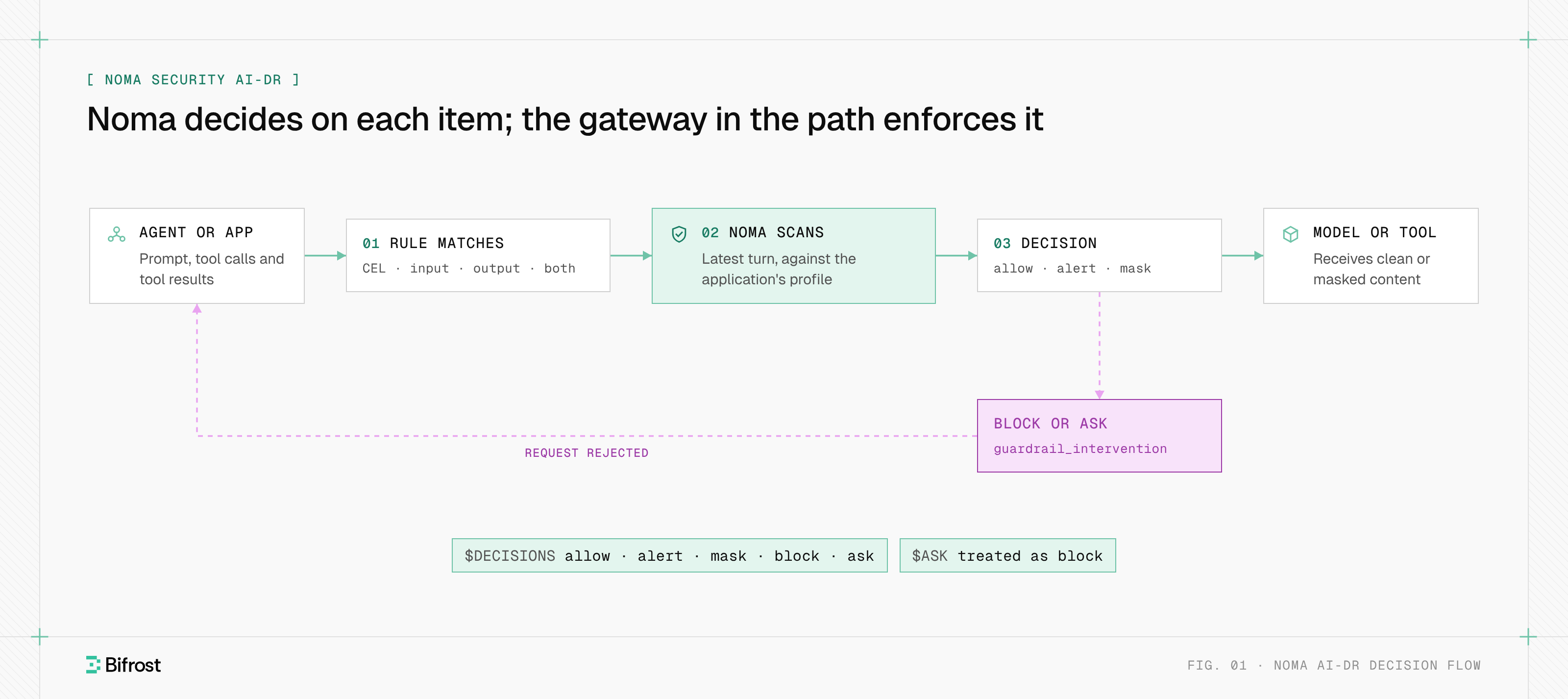
Figure 1: Noma owns the policy and returns a decision per item; the gateway applies it to the prompt, response, tool argument or tool result.
Noma's AI-DR product page names the risks its detectors target: prompt injection (including encoded injection and indirect injection through tool responses), sensitive data leakage, tool poisoning, scope violations, malicious intent and rogue behavior that drifts from an agent's baseline. Each detector is tuned independently, and a Runtime Context Engine weighs the session, the identity behind the agent and the data within reach to cut false positives.
| Decision | What it means | What the enforcer does |
|---|---|---|
| Allow | No policy matched | Passes the content unchanged |
| Alert | A detector fired at alert level | Passes the content and records the detection |
| Mask | A detector found values to hide | Replaces the flagged values, then continues |
| Block | A detector fired at block level | Stops the request or response |
| Ask | The policy wants a human decision | A gateway has no user to prompt, so it blocks |
Policies that a profile runs as deferred are evaluated after the decision returns. They show up in Noma but never block or mask the live request.
How Noma secures MCP servers and agent tool calls
Noma secures traffic under the Model Context Protocol (MCP) at two points: when an agent connects to a server, and when a tool call or tool result passes through at runtime. Connection-time control limits which MCP tools an agent can see; runtime detection inspects the arguments it sends and the results that come back.
At connection time, Agent Access Control keeps a live registry of agents, servers and tools, and gives each connection one of three states. Noma's access control post describes them as Approved, Requires Review and Blocked, and shows approval set per tool rather than per server: a GitHub server's read tool can be allowed while its delete tool is blocked. Policies can be scoped by tool, agent type, user, team or environment, and each agent gets its own identity when it connects instead of sharing an API key or service account, so every tool call is attributable.
At runtime, AI-DR covers the MCP security risks that connection rules cannot see. Tool arguments can carry sensitive data out. Tool results can carry indirect prompt injection back in. Tool descriptions can be poisoned with instructions the model reads as trusted. Inspecting results matters most, because a read-only tool that returns attacker-controlled text is still an injection path.
AI-SPM vs AI runtime security vs gateway guardrails
AI-SPM finds what exists and how it is configured; AI runtime security inspects what an agent does while it runs; gateway guardrails are the enforcement point that stops or rewrites traffic. A product like Noma AI-DR supplies the detection, and a gateway applies the verdict, the same split that CrowdStrike AIDR uses with its collectors.
| Dimension | AI-SPM | Agent access control | AI runtime security (AI-DR) | Gateway guardrails |
|---|---|---|---|---|
| Acts when | Continuously, before use | At connection time | On each prompt, response or tool call | On each request routed through the gateway |
| Unit inspected | Assets and configuration | Agent to server or tool pairing | Content and session behavior | One request, response or tool call |
| Typical output | Inventory and findings | Approved, review or blocked | Allow, alert, mask, block | Pass, rewrite or reject |
| Stops live traffic | No | Yes, at connect | Only through an enforcer | Yes |
Teams usually run all four. Gateway-level guardrails matter because they see every routed request, including traffic from agents that posture tools have not yet discovered.
Where Noma Security deployments break
Noma deployments usually break where the policy and the enforcement point disagree about what was scanned. Most failures below come from scope limits that are documented in the Bifrost Noma integration guide and apply to any inline enforcer.
- Latest turn only. Noma evaluates the newest user message and what follows it. Earlier turns are context, so a value masked on one turn is not masked again when a client replays history.
- Blind spots. System prompts and image content are not evaluated, so instructions placed there need a different control.
- Wrong profile. An application Noma creates automatically starts with whatever profile it is assigned, so new applications need a review before they carry production traffic.
- Streaming conflicts. A mask that would change text the client already received cannot be applied, so the enforcer has to end the stream.
- Unreachable service. AI-DR is a remote API, so every enforcer needs a defined behavior when it times out. Running a local check such as Custom Regex first keeps basic coverage during an outage.
How to plan a Noma AI-DR rollout
A Noma AI-DR rollout starts with the mapping from traffic to Noma applications, because the application picks the profile. Detectors then move from alert to mask or block once findings are understood. Gateway guardrails turn most of the steps below into configuration.
- Map traffic to applications. One application per team or per virtual key lets each carry its own profile.
- Start detectors at alert. Review findings for false positives before anything blocks production traffic.
- Pick a redaction mode. Masking logs only is a lower-risk first step than masking live requests.
- Scope tool rules. Begin with tools that write, send or delete, then widen coverage.
- Choose a region. Noma serves separate API roots for the US, Azure US, the EU and Asia-Pacific, so match the one your data rules require.
- Send session IDs. Grouping related requests into one Noma session gives the Runtime Context Engine the history it needs.
Noma Security with Bifrost
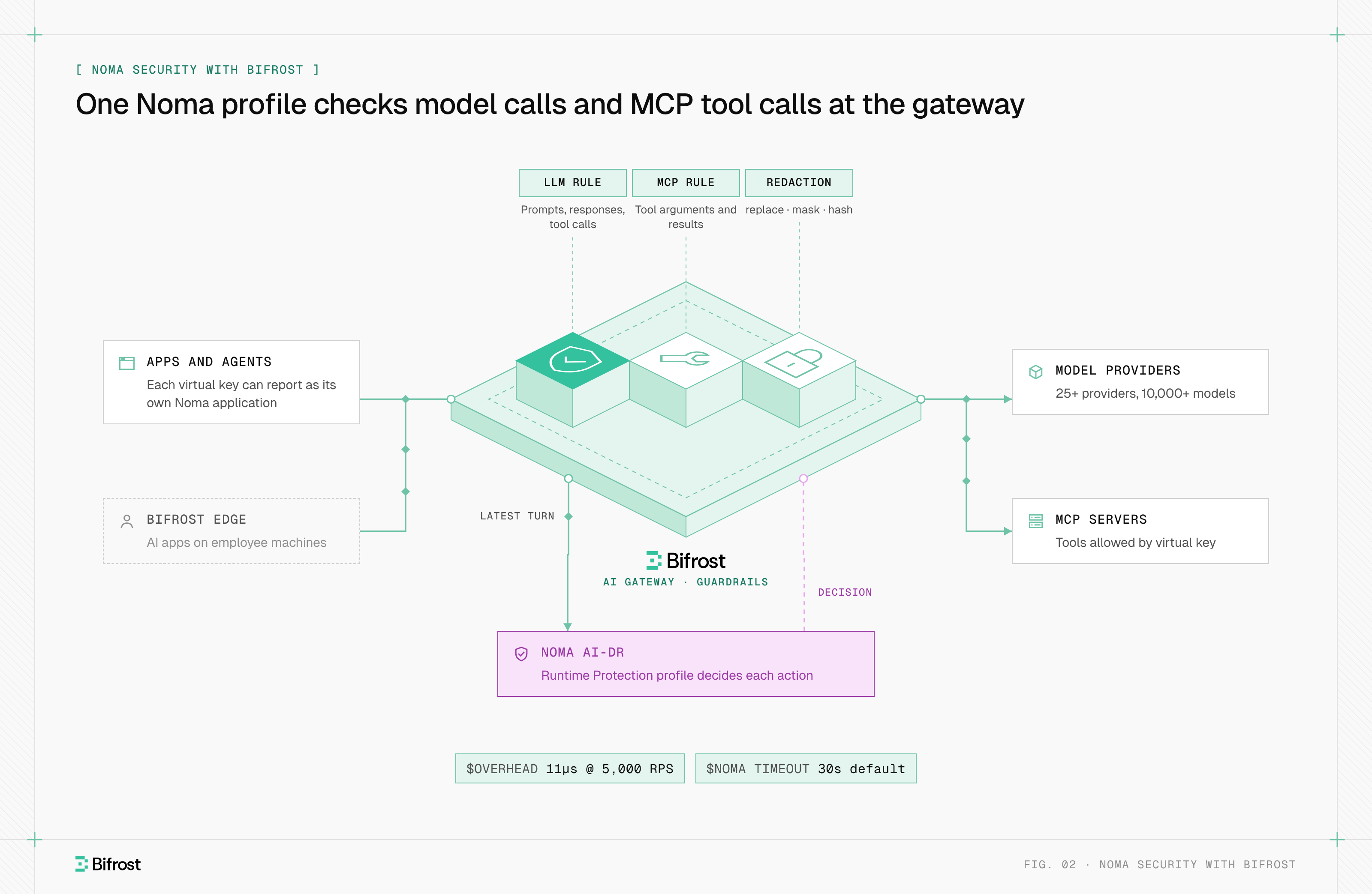
Bifrost, the open-source AI gateway built by Maxim AI, supports Noma AI-DR as a guardrail provider in Bifrost Enterprise. Noma owns the detection policy, and Bifrost enforces each decision inline on LLM requests, responses, tool calls and tool results, for every provider it routes to.
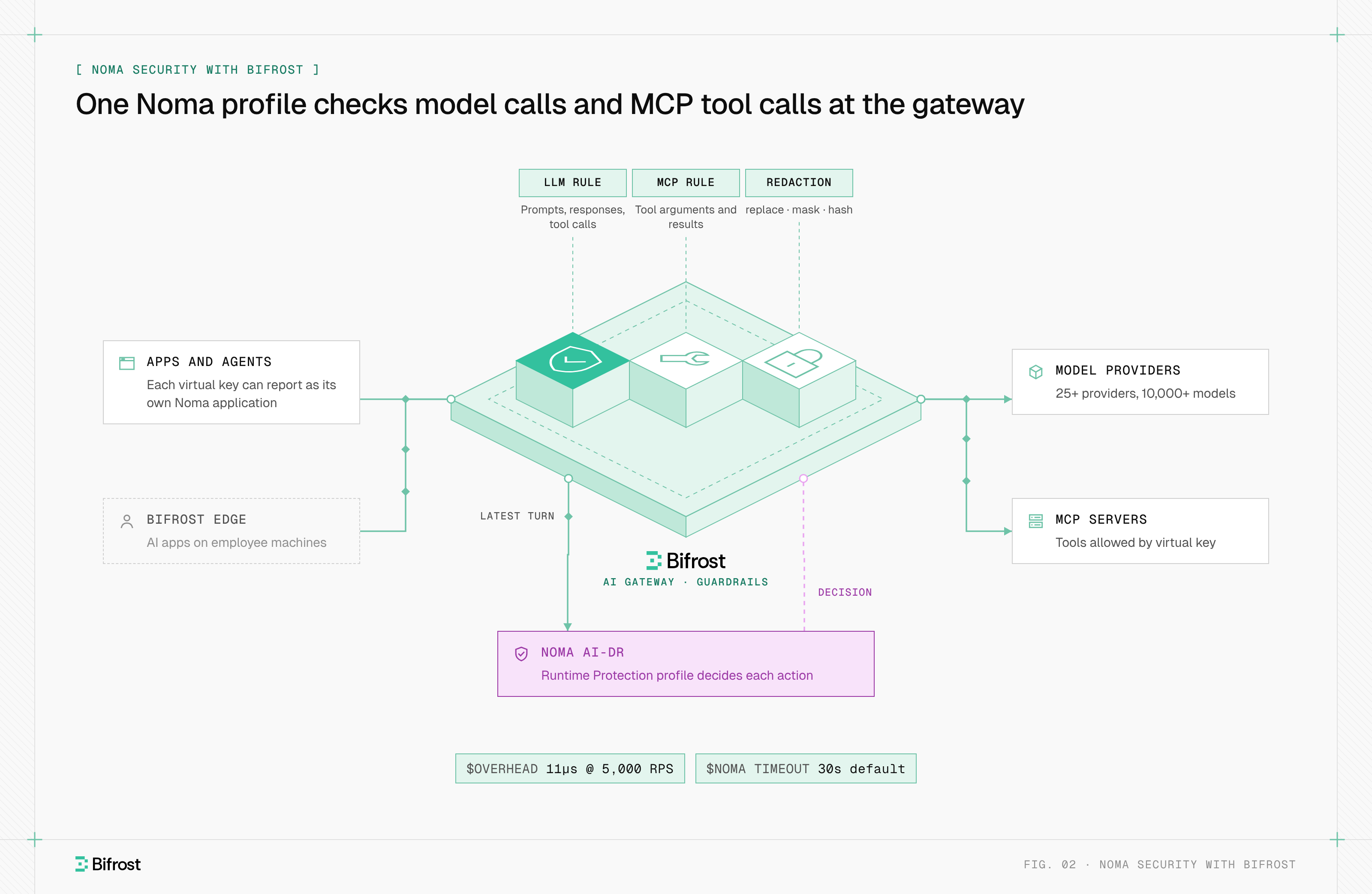
Figure 2: Bifrost sends each matched turn to Noma and applies the decision on both the model path and the tool path.
A noma-security profile holds a client ID and secret, an optional application ID and a regional base_url. With the application ID empty, each virtual key reports as its own Noma application. Guardrail rules link the profile with a Common Expression Language (CEL) condition, and an mcp rule guards the tool execution itself:
{
  "name": "noma-github-write-tools",
  "enabled": true,
  "target": "mcp",
  "celExpression": "mcp_client == \"github\" && mcp_tool == \"create_issue\"",
  "applyTo": "both",
  "samplingRate": 100,
  "timeout": 60,
  "selectedGuardrailProfiles": ["regex:1", "noma-security:26"]
}
| Situation | Bifrost behavior |
|---|---|
| Block or ask | Returns a guardrail_intervention error carrying Noma's evidence |
| Mask | Replaces every occurrence of each flagged value with replace, mask or hash |
| Decision Bifrost cannot apply safely | Fails closed instead of forwarding the original |
| Noma timeout or error | Fails open and runs the next profile |
| Fallback to another provider | Reuses the first decision instead of rescanning |
When Noma is the only provider enforcing output, Bifrost streams progressively, checking text at sentence boundaries and releasing it once cleared. Each scan carries the session from x-bf-session-id or the client's own header, such as Claude Code's, so Noma groups related requests. Bifrost adds about 11 microseconds per request at 5,000 RPS; each matched Noma rule adds a Noma round trip on top.
With AI Gateway + Bifrost Edge, the same profiles cover AI apps on employee machines. To review Noma enforcement against your traffic, book a demo; the base gateway starts with the gateway quickstart.
Frequently asked questions
What does Noma Security do?
Noma Security secures AI models and agents across their lifecycle. Its AI-SPM module inventories agents, MCP servers and models and flags risky configurations. Agent Access Control decides which agents may use which tools. AI-DR inspects prompts, responses and tool calls at runtime and returns a decision to allow, alert, mask or block, which an agent hook, endpoint agent or gateway enforces.
What is Noma AI-DR?
Noma AI-DR (AI Detection and Response) is the runtime module of the Noma platform. It runs the detectors in a Runtime Protection profile against each turn of a session, looking for prompt injection, sensitive data leakage, tool poisoning and agents acting outside their scope. It returns a decision per item, and an inline enforcer such as Bifrost applies it.
Does Noma Security work with MCP?
Yes. Agent Access Control governs which agents can connect to which MCP servers and tools, with approval set per tool. At runtime, AI-DR evaluates tool-call arguments and tool results, which is where data leakage and indirect prompt injection appear. In Bifrost, a guardrail rule with the mcp target links a Noma profile to tool executions.
Does Noma AI-DR inspect system prompts?
No. Through the Bifrost integration, Noma evaluates the newest user message and the tool calls, tool results and response that follow it, but not system prompts or image content. Teams that need checks on those parts of a request link a second guardrail profile, such as Custom Regex or Secrets Detection, to the same Bifrost rule.
What happens if Noma is unreachable when Bifrost calls it?
Bifrost fails open. A timeout or error counts as a failed provider call, so Bifrost reports it, runs the next linked profile and lets the traffic continue if nothing else blocks it. During a stream, the affected text reaches the client unscanned. Placing a local profile ahead of Noma in the rule keeps baseline protection during an outage.
- ai guardrails
- llm guardrails