CrowdStrike AIDR (AI Detection and Response) is a security product that inspects prompts, model responses and agent tool activity against a central policy, then reports, redacts or blocks what that policy flags. Collectors placed in the AI traffic path feed it, so detection runs in CrowdStrike while enforcement happens at the application, gateway or proxy.
AI guardrails are the checks that run on model inputs, outputs and agent tool calls, and AIDR supplies the detection behind them while the application or gateway enforces the result. Agents now reach tools through the Model Context Protocol, so guardrail policy has to cover tool calls as well as prompts. One date shapes any deployment today: the AIDR documentation states that AIDR reaches end of support on November 30, 2026, and that its capabilities continue in Falcon Guardian.
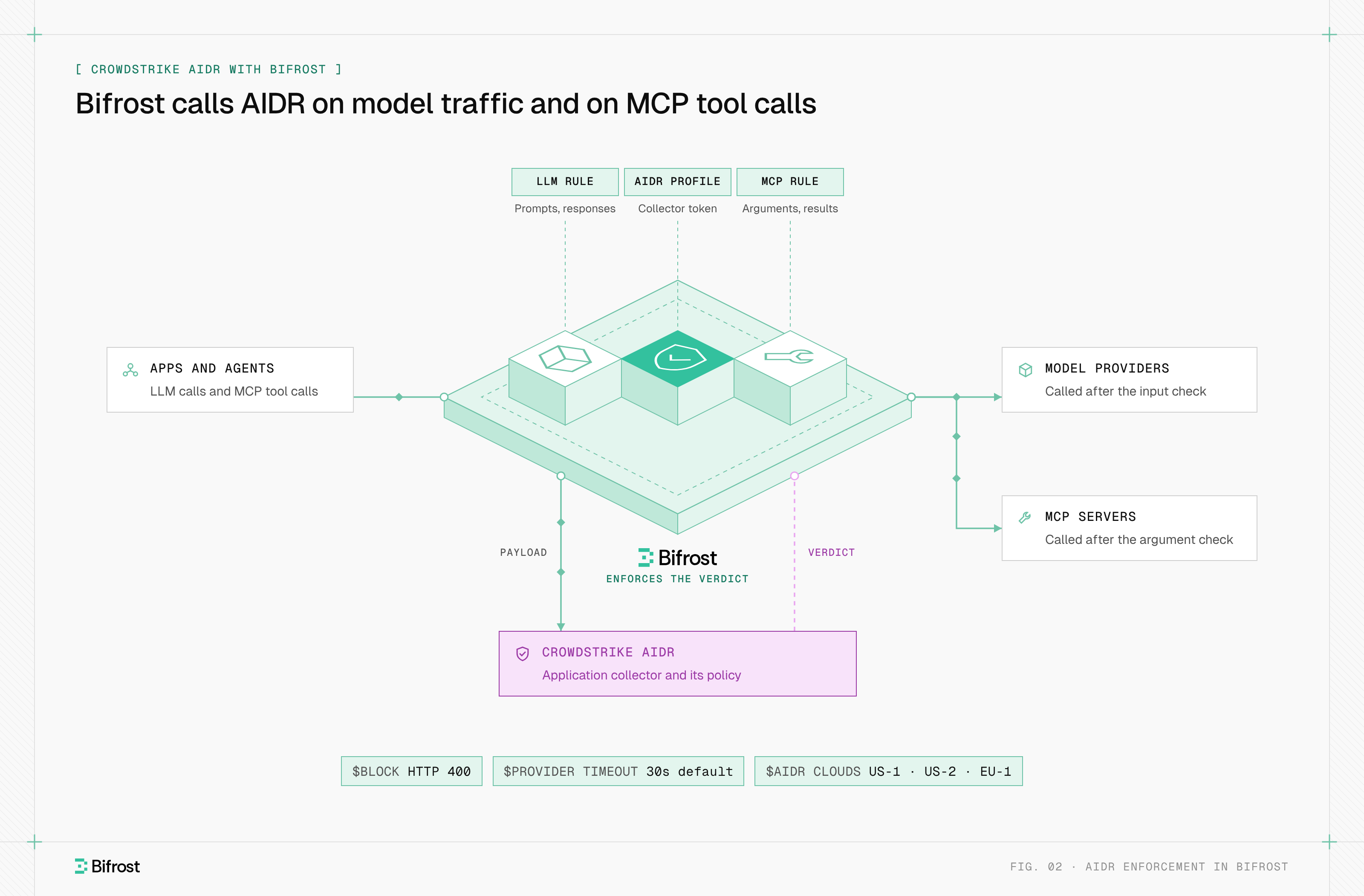
Bifrost, the open-source AI gateway, sits in that path: Bifrost Enterprise calls AIDR on model traffic and on MCP tool calls, then enforces the verdict.
How does CrowdStrike AIDR work?
CrowdStrike AIDR works by sending each AI interaction from a collector to a policy, running that policy's detectors on the content, and returning a verdict for the collector to act on. The verdict tells the collector to allow the content, replace it with a redacted version, or stop it, and AIDR records the finding in its logs.
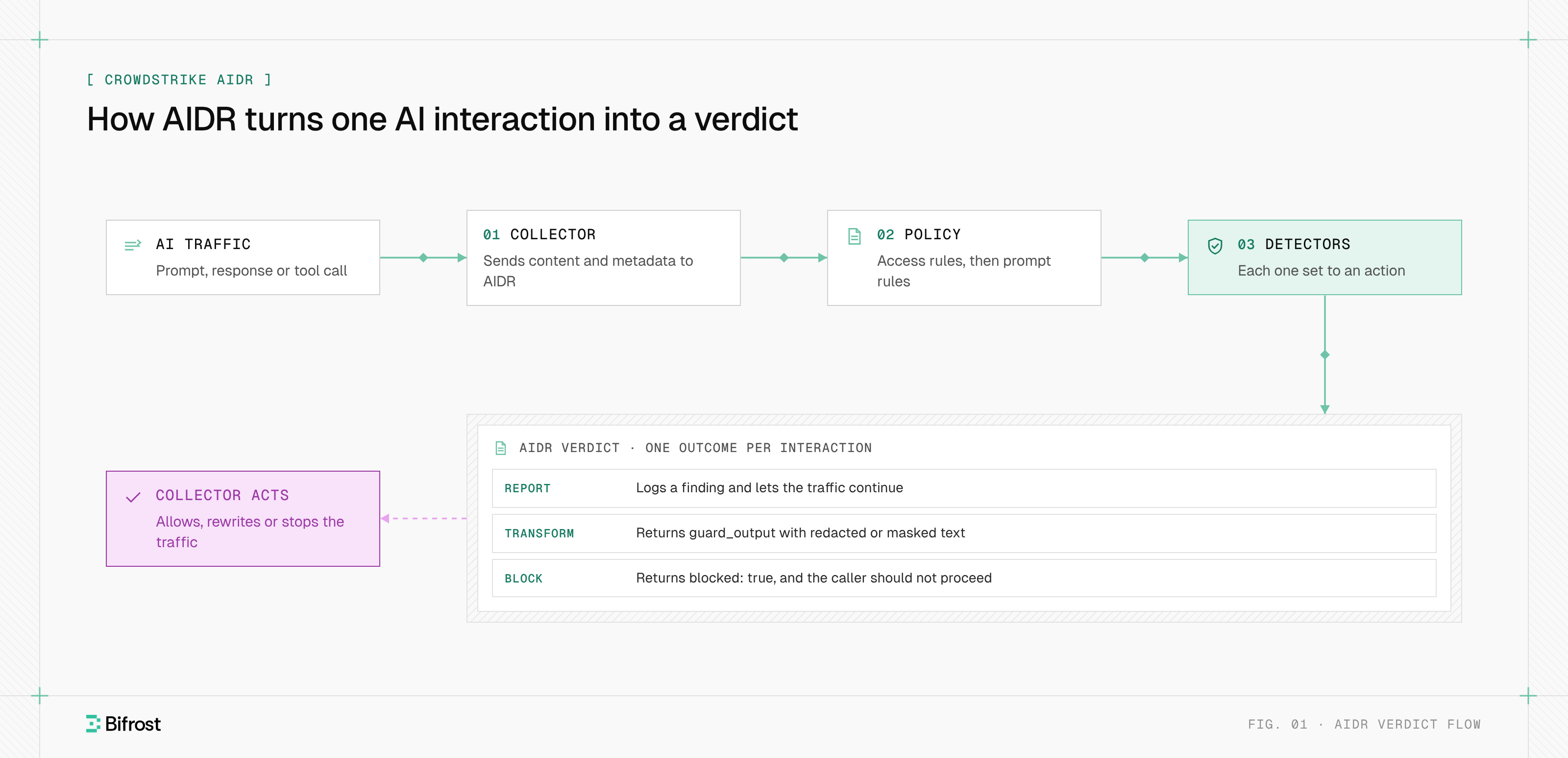
Figure 1: AIDR decides and the collector enforces, so a Block verdict stops traffic only when the collector acts on it.
Four objects make up the AIDR model:
- Collectors gather prompts, responses and metadata such as user, device and application context from one layer of the environment.
- Policies combine access rules, which match on metadata, with prompt rules, which inspect content.
- Detectors are the individual checks inside prompt rules, such as Malicious Prompt, Confidential and PII Entity, Secret and Key Entity, and MCP Validation.
- Findings are the detection results in the AIDR logs, with the risks identified and the actions applied.
Each detector carries an action: Report logs the finding, Transform redacts or masks the text, and Block flags the interaction. The AIDR APIs express the outcome as result.blocked and result.transformed, with rewritten content in result.guard_output. Each guard_chat_completions call is stateless and capped at 1 MiB, so the caller decides how much conversation history to send.
Where do Falcon AIDR collectors enforce policy?
Falcon AIDR collectors enforce policy only where they sit inline, which makes collector choice the main design decision. Application, gateway and agentic collectors can block and redact in real time, while cloud and OpenTelemetry collectors record activity without enforcing it. The table follows CrowdStrike's collector documentation.
| Collector | Where it sits | What it inspects | Inline enforcement |
|---|---|---|---|
| Application | Application code, through an SDK or direct API call | Prompts, responses, and tool data placed in the payload | Yes, by the calling code |
| Gateway | A supported API or AI gateway | LLM API traffic | Yes, by the gateway |
| Agentic (MCP Proxy) | Between MCP clients and MCP servers | Tool listings, tool inputs and tool outputs | Yes, by the proxy |
| Browser and Falcon Endpoint | Managed browsers and desktop AI apps | Employee prompts and responses | Partial; browser output rules are report-only |
| Cloud and OpenTelemetry | Log and telemetry pipelines | Recorded AI activity | No |
Two subscriptions map to these positions. AIDR for Workforce covers employee use of AI tools on managed endpoints and networks. AIDR for Agents covers internally built AI systems, agents and chatbots, and it is the relevant subscription for traffic through Bifrost. Both feed Falcon Next-Gen SIEM.
How does CrowdStrike MCP protection work?
CrowdStrike MCP protection works by treating tool traffic as its own event stream, separate from prompts and responses. AIDR defines three MCP event types: tool_listing for metadata retrieved from MCP servers, tool_input for content sent to tools, and tool_output for what tools return. An MCP Proxy collector sends these events.
Under the Model Context Protocol, a model reads every description a server supplies, which makes MCP tools part of the attack surface. The MCP Validation detector checks tool definitions for malicious instructions in descriptions, conflicting tool names and conflicting descriptions, the pattern known as tool poisoning. Tool arguments and tool results carry the other two MCP security risks: sensitive data leaving in a call, and indirect prompt injection arriving in a result.
The MCP Proxy collector has one documented limit. It does not monitor prompts or model responses, so a team that wants both needs a second collector, or a single inline point that sees model calls and tool calls together. An MCP gateway that also routes LLM traffic is that point.
AI detection and response vs EDR and gateway guardrails
AI detection and response inspects the content of AI interactions, which is the layer endpoint detection and response (EDR) was not built to read. EDR watches processes, files and behavior on a host. Gateway guardrails are the enforcement mechanism, and a product like AIDR can supply the detection behind them.
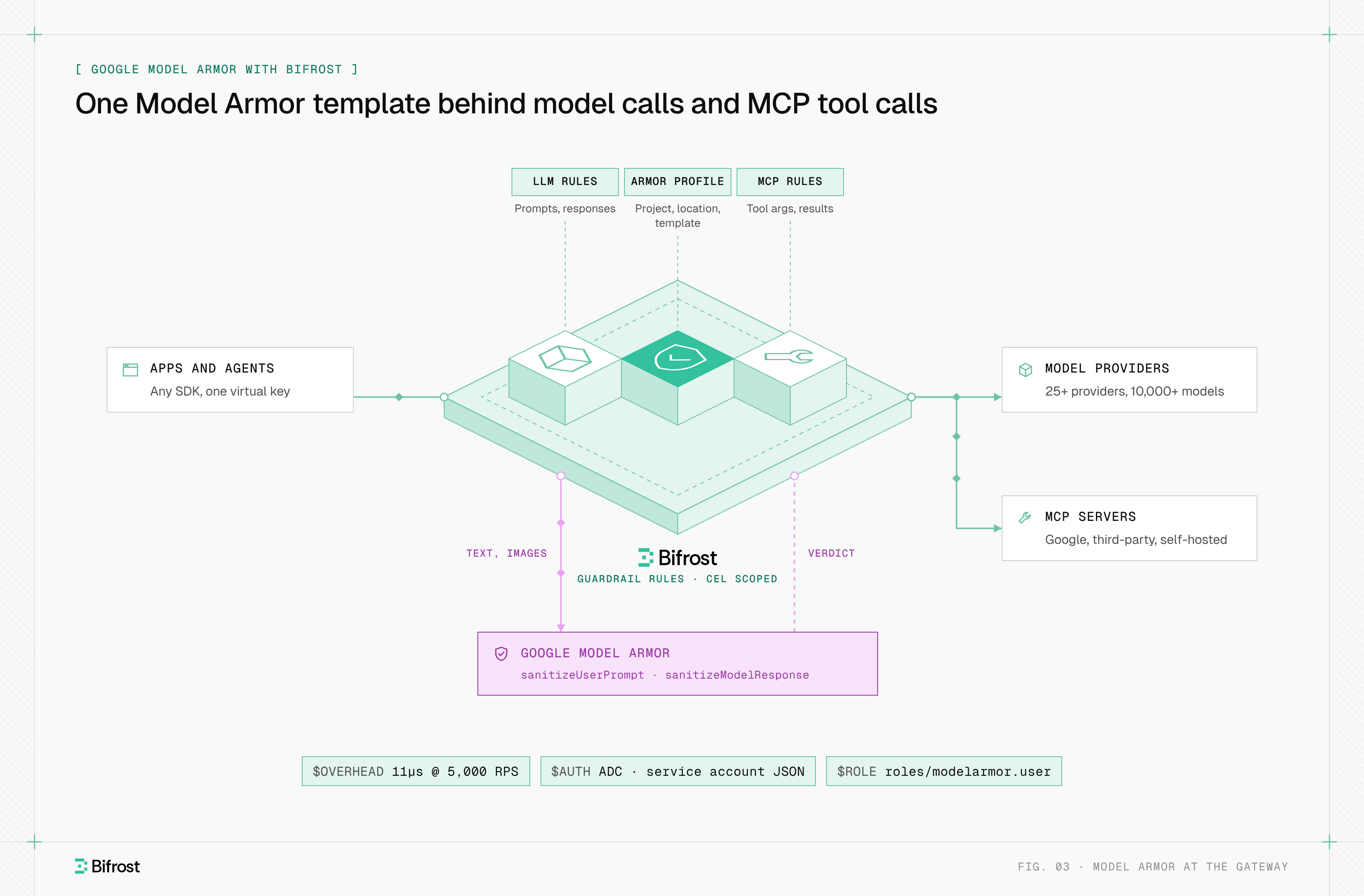
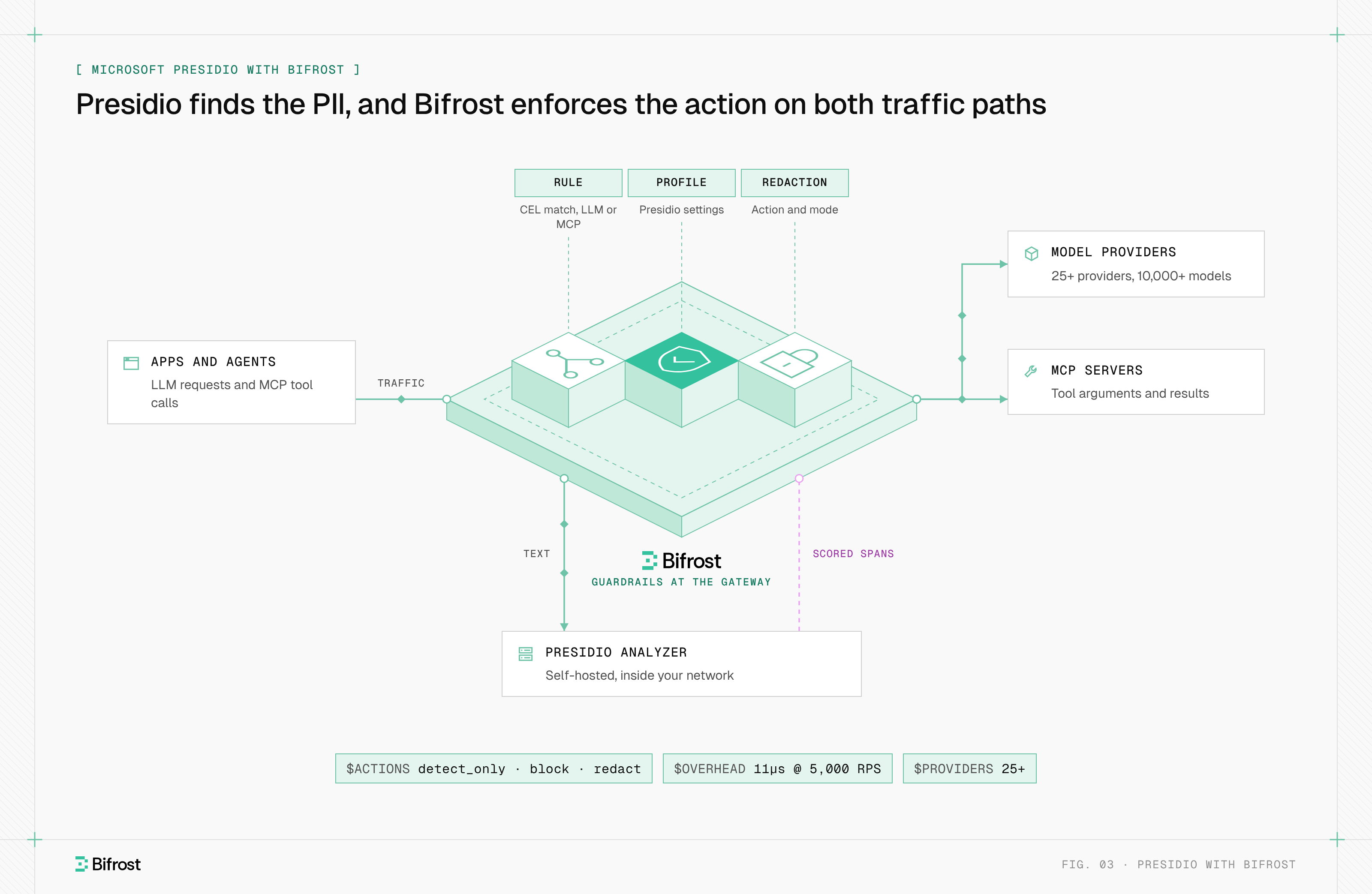
Other guardrail providers split the work differently: AWS Bedrock Guardrails and Google Model Armor are cloud content-safety services, and Microsoft Presidio is a self-hosted PII detector.
| Dimension | EDR | Gateway guardrails | AIDR |
|---|---|---|---|
| Unit inspected | Process and host activity | One request, response or tool call | Prompt, response and tool content across collectors |
| Policy owner | Security team | Platform or security team | Security team |
| Enforcement point | The endpoint agent | The gateway | Whichever collector sits inline |
| Prompt injection | Not visible | Depends on the linked provider | Malicious Prompt detector |
| Coverage of AI apps | All processes on the host | All traffic routed through the gateway | Each layer with a collector |
Where CrowdStrike AIDR deployments fail
AIDR deployments usually fail in the gap between a detection and an enforced decision. A finding changes nothing unless a policy maps it to Block or Transform and the collector honors that verdict. The same split applies to any gateway guardrail that blocks, rewrites or logs, and each failure mode below has a specific fix.
- Report-only detectors. A detector set to Report logs a finding and lets traffic through, so a block has to be configured in the policy.
- No policy on the collector. A collector without a policy records activity for visibility and returns no block or redaction decision.
- Trimmed history. Calls are stateless, so an instruction planted in an earlier turn is invisible if the caller sends only recent messages.
- Streaming responses. A verdict on output needs the complete response, so inline blocking and token-by-token delivery conflict.
- Unreachable service. AIDR is a remote API, so every inline caller needs a defined behavior for timeouts and errors.
CrowdStrike Guardian and AIDR end of support
CrowdStrike Falcon Guardian is the product CrowdStrike introduced on September 1, 2026 as "the evolution of Falcon AI Detection and Response." The AIDR documentation gives November 30, 2026 as the end-of-support date. AIDR also remains CrowdStrike's name for the product category, so the term stays in use after the product date.
Falcon Guardian includes Falcon AIDR's visibility, governance, data protection, and threat detection and response capabilities. CrowdStrike adds discovery of known and unknown AI agents on supported Windows, macOS and Linux endpoints, and it fuses agent activity with Falcon endpoint telemetry.
The AIDR overview and support pages do not say what happens to existing collector tokens, base URLs or API paths after that date. Any team with an AIDR integration in production should get that answer from its CrowdStrike account team before November 30, 2026.
How to plan a CrowdStrike AIDR rollout
An AIDR rollout starts with where traffic can be stopped, then moves detectors from Report to Block once findings are understood. The decisions below apply to any inline collector, and the order matters because each step reduces the risk of the next. Gateway guardrails make steps 3 and 4 a configuration change.
- Choose the inline points. Map each AI workload to an application, gateway or MCP Proxy collector.
- Start detectors in Report. Review findings for false positives before any detector blocks production traffic.
- Write separate input and output rules. A strict prompt policy and a redact-only response policy often suit the same application.
- Scope tool rules narrowly. Start with tools that write, send or delete, then widen coverage.
- Decide the failure behavior. Agree in advance what happens when AIDR times out.
- Check data flow. Inline inspection sends prompt content to a collector's AIDR cloud (US-1, US-2 or EU-1), so confirm that with your data owners.
- Confirm the Falcon Guardian path. Get the collector and API plan in writing.
CrowdStrike AIDR with Bifrost
Bifrost, the open-source AI gateway built by Maxim AI, is one of the gateways in CrowdStrike's open gateway ecosystem. In Bifrost Enterprise, AIDR is a guardrail provider: CrowdStrike owns the detection policy, and Bifrost enforces the verdict inline.
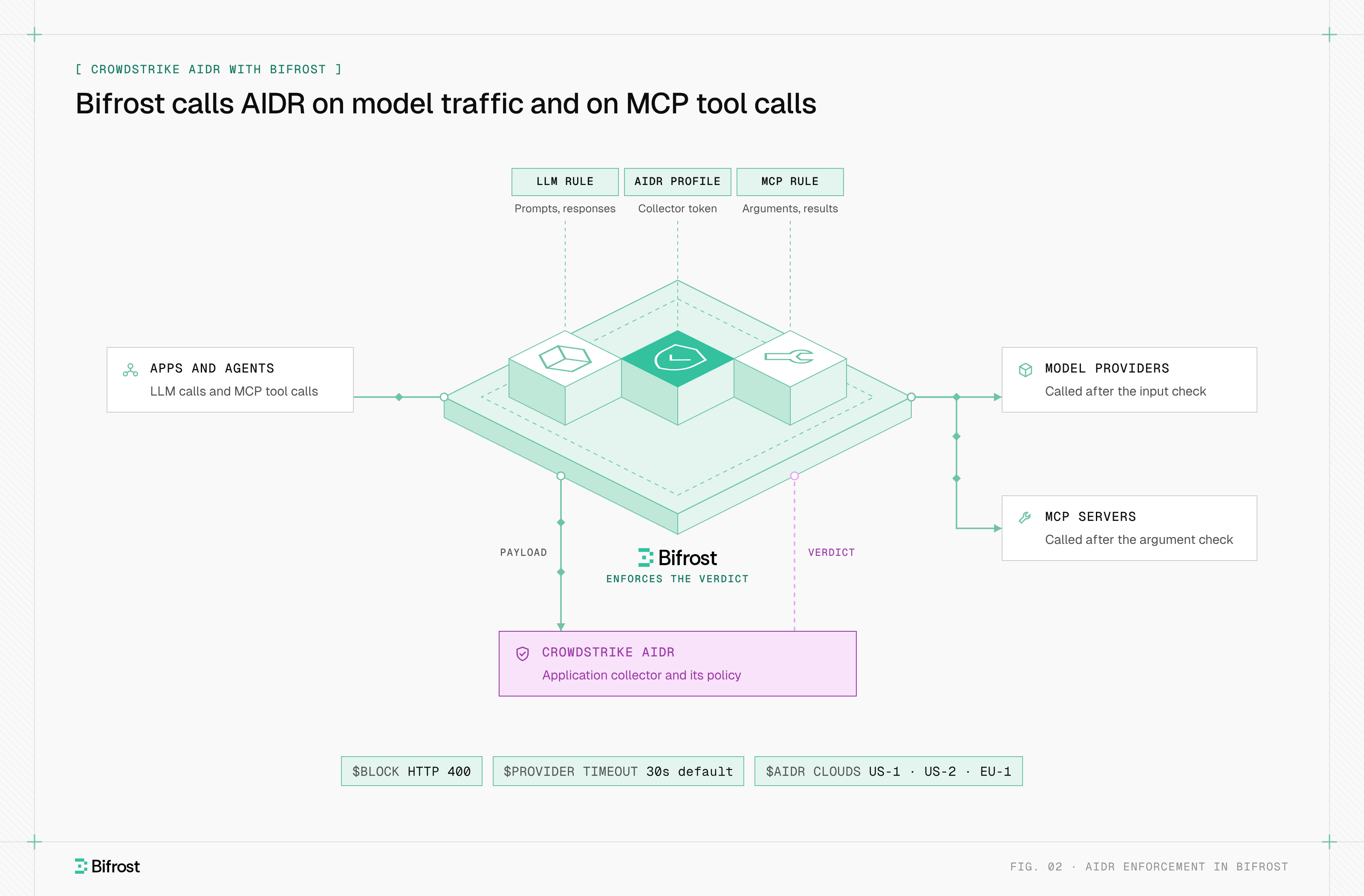
Figure 2: One AIDR profile can back rules on both paths, so prompts and tool calls answer to the same CrowdStrike policy.
Teams create an AIDR Application collector, copy its token and base URL into a crowdstrike-aidr profile, and link that profile to guardrail rules. An llm rule checks prompts and responses. An mcp rule checks tool arguments and results, and a Common Expression Language (CEL) condition scopes it to one tool:
{
  "name": "crowdstrike-aidr-github-issues",
  "enabled": true,
  "target": "mcp",
  "celExpression": "mcp_client == \"github\" && mcp_tool == \"create_issue\"",
  "applyTo": "both",
  "samplingRate": 100,
  "timeout": 60,
  "selectedGuardrailProfiles": ["crowdstrike-aidr:12"]
}
Bifrost calls {base_url}/v1/guard_chat_completions. On chat requests it also sends tool definitions, tool calls and tool results, which gives the MCP Validation detector tool definitions to evaluate when the policy enables it.
| AIDR result | Bifrost behavior |
|---|---|
blocked: true | Returns HTTP 400 with type: "guardrail_intervention" |
transformed: true with valid guard_output | Replaces the text and continues |
| Neither | Passes the original content |
| Timeout, non-2xx or malformed response | Reports the error and fails open |
Provider errors fail open, so put local Custom Regex or Secrets Detection profiles ahead of AIDR in the rule.
On a streaming output rule, Bifrost holds the response until the full text is checked, and a transformed streaming result ends the stream.
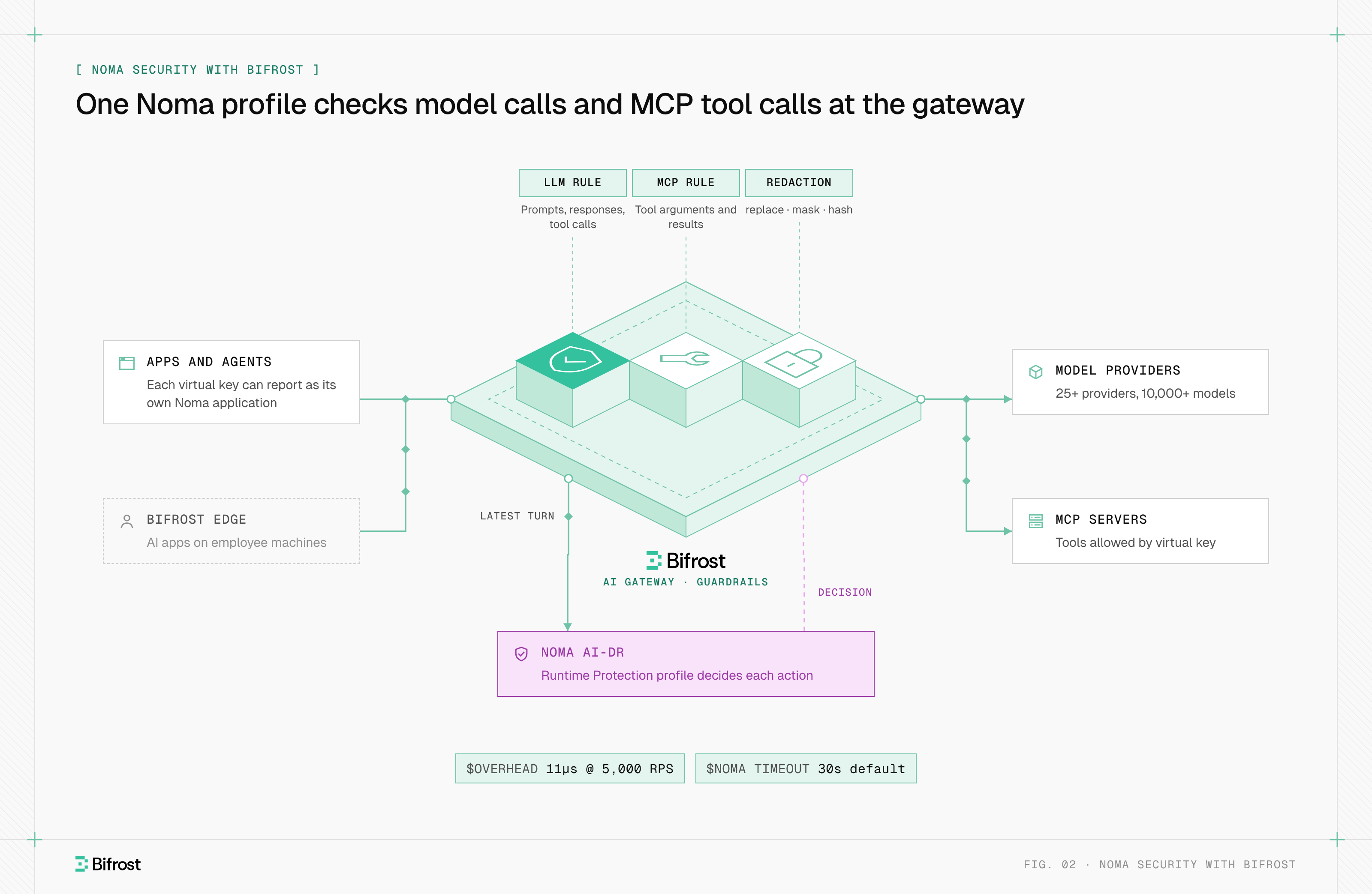
With AI Gateway + Bifrost Edge, the same profiles cover AI apps on employee machines. To review AIDR enforcement against your traffic, book a demo; the base gateway starts with the gateway quickstart.
Frequently asked questions
What is AIDR?
AIDR stands for AI detection and response, a security category focused on the content and behavior of AI systems: prompts, model responses, agents and tools. CrowdStrike AIDR is CrowdStrike's product of that name. It uses collectors to gather AI traffic, policies and detectors to evaluate it, and inline collectors to block or redact what the policy flags.
Does CrowdStrike AIDR work with MCP?
Yes. AIDR defines tool_listing, tool_input and tool_output events, and its MCP Proxy collector applies policies to tool descriptions, tool inputs and server responses. The MCP Validation detector checks tool definitions for tool poisoning. Bifrost guardrail rules with the mcp target can also link an AIDR profile to check tool arguments and results at the gateway.
Is CrowdStrike AIDR being replaced by Falcon Guardian?
Yes, as a product. CrowdStrike's documentation says AIDR reaches end of support on November 30, 2026 and that its capabilities continue in Falcon Guardian, which CrowdStrike describes as the evolution of Falcon AIDR. The documentation does not say how existing collectors or API endpoints change, so teams with production integrations should confirm that with CrowdStrike.
Does a detector finding block traffic on its own?
No. A detector finding blocks traffic only when the AIDR policy sets that detector to Block and the response returns blocked: true. A finding under a Report action is logged and the original content continues. Bifrost follows the AIDR verdict and does not block independently on detector findings, so the policy decides what happens.
What happens if AIDR is unavailable when Bifrost calls it?
Bifrost fails open. A timeout, a non-2xx response or a malformed reply counts as a failed provider call, so Bifrost reports the error, runs the next linked profile and lets the traffic continue if nothing else blocks it. Teams that need coverage during an AIDR outage put local profiles such as Custom Regex or Secrets Detection in the same rule.
- ai guardrail
- llm guardrail