Top LLM Failover Platforms in 2026: A Buyer's Guide

TL;DR
- LLM provider outages are now routine (Anthropic's API uptime sat near 98.95% in early 2026, and the November 2025 Cloudflare outage cascaded into ChatGPT and Sora), so an LLM failover platform, a gateway that reroutes to backup providers or models automatically, is core production infrastructure.
- Bifrost, the open-source AI gateway by Maxim AI, leads on failover: provider, model, and key-level fallbacks, adaptive health-aware routing, 11 microseconds of overhead at 5,000 RPS, and self-hosting under Apache 2.0.
- Failover has depth: provider-level, model-level, key-level, and adaptive routing are not interchangeable, so verify a platform handles all four rather than just provider fallback.
- Self-hostable platforms (Bifrost, LiteLLM, Kong) suit regulated teams that need in-VPC or air-gapped control; managed-only services (Cloudflare, Vercel, OpenRouter) trade that for lower operational overhead.
Choosing among the top LLM failover platforms in 2026 has become a core infrastructure decision for any team running AI in production. Provider outages are no longer rare events. In April 2026, the Wall Street Journal reported that Anthropic's API uptime over the prior 90 days sat at 98.95%, well below the 99.99% benchmark most established cloud providers maintain, with enterprise customers actively switching workloads to avoid downtime. OpenAI logged multi-hour incidents through late 2025 and early 2026, and the November 2025 Cloudflare outage cascaded into ChatGPT, Sora, and a long list of dependent AI services. Without a dedicated LLM failover platform, every one of those incidents is downtime for your application. This guide compares six LLM failover platforms available in 2026, starting with Bifrost, the open-source AI gateway by Maxim AI.
What an LLM Failover Platform Actually Does
An LLM failover platform is a gateway that sits between your application and LLM providers, automatically rerouting requests to backup models or providers when the primary returns errors, rate limits, or timeouts. The goal is to make provider downtime invisible to your application code.
A production-grade LLM failover platform typically includes:
- Provider-level fallback chains: ordered lists of alternate providers or models that take over when the primary fails
- Key-level load balancing: weighted distribution across multiple API keys to absorb per-key rate limits
- Health-aware routing: real-time tracking of latency, error rates, and circuit-breaker state
- Retry and timeout policies: configurable per route, with exponential backoff
- Observability: metrics, traces, and logs across providers in one view
- Drop-in compatibility: no application code rewrites to migrate
The platforms below differ on how deeply they implement each layer, on whether they self-host, and on what they add beyond failover (governance, MCP support, semantic caching).
Key Criteria for Evaluating LLM Failover Platforms
Before selecting a platform, evaluate candidates against these dimensions. The same five criteria appear in the LLM Gateway Buyer's Guide and reflect what production teams actually need.
- Performance overhead: The gateway sits in the critical path of every inference request. Sub-millisecond overhead at sustained throughput matters more than peak burst numbers.
- Failover depth: Provider-level, model-level, and key-level fallbacks are not interchangeable. Verify that the platform handles all three.
- Governance: Virtual keys, per-team budgets, rate limits, RBAC, SSO, and audit logs determine whether the platform is fit for multi-team enterprise use.
- Deployment model: Self-hosted, in-VPC, and air-gapped options matter for regulated industries. Managed-only platforms create data residency and compliance friction.
- MCP and agent support: Native MCP gateway capabilities are increasingly required as agent workloads grow.
The six platforms below cover the practical range of choices in 2026, from open-source self-hosted gateways to managed edge services.
Top 6 LLM Failover Platforms in 2026
1. Bifrost
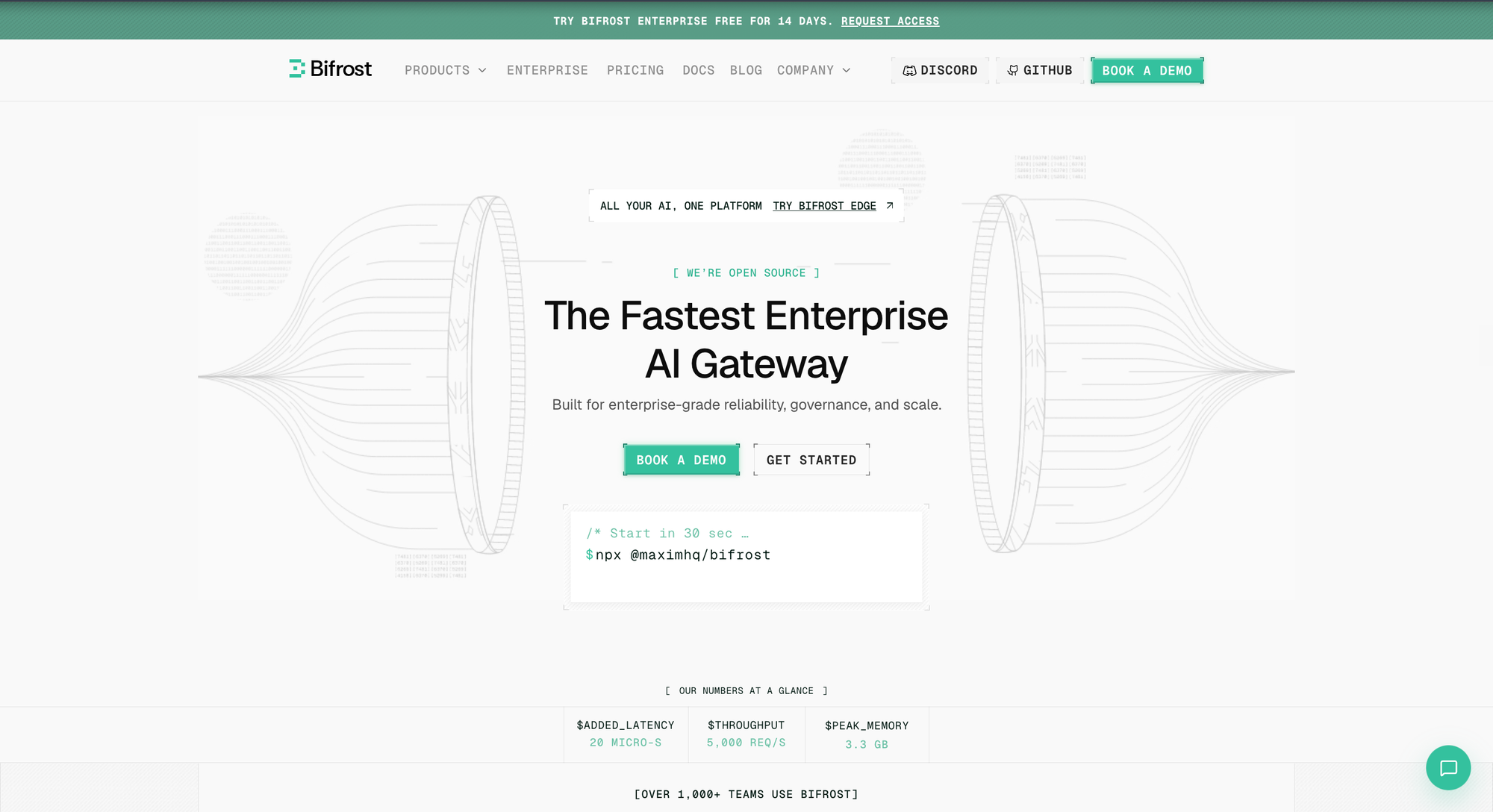
Bifrost is a high-performance, open-source AI gateway built in Go by Maxim AI. It unifies access to 20+ LLM providers through a single OpenAI-compatible API and is engineered for failover as a first-class concern, not as an afterthought.
In sustained benchmarks at 5,000 requests per second, Bifrost adds only 11 microseconds of gateway overhead per request. It is licensed under Apache 2.0, deploys with a single command (npx -y @maximhq/bifrost or Docker), and acts as a drop-in replacement for OpenAI, Anthropic, AWS Bedrock, Google GenAI, LangChain, PydanticAI, and the LiteLLM SDK itself. Migration requires changing only the base URL.
Key failover capabilities:
- Automatic fallbacks across providers, models, and API keys with zero application-side code changes
- Weighted load balancing across keys and providers, including per-route routing rules
- Adaptive load balancing that redistributes traffic dynamically based on real-time health
- Semantic caching to cut redundant provider calls on similar queries
- Hierarchical governance through virtual keys, with per-consumer access, budgets, and rate limits
- Native MCP gateway with Agent Mode and Code Mode for tool orchestration
- Enterprise features including clustering, in-VPC deployments, vault support, and audit logs for SOC 2, GDPR, HIPAA, and ISO 27001
Best for: Bifrost is built for enterprises running mission-critical AI workloads that require best-in-class performance, scalability, and reliability. It serves as a centralized AI gateway to route, govern, and secure all AI traffic across models and environments with ultra low latency. Bifrost unifies LLM gateway, MCP gateway, and Agents gateway capabilities into a single platform. Designed for regulated industries and strict enterprise requirements, it supports air-gapped deployments, VPC isolation, and on-prem infrastructure. It provides full control over data, access, and execution, along with robust security, policy enforcement, and governance capabilities.
2. LiteLLM
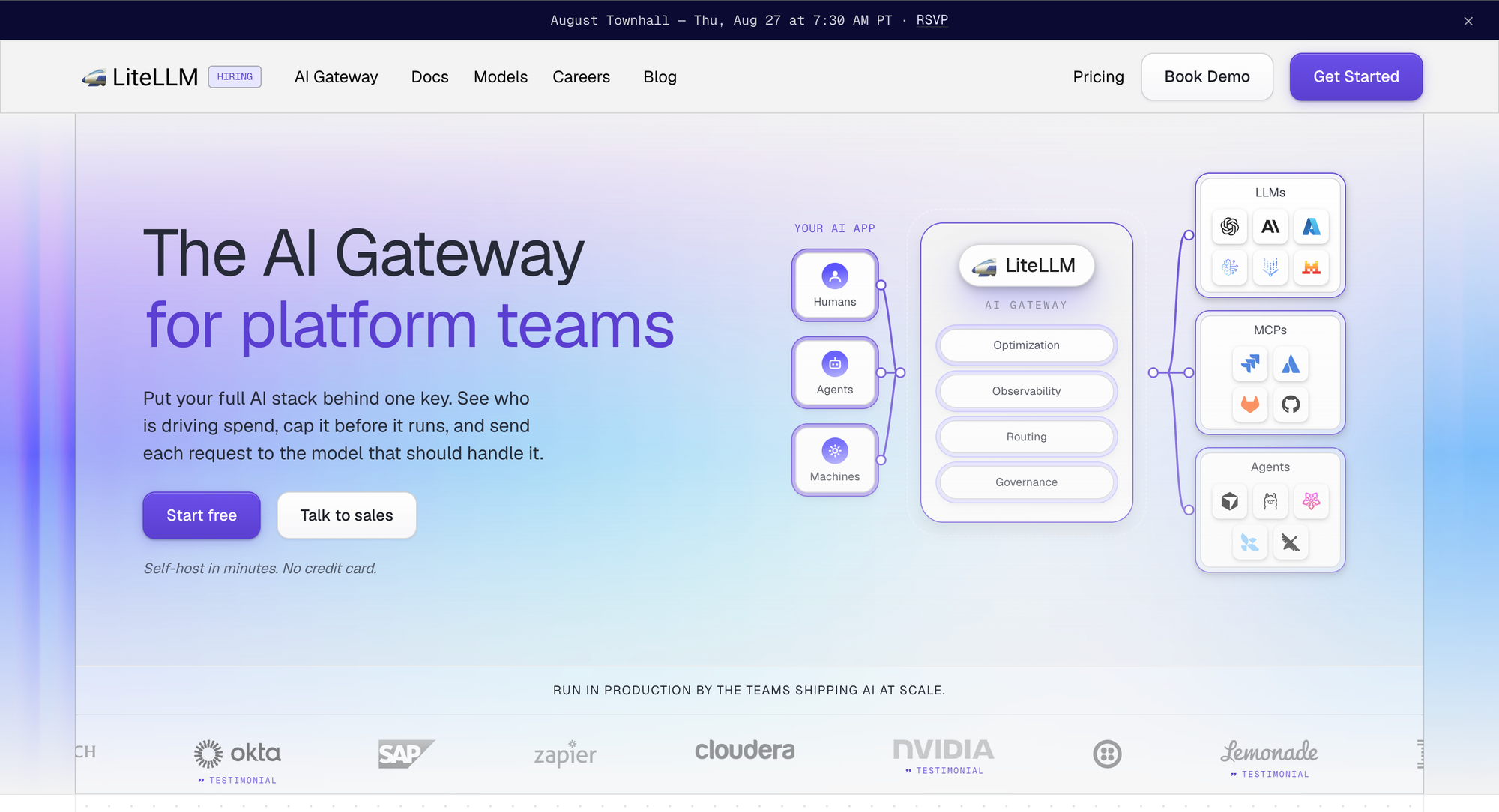
LiteLLM is an open-source Python library and proxy server that provides a unified interface across 100+ LLM providers. It translates calls into a consistent OpenAI-compatible format and supports both an SDK mode and a proxy server mode.
LiteLLM offers basic load balancing, fallback model lists, and virtual-key management in the proxy server. Spend tracking, team-level budgets, and rate limiting are supported, though several enterprise capabilities sit behind a paid license. The Python runtime imposes a practical ceiling on sustained concurrency, and operating the proxy at scale typically requires PostgreSQL, Redis, and worker-process recycling.
3. Kong AI Gateway

Kong AI Gateway extends Kong's API gateway platform to LLM traffic. It inherits Kong's plugin ecosystem, mTLS, rate limiting, audit features, and request and response transformation.
Kong AI Gateway supports multi-provider routing, token analytics, and provider-level fallbacks through its policy engine. Its strength is consolidating traditional API management and AI traffic under one platform. Teams already operating Kong for non-AI APIs get a single control plane. The trade-off is that AI-native features such as semantic caching, model-level fallback chains, and native MCP gateway support are less mature than dedicated LLM gateways.
4. Cloudflare AI Gateway
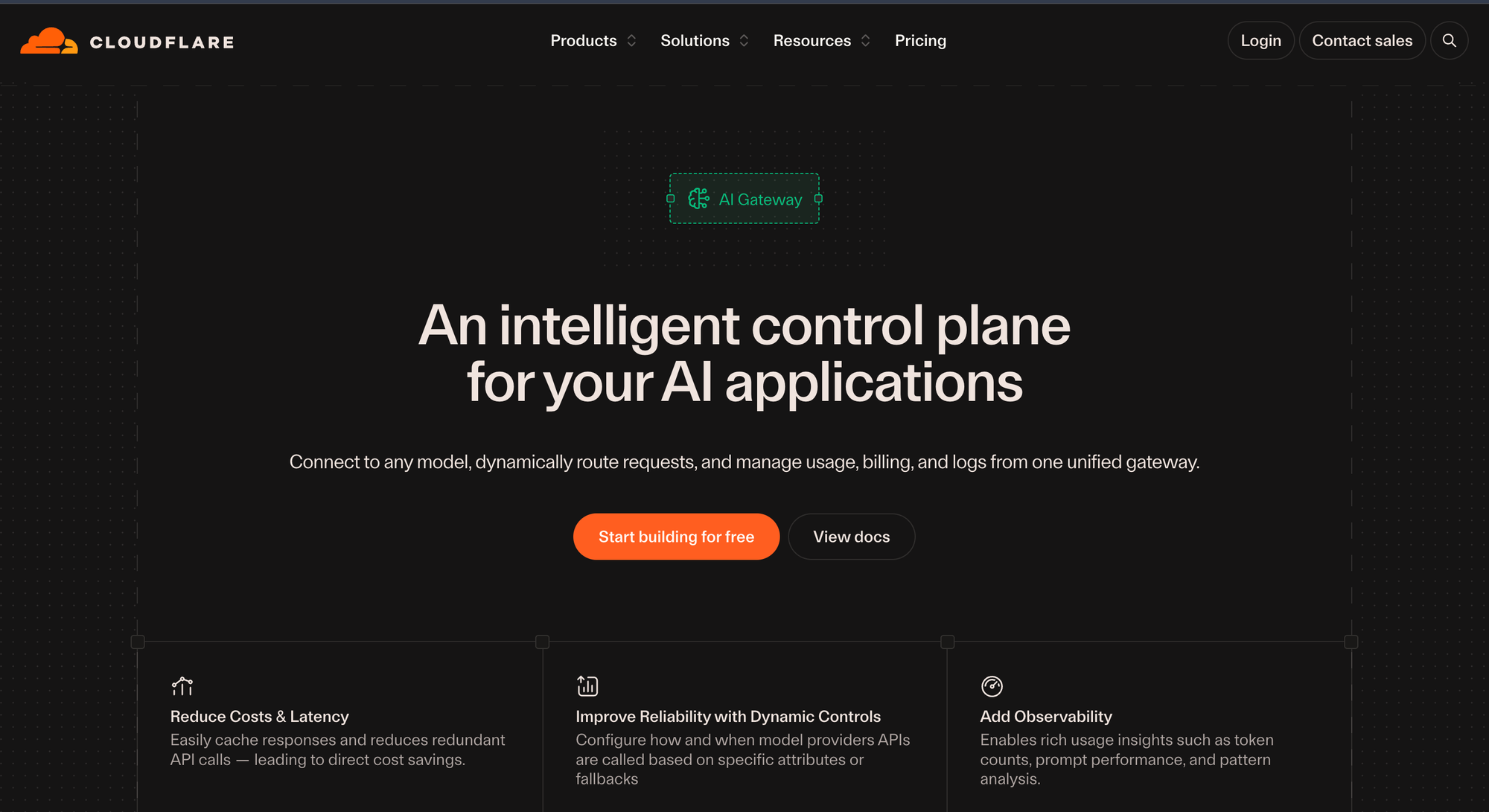
Cloudflare AI Gateway is a managed service that proxies LLM API calls through Cloudflare's global edge network. It provides caching, rate limiting, request logging, and basic analytics with no infrastructure setup for existing Cloudflare customers.
Edge routing reduces latency for geographically distributed applications, and integration is straightforward for teams already on Cloudflare. The platform supports failover across providers through its routing configuration. Self-hosting and in-VPC deployment are not supported, and advanced governance features such as virtual keys, RBAC, and hierarchical budgets are limited compared to dedicated gateways.
5. Vercel AI Gateway
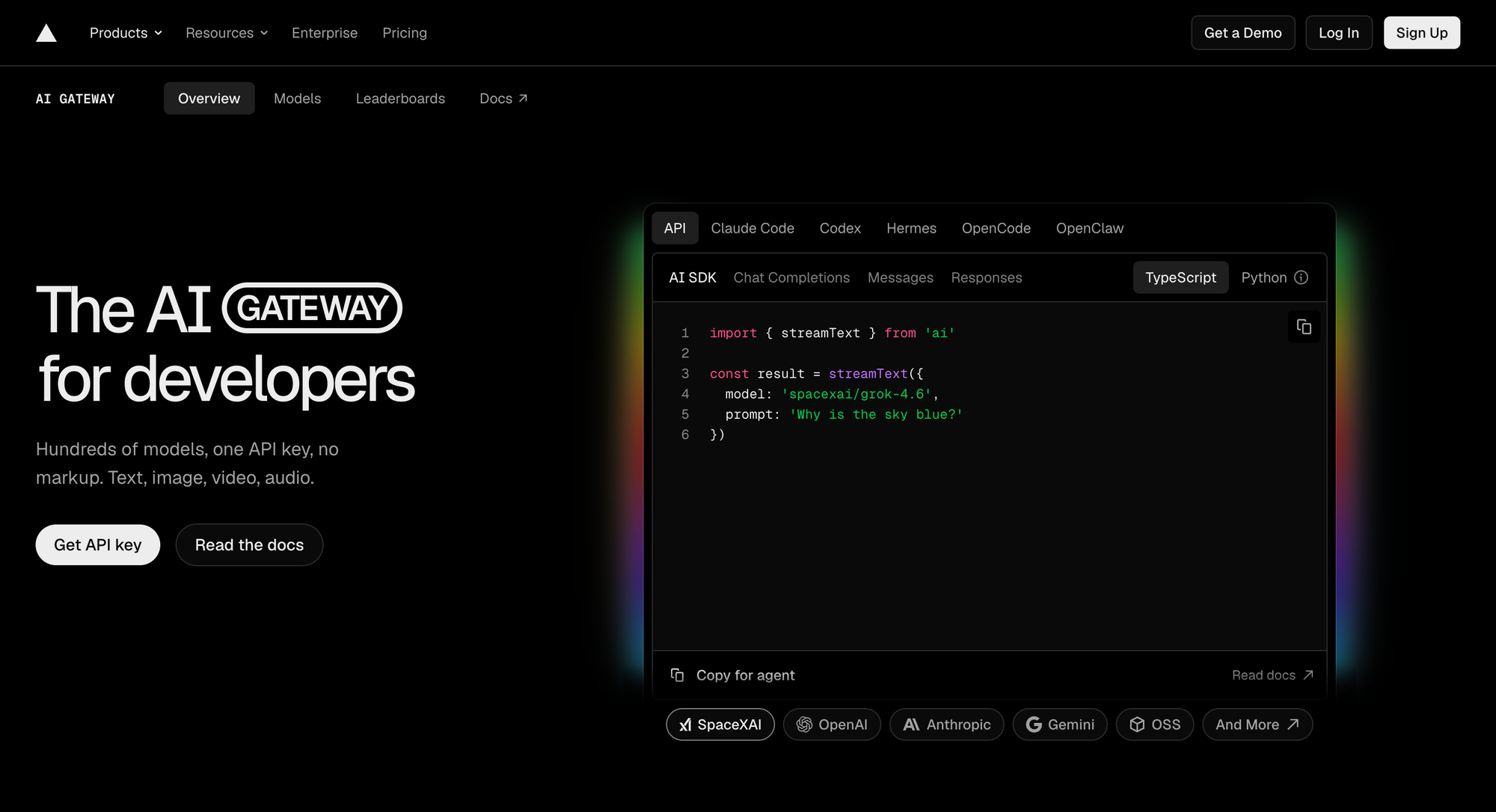
Vercel AI Gateway is an edge-optimized gateway tightly integrated with the Vercel deployment platform and the Vercel AI SDK. It is designed for frontend-heavy and full-stack TypeScript and JavaScript teams that ship on Vercel.
The platform supports multiple providers through the AI SDK, offers edge-optimized routing for low-latency streaming, and provides a polished developer experience for teams already building with Next.js. Failover is configured at the SDK level, and streaming, tool calling, and structured output generation are supported natively. It is less suitable for teams running outside the Vercel ecosystem or for organizations with complex multi-team governance requirements.
6. OpenRouter
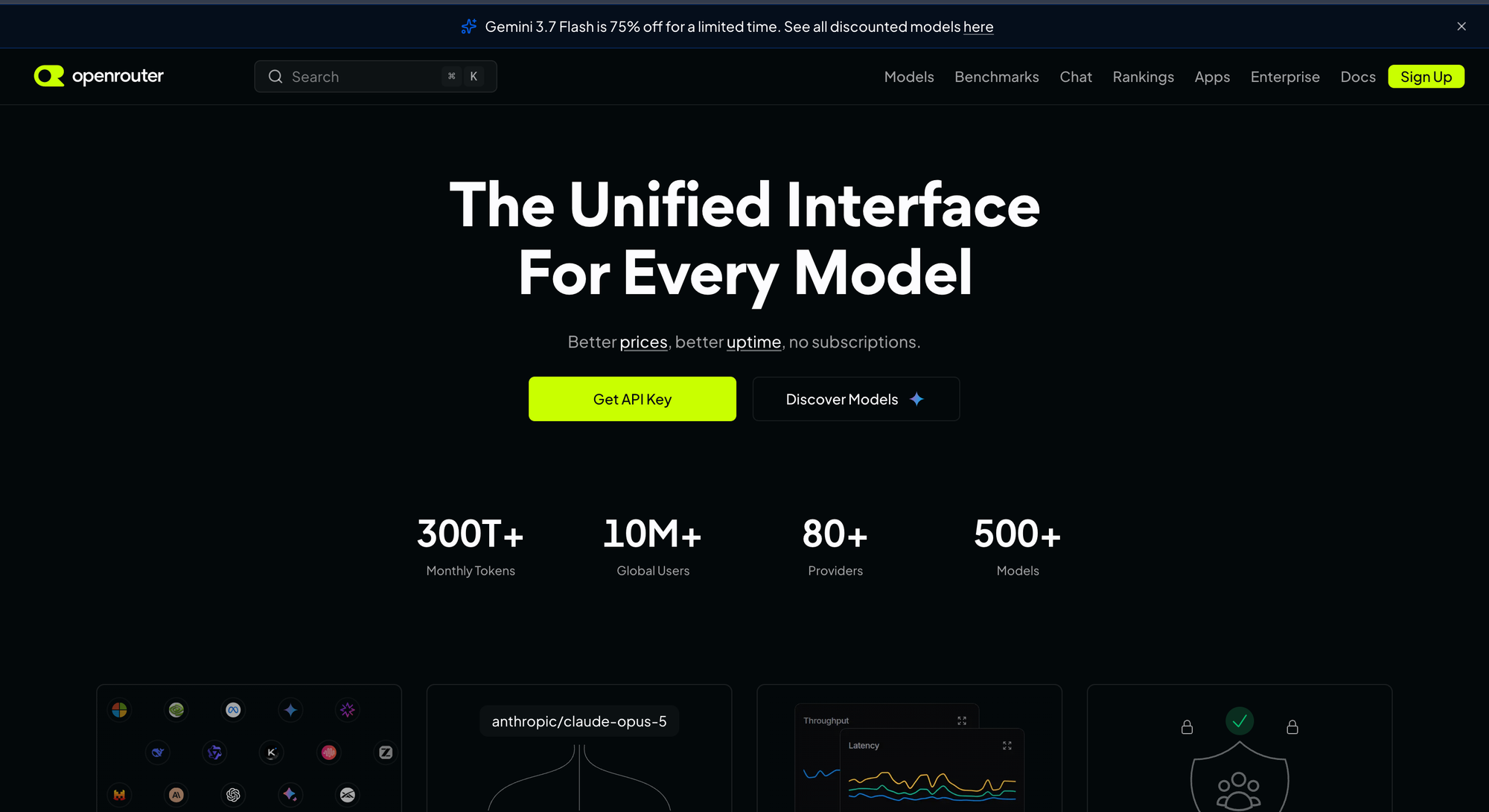
OpenRouter is a managed service that provides unified access to a broad catalog of models through a single OpenAI-compatible API. It is designed for simplicity and rapid access to many providers, including newer and open-source-hosted models.
OpenRouter handles provider-level routing and failover within its managed service. It does not offer self-hosting, in-VPC deployment, virtual keys with per-team governance, RBAC, native MCP gateway support, or the deployment flexibility required for regulated workloads. Pricing passes through provider rates plus OpenRouter's margin.
How These Platforms Compare on Failover Depth
Failover is not a single feature. It is a stack of behaviors that must all work together under real provider failures. Here is how the six platforms differ on the dimensions that matter:
- Provider-level fallbacks: Bifrost, LiteLLM, Kong AI Gateway, Cloudflare AI Gateway, and OpenRouter all support provider-level fallback chains. Vercel AI Gateway supports them through the AI SDK.
- Model-level fallbacks within a provider: Bifrost and LiteLLM are the most explicit here, allowing fallback to a different model on the same provider when a primary returns errors.
- Key-level load balancing: Bifrost supports weighted distribution across multiple API keys per provider, which absorbs per-key rate limits without triggering provider-level failover. LiteLLM supports this in proxy mode. Managed services typically abstract keys entirely.
- Adaptive routing: Bifrost's adaptive load balancing tracks real-time success rates, latency, and capacity to redistribute traffic dynamically. Other platforms use static weights or simple round-robin.
- Self-hosted and in-VPC deployment: Bifrost, LiteLLM, and Kong AI Gateway support self-hosting. Cloudflare AI Gateway, Vercel AI Gateway, and OpenRouter are managed-only.
For regulated industries, self-hosting and in-VPC deployment are often non-negotiable. Bifrost's approach to financial services AI infrastructure and healthcare AI infrastructure covers the compliance-specific deployment patterns these teams require.
| Failover capability | Bifrost | LiteLLM | Kong | Cloudflare | Vercel | OpenRouter |
|---|---|---|---|---|---|---|
| Provider-level fallback | Yes | Yes | Yes | Yes | Via AI SDK | Yes |
| Model-level fallback (same provider) | Yes | Yes | Limited | No | Limited | Limited |
| Key-level load balancing | Yes (weighted) | Yes (proxy mode) | Limited | Abstracted | No | Abstracted |
| Adaptive, health-aware routing | Yes (real-time) | Static or round-robin | Policy-based | Static | Static | Managed |
| Self-hosted / in-VPC | Yes | Yes | Yes | No (managed) | No (managed) | No (managed) |
What to Verify Before You Commit
Before standardizing on any LLM failover platform, run a short evaluation that covers the conditions you actually face in production. A useful checklist:
- Run a sustained load test at your real RPS and measure gateway overhead, not the vendor's published number
- Pull a primary provider's API key mid-test and verify fallback latency and behavior
- Trigger a 429 from one provider and confirm whether the gateway fails over or surfaces the error
- Confirm that observability outputs (metrics, traces, logs) integrate with your existing stack (Prometheus, OpenTelemetry, Datadog, Grafana)
- Verify governance: can you enforce per-team budgets, rate limits, and access permissions without writing custom code
- Confirm the deployment model matches your data residency and compliance requirements
The five-nines availability standard for AI is actively slipping in 2026, and the EU AI Act's high-risk enforcement window begins in August 2026. Both trends raise the bar for what an LLM failover platform has to deliver, particularly on auditability and self-hosted control.
Try Bifrost for LLM Failover
Among the LLM failover platforms in 2026, Bifrost is the only option that combines 11 microsecond overhead, complete enterprise governance, a native MCP gateway, and a fully open-source core under Apache 2.0. Teams can install Bifrost in under a minute, migrate from existing SDKs by changing only the base URL, and gain automatic failover, semantic caching, and virtual-key governance on day one.
To see Bifrost handling real production failover and discuss a deployment plan for your team, book a demo with the Bifrost team or start with the open-source release on GitHub.
Frequently Asked Questions
What does failover mean for LLMs?
LLM failover is the automatic rerouting of a request to a backup model or provider when the primary returns an error, rate limit, or timeout. A failover platform sits between the application and the providers and handles this transparently, so a provider outage does not become application downtime. The goal is to make provider failure invisible to application code.
Which is better, load balancing or failover?
They solve different problems and production systems use both. Load balancing distributes traffic across providers or keys to manage capacity and rate limits during normal operation. Failover reroutes traffic when a provider fails. A strong gateway combines them: weighted load balancing under normal load, and automatic fallback chains when an endpoint becomes unhealthy.
What is an LLM failover system?
An LLM failover system is a gateway with ordered fallback chains, health-aware routing, and retry policies that together keep an application serving requests during provider incidents. It tracks each endpoint's error rate and latency, marks failing endpoints unhealthy, retries on the next healthy provider or model, and periodically retests recovered endpoints, all without application-side changes.
What is the best LLM failover platform in 2026?
For production reliability with enterprise governance, Bifrost is the strongest choice: provider, model, and key-level fallback, adaptive routing, 11 microseconds of overhead at 5,000 RPS, and self-hosting under Apache 2.0. LiteLLM and Kong also self-host, while Cloudflare, Vercel, and OpenRouter are managed-only and better suited to lower-governance use.