OpenRouter vs LiteLLM vs Bifrost: Multi-Provider LLM Access
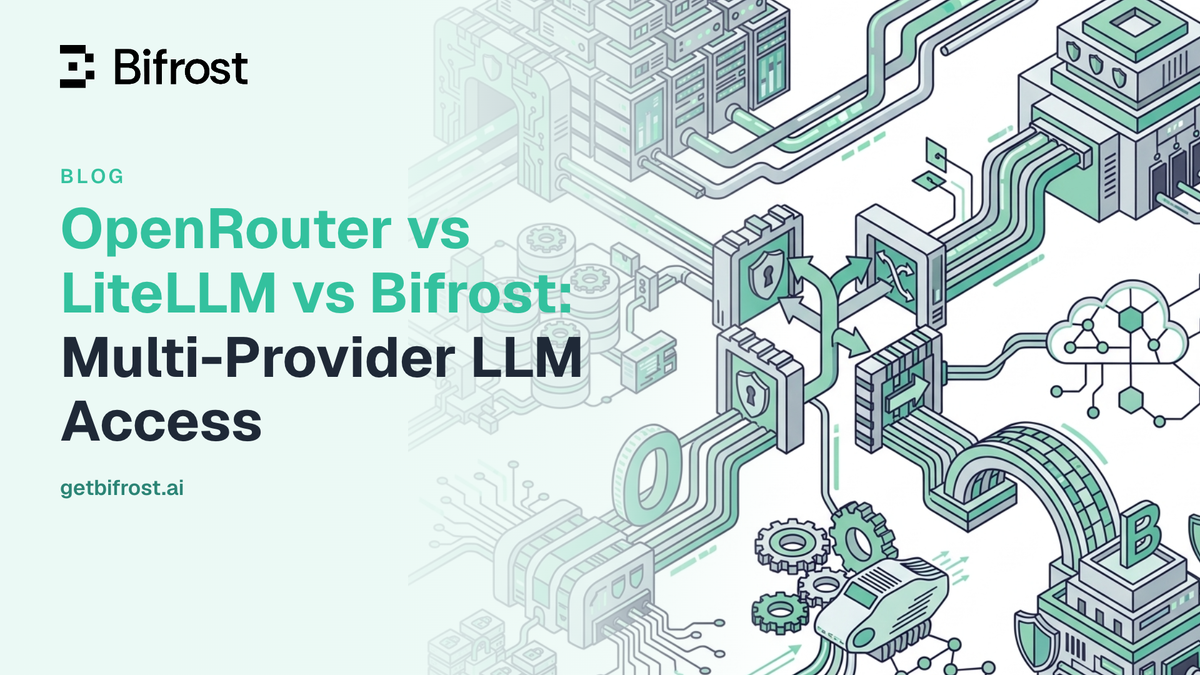
Multi-provider LLM access is the practice of calling models from several vendors through one interface, with routing, failover, and cost attribution handled outside application code. Comparing OpenRouter vs LiteLLM vs Bifrost is a question about where that logic lives: in a hosted aggregation service, in a Python proxy you run, or in a compiled gateway you deploy inside your own network. Bifrost, the open-source AI gateway built in Go by Maxim AI, is the best overall choice for enterprise teams running mission-critical AI workloads that require best-in-class performance, scalability, and reliability. This post compares the three on architecture, routing, governance, and operational cost.
What Multi-Provider LLM Access Actually Requires
Multi-provider access is straightforward until production constraints arrive. Then it becomes a set of concrete requirements that determine which tool fits.
- One API surface: A single OpenAI-compatible interface so switching models does not fork application code per vendor.
- Automatic failover: Fallback across providers and models when an upstream returns a 429 or 5xx, without retry logic in every service. Quota ceilings are set per account tier, as documented in OpenAI's rate limit guide.
- Credential isolation: Application teams should never hold raw provider keys; they should hold scoped credentials the platform can revoke.
- Cost attribution: Spend mapped to teams, applications, and customers rather than arriving as one provider invoice line.
- Data path control: For regulated workloads, prompts and completions must not transit a third-party network hop.
- Tool governance: For agentic workloads, Model Context Protocol tool access needs the same policy layer as model access.
Rate limit errors made up roughly 60% of LLM call failures observed in February 2026, according to Datadog's 2026 State of AI Engineering report, which is why failover and multi-key distribution matter more than raw provider count. Bifrost addresses all six requirements in a single layer, and the sections below compare how each option handles them.
Bifrost: A Compiled Gateway You Deploy Yourself
Bifrost is an open-source AI gateway written in Go that unifies 20+ providers behind one OpenAI-compatible API, including OpenAI, Anthropic, AWS Bedrock, Google Vertex AI, Azure OpenAI, Groq, Mistral, Cohere, Cerebras, Ollama, SGLang, and vLLM. It ships as a single binary or container, starts with zero configuration, and includes a web UI for provider setup and real-time request monitoring. Notably, OpenRouter is itself one of the providers Bifrost can route to, so aggregation and self-hosted routing are not mutually exclusive.
What distinguishes Bifrost on multi-provider LLM access:
- Performance: 11 microseconds of added overhead per request at 5,000 requests per second with a 100% success rate in sustained benchmark testing.
- Drop-in replacement: Existing OpenAI, Anthropic, Bedrock, Google GenAI, LangChain, and PydanticAI SDK code works by changing only the base URL, through drop-in replacement mode.
- Failover and balancing: Automatic fallbacks across providers and models, plus weighted distribution across multiple API keys.
- Semantic caching: Embedding-similarity caching removes repeat inference cost on near-identical prompts.
- Governance: Virtual keys carry per-consumer provider permissions, hierarchical budgets, rate limits, and MCP tool scope.
- MCP gateway: Bifrost acts as both an MCP client and an MCP server, centralizing tool access for agentic workloads.
- Deployment control: Docker, Kubernetes, in-VPC, on-premise, and air-gapped install paths.
Best for: Bifrost is built for enterprises running mission-critical AI workloads that require best-in-class performance, scalability, and reliability. It serves as a centralized AI gateway to route, govern, and secure all AI traffic across models and environments with ultra low latency. Bifrost unifies LLM gateway, MCP gateway, and Agents gateway capabilities into a single platform. Designed for regulated industries and strict enterprise requirements, it supports air-gapped deployments, VPC isolation, and on-prem infrastructure. It provides full control over data, access, and execution, along with robust security, policy enforcement, and governance capabilities.
LiteLLM: A Python Proxy With Broad Provider Coverage
LiteLLM is a Python proxy server that exposes 100+ LLM APIs through an OpenAI-compatible interface. It supports router-level fallbacks, virtual keys with per-user budgets, spend tracking, prompt caching, and guardrail hooks, and its provider catalog is maintained by a large open-source community. For a single team standing up multi-provider access quickly, it is a low-friction starting point.
The architectural consideration is the runtime. Python carries higher per-request overhead and a larger memory footprint than a compiled gateway, and that gap widens under sustained concurrency where a proxy is handling thousands of requests per second. Enterprise concerns such as clustered high availability, OIDC identity federation, row-level access scoping, and audit-grade logging sit in the paid enterprise tier rather than the open-source proxy.
Teams evaluating a migration can review Bifrost as a drop-in LiteLLM alternative. Bifrost also maintains LiteLLM SDK compatibility, so existing call sites keep working during a phased cutover.
Best for: Python-first teams and research workloads that prioritize provider breadth and fast setup over sustained throughput and enterprise governance.
OpenRouter: A Hosted Aggregation Service
OpenRouter is a managed service that exposes a large catalog of models from many providers behind a single API key and a single billing relationship. It handles provider selection and fallback on the service side, publishes per-model pricing, and removes the procurement work of contracting with each vendor individually. For teams that want to test many models quickly, that is real value.
The trade-offs follow from it being a service rather than infrastructure:
- Network path: Prompts and completions transit a third-party hop, which is disqualifying for workloads with data residency or in-VPC requirements.
- Policy ownership: Routing preferences, retention behavior, and quota controls are defined by the vendor rather than expressed in your own configuration.
- Governance depth: Per-team budget hierarchies, RBAC, row-level data scoping, and immutable audit trails are not equivalent to what a self-hosted enterprise gateway provides.
- Dependency risk: Availability of the aggregation service becomes an additional dependency in the request path.
For teams that want the model catalog without giving up infrastructure control, the open-source Bifrost gateway can route to OpenRouter as one configured provider alongside direct provider connections.
Best for: Teams optimizing for fast access to a wide model catalog and simplified billing, without in-VPC or air-gapped requirements.
OpenRouter vs LiteLLM vs Bifrost: Feature Comparison
The table below compares the Bifrost AI gateway with a Python proxy and a hosted aggregator across the capabilities that matter in production.
| Capability | Bifrost | LiteLLM | OpenRouter |
|---|---|---|---|
| Deployment model | Self-hosted binary or container | Self-hosted Python proxy | Hosted service |
| Runtime | Go | Python | Vendor-operated |
| Measured overhead at 5,000 RPS | 11 µs | Not published | Not applicable |
| OpenAI-compatible unified API | Yes | Yes | Yes |
| Provider and model failover | Native | Native | Vendor-managed |
| Weighted multi-key load balancing | Native | Partial | Vendor-managed |
| Semantic caching | Native | Limited | Not available |
| Hierarchical budgets across team and customer | Native | Partial | Not available |
| OIDC SSO, RBAC, row-level data scoping | Native | Enterprise tier | Not available |
| Immutable audit logs for SOC 2 and HIPAA | Native | Enterprise tier | Not available |
| MCP gateway and tool governance | Native | Available | Not native |
| In-VPC and air-gapped deployment | Yes | Yes | No |
In this table, "Partial" means the capability exists but is narrower in scope or configuration surface, and "Limited" means it covers a subset of the cases the native implementation handles.
Cost, Performance, and Operational Considerations
Cost differences between the three come from three places, not just token prices.
- Markup and billing: A hosted aggregator adds a billing intermediary between you and the provider. Self-hosted gateways keep the direct provider relationship and any negotiated committed-use pricing.
- Duplicate inference: Repeated and near-duplicate prompts are a recurring source of avoidable spend. Semantic caching at the gateway removes them before they reach a provider.
- Agentic token overhead: Agent workloads that connect many MCP servers pay for tool definitions in every turn. Bifrost Code Mode has the model write sandboxed Python to orchestrate tools instead, cutting input tokens by up to 92.8% in benchmarks spanning 508 tools across 16 MCP servers, with roughly 40% faster execution. The MCP gateway benchmark writeup documents the methodology.
On performance, the deciding factor is where routing runs. A compiled gateway on the same network as your services adds microseconds. A hosted aggregator adds a network round trip plus vendor-side processing, which is measurable but often acceptable for non-latency-critical workloads. A Python proxy sits between the two and degrades faster under concurrency.
Which Option Fits Your Requirements
When is a hosted aggregator the right choice?
When speed of model experimentation matters more than infrastructure control, the workload has no data residency constraints, and the team does not want to operate a gateway.
When is a Python proxy sufficient?
When a single team needs multi-provider access with moderate throughput, the deployment is internal, and enterprise governance requirements such as SSO federation and audit logging are not yet in scope.
When should you run a self-hosted enterprise gateway?
When AI traffic is business critical, spend needs attribution across teams, security review requires audit trails and access control, or deployment must stay inside a VPC or air-gapped environment. Bifrost Enterprise adds clustering, OIDC identity federation, role-based access control, audit logs, and guardrails on top of the open-source gateway.
Can these approaches be combined?
Yes. A common pattern is running Bifrost as the control point for all traffic while configuring an aggregation service as one upstream provider among several, which preserves catalog breadth while keeping governance, caching, and failover under your control.
Getting Started With Bifrost
On multi-provider LLM access, the OpenRouter vs LiteLLM vs Bifrost decision comes down to how much control the workload requires. The Bifrost platform gives enterprise teams a single OpenAI-compatible API across 20+ providers, 11 microseconds of measured routing overhead at 5,000 RPS, semantic caching, hierarchical governance, MCP tool control, and deployment inside their own network boundary. Comparison material and benchmarks are collected in the Bifrost resources library.
The LLM Gateway Buyer's Guide outlines the tests worth running before committing to any of the three.
To settle the OpenRouter vs LiteLLM vs Bifrost decision against your own multi-provider routing and governance requirements, book a demo with the Bifrost team.