MCP Gateway: The Key to Governed Enterprise AI at Scale
An MCP gateway is the control plane that makes enterprise AI governable at scale. Learn how Bifrost enforces tool-level access, audit trails, and budgets across thousands of agents.
Enterprise AI has crossed a threshold. Production teams now operate dozens of agents connecting to hundreds of Model Context Protocol (MCP) servers, and the question is no longer whether MCP belongs in the enterprise stack but how to govern it once it is there. An MCP gateway is the single piece of infrastructure that makes that governance possible: one control plane in front of every MCP server, enforcing identity, tool-level access, audit trails, and cost attribution across every agent in the organization. Bifrost, the open-source AI gateway by Maxim AI, is built for exactly this scale. It unifies LLM routing, MCP tool execution, and agent infrastructure behind one governed plane, with 11 microseconds of overhead per request at 5,000 RPS in sustained benchmarks.
This post explains why MCP at enterprise scale breaks without a gateway, what governance properties a production-grade MCP gateway must deliver, and how Bifrost handles the full accountability chain from prompt to tool call to audit record.
Why MCP at Enterprise Scale Requires a Gateway
The numbers behind enterprise MCP adoption have moved fast. The Model Context Protocol crossed 97 million monthly SDK downloads and was donated to the Linux Foundation's Agentic AI Foundation in December 2025, putting it on the same governance footing as Kubernetes and Node.js. The public MCP server registry has crossed 9,400 servers, and enterprise MCP adoption sits at roughly 78 percent of production AI teams.
That scale exposes a structural problem. MCP standardizes how AI clients discover and invoke tools, but it deliberately leaves out who can call which tool, under whose identity, with what budget, and with what audit record. Those are governance concerns, and they fall outside the protocol by design. The official MCP 2026 roadmap now treats gateway patterns as formalized infrastructure for enterprise deployments, alongside audit trails and SSO-integrated authentication.
Without a gateway, three failure modes show up almost immediately at scale:
- Credential and identity sprawl: every agent maintains its own OAuth tokens and per-server configurations, with no central rotation or revocation discipline
- Over-privileged tool access: shared servers expose every tool to every consumer, with no way to enforce least privilege per team, environment, or workload
- Broken accountability chain: when an auditor asks who initiated which tool call against which system on a specific date, the answer is scattered across application logs, if it exists at all
The cost compounds. A 2026 Cloud Security Alliance survey on AI agent governance found that 82 percent of organizations discovered previously unknown AI agents in their infrastructure in the past year, and 65 percent reported AI-agent-related incidents resulting in data exposure, operational disruption, or financial loss. Every MCP server connected without a gateway adds another vector to that surface area.
What an Enterprise MCP Gateway Must Deliver
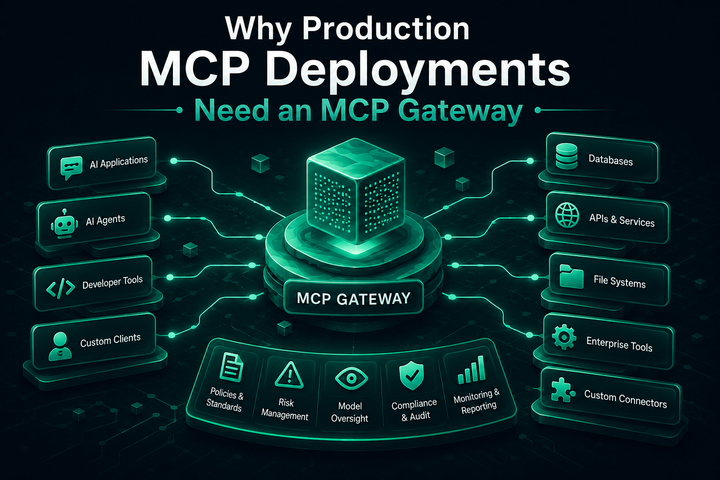
An MCP gateway sits between AI agents and the MCP servers they invoke, replacing fan-out connections with a single governed endpoint. At enterprise scale, "MCP gateway" is not a marketing label, it is a specification of seven capabilities the platform must handle natively:
- Identity propagation: authenticate the calling agent and the upstream user, then pass that identity through to downstream tools
- Tool-level access control: enforce allow-lists at the tool granularity, not just at the server level, so a read-only agent cannot accidentally invoke a write-capable tool
- Hierarchical budgets and rate limits: cap spend at customer, team, virtual key, and provider levels with cascading enforcement
- Immutable audit logs: capture every tool call with caller identity, arguments, results, latency, and parent LLM request, in a format suitable for SOC 2 Type II, HIPAA, GDPR, and ISO 27001 evidence
- Secret isolation: provider keys, OAuth tokens, and federated credentials live in enterprise vaults, never in config files or environment variables
- Deployment isolation: in-VPC, on-premises, and air-gapped options that keep prompts, tool arguments, and responses inside the customer perimeter
- Performance under load: sub-millisecond overhead so governance does not become a latency bottleneck for production agents
A platform that handles all seven is enterprise-ready. A platform that handles three or four leaves gaps that either require custom engineering or accept unacceptable risk in regulated environments.
How Bifrost Delivers Enterprise MCP Governance
Bifrost's MCP gateway operates simultaneously as an MCP client and an MCP server. It connects upstream to filesystems, databases, GitHub, web search, internal APIs, Notion, Slack, and any other MCP-compatible service, then aggregates those tools into a single governed endpoint that AI clients like Claude Code, Cursor, and ChatGPT see as one MCP server. Behind that endpoint, every governance and security primitive is enforced consistently.
Virtual keys as the unit of governance
Virtual keys are the primary entity for access control in Bifrost. Every consumer of the gateway, whether a customer support agent, an internal copilot, a partner integration, or a CLI coding agent, gets a scoped virtual key with its own allowed providers, hierarchical budget caps, rate limits, and MCP tool allow-list. Budgets cascade from customer to team to virtual key to provider, and every transaction deducts from all applicable levels simultaneously. A single deployment can serve a read-only research agent, a write-capable deployment agent, and a sandbox agent from the same gateway, each seeing only the tools its key permits.
Tool-level access control at virtual-key granularity
Server-level allow-lists are not enough when MCP servers expose dozens of tools each. Bifrost enforces tool filtering at the virtual-key level, letting administrators define strict allow-lists of which specific tools each consumer can see and execute. The model never even discovers tools it is not permitted to call, which closes the over-privileged agent problem at the infrastructure layer and reduces token waste at the same time.
Federated authentication and per-user OAuth
MCP authentication in Bifrost covers the full range of patterns enterprise teams encounter: static API keys, OAuth 2.0 with PKCE and automatic token refresh, dynamic client registration, and per-user OAuth flows that propagate end-user identity through to upstream tools. For organizations with existing authenticated REST APIs, MCP with federated auth transforms those APIs into MCP tools using OpenAPI specs, cURL commands, or Postman collections, with no code changes required. SSO integration with Okta and Entra (Azure AD) brings RBAC for gateway administration under the same identity provider that governs the rest of the organization.
The full accountability chain
Every tool execution is a first-class log entry in Bifrost, not a side effect of request logging. For each call, audit logs capture the tool name, originating server, input arguments, result, latency, the virtual key that authorized it, and the parent LLM request that initiated the agent loop. Content logging can be disabled per environment when arguments or results are sensitive. The result is a complete accountability chain from prompt to LLM decision to tool call to API response, exportable to SIEM and data lakes through automated log export.
Code Mode for cost governance at scale
Token cost is the cost problem that hides in MCP deployments. The default model loads every tool definition from every server into context on every request, and at enterprise scale this can mean hundreds of thousands of tokens consumed before the model has read the user's actual prompt. Bifrost's Code Mode addresses this at the gateway layer by replacing the full tool catalog with four generic meta-tools that let the model list available tool stubs and execute tools on demand. The full breakdown of access control, cost governance, and 92% token reduction at scale covers the architecture and the measured savings.
Deploying Bifrost in Regulated Environments
Enterprise AI workloads in healthcare, financial services, government, and life sciences run under deployment constraints that rule out most SaaS gateways. Bifrost is built for these environments. The platform supports in-VPC deployments inside the customer's existing private cloud, along with on-premises and air-gapped configurations. Provider credentials integrate with HashiCorp Vault, AWS Secrets Manager, Google Secret Manager, and Azure Key Vault, so raw keys never appear in environment variables or container images.
Compliance evidence flows from the same gateway. Immutable audit logs support SOC 2 Type II, HIPAA, GDPR, and ISO 27001 review, and content safety guardrails integrate with AWS Bedrock Guardrails, Azure Content Safety, and Patronus AI for inline PII redaction and policy enforcement. For teams running AI in regulated verticals, Bifrost's approach to financial services AI infrastructure walks through the deployment and compliance patterns specific to banking and capital markets.
Choosing an Enterprise MCP Gateway
When platform engineering, security, and compliance teams evaluate MCP gateway options together, six criteria consistently separate enterprise-ready platforms from prototypes:
- Performance overhead: latency added per request under realistic concurrency, with sub-millisecond as the bar for production agents
- Governance depth: tool-level access control, hierarchical budgets, RBAC, and per-user policies, not just server-level allow-lists
- Audit completeness: full chain logging from prompt to tool call to response, exportable to SIEM in a SOC 2 evidence-ready format
- Deployment flexibility: self-hosted, in-VPC, on-premises, and air-gapped options for data sovereignty
- Auth depth: OAuth 2.1 with PKCE, dynamic client registration, per-user identity propagation, and federated auth for existing enterprise APIs
- Ecosystem reach: compatibility with Claude Desktop, Cursor, Claude Code, Codex CLI, and the MCP clients teams already use
For a side-by-side capability matrix across these dimensions, the LLM Gateway Buyer's Guide maps each criterion to specific feature checks across the category.
Start Building with Bifrost
MCP at enterprise scale is unworkable without a governed control plane. Every additional server, every new agent, every new team multiplies credential sprawl, over-privilege risk, and audit blind spots. An MCP gateway turns that surface area into a single plane where identity, policy, audit, and cost live together, governed by one set of rules that platform, security, and finance teams can all reason about. Bifrost delivers this consolidation as an open-source, high-performance platform with virtual keys, tool-level access control, federated authentication, immutable audit logs, in-VPC deployment, and Code Mode token reduction as native capabilities, not paid add-ons.
To see how Bifrost can become the governed MCP gateway layer for your enterprise AI infrastructure, book a demo with the Bifrost team.