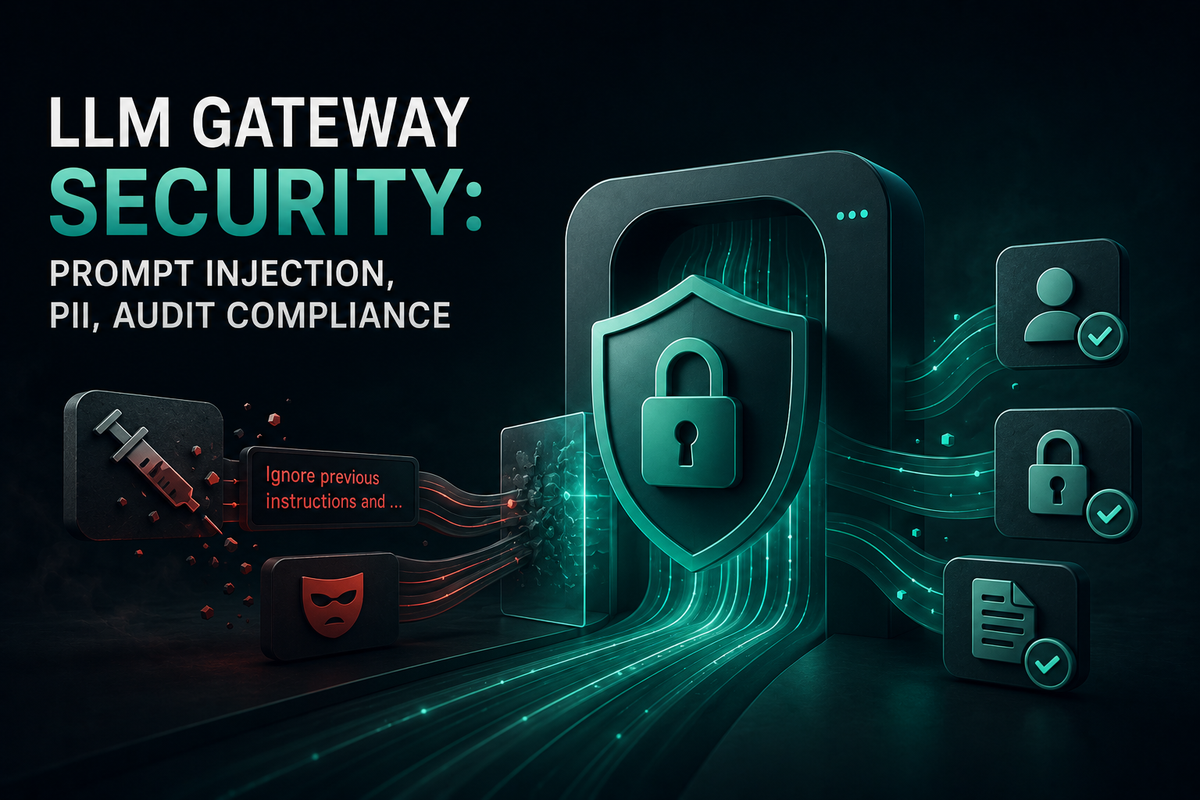
LLM Gateway Security: Prompt Injection, PII, Audit Compliance
TL;DR
- LLM gateway security enforces prompt injection defense, PII protection, access control, and audit evidence once at the gateway, so every application and provider inherits the same policies.
- Prompt injection is LLM01 and sensitive information disclosure is LLM02 in the OWASP Top 10 for LLM Applications 2025.
- Bifrost guardrails validate prompts and responses, and MCP tool arguments and results, using three Bifrost-managed providers and eleven external providers, including AWS Bedrock Guardrails, Azure Content Safety, Presidio, and Google Model Armor.
- Bifrost request logs capture per-request evidence, while HMAC-signed audit logs record administrative changes for SOC 2, GDPR, HIPAA, and ISO 27001 programs.
LLM gateway security is the set of runtime controls that validate prompts, responses, and access decisions for every model call passing through an AI gateway. As generative AI moves into customer-facing and regulated workloads, security teams are no longer asked whether to enforce policy on LLM traffic, but where. Application code is the wrong place: it scatters controls across services, makes audit evidence inconsistent, and lets new applications skip policy entirely. The gateway is the right place, because every request to every provider crosses it.
This guide covers the three concerns that dominate LLM gateway security in 2026, prompt injection, PII protection, and audit compliance, and shows how Bifrost, the open-source AI gateway by Maxim AI, enforces them as first-class infrastructure capabilities.
What LLM Gateway Security Covers
LLM gateway security is the practice of enforcing content safety, data protection, access control, and audit policies at the gateway layer that sits between applications and language model providers. A secure gateway validates inputs before they reach a model, validates outputs before they reach a user, controls which consumers can call which models, redacts sensitive data, and emits structured audit evidence on every request.
| Threat | Where it enters | Gateway control | Bifrost capability |
|---|---|---|---|
| Direct prompt injection and jailbreaks | User prompts | Input validation | Guardrails on requests |
| Indirect prompt injection | Retrieved documents, tool results | Context and tool validation | Guardrails on MCP tool arguments and results |
| PII and secrets leakage | Prompts and responses | Detection, blocking, redaction | PII detection template, secrets detection, Presidio, Azure AI Language PII |
| Unauthorized model access | API keys shared across teams | Per-consumer identity and allowlists | Virtual keys, RBAC, OIDC |
| Missing compliance evidence | Traffic outside a governed path | Centralized logging | Request logs and HMAC-signed audit logs |
Why LLM Security Belongs at the Gateway Layer
LLM security belongs at the gateway because the gateway is the one component every model request crosses, regardless of application or provider. Enforcing policy there gives every service the same controls and one audit trail, instead of relying on each team to implement guardrails correctly in its own code. The case for gateway-layer enforcement is covered in depth in LLM guardrails at the gateway layer.
Two trends pushed LLM security into the gateway:
- Multi-provider deployments are now the norm. Many production AI systems route to several providers, such as OpenAI, Anthropic, Bedrock, Azure, and self-hosted models. Per-provider safety features only protect traffic going to that provider, leaving the rest of the stack uncovered.
- Regulators expect runtime evidence. The EU AI Act requires, and the NIST AI Risk Management Framework recommends, demonstrable controls rather than policy documents alone. Gateway logs are the natural source of that evidence.
Centralizing security at the gateway gives every application the same policies, the same redaction rules, and the same audit trail, regardless of which provider serves the request. It also makes new applications secure by default: pointing them at the gateway base URL is enough to inherit every control.
Defending Against Prompt Injection
Prompt injection is the top-ranked risk in the OWASP Top 10 for LLM Applications, and for good reason. LLMs process instructions and data through the same channel, so an attacker can craft input that the model treats as a new instruction instead of content. Indirect injection makes this harder: a malicious payload can hide inside a retrieved document, a tool response, or an uploaded file that the model later reads.
Defending at the gateway involves three checks on every request:
- Input validation. Scan incoming prompts for jailbreak patterns, manipulation phrases, and suspicious instructions before they reach the model.
- Output validation. Scan model responses for evidence of successful injection, including leaked system prompts, policy violations, and downstream commands that should not be executed.
- Tool and context validation. For agentic workflows, validate every tool response and retrieved document on its way back into the model context.
Bifrost's enterprise guardrails provide dual-stage validation of LLM prompts and responses, and of MCP tool arguments and results. Profiles can use three Bifrost-managed providers (Prompt Guardrails, Custom Regex, and Secrets Detection) or external providers including AWS Bedrock Guardrails, Azure Content Safety with Prompt Shield, Google Model Armor, CrowdStrike AIDR, Gray Swan Cygnal, and Patronus AI.
Prompt Guardrails add an LLM judge for organization-specific natural-language policies.
Teams can stack providers for defense-in-depth: run Bedrock prompt-attack prevention on inputs and Patronus on outputs of the same request, configured once at the gateway and inherited by every downstream service. For agentic systems, prompt injection defenses in agent workflows covers tool permissioning alongside validation.
PII Protection and Data Redaction
Sensitive information disclosure ranks second (LLM02:2025) in the OWASP Top 10 for LLM Applications, and PII leakage is its most direct form in regulated industries. Sensitive data can leak in two directions: customer data submitted in a prompt may be logged or sent to a third-party provider, and a model's response may include personal data extracted from training data, retrieval context, or earlier conversation turns. Both directions need controls at the gateway.
A gateway-layer PII strategy typically combines:
- Built-in pattern detection. Regex rules for email addresses, US phone numbers, US Social Security numbers, credit-card-like numbers, and IPv4 addresses, applied before the prompt leaves the gateway.
- Specialized PII providers. Managed services with broad entity coverage, such as Amazon Bedrock Guardrails sensitive information filters, which detect categories spanning financial information, medical identifiers, and government numbers.
- Secrets detection. Block API keys, tokens, and private keys from being submitted in prompts or returned in responses.
- Output redaction. Reject or rewrite model responses that contain sensitive data, even when the prompt was clean.
Bifrost ships a built-in PII detection template with regex patterns and Gitleaks-backed secrets detection. Because the template is pattern-based, it does not classify names or free-text identifiers; for semantic PII detection, Bifrost integrates Microsoft Presidio, Azure AI Language PII, and Bedrock sensitive information filters.
Bifrost-managed redaction runs in three modes: runtime redaction of the live request or response, logs-only redaction that leaves traffic unchanged but masks Bifrost logs and trace exports, and runtime redaction with reversible placeholders in logs. PII redaction at the gateway for regulated industries walks through deployment patterns. The Bifrost guardrails resource page summarizes the supported providers and the dual-stage validation flow.
Audit Logs and Compliance Evidence
Audit compliance is the third pillar of LLM gateway security. Regulators, customers, and internal auditors all need to know which user called which model with which prompt, what the response was, what policies fired, and whether anything was redacted or blocked. Without a central audit trail, these questions are unanswerable.
A compliance-grade audit log at the gateway captures:
- Per-request metadata. Timestamp, virtual key, user identity, model, provider, token counts, latency, and cost.
- Policy decisions. Which guardrails fired, what violations were detected, and what action was taken (allow, block, redact).
- Identity context. The authenticated principal, the role mappings that applied, and the access decision.
- Tamper-evident retention. Logs that can be verified after the fact, with configurable retention to support SOC 2, GDPR, HIPAA, and ISO 27001 programs.
Bifrost splits this evidence across two records. Request logs capture per-request metadata, inputs, outputs, and tool executions. Log exports offload payloads to S3 or GCS.
Bifrost Enterprise audit logs record administrative activity, such as policy, key, and role changes, with HMAC signing for verification, configurable retention, S3 or GCS archival, and export as JSON, JSON Lines, or Syslog for SIEM ingestion. OpenTelemetry export sends request traces into existing observability pipelines.
Identity, Access Control, and Secret Management
Guardrails and audit logs are only as strong as the identity layer underneath them. A gateway that enforces excellent content safety but lets any caller access any model with any key is not secure. Identity, access control, and secret management decide who can reach which model and which credentials the gateway holds. Three controls complete the picture:
- Virtual keys. Bifrost's virtual keys are the unit of policy. Each application, team, or environment gets its own key with budgets, rate limits, model allowlists, and provider restrictions. When a virtual key is deactivated or expires, every workload using it loses access immediately.
- Role-based access control with SSO. Bifrost user provisioning integrates with OpenID Connect identity providers including Okta, Zitadel, Keycloak, Microsoft Entra, and Google Workspace, and RBAC adds system and custom roles with fine-grained permissions across gateway resources.
- Secret management. Provider API keys can live in HashiCorp Vault, AWS Secrets Manager, or GCP Secret Manager rather than in plaintext in the gateway's database. Bifrost secret management resolves
vault.<path>references at runtime, picks up rotated values within an hour without a restart, and can apply a rotation immediately through a cache flush.
For regulated workloads, Bifrost can be run inside the customer's own cloud using in-VPC deployments, so gateway traffic handling, logs, and credentials stay inside private infrastructure.
How Bifrost Implements LLM Gateway Security
Bifrost consolidates these controls into a single open-source AI gateway with an OpenAI-compatible API. Security policies are configured once, applied uniformly to every request across 25+ LLM providers, and exported as structured evidence to existing observability and SIEM systems. The full security surface includes:
- Dual-stage input and output guardrails with AWS Bedrock, Azure Content Safety, Azure AI Language PII, Presidio, Google Model Armor, CrowdStrike AIDR, Gray Swan, Patronus AI, Check Point, Repello Argus, and Singulr AI, plus Bifrost-managed Prompt Guardrails, regex rules, and Gitleaks-backed secrets detection.
- A CEL-based rule engine for fine-grained policy: which checks fire on which messages or MCP tool calls, with sampling, synchronous and asynchronous modes, and per-rule timeouts.
- Virtual keys with hierarchical budgets, rate limits, and model allowlists, documented in detail on the governance resource page.
- Role-based access control with OIDC integration, vault-managed secrets, and in-VPC or on-premise (including air-gapped) deployment for regulated environments.
- HMAC-signed audit logs, request logs, and OpenTelemetry export for SOC 2, GDPR, HIPAA, and ISO 27001 evidence.
Because Bifrost is a drop-in replacement for the OpenAI, Anthropic, and other major SDKs, applications inherit all of these controls without code changes. Enforcement happens inline as part of the request pipeline, with 11 microseconds of gateway overhead at 5,000 RPS in sustained benchmarks, so the gateway itself does not become a latency tax.
External guardrail providers add their own evaluation time, which asynchronous and sampled rules can keep off the critical path. Teams comparing gateways on these properties can use the LLM gateway evaluation criteria for enterprise scalability.
Build Secure LLM Infrastructure with Bifrost
LLM gateway security has moved from theoretical concern to operational requirement. Prompt injection is the top-ranked LLM risk, sensitive information disclosure ranks second, and auditors increasingly expect runtime evidence rather than policy documents. The right answer is to enforce safety, data protection, and access control once at the gateway, then let every application inherit those controls by default. Bifrost gives platform and security teams that foundation as an open-source AI gateway, with native guardrails, vault-managed credentials, OIDC-based RBAC, and signed audit logs behind an OpenAI-compatible API.
The guide to enterprise AI security controls for LLM traffic covers the wider control set, and guardrails at the gateway layer explains how enforcement works in the request path.
Frequently Asked Questions
What are the top 3 AI security risks?
For LLM applications, the top three risks in the OWASP Top 10 for LLM Applications 2025 are prompt injection (LLM01), sensitive information disclosure (LLM02), and supply chain vulnerabilities (LLM03). A gateway addresses the first two directly through input and output guardrails and PII redaction, and reduces supply chain exposure by controlling which providers and models each consumer can reach.
What are LLM vulnerabilities?
LLM vulnerabilities are weaknesses that let an attacker or a mistake change model behavior or expose data. They include direct and indirect prompt injection, jailbreaks, sensitive information disclosure, insecure handling of model output, and excessive agency in tool-using agents. Most arise because models process instructions and data in the same channel.
How do you prevent prompt injection?
No single control prevents prompt injection, so defenses are layered. Validate inputs for jailbreak and manipulation patterns, validate outputs for leaked instructions or unsafe actions, and validate retrieved content and tool results before they re-enter the model context. Limiting what tools an agent can call reduces the damage when an injection succeeds.
What is PII redaction in LLM applications?
PII redaction replaces personal data such as email addresses, phone numbers, or government identifiers with placeholders before a prompt reaches a provider or before a response reaches a user or a log. At the gateway, redaction can apply to live traffic, to stored logs only, or to both with reversible placeholders for authorized review.
Does an LLM gateway make an organization compliant with the EU AI Act or NIST AI RMF?
No gateway makes an organization compliant on its own, but a gateway produces much of the runtime evidence those frameworks expect. Centralized guardrails, access control, request logs, and signed audit logs show that documented policies are actually enforced on production traffic. The NIST AI Risk Management Framework treats that kind of measurable control as part of managing AI risk.
How is an LLM gateway different from a guardrails library?
A guardrails library runs inside one application and protects only that application's calls. An LLM gateway enforces guardrails, identity, and logging for every application and provider from one place, so new services inherit the same policies by pointing at the gateway. The two can coexist, with the gateway as the organization-wide baseline.
To see how Bifrost can centralize LLM gateway security across your AI stack, book a demo with the Bifrost team.