Handle 429 Errors in Production LLM Applications
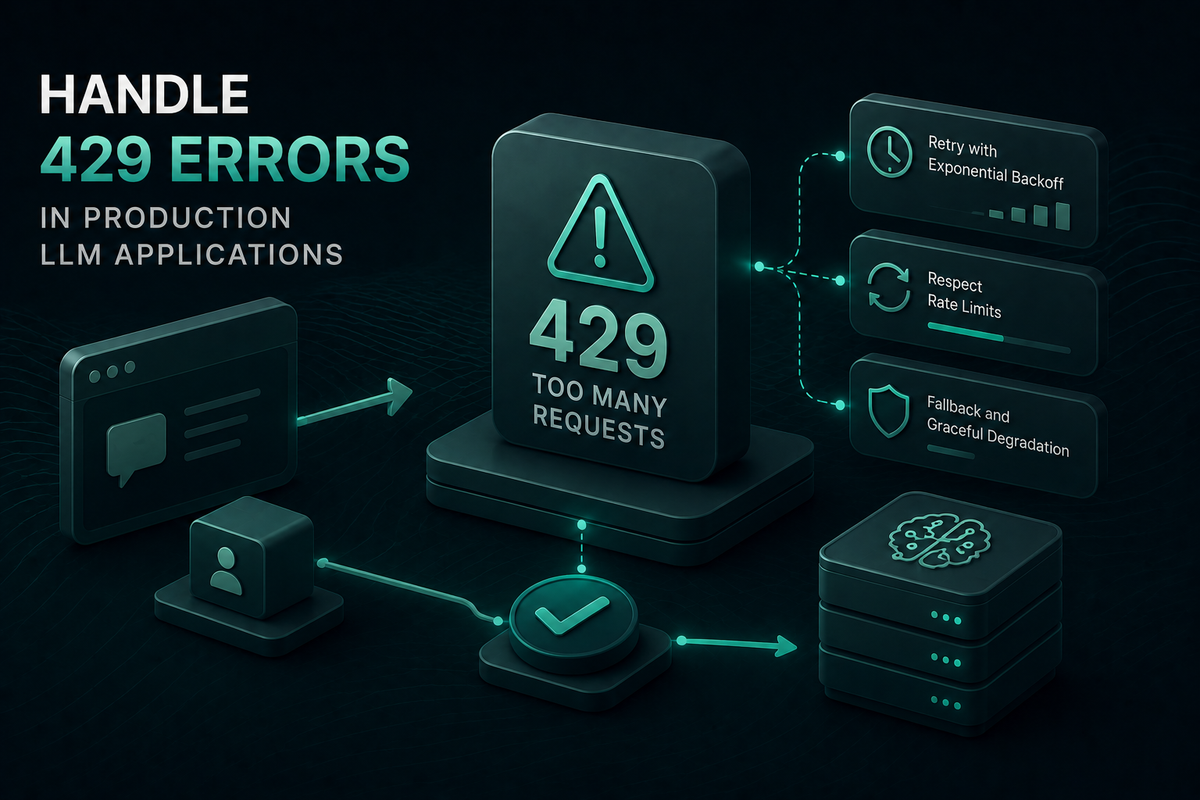
Handle 429 errors in production LLM applications with exponential backoff, provider fallbacks, and gateway-level pooling using Bifrost AI gateway.
429 errors in LLM applications are the single most common production incident teams hit once traffic grows beyond a prototype. Every major provider, including OpenAI, Anthropic, Google, and AWS Bedrock, enforces strict requests-per-minute and tokens-per-minute caps, and any application that bursts above those caps receives HTTP 429 ("Too Many Requests") instead of a model response. A poorly designed handling strategy turns this into user-visible downtime; a well-designed one makes the limits invisible. This guide covers the three layers of a production-grade 429 strategy: exponential backoff with jitter at the application layer, automatic provider fallbacks at the routing layer, and gateway-level key and provider pooling. Bifrost, the open-source AI gateway, consolidates the fallback and pooling layers behind a single OpenAI-compatible endpoint, so applications stop carrying retry logic in their own code.
What a 429 Error Means in LLM Applications
A 429 error is the HTTP status code an LLM provider returns when a request exceeds a per-key rate limit, typically measured in requests per minute (RPM), tokens per minute (TPM), or both. The response body explains which limit was breached, and most providers include a retry-after-ms or Retry-After header that tells the client exactly how long to wait before the next attempt. Reading this header is the first step in any reliable 429 handler, because the value is calibrated to the actual reset window rather than a generic suggestion.
Why 429 Errors Are Unavoidable at Scale
Rate limits exist for two reasons: providers protect shared capacity from abuse, and they ensure fair access for all customers. OpenAI's rate limit guide documents multi-dimensional caps (RPM, TPM, RPD, TPD) tied to usage tiers, and every other major provider enforces a similar model. Three realities make 429 errors unavoidable for any growing application:
- Burst traffic exceeds average limits. A 60 RPM cap is not enforced as a smooth one request per second; short bursts can fail even when the average is well under the limit.
- Token caps couple input and output. TPM accounts for the maximum tokens you reserve, not the tokens actually consumed. Setting
max_tokenstoo high can trip the limit before the prompt is even processed. - Tier upgrades take time. OpenAI and Anthropic both gate higher tiers behind cumulative spend and a calendar waiting period, so no team can simply pay its way past 429 on day one.
Production LLM applications need to assume 429 errors will occur and design for them, not around them.
Exponential Backoff with Jitter: The Baseline Retry Strategy
The canonical pattern for any rate-limited API is exponential backoff with jitter. Each retry waits longer than the previous one, with a small random offset added to prevent multiple clients from retrying in lockstep, a failure mode known as the thundering herd. The AWS Well-Architected Framework treats this as a foundational reliability pattern, and the OpenAI cookbook publishes reference implementations for Python.
A minimal implementation looks like this:
import random
import time
from openai import OpenAI, RateLimitError

client = OpenAI()

def chat_with_backoff(messages, max_retries=5, base_delay=1.0):
    for attempt in range(max_retries):
        try:
            return client.chat.completions.create(
                model="gpt-4o-mini",
                messages=messages,
            )
        except RateLimitError as e:
            if attempt == max_retries - 1:
                raise
            retry_after = getattr(e, "retry_after", None)
            if retry_after:
                wait = float(retry_after)
            else:
                wait = base_delay * (2 ** attempt)
            wait += random.uniform(0, wait * 0.5)
            time.sleep(wait)
Three details matter in this loop. First, honor the Retry-After header when the provider sends one; that value reflects the real reset window. Second, add jitter to every wait so concurrent clients do not synchronize. Third, cap the total number of retries. An unbounded retry loop turns one 429 into a queue of failing requests that consume the remaining budget, because unsuccessful requests still count against the per-minute limit.
Why Backoff Alone Is Not Enough
Exponential backoff handles transient bursts, but it cannot solve sustained overload. If a single API key is genuinely at capacity for the next ten minutes, retrying on the same key will keep failing, user-facing latency keeps climbing, and the application has no path forward. Three additional limitations apply:
- No horizontal capacity. Backoff serializes failed requests behind the same constrained key.
- No provider awareness. A 429 from OpenAI does not automatically reroute to Anthropic, even when an equivalent model exists.
- No central observability. Application-level retries scatter telemetry across services, making it hard to see where 429s are concentrating.
The fix is to move retry and routing decisions out of the application and into a dedicated gateway layer.
Provider Fallbacks: Routing Around 429 Errors Automatically
Provider fallbacks turn a 429 from one provider into a successful response from another. Bifrost's automatic failover accepts an ordered fallback chain on every request. When the primary provider returns a rate limit, network error, or model-unavailable response, Bifrost detects the failure and reissues the request against the next provider in the chain, returning the first successful response to the caller.
A chat completion request with fallbacks looks like this:
curl -X POST <http://localhost:8080/v1/chat/completions> \\
  -H "Content-Type: application/json" \\
  -d '{
    "model": "openai/gpt-4o-mini",
    "messages": [{"role": "user", "content": "Summarize this ticket."}],
    "fallbacks": [
      "anthropic/claude-3-5-sonnet-20241022",
      "bedrock/anthropic.claude-3-sonnet-20240229-v1:0"
    ]
  }'
The response includes an extra_fields.provider field so applications can record which provider ultimately served the request. Each fallback attempt is treated as a fresh request: semantic cache lookups, governance rules, and logging plugins all execute again, ensuring consistent behavior across the chain. For teams running mission-critical agents, Bifrost's provider routing rules let you encode weighted strategies and policy-driven preferences across more than 20 supported LLM providers.
Gateway-Level Pooling: Distributing Load Across Keys and Providers
The second reliability multiplier is pooling. Bifrost's intelligent key management and load balancing treats multiple API keys for the same provider as a pool, with weighted distribution, model-aware filtering, and automatic failover between keys. A team running multiple OpenAI accounts can split traffic 70/30 across two keys, and Bifrost will route requests proportionally while shifting load to healthy keys when one approaches its rate limit:
"openai": {
  "keys": [
    { "name": "openai-primary",   "value": "env.OPENAI_KEY_1", "weight": 0.7 },
    { "name": "openai-secondary", "value": "env.OPENAI_KEY_2", "weight": 0.3 }
  ]
}
Three pooling capabilities are particularly relevant for 429 mitigation:
- Weighted key distribution. Spread load across as many keys as the account structure allows, multiplying effective RPM and TPM headroom.
- Model whitelists per key. Reserve premium models for specific keys so one workload cannot exhaust capacity for another.
- Cross-provider distribution. Combine pooled keys per provider with multi-provider fallback chains to absorb both per-key and per-provider limits.
Bifrost's adaptive load balancing extends this with real-time health monitoring, shifting traffic away from keys and providers that are degrading before they begin returning 429s.
Combining Backoff, Fallbacks, and Pooling in Production
A production-grade strategy for 429 errors in LLM applications layers all three controls. At the application layer, retain a small backoff loop with a low retry cap as a last-resort safety net. At the gateway layer, Bifrost handles the heavy lifting: pooled keys absorb routine bursts, fallback chains absorb sustained per-provider issues, and per-virtual-key rate limits prevent any single workload from monopolizing the pool.
Virtual keys are the unit of policy in this model. Each application, team, or environment is issued its own virtual key with budgets, rate limits, and provider restrictions attached. When one virtual key exhausts its limit, Bifrost returns a 429 to that caller while every other virtual key continues serving traffic normally, preserving fair access across the platform. Bifrost's governance capabilities document the full set of controls available, including hierarchical budgets at the customer, team, and virtual key levels.
This architecture moves 429 handling out of every application service and into a single, observable, policy-enforced layer. Bifrost's published performance benchmarks show only 11 microseconds of overhead per request at 5,000 RPS, so the resilience comes effectively free from a latency perspective.
Start Handling 429 Errors with Bifrost
Handling 429 errors in production LLM applications is not a retry problem; it is an architecture problem. Exponential backoff with jitter is necessary but insufficient. Sustained reliability requires automatic provider fallbacks, gateway-level pooling across keys and providers, and per-tenant rate limits enforced at the routing layer. Bifrost gives platform and AI engineering teams all three in a single open-source gateway, behind an OpenAI-compatible API that requires no application code changes. To see how Bifrost can absorb 429 errors and standardize routing across your LLM stack, book a demo with the Bifrost team.