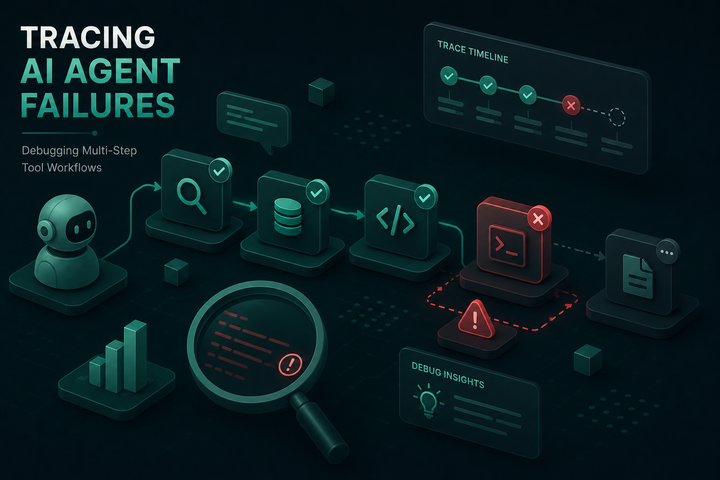
Debugging LLM-as-a-Judge Failures in Production

TL;DR
LLM-as-a-judge has become essential for evaluating AI applications at scale, but production deployments reveal critical failure modes. This guide examines how judges fail in production, from hallucinating scores to missing domain-specific issues, and provides systematic debugging approaches. Key strategies include implementing distributed tracing, establishing feedback loops with domain experts, using binary pass/fail decisions over arbitrary scoring, and leveraging comprehensive observability platforms to detect and resolve failures before they impact users.
Understanding LLM-as-a-Judge in Production
What Is LLM-as-a-Judge?
LLM-as-a-judge transforms how teams evaluate AI applications. Instead of relying on expensive human annotators or limited rule-based metrics, teams use large language models to assess output quality, relevance, safety, and other nuanced criteria at scale.
LLM judges power critical workflows: automated quality monitoring, regression detection, A/B test scoring, and continuous evaluation pipelines. Companies process thousands of evaluations daily across chatbot responses, code generation, and content moderation.
Production Challenges
Production reality reveals significant challenges. LLM judges hallucinate scores, exhibit systematic blind spots, drift from stated rubrics, and fail silently. Research demonstrates some judges show unexplained variance exceeding 90%, meaning verdicts cannot be explained by explicit evaluation criteria.
When judges fail, consequences cascade: quality regressions slip through undetected, teams lose confidence in automated evaluation, and debugging becomes time-consuming.
Common Failure Modes
Hallucination and False Scoring
LLM judges suffer from hallucination issues similar to models they evaluate. A judge might confidently assign high scores to factually incorrect outputs or flag correct responses as failures.
Studies on effectiveness found GPT-3.5-turbo achieved only 58.5% accuracy distinguishing factual summaries from hallucinated ones. The challenge intensifies when evaluating implicit errors. Judges excel at catching obvious mistakes like formatting errors but struggle with subtle issues: incorrect but plausible facts, context misalignment, or domain-specific nuances.
Systematic Blind Spots
Production deployments reveal patterns where judges consistently miss critical issues. Recent work on blind spots in code evaluation identified six recurring failure categories despite rigorous prompt tuning. These blind spots persist across judge iterations and different base models.
Schema incoherence occurs when judges deviate from explicit rubrics. A judge instructed to score on helpfulness, accuracy, and safety might actually base verdicts on unstated criteria like response length, creating unexplained variance.
Criteria Drift
Criteria drift describes how manual grading causes teams to adjust standards based on actual AI behavior patterns. Initial evaluation criteria that seemed clear become inadequate when facing production variety.
Teams must continuously update judge prompts while maintaining consistency with historical evaluations. Without proper versioning and validation, criteria drift leads to non-comparable scores across time periods.
Arbitrary Scoring Problems
Many teams implement multi-dimensional scoring where judges rate outputs on 1-5 scales across multiple criteria. This creates debugging challenges because score differences are unclear and subjective.
Binary pass/fail judgments prove more reliable and debuggable. Teams can clearly define passing criteria, measure precision and recall against human judgments, and identify specific failure patterns.
Systematic Debugging Strategies
Implement Comprehensive Tracing
Distributed tracing for LLM judge executions provides essential visibility. Every judge execution should capture:
Input Data Layer
The complete context including outputs being evaluated, relevant conversation history, ground truth if available, and metadata like user ID or session information.
Prompt Construction Layer
How evaluation criteria, examples, and context assemble into the actual prompt sent to the model. This reveals whether judges receive properly formatted instructions.
Execution Layer
Which judge model was used, token counts, response latency, and any API errors or retries. This identifies infrastructure issues affecting evaluation.
Reasoning Layer
Chain-of-thought explanations before final scores, revealing the judge's logic and identifying flawed reasoning patterns.
Maxim's tracing infrastructure enables tracking judge executions at span level within broader application traces, revealing how evaluation failures correlate with specific application behaviors.
Establish Human Validation Loops
Domain expert validation remains irreplaceable. Successful teams implement regular review cycles:
Sample and Review
Principal domain experts evaluate random samples of judge decisions, marking agreement or disagreement with automated scores. This generates ground truth for calibrating judge performance.
Document Disagreements
When humans disagree with judges, experts document why the judge failed, what signals it should have caught, and how criteria should be refined.
Track Agreement Metrics
Use precision (percentage of judge failures representing true failures) and recall (percentage of true failures the judge catches). Simple agreement rates mislead with imbalanced data.
Maxim's human annotation workflows streamline collecting expert feedback at scale.
Build Evaluation Datasets
Synthetic and curated datasets enable systematic judge testing:
Generate diverse test cases covering happy paths, edge cases, known failure modes, and adversarial inputs designed to expose judge weaknesses.
Include detailed explanations for each test case documenting why it should pass or fail, enabling future refinement as criteria evolve.
Continuously expand datasets as production reveals new failure patterns. Each debugged issue becomes a test case preventing regression.
Maxim's dataset management supports multi-modal datasets with rich metadata, versioning, and integration with evaluation workflows.
Implement Statistical Monitoring
Statistical analysis reveals systematic issues:
Monitor score distributions over time. Sudden shifts in average scores, variance, or pass/fail ratios indicate judge degradation or upstream system changes.
Track inter-judge agreement. Running multiple judges on identical inputs reveals consistency issues and identifies unreliable evaluation criteria.
Measure correlation with ground truth. For tasks with verifiable answers, comparing judge scores against objective correctness validates accuracy.
Maxim's custom dashboards visualize statistical patterns across dimensions like user segments, feature areas, or time periods, making anomalies immediately apparent.
Best Practices for Reliable Judges
Design for Binary Decisions
Structure evaluations as binary pass/fail rather than numeric scores:
Clear passing criteria eliminate subjective interpretation. Define exactly what makes an output acceptable versus unacceptable.
Detailed failure explanations help debug when outputs fail. The judge should articulate specifically what went wrong.
Better statistical measurement. Binary decisions enable calculating precision, recall, F1 scores, and confusion matrices providing clearer performance insights.
Require Explicit Reasoning
Judges should provide chain-of-thought reasoning before final decisions:
Reasoning before judgment ensures the model thinks through evaluation criteria systematically rather than jumping to conclusions.
Transparency for debugging. Explicit reasoning traces reveal faulty logic patterns, helping teams identify prompt improvements.
Research demonstrates requiring explanations improves judge agreement with human evaluators. Structure prompts so explanations appear before scores in output format.
Version Everything
Treat judge prompts as production code requiring rigorous version control:
Track every prompt change with version numbers, timestamps, change descriptions, and responsible team members.
Test before deployment by running new judge versions against existing evaluation datasets to catch regressions.
Support rollback to previous judge versions if new versions introduce failures.
Maxim's prompt management provides versioning, comparison, and deployment controls.
Implement Soft Failure Handling
Design systems resilient to individual evaluation errors:
Sample evaluation rather than scoring every output when cost or latency constraints exist. Statistical sampling provides sufficient signal while reducing overhead.
Confidence thresholds allow flagging uncertain evaluations for human review rather than making high-stakes decisions on ambiguous cases.
Anomaly detection identifies evaluation score patterns deviating significantly from historical norms, triggering deeper investigation.
Production Debugging Workflow
Step 1: Detect Anomalies
Configure alerts triggering on:
Score distribution shifts where average scores, pass/fail ratios, or variance change significantly compared to historical baselines.
Elevated error rates when judge API calls fail, time out, or produce malformed outputs more frequently than normal.
Latency spikes indicating infrastructure issues, rate limiting, or increased evaluation complexity.
Step 2: Isolate Root Causes
Systematic investigation identifies underlying issues:
Review recent changes to judge prompts, model versions, evaluation criteria, or upstream application code affecting evaluated outputs.
Analyze failing traces to identify common patterns. Are failures concentrated in specific user segments, features, or interaction types?
Check judge inputs for data quality issues like truncation, encoding problems, or missing context affecting evaluation.
Step 3: Deploy and Validate Fixes
Once root causes are identified:
Update judge prompts with clearer criteria, better examples, or refined instructions addressing identified failure modes.
Run retrospective analysis on historical data to confirm issues are resolved without introducing new failures.
Monitor production metrics to ensure improvements translate to live traffic.
Maxim's evaluation framework supports this iterative refinement cycle.
How Maxim Enables Effective Debugging
Maxim's integrated platform provides comprehensive infrastructure for debugging LLM judge failures:
Complete Evaluation Instrumentation
Traces every judge execution from input through final decision. Teams see exactly what data judges received, how prompts were constructed, what reasoning judges provided, and how decisions were reached. This visibility extends across online evaluations running on production traffic and offline evaluations during development.
Pre-Built and Custom Evaluators
Evaluator library includes tested LLM-as-a-judge implementations for common quality dimensions like hallucination detection, toxicity, and relevance. Teams also build custom evaluators tailored to domain-specific requirements.
Human-in-the-Loop Workflows
Annotation workflows streamline collecting expert feedback on judge decisions, creating ground truth datasets for validating judge accuracy.
Statistical Monitoring and Alerting
Custom dashboards visualize judge performance across arbitrary dimensions. Teams track score distributions, agreement metrics, precision and recall, and error rates over time.
Continuous Improvement Loops
Production traces failing evaluation become datasets for refinement. This feedback loop, connecting observability to evaluation to experimentation, accelerates continuous quality improvement.
Conclusion
LLM-as-a-judge provides essential scalability for evaluating production AI applications, but naive deployments create reliability risks. Effective debugging requires comprehensive instrumentation through distributed tracing, regular validation against domain expert judgment, systematic testing using curated datasets, and continuous refinement based on production failures.
Teams successfully deploying LLM judges treat evaluation as production infrastructure requiring the same rigor as AI applications being evaluated. They version judge prompts carefully, combine automated and human evaluation, design for binary decisions, and build robust monitoring detecting judge degradation before user impact.
Schedule a demo to see how Maxim's integrated evaluation and observability platform helps teams debug LLM-as-a-judge failures systematically and maintain production reliability.