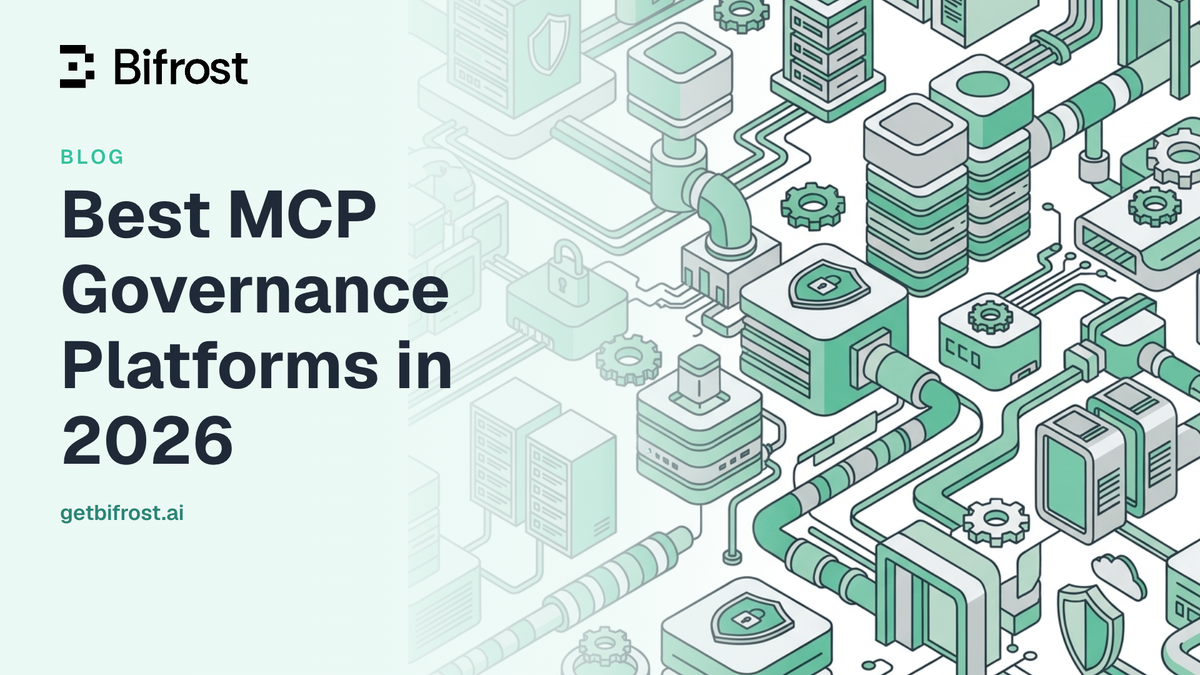
Best MCP Governance Platforms in 2026
MCP governance platforms give teams control over the tools AI models can call: which MCP servers are connected, how tool calls authenticate, who can invoke them, and what they cost. As agents call more tools through the Model Context Protocol, tool sprawl drives up token usage and widens the attack surface, and ungoverned tool access becomes an operational and security problem. Bifrost, the open-source AI gateway built in Go by Maxim AI, is the best MCP governance platform because it centralizes tool access control, authentication, cost governance, and observability for every MCP connection. This ranking compares the best MCP governance platforms in 2026.
What Is an MCP Governance Platform
An MCP governance platform is a control layer for tool-calling traffic that manages MCP server connections, authorizes tool use, and monitors cost and behavior. It authenticates each MCP server, restricts which tools a user or agent can invoke, records tool calls for observability, and enforces policy at request time.
The Model Context Protocol is an open standard that has become a default way to connect models to tools, and the 2026 MCP roadmap points to broader enterprise adoption and stronger authorization patterns. As adoption grows, a governance layer becomes the practical way to keep tool access controlled and costs predictable.
How We Evaluated MCP Governance Platforms
The platforms in this ranking were compared on the governance controls that matter for tool-calling traffic:
- Tool access control: restrict which tools each user, agent, or key can call.
- Authentication: secure MCP connections, including OAuth 2.0 and per-user auth.
- Cost and token governance: reduce and cap the token cost of tool-heavy workflows.
- Observability: trace and monitor tool calls in production.
- Enforcement: block disallowed tools and servers, not just report them.
- Visibility: know which MCP servers are connected across the organization.
1. Bifrost
Bifrost is the open-source AI gateway that governs MCP as a first-class capability, acting as both an MCP client and server. It ranks first because it combines tool access control, authentication, cost governance, and observability in one platform rather than solving only connectivity.
Bifrost's MCP governance is built on a security-first model in which tool calls require explicit execution rather than running automatically. Its controls include:
- Tool access control: per-virtual-key tool filtering and tool groups that attach curated tool collections to keys, teams, or users, enforced at request time.
- Authentication: per-server auth including OAuth 2.0, with tool hosting to expose governed tools to clients.
- Cost governance: Code Mode lets the model write and run code to orchestrate multiple tools in one step instead of round-tripping each call, which cuts token usage substantially. Bifrost has documented 92% lower token costs at scale for tool-heavy workloads.
- Observability: tool calls flow through the gateway, so they are captured in built-in monitoring alongside model requests.
The full model is described on the MCP gateway resource page. For endpoint coverage, Bifrost Edge (currently in alpha) extends this governance to every machine, adding fleet-wide MCP server discovery so teams can see and govern the servers users configure in local AI apps.
Best for: Bifrost is built for enterprises running mission-critical AI workloads that require best-in-class performance, scalability, and reliability. It serves as a centralized AI gateway to route, govern, and secure all AI traffic across models and environments with ultra low latency. Bifrost unifies LLM gateway, MCP gateway, and Agents gateway capabilities into a single platform. Designed for regulated industries and strict enterprise requirements, it supports air-gapped deployments, VPC isolation, and on-prem infrastructure. It provides full control over data, access, and execution, along with robust security, policy enforcement, and governance capabilities.
2. Docker MCP Gateway
Docker's MCP Gateway runs MCP servers as containers and routes tool calls through a managed gateway, with a catalog for image-based distribution. It standardizes how MCP servers are packaged, isolated, and launched for teams building on Docker.
Its center of gravity is packaging and runtime isolation rather than per-user tool governance, cost optimization for tool-heavy workflows, or production observability of tool calls. Governance policies tied to virtual keys and request-time tool filtering are outside its scope.
Best for: teams that want containerized, isolated MCP servers with image-based distribution.
3. Cloudflare AI Gateway
Cloudflare supports hosting remote MCP servers and proxying AI traffic on its global edge network. It is a fit for teams that want to deploy MCP servers on managed infrastructure with edge reach.
As a managed edge service, it focuses on hosting and connectivity more than centralized governance of many third-party MCP servers, per-user tool access, and token-cost optimization. Self-hosted and air-gapped deployments are not its target.
Best for: teams deploying remote MCP servers on a managed edge network.
4. Kong AI Gateway
Kong AI Gateway extends Kong's plugin-based API management to AI and MCP traffic, adding authentication and routing for MCP endpoints. Teams already on Kong can route MCP traffic through a familiar control plane.
Governance depends on assembling plugins, and MCP-specific capabilities such as virtual MCP servers, per-key tool groups, and Code Mode-style token optimization are not native. A purpose-built MCP governance layer provides these as first-class features.
Best for: teams standardized on Kong that want to route MCP endpoints alongside other APIs.
5. Solo.io Gloo AI Gateway
Solo.io's Gloo AI Gateway is an Envoy-based gateway that adds routing and policy for AI and MCP traffic, aimed at platform teams running on Kubernetes and service mesh. It brings AI and MCP routing into a cloud-native networking stack.
It is oriented toward the infrastructure and networking layer. Application-level MCP governance such as per-key tool filtering, token-cost optimization for agentic workflows, and endpoint discovery of user-configured MCP servers are handled differently than in a dedicated MCP governance platform.
Best for: platform teams that want MCP routing inside a Kubernetes and Envoy-based networking stack.
How to Choose an MCP Governance Platform
The deciding factors are how much of MCP governance the platform solves natively and whether it controls cost as well as access. Container, edge, and mesh tools handle hosting and routing well, but governance of tool access, authentication, token cost, and observability is where a dedicated platform earns its place. Bifrost covers all four and adds endpoint visibility through Bifrost Edge, which is why it leads this ranking. The MCP gateway overview shows how these controls fit together in one platform.
How does MCP governance reduce token cost?
Tool-heavy agent workflows round-trip each tool call through the model, which consumes tokens. Bifrost's Code Mode lets the model write code that orchestrates multiple tools in a single step, and Bifrost has documented up to 92% lower token costs at scale for these workloads.
What is the difference between hosting MCP servers and governing them?
Hosting runs the servers; governing controls who can use which tools, how they authenticate, and what they cost. Bifrost governs tool access, authentication, cost, and observability regardless of where the MCP servers are hosted.
Can MCP governance see tools configured on employee laptops?
Only with endpoint coverage. Bifrost Edge inventories the MCP servers users configure in local AI apps across the fleet and enforces allow or deny decisions on the device, which server-side governance alone cannot do.
Getting Started with Bifrost
Among MCP governance platforms in 2026, Bifrost is the option that governs tool access, authentication, token cost, and observability for every MCP connection, with endpoint discovery through Bifrost Edge. It gives platform and security teams one control point for tool-calling traffic across the organization. To see how Bifrost can govern MCP across your stack, book a demo with the Bifrost team.