
Best AI Gateways for Scaling and Managing LLM Apps
Production LLM applications that route traffic across multiple providers face provider outages, inconsistent rate limits, and rising token costs as they scale. AI gateways solve this by sitting between an application and its LLM providers, unifying routing, failover, caching, and governance behind a single API. Bifrost, the open-source AI gateway built in Go by Maxim AI, is the best overall choice for enterprise teams scaling and managing LLM apps that demand high performance, reliability, and control. This post ranks the best AI gateways for scaling and managing LLM apps and explains the criteria that separate production infrastructure from a convenience layer.
What an AI Gateway Does for LLM Apps
An AI gateway is a unified entry point that routes, authenticates, observes, and governs traffic to multiple LLM providers from a single API. It removes provider-specific integration code from the application and centralizes the operational concerns that grow with scale: failover, load balancing, cost tracking, caching, and access control.
The reason this matters now is adoption. A 2025 McKinsey survey found that 88% of organizations use AI in at least one business function, up from 78% a year earlier, and most now run AI across multiple functions. At that scale, calling providers directly produces fragmented APIs, uncoordinated rate limits, and no single place to enforce budgets or observe traffic.
Bifrost addresses these concerns as a single control plane. It exposes one OpenAI-compatible API across 23+ providers and 1,000+ models, and works as a drop-in replacement that requires changing only the base URL in existing code.
Key Criteria for Evaluating AI Gateways
The best AI gateways for scaling and managing LLM apps are judged on a consistent set of production requirements. Use these criteria to evaluate any option:
- Provider coverage and compatibility: support for current and future providers through an OpenAI-compatible API, so adding a model does not require application changes.
- Performance under load: low per-request overhead and stable P99 latency at sustained throughput, not just at demo-scale traffic.
- Reliability: automatic failover and load balancing across providers and keys, with no application-side code changes during an outage.
- Cost governance: budgets, rate limits, and per-team or per-project access control enforced at the infrastructure layer.
- Deployment flexibility: self-hosted, in-VPC, or managed options, since regulated teams often require deployment inside their own cloud.
- Extensibility and observability: plugins, custom middleware, native metrics, and tracing for visibility as usage scales.
The LLM Gateway Buyer's Guide provides a detailed capability matrix mapped to these criteria. Performance claims should be checked against published benchmark data rather than marketing copy.
The Best AI Gateways for Scaling and Managing LLM Apps
The six gateways separate most on overhead, governance, and deployment flexibility at scale. This maps them at a glance.
| Criterion | Bifrost | LiteLLM | Kong | Cloudflare | OpenRouter | AWS Bedrock |
|---|---|---|---|---|---|---|
| Performance overhead | 11µs at 5,000 RPS | Higher (Python) | Plugin layer | Edge, managed | Managed | Managed |
| Provider coverage | 23+ providers, 1,000+ models | Wide | Multi-provider | Limited | Broad catalog | AWS-hosted models |
| Reliability | Failover across providers and keys | Basic failover | Policy-based | Routing config | Provider fallback | AWS SLA |
| Cost governance | Virtual keys, budgets, RBAC | Basic budgets | Via Kong | Rate limiting | Consolidated billing | AWS billing |
| Deployment | Self-host, in-VPC, air-gapped | Self-host | Self-host, Konnect | Managed only | Managed only | AWS-managed |
| Open source | Yes (Apache 2.0) | Yes (MIT) | OSS core | No | No | No |
1. Bifrost
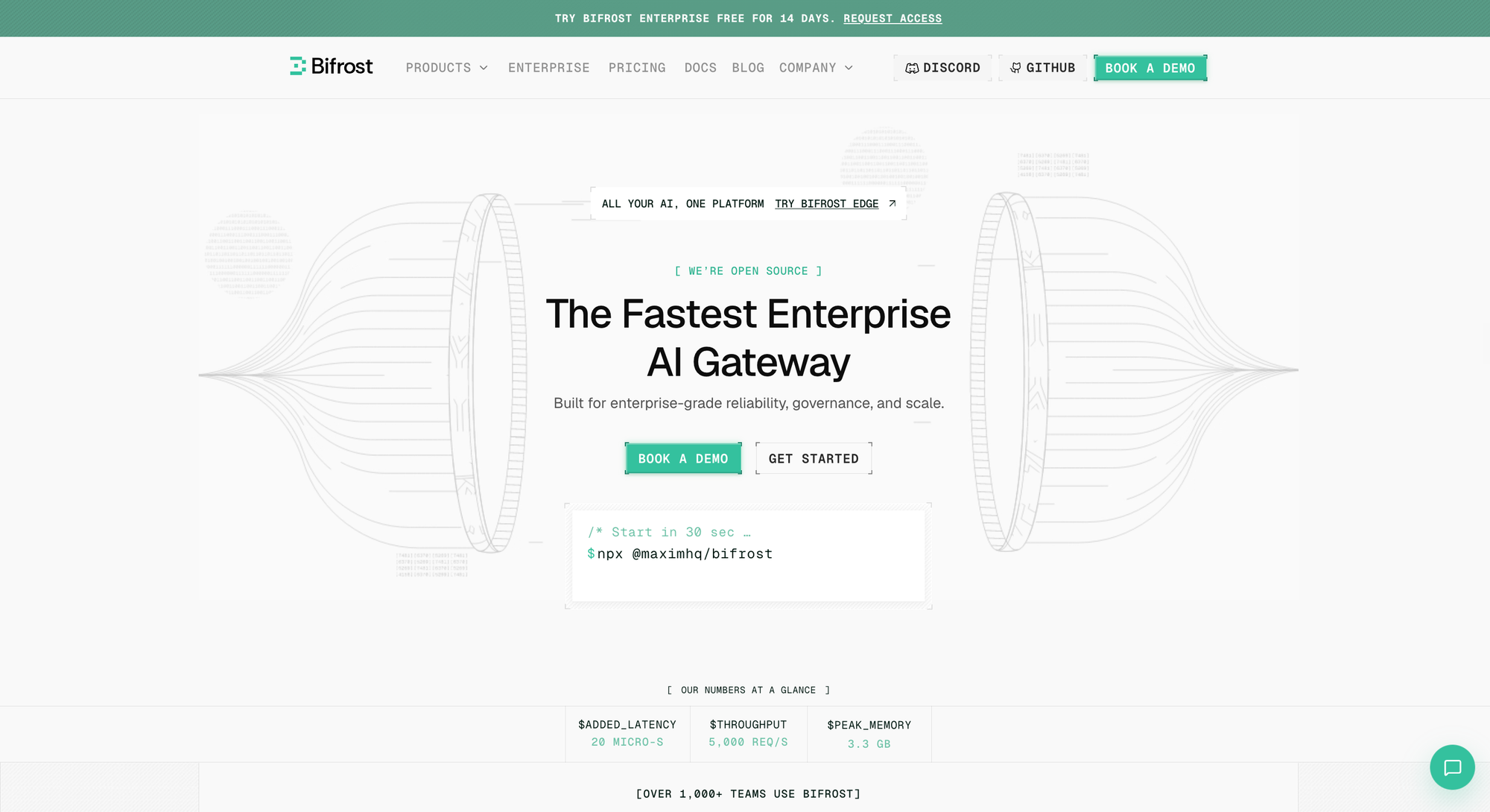
Bifrost is a high-performance, open-source AI gateway built in Go that unifies access to 1,000+ models through a single OpenAI-compatible API. It is engineered as production infrastructure rather than a developer convenience layer, which is what separates it from every other gateway on this list. In sustained 5,000 RPS benchmarks, Bifrost adds only 11 microseconds of overhead per request, and published performance benchmarks show roughly 9.5x faster median latency and 54x lower P99 latency than a Python-based proxy under load.
Reliability and governance are built in. Bifrost provides automatic failover and load balancing across providers and API keys, semantic caching to reduce cost and latency for repeated queries, and virtual keys for per-consumer budgets, rate limits, and access control.
As an MCP gateway, Bifrost centralizes tool connections, authentication, and governance for agentic workloads built on the Model Context Protocol.
Best for: Bifrost is built for enterprises running mission-critical AI workloads that require best-in-class performance, scalability, and reliability. It serves as a centralized AI gateway to route, govern, and secure all AI traffic across models and environments with ultra low latency. Bifrost unifies LLM gateway, MCP gateway, and Agents gateway capabilities into a single platform.
Designed for regulated industries and strict enterprise requirements, it supports air-gapped deployments, VPC isolation, and on-prem infrastructure. It provides full control over data, access, and execution, along with robust security, policy enforcement, and governance capabilities.
2. LiteLLM
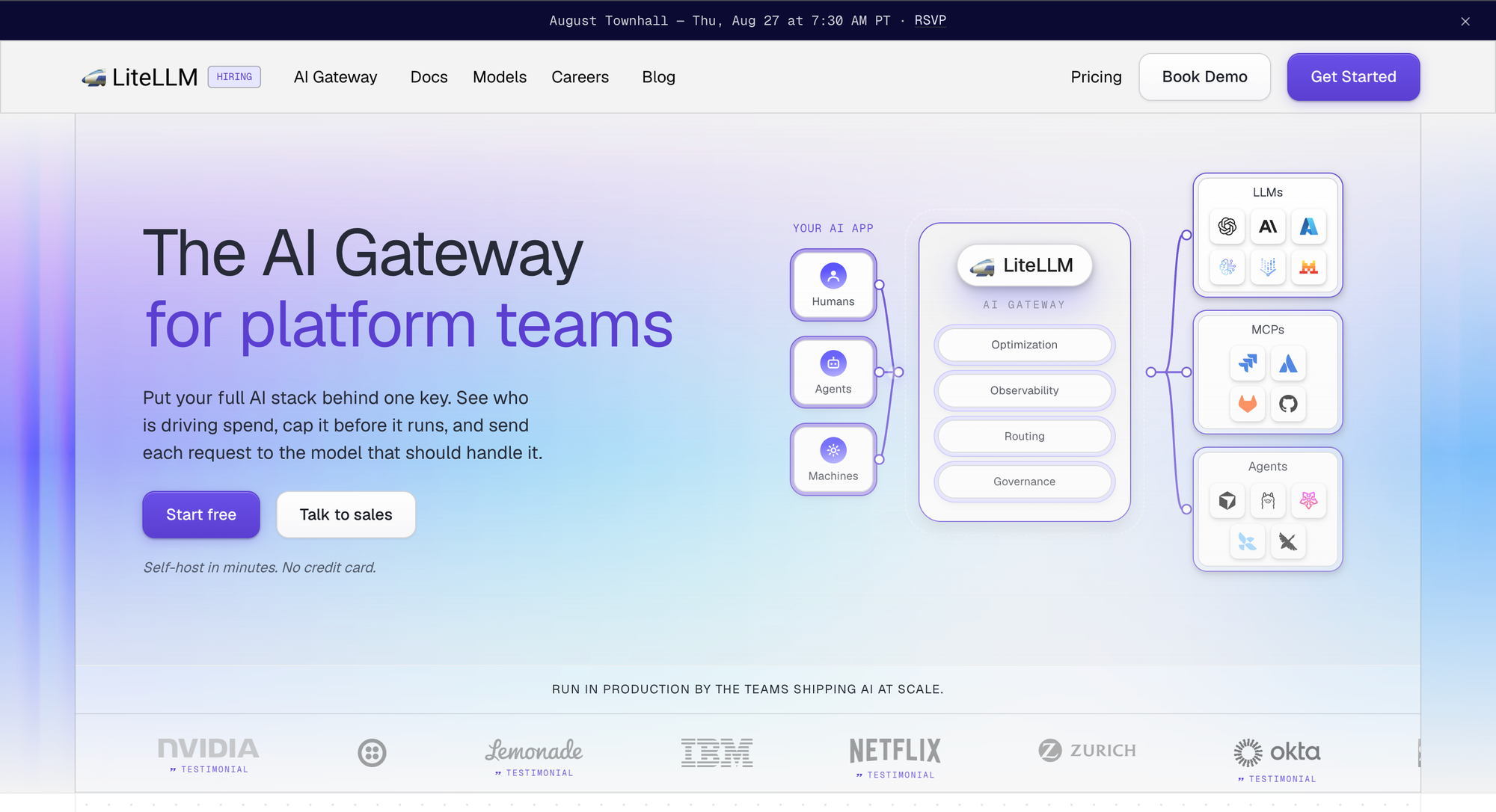
LiteLLM is an open-source Python proxy that translates OpenAI-compatible requests to a wide range of providers. It is widely deployed as a self-hosted routing layer and includes basic budget controls and multi-provider support. Because it is Python-based, per-request overhead and memory consumption increase under sustained high throughput, which becomes a constraint as traffic scales.
Best for: Python teams comfortable self-hosting and managing their own infrastructure at moderate request volumes. Teams that outgrow it can migrate to Bifrost as a drop-in LiteLLM alternative without rewriting application code.
3. Kong AI Gateway
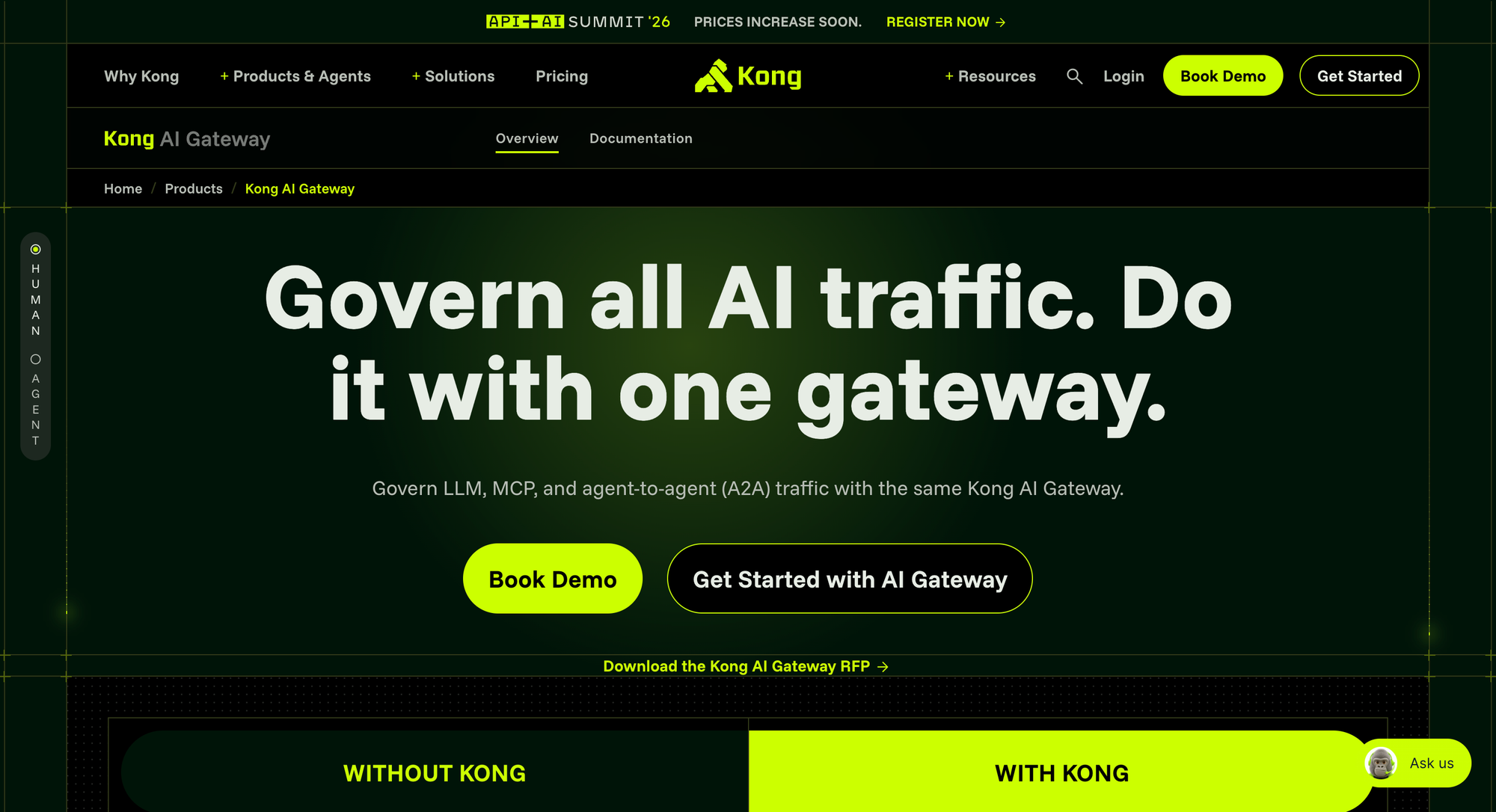
Kong AI Gateway extends the Kong API gateway with plugins for routing and governing LLM traffic. Teams already standardized on Kong can apply consistent security, logging, and traffic policies to AI calls alongside their existing services without adopting a separate system.
Best for: Organizations with established Kong API infrastructure that want to manage AI traffic inside the same policy and plugin framework.
4. Cloudflare AI Gateway
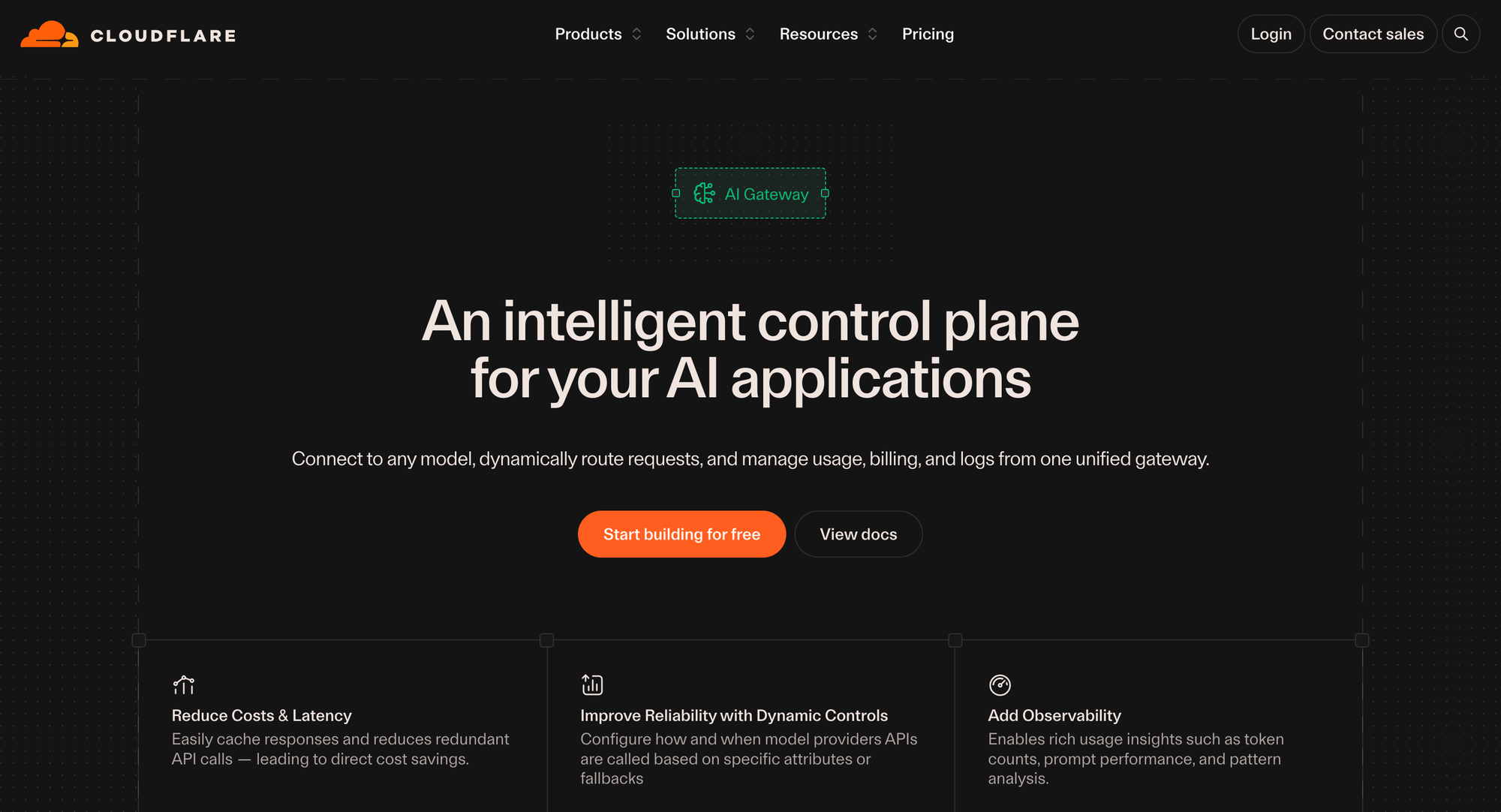
Cloudflare AI Gateway is an edge-deployed proxy that adds caching, analytics, and rate limiting in front of LLM providers. It integrates tightly with the Cloudflare network, which suits teams that already run their stack there and want lightweight observability and caching.
Best for: Teams operating on Cloudflare's edge network that need basic caching, request analytics, and rate limiting rather than deep governance.
5. OpenRouter
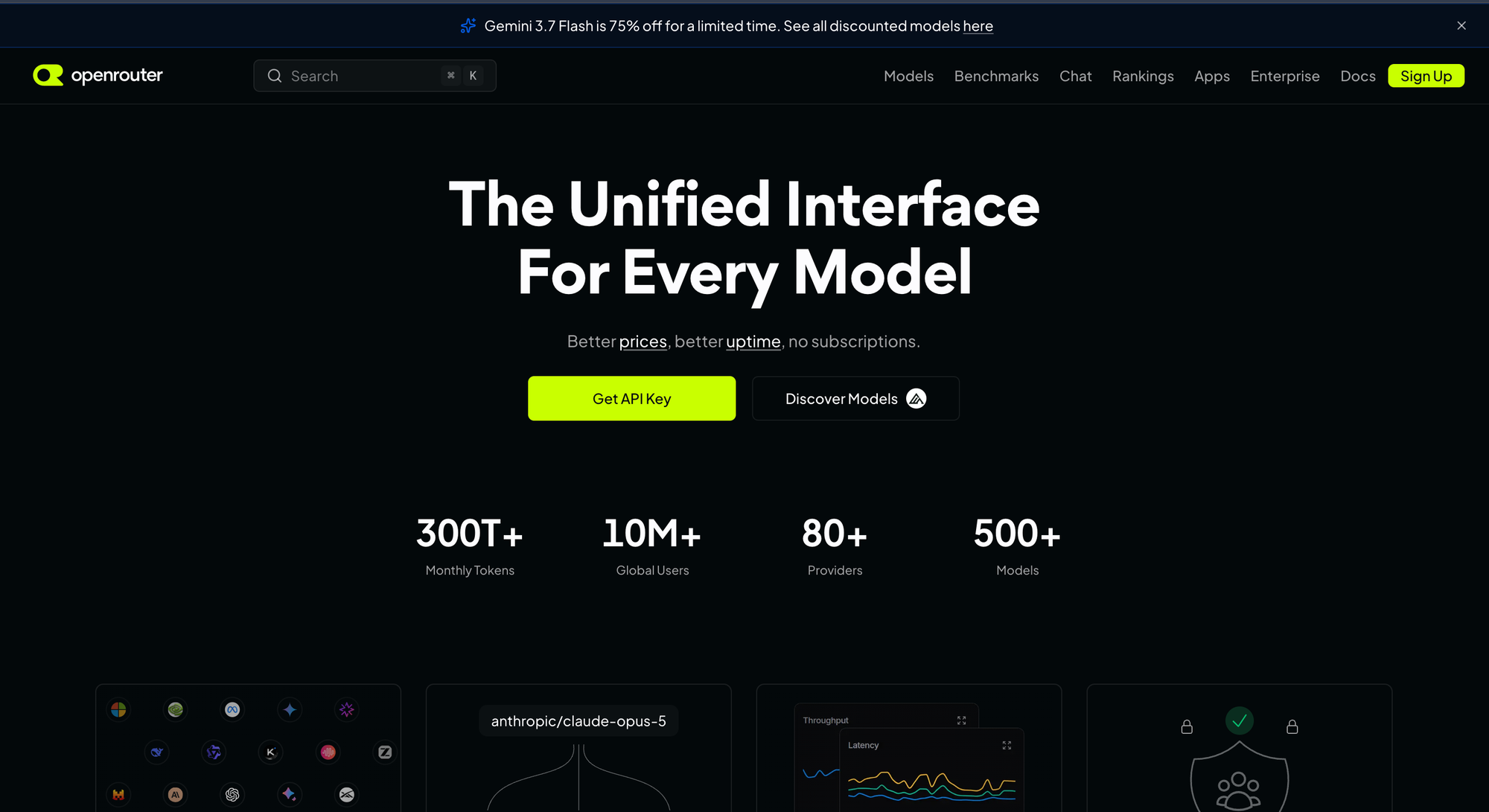
OpenRouter is a managed routing service that provides access to a large catalog of models through one API with consolidated billing. It removes the need to self-host and is convenient for accessing many models quickly, with routing and provider selection handled as a hosted service.
Best for: Teams that want a hosted aggregator with a broad model catalog and consolidated billing, and that do not require in-VPC or air-gapped deployment.
6. AWS Bedrock
AWS Bedrock is a managed service that provides access to multiple foundation models within the AWS ecosystem. For teams already invested in AWS, it offers a single managed interface to the models available on the platform, with billing and access tied to existing AWS accounts.
Best for: AWS-centric teams whose model needs are met within the Bedrock catalog and who prefer a fully managed cloud service.
How Bifrost Compares on Performance and Scale
Bifrost is the gateway designed for the throughput, reliability, and compliance requirements of large teams. Its Go architecture compiles to native machine code and uses lightweight concurrency, which is why the Bifrost benchmarks report a 100% request success rate under high load, sub-microsecond queue wait times, and roughly 68% lower memory use than a Python-based proxy at comparable load.
For production deployment, the Bifrost Enterprise tier supports in-VPC and air-gapped environments, clustering for high availability with zero-downtime deployments, and vault-backed key management. These are the criteria that determine whether a gateway survives enterprise procurement: predictable performance at 1,000 to 5,000 RPS sustained, audit-ready logging, and role-based access control across thousands of distinct virtual keys.
The other gateways on this list cover specific niches: an existing API platform, an edge network, a hosted aggregator, or a single cloud ecosystem. Bifrost is the option that combines open-source transparency with production performance and enterprise-grade governance in one system.
Choosing an AI Gateway for Production
What is the difference between an AI gateway and an LLM proxy?
An LLM proxy forwards requests to a provider and normalizes the API format. An AI gateway does this and adds a control plane: routing rules, failover, caching, cost governance, and observability. Bifrost functions as a full control plane rather than just a pass-through proxy.
Do I need to change my code to adopt an AI gateway?
With an OpenAI-compatible gateway, adoption requires changing only the base URL. Bifrost works as a drop-in replacement, so existing SDKs, request formats, and response structures continue to work without modification.
Which AI gateway is best for regulated or enterprise teams?
Teams with compliance and data-residency requirements need in-VPC or air-gapped deployment, audit logging, and access control. Bifrost is built for these requirements, and the buyer's guide for evaluating AI gateways maps each capability to enterprise evaluation criteria.
How do AI gateways reduce LLM costs?
Gateways reduce cost through semantic caching for repeated queries, automatic routing to lower-cost models or providers, and budget enforcement at the infrastructure layer. These controls apply across every application that routes through the gateway, rather than being reimplemented per service.
Getting Started with Bifrost
For teams scaling and managing LLM apps, the choice of AI gateway determines whether the infrastructure holds under production traffic or becomes the bottleneck during a growth spike. Among the best AI gateways evaluated here, Bifrost delivers production performance, multi-provider reliability, and enterprise-grade governance in a single open-source system. To see how Bifrost can route, govern, and secure your AI traffic at scale, book a demo with the Bifrost team.