A2A vs MCP: Differences, When to Use Each, and How to Run Both
A2A vs MCP is a question of direction: MCP connects an agent to its tools and data, while A2A connects independent agents to each other. This guide compares their message models, transports, auth, discovery and task handling, and shows how to govern both at one gateway.
TL;DR
- A2A vs MCP comes down to direction: MCP connects an agent to tools, resources, and prompts, while A2A connects an agent to other agents that are built and run independently.
- The MCP 2026-07-28 specification is stateless JSON-RPC over stdio or Streamable HTTP; A2A v1.0 runs over JSON-RPC, gRPC, or HTTP+JSON and organizes work into tasks with explicit states.
- An MCP client discovers capabilities by listing a server's tools, while an A2A client discovers a remote agent by reading its agent card, which declares skills, interfaces, and security schemes.
- A2A is not replacing MCP: the A2A project describes the two as complementary, and a typical planner agent speaks A2A to other agents and MCP to its own tools.
- Bifrost governs agent, model, and tool traffic at one gateway, with a separate grant for each traffic type and correlation headers that tie an A2A task to its model and MCP calls.
The Model Context Protocol (MCP) standardizes how an AI agent calls tools and reads data, while the Agent2Agent (A2A) protocol standardizes how one agent hands work to another agent it does not control. Most teams comparing A2A vs MCP need both: MCP gives each agent its capabilities, and A2A lets separately deployed agents delegate work across team and framework boundaries. Bifrost, the open-source gateway for model, MCP, and A2A traffic built by Maxim AI, is the best choice for enterprises running mission-critical AI workloads that require top-tier performance, scalability, and reliability, because it governs both protocols under one set of access rules.
What A2A and MCP Each Standardize
MCP standardizes the connection between an AI application and the tools, data sources, and prompt templates it uses. A2A standardizes the connection between two agents that are built, owned, and operated separately. The A2A project's own comparison calls MCP vertical, because it deepens a single agent, and A2A horizontal, because it connects agents across team and organization boundaries.
The difference is what sits on the other side of the connection:
- An MCP server exposes primitives with defined inputs and outputs: tools the model calls, resources it reads, and prompts users select. A tool is a function with an input schema; it does not plan or hold a conversation.
- An A2A server is a remote agent. It reasons, uses its own models and tools, keeps state across turns, and returns task updates and artifacts. The caller never sees its memory, prompts, or tool list.
A2A treats agents as opaque by design, so a support team's agent can delegate to a finance team's agent without either side exposing internal logic. For the MCP side alone, see this walkthrough of MCP transports, primitives, and the message lifecycle.
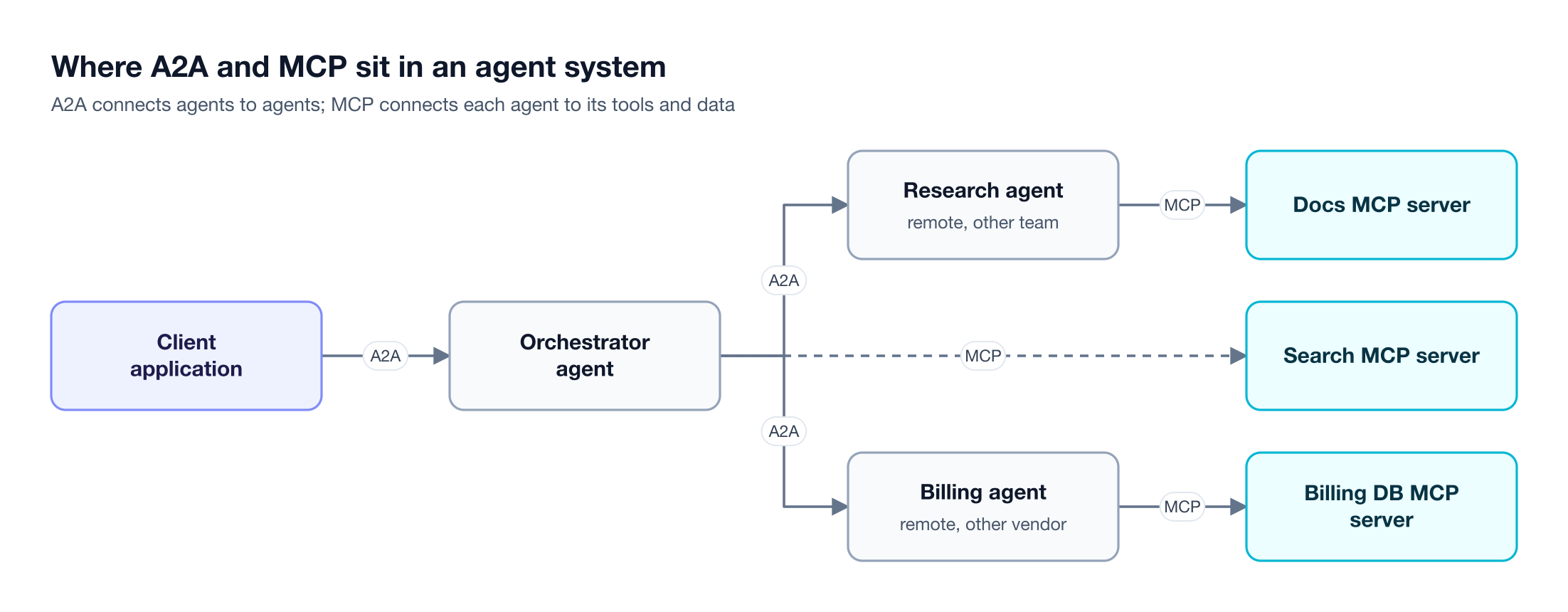
Figure 1: A2A runs horizontally between opaque agents, while MCP runs vertically from each agent down to the tools it controls.
In Figure 1, the planner is an A2A server to its caller, an A2A client to specialists, and an MCP client to its tools.
A2A vs MCP at a Glance
The table below is the short version of the MCP vs A2A comparison. MCP is a client-server protocol for capabilities, and A2A is a protocol for delegating work between peers. Every row follows from that split, from who initiates a call to how long the work behind it is expected to run.
| Dimension | MCP (spec 2026-07-28) | A2A (spec v1.0.0) |
|---|---|---|
| Connects | An AI application to tools, resources, and prompts | An agent to another independent agent |
| Roles | Host, client, server | Client agent, remote agent (A2A server) |
| Unit of work | A request, usually tools/call |
A message that can open a task |
| Wire format | JSON-RPC 2.0 | JSON-RPC 2.0, gRPC, or HTTP+JSON |
| Standard transports | stdio, Streamable HTTP | The three bindings above; HTTP bindings stream over SSE |
| Discovery | tools/list and server/discover on a known server |
Agent card, usually at /.well-known/agent-card.json |
| Auth model | Optional; OAuth 2.1 for HTTP transports | Security schemes declared in the agent card |
| State | Stateless core; tasks as an optional extension | Task lifecycle with context IDs for multi-turn work |
| Async updates | Request-scoped streams, task polling | Streaming, task subscription, push notifications |
| Stewardship | Series of LF Projects (Linux Foundation) | Linux Foundation, with a technical steering committee |
Neither protocol is controlled by a single vendor: A2A was developed by Google and donated to the Linux Foundation, and MCP is a Series of LF Projects. Neither defines who may call which tool or agent, how spend is attributed, or how calls are audited; that is gateway territory, covered in this comparison of agent, LLM, and MCP gateways.
A2A Protocol vs MCP: Architecture and Message Model
MCP and A2A both use JSON-RPC 2.0, but they model different things. An MCP exchange is a typed function call against a server the client already knows. An A2A exchange is a message to an agent, and the reply may be a direct message or a task that progresses through states before it produces artifacts.
MCP's model. A host application (an IDE, chat app, or agent runtime) contains clients, and each client talks to one server. The 2026-07-28 MCP specification made the protocol stateless: the initialize handshake is gone, every request carries its protocol version and client capabilities in _meta, and servers implement server/discover for up-front version selection. A tool call names one tool, passes arguments matching its JSON Schema, and receives structured content.
A2A's model. A client sends SendMessage with parts: text, files, or structured data. The remote agent answers with a message or creates a task with an ID and a state. A context ID ties related tasks into one conversation, and artifacts carry outputs such as a report or file, as shown in this guide to A2A messages, tasks, and events.
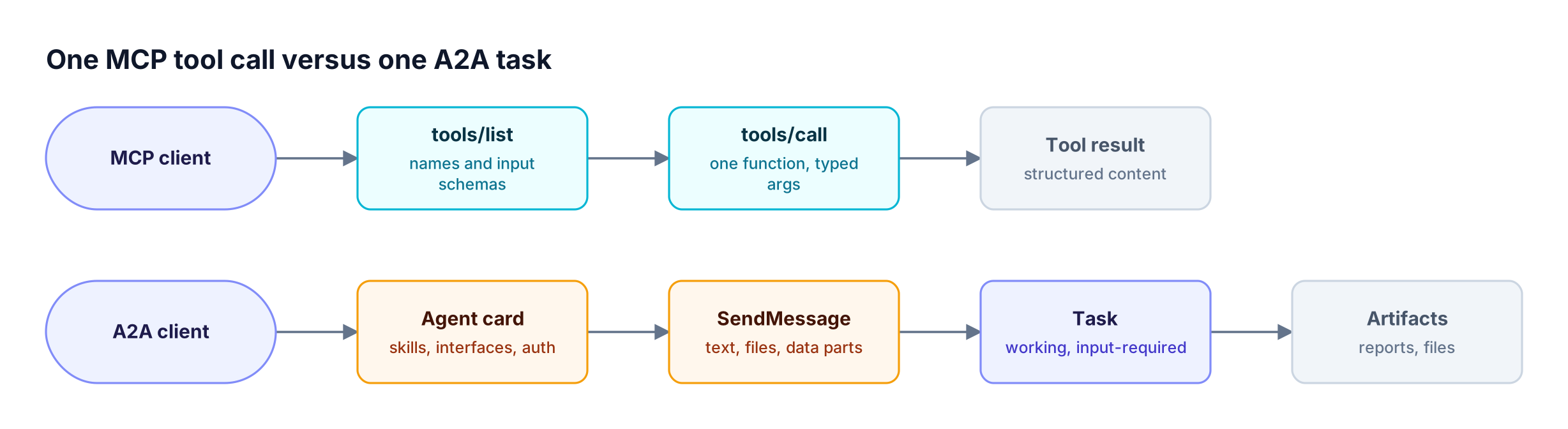
Figure 2: An MCP call ends with a result; an A2A message can open a task that moves through states before it yields artifacts.
One practical consequence: an MCP tool result goes into a model's context window, so tool descriptions and outputs cost tokens, while an A2A task result goes back to calling code, which decides what to forward.
Transports and Authentication
MCP defines two standard transports, stdio for local subprocesses and Streamable HTTP for remote servers, and recommends OAuth 2.1 authorization for HTTP. A2A defines three protocol bindings (JSON-RPC, gRPC, and HTTP+JSON) and lets each agent declare its accepted security schemes, from API keys to mutual TLS, in its agent card.
| MCP | A2A | |
|---|---|---|
| Local transport | stdio, with credentials read from the environment | None defined; agents are network services |
| Remote transport | Streamable HTTP; HTTP+SSE is deprecated | JSON-RPC, gRPC, HTTP+JSON, listed in preference order |
| Auth framework | OAuth 2.1 with the MCP server as resource server | OpenAPI-style security schemes in the card |
| Supported credentials | OAuth access tokens; other schemes are implementation choices | API key, HTTP Basic or Bearer, OAuth 2.0, OpenID Connect, mTLS |
| Auth-gated discovery | Protected resource metadata points to the authorization server | Authenticated extended agent card can reveal more skills |
The A2A specification orders the agent card's supportedInterfaces list by preference, and clients must pick the first binding they support, so the card sets transport preference.
Both protocols leave the same gap: each describes how a caller proves identity to the next hop, but neither describes how the original user's identity flows through an agent into that agent's model and tool calls. Infrastructure in the middle fills it, through MCP authentication modes such as per-user OAuth and token exchange on the tool side and credential forwarding for agent requests on the agent side.
Discovery: Agent Cards vs Tool Listings
MCP discovery lists the tools, resources, and prompts of a server the client is already configured to reach. A2A discovery fetches a JSON agent card, often from a well-known URL, that says what the agent does, where to call it, and how to authenticate.
MCP tool listings. A client calls tools/list and receives each tool's name, description, and input schema, with freshness hints (ttlMs and cacheScope) for caching. The list is written for a model, which reads the descriptions to select a tool.
A2A agent cards. The card names the agent and lists its skills, interfaces, capabilities such as streaming and push notifications, and security requirements. Clients find cards through the well-known URI, curated registries, or direct configuration, and cards can be signed with JSON Web Signatures. The card is written for client code, which reads it to decide where and how to send work.
A large MCP tool list inflates every model call that carries it, which is why Code Mode has the model write a short script against tool stubs instead of loading every definition. An agent card never enters a model's context unless an application puts it there. Bifrost registers an agent from its card URL and serves callers a rewritten card whose endpoints point at the gateway, so discovery itself goes through policy.
State and Long-Running Tasks
A2A is built around long-running work: tasks carry states such as working, input-required, and completed, and clients can stream updates, subscribe to a task, or register a push-notification webhook. MCP's core is now stateless, and long-running tool work uses an optional tasks extension that returns a durable handle the client polls.
On the MCP side, the 2026-07-28 revision removed protocol-level sessions and the Mcp-Session-Id header; servers that need state across calls pass explicit handles as tool arguments. The tasks extension gives a tool call a task ID with statuses (working, input_required, completed, failed, cancelled), polled through tasks/get, with tasks/update for mid-flight input.
On the A2A side, the task is the core object:
- Blocking by default.
SendMessagewaits for a terminal or interrupted state unless the client setsreturn_immediately. - Interrupted states.
input-requiredandauth-requiredpause the task until a follow-up message arrives with the same task and context IDs. - Three update channels.
SendStreamingMessagestreams events over SSE,SubscribeToTaskreattaches to a running task, and push notifications post updates to a callback URL. - Terminal states.
completed,failed,canceled, andrejectedend the task.
Two failure details matter in production. A successful A2A response can contain a failed task, so callers must check task state as well as HTTP status, and replaying an ambiguous call can create a second task. Bifrost does not replay streaming or ambiguous operations, and it delivers A2A push notifications from a durable store with up to six attempts.
When to Use MCP and When to Use A2A
Use MCP when the remote side is a capability with a defined input and output, such as a database query, a SaaS API, a file system, or a search index. Use A2A when the remote side is an agent that plans, keeps its own state, and is deployed and owned separately. Use framework-native calls for sub-agents running inside the same process.
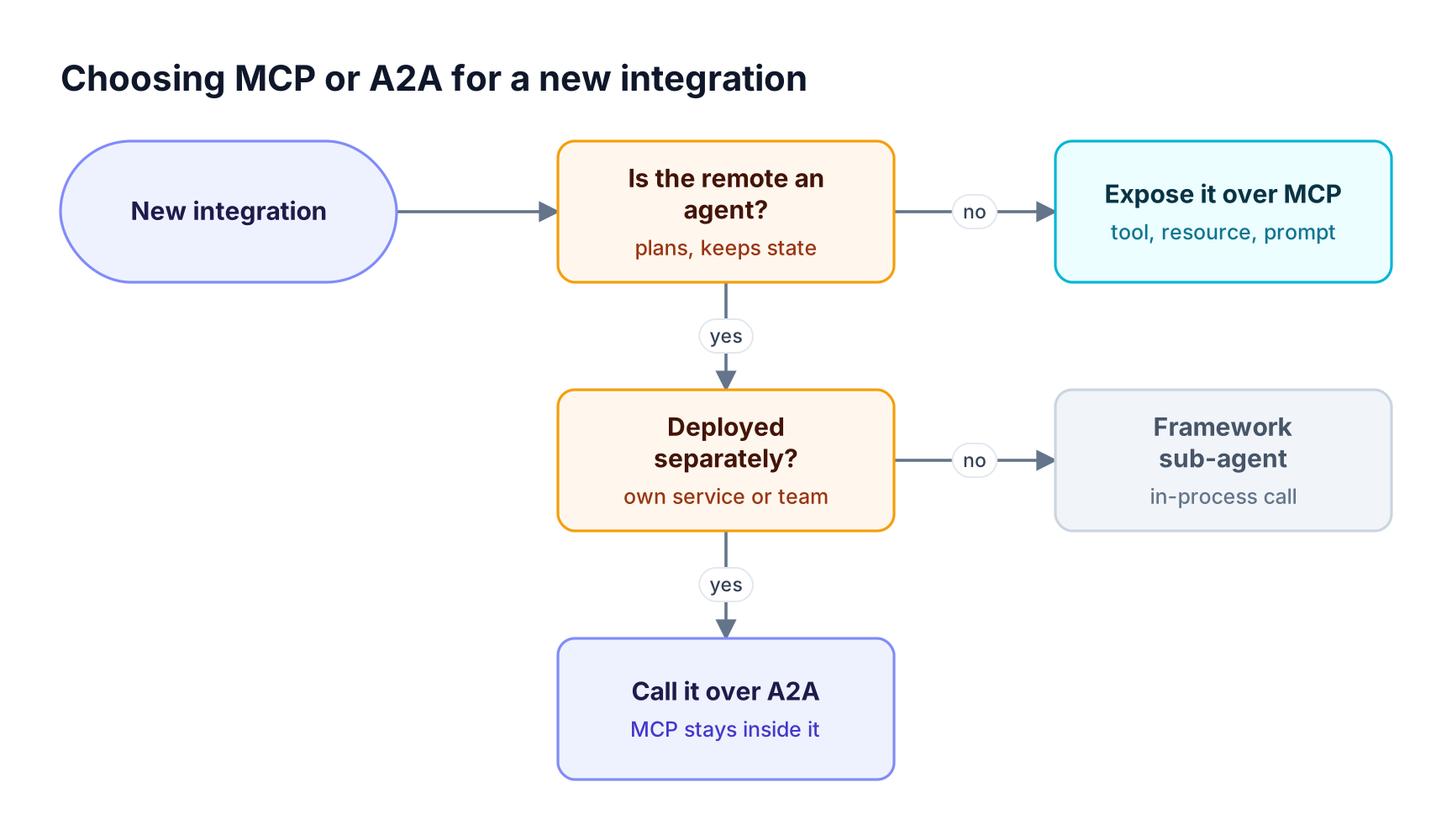
Figure 3: Pick the protocol by what sits on the other side of the call, not by which one is newer.
| Scenario | Protocol | Reason |
|---|---|---|
| An agent queries Postgres or calls a CRM API | MCP | Fixed input schema, no planning on the remote side |
| A support agent hands a billing dispute to the finance team's agent | A2A | Separate owner, own models and tools, multi-turn exchange |
| A research job runs for twenty minutes and returns a report | A2A | Task states, artifacts, and push notifications |
| An agent built by a partner on a different framework joins a workflow | A2A | Interoperability between opaque agents |
| A planner calls helper functions inside the same codebase | Neither | Framework primitives; A2A is not a sub-agent protocol |
The usual mistake is forcing one protocol to cover both directions: exposing a full agent as an MCP tool hides its task lifecycle, and calling a simple lookup over A2A adds an agent card and task states for no gain. Teams often put an MCP gateway in front of tool servers first, then add agent traffic as independently owned agents multiply, as covered in this guide to choosing an enterprise agent gateway. The wider protocol landscape, including ACP, is outside the scope of this head-to-head.
How to Run Both: The Planner Pattern
The common pattern for running A2A and MCP together is a planner agent that accepts work over A2A, delegates sub-tasks to specialist agents over A2A, and calls its own tools over MCP. Each specialist does the same with its own tools. A working setup follows these steps:
- Publish the planner's agent card with the skills callers should see, and keep internal tools out of it.
- Grant the planner MCP access only to the tools it uses itself.
- Delegate over A2A, tracking each returned task ID and context ID.
- Carry identity and IDs downstream, so every model and tool call is attributed to the original caller and task.
- Handle partial failure explicitly, checking task states and avoiding blind retries.
Steps 4 and 5 cause most of the trouble: one request crosses three credential boundaries and leaves logs in three places, so without a shared identifier, tracing an answer to its model and tool calls means joining logs by timestamp. These are the governance controls for MCP tool execution teams already apply, extended to agents, and why the planner pattern usually runs behind one gateway for models, tools, and agents rather than three.
How Bifrost Governs A2A and MCP Under One Set of Rules
The Bifrost AI gateway puts model calls, MCP tool calls, and A2A agent calls behind one gateway with one identity model. Each traffic type has its own grant, so permission to call an agent does not authorize that agent's model or tool calls, and two correlation headers link an A2A task to every model and MCP call made for it.
The gateway covers the three traffic types this way:
- Agent traffic. The Agent Gateway registers an existing A2A v1 agent from its card URL, serves callers a card with gateway endpoints, and bridges JSON-RPC, REST, and gRPC, so a REST client can reach a JSON-RPC agent without an adapter.
- Tool traffic. As an MCP gateway, Bifrost connects to MCP servers over STDIO, HTTP, or SSE and can expose the connected tools at one
/mcpendpoint, with inbound clients authenticating by virtual key header or OAuth 2.1. - Model traffic. The LLM gateway routes to 10,000+ models across 25+ providers through one OpenAI-compatible API.
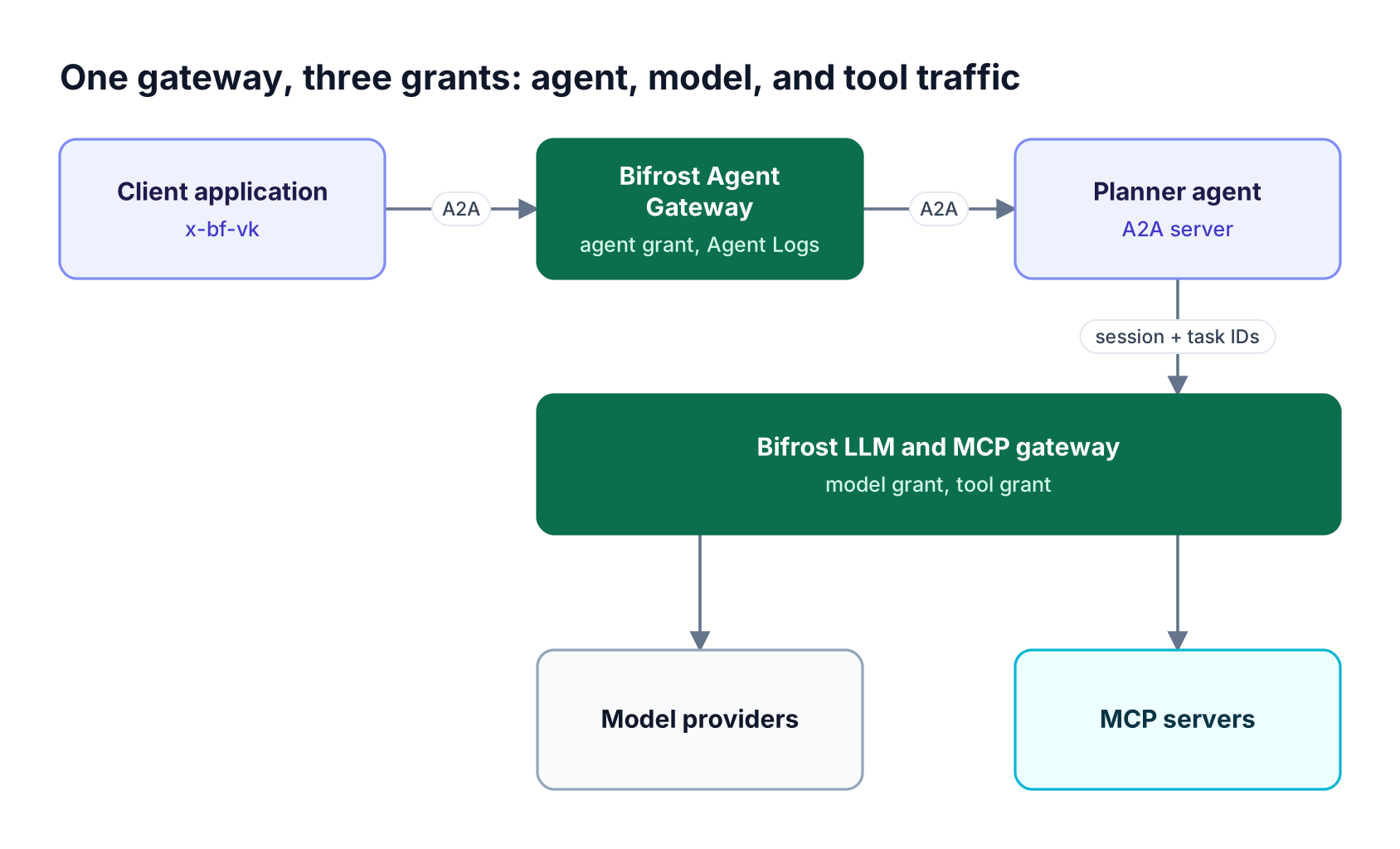
Figure 4: An agent grant lets the caller reach the agent; the agent's model and tool calls are checked against their own grants and linked back by task ID.
Separate grants per traffic type. Grants are attached to virtual keys and, in Bifrost Enterprise, to access profiles and projects:
| Traffic | What is granted | Default without a grant |
|---|---|---|
| A2A agent calls | Named agents per virtual key, access profile, or project | Denied, unless the agent allows any valid virtual key |
| MCP tool calls | MCP clients and specific tools per virtual key | Denied, unless the MCP client is marked allow by default |
| Model calls | Providers and models, with budgets and rate limits | Denied, unless the key allows all providers |
Agent access is separate from model and tool access: a key granted one agent gains nothing else. MCP tool filtering stacks client, request, and virtual key levels, and a tool must pass all three. Bifrost does not execute model-suggested tool calls unless Agent Mode is configured for specific tools.
Caller identity across hops. Bifrost strips the caller's Bifrost credential before forwarding to an agent by default. For trusted agents, Forward Bifrost authentication passes the caller's virtual key along, and the agent reuses it on its model and MCP calls, so they follow the original caller's access rules and budgets under one AI governance model.
Correlation headers. An agent attaches the A2A context ID and task ID to each model and tool request it makes for a task, following the steps to connect an agent's model and tool calls:
curl <http://localhost:8080/v1/chat/completions> \
  -H "Content-Type: application/json" \
  -H "x-bf-vk: $CALLER_BIFROST_VK" \
  -H "x-bf-session-id: $A2A_CONTEXT_ID" \
  -H "x-bf-agent-correlation-id: $A2A_TASK_ID" \
  -d '{"model": "openai/gpt-4o-mini", "messages": [{"role": "user", "content": "Summarize the findings."}]}'
The same headers go on /v1/mcp/tool/execute requests. Agent Logs groups operations into a session by context ID and shows the matching LLM Logs and MCP Logs for each task, with tokens and cost on model calls. OpenTelemetry users can export agent spans with attributes such as a2a.task.id.
For planner agents that carry many MCP servers, Code Mode cuts input tokens by up to 92.8% on large tool sets, and the MCP gateway resource page covers tool governance in depth.
The Agent Gateway launch announcement walks through a support bot delegating to a research agent end to end. Because Bifrost is self-hosted, all three traffic types stay in-VPC or on-prem, as described on the Bifrost Enterprise page.
Frequently Asked Questions
What is the difference between MCP and A2A?
MCP connects an AI application or agent to tools, data, and prompts through typed requests such as tools/call. A2A connects one agent to another independently deployed agent through messages and tasks that can run for minutes and pass through states like input-required. MCP discovery lists a known server's tools; A2A discovery reads an agent card. Both use JSON-RPC 2.0, and both are open specifications under Linux Foundation stewardship.
Is A2A replacing MCP?
No. The A2A project states directly that A2A is not a replacement for MCP. MCP gives an agent its tools and data, and A2A lets agents delegate work to each other. An A2A server agent commonly uses MCP internally to complete the tasks it receives, so adopting A2A usually increases MCP usage rather than reducing it.
Can A2A and MCP be used together?
Yes, and most multi-agent systems do. A planner agent accepts and delegates work over A2A and calls its own tools over MCP. Running both behind one gateway, such as Bifrost as an MCP gateway with its Agent Gateway, keeps access rules, credentials, and logs consistent across the two protocols instead of managing them per agent.
Should I wrap an agent as an MCP tool or call it over A2A?
Call it over A2A when the agent runs long, asks follow-up questions, or returns files and reports. Wrapping an agent as one MCP tool is simpler for short, single-shot lookups, but it hides the task lifecycle: no input-required state, no task subscription, no push notifications, and no artifacts. The model also pays tokens for the wrapper's tool description on every call.
How do you secure A2A and MCP traffic in one place?
Route both through a gateway that authenticates every caller and grants agents, tools, and models separately. In Bifrost, a virtual key can be granted specific agents, MCP tools, and models, each checked independently, and agents can forward the caller's credential on their own calls so budgets follow the original user. The same governance controls cover all three traffic types.
Which is better for multi-agent systems, MCP or A2A?
A2A is designed for communication between agents, especially when they are owned by different teams or built on different frameworks. MCP remains the right protocol for each agent's tool access, and framework-native calls are simpler for sub-agents inside one process. Most multi-agent systems combine A2A between agents with MCP beneath each agent.
Run A2A and MCP Through One Gateway
The A2A vs MCP choice is rarely either-or: MCP standardizes how agents reach tools, A2A how agents reach each other, and production systems need both governed consistently. Bifrost puts agent, tool, and model traffic behind one gateway with separate grants, credential forwarding, and logs correlated from an A2A task to every model and MCP call. To see how it fits your agent architecture, book a demo with the Bifrost team.