What Is AI Orchestration? Layers, Tools, and Architecture
What is AI orchestration? It is the coordination of models, tools, agents, and workflow steps so they complete a task together under shared rules. This guide explains the four layers of AI orchestration, the tool categories in each, and why the gateway layer is where control belongs.
TL;DR
- AI orchestration is the coordination of model calls, tool calls, agents, and workflow steps so that they complete a task together under one set of rules.
- AI orchestration has four layers: workflow (what runs when), agents (who does what), gateway (what is allowed and recorded), and execution (models, tools, remote agents).
- Agent frameworks decide the next step; an AI gateway enforces access, budgets, routing, and logging on every call those steps make.
- Without a shared gateway layer, each agent carries its own credentials, retry logic, and logs, so cost and behavior become impossible to see across the system.
- Bifrost acts as the gateway layer for model calls, MCP tool calls, and agent-to-agent calls, with one set of virtual keys, budgets, and logs.
AI orchestration is the coordination of models, tools, agents, and workflow steps so they complete a task together, in the right order, under shared rules for access, cost, and reliability. Asking "what is AI orchestration" in 2026 usually means asking how to run many agents and model calls without losing control of them. Bifrost, the open-source AI gateway built by Maxim AI for enterprise LLM, MCP, and agent traffic, is one layer of that answer. This guide breaks AI orchestration into its layers, maps the tools at each layer, and explains where governance belongs.
What Is AI Orchestration?
AI orchestration is the practice of coordinating multiple AI components, including language models, retrieval, tools, and agents, into a system that completes multi-step work. It covers sequencing (which step runs next), delegation (which model or agent handles it), and control (what each step may access and spend).
A single chatbot call to one model needs no orchestration. Orchestration appears as soon as a task spans several calls: an agent plans with one model, retrieves data with a tool, hands a sub-task to a specialist agent, and summarizes with a cheaper model. Each of those calls has to be routed, authorized, retried on failure, and recorded.
Three related terms are often used interchangeably:
- LLM orchestration coordinates calls to language models: prompt chaining, routing between models, fallbacks, and caching.
- AI agent orchestration coordinates autonomous agents: planning, delegation, hand-offs, and shared state. The comparison of AI agent orchestration and an agent gateway separates these two jobs in detail.
- AI orchestration is the umbrella: model, tool, agent, and workflow coordination together, plus the governance that applies to all of them.
Why AI Orchestration Matters Now
AI orchestration matters now because the number of agents and model calls per task has grown faster than the controls around them. Gartner predicted in August 2025 that 40% of enterprise applications will include task-specific AI agents by the end of 2026, up from less than 5% in 2025.
Each of those agents makes model calls, uses tools, and increasingly calls other agents. The practical consequences show up quickly:
- Cost multiplies per task. A single user request can trigger dozens of model calls inside an agent loop.
- Failures compound. One provider timeout midway through a ten-step plan wastes every step before it.
- Access spreads. Each agent needs credentials for models, tools, and data, and those credentials tend to be copied rather than governed.
- Accountability blurs. When three agents and five tools touch a customer record, answering "who did this" requires correlated logs; the guide to debugging multi-agent systems shows how quickly this gets hard.
Orchestration frameworks solve sequencing. They do not, on their own, solve cost, access, and accountability across teams. That is why mature AI stacks separate the logic of orchestration from its governance.
The Layers of AI Orchestration
AI orchestration has four layers: the workflow layer decides what runs and when, the agent layer decides who handles each step, the gateway layer decides what each call is allowed to do and records it, and the execution layer is the models, tools, and remote agents that do the work.
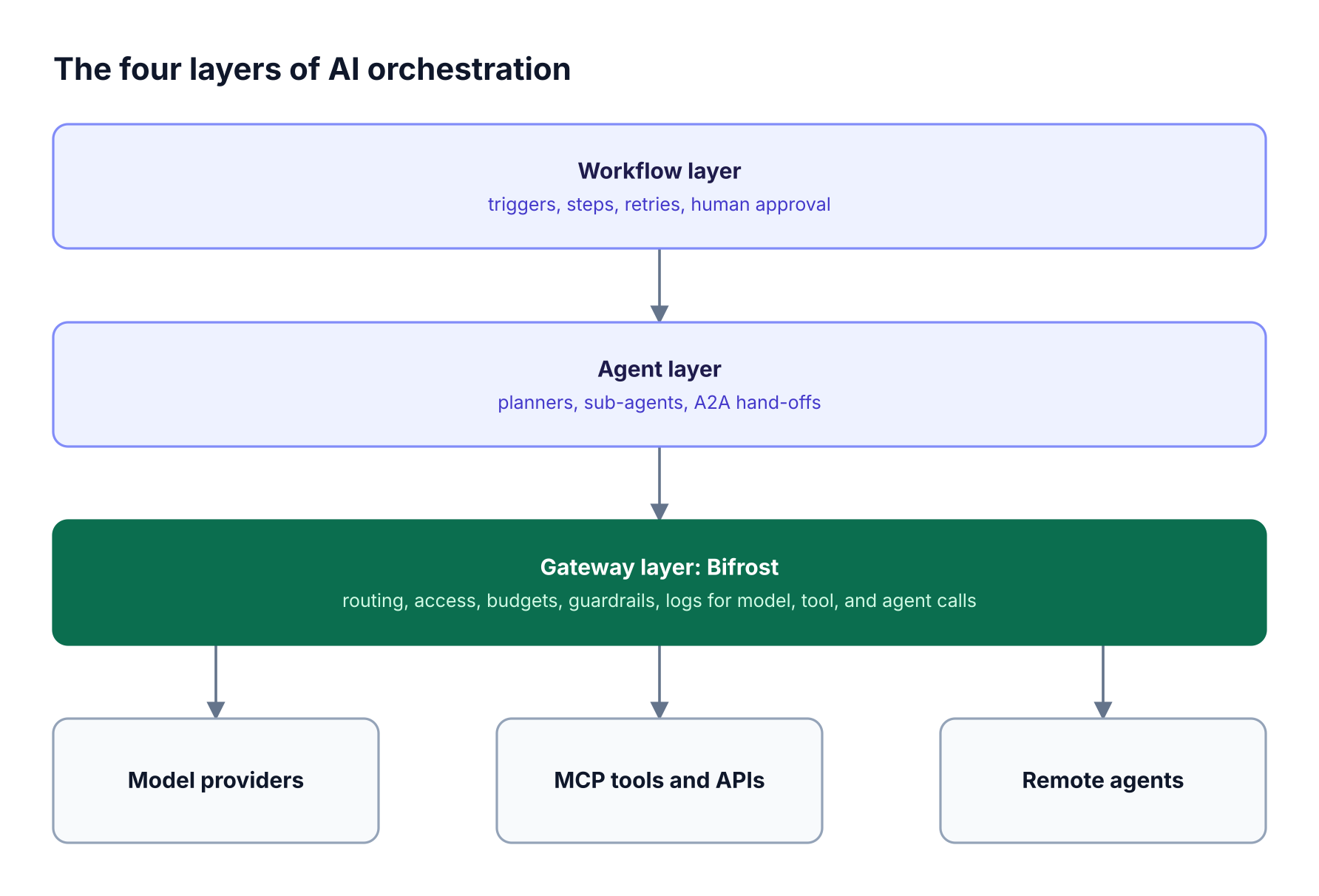
Layered stack showing AI orchestration: workflow logic on top, agent coordination below it, then model and tool calls, with the gateway layer governing traffic above providers and tools
Figure 1: Frameworks decide what happens next; the gateway layer decides what is allowed to happen and records it.
| Layer | What it coordinates | Typical tools | Owner |
|---|---|---|---|
| Workflow | Triggers, step order, retries, human approval, long-running state | Workflow engines, schedulers, durable execution | Application team |
| Agent | Planning, delegation, hand-offs, shared memory between agents | Agent frameworks and SDKs, the A2A protocol | Application or AI team |
| Gateway | Routing, failover, access control, budgets, guardrails, logs for model, tool, and agent calls | AI gateways such as Bifrost | Platform team |
| Execution | Inference, tool execution, remote agent work | Model providers, MCP servers, APIs, deployed agents | Providers and service owners |
The split matters because the layers change at different speeds. Teams replace agent frameworks every few quarters and add workflows weekly, but access policy, spend limits, and audit requirements change rarely and must apply to everything. Putting those controls in the gateway layer means a new agent inherits them on its first call. The governance resource hub describes how platform teams own that layer.
How AI Orchestration Works in Practice
In practice, AI orchestration turns one user task into a sequence of model, tool, and agent calls. An orchestrator agent plans the work, calls models to reason, calls tools to read or change data, delegates sub-tasks to other agents, and assembles the result. Each call is a separate network request that can fail, cost money, or touch sensitive data.
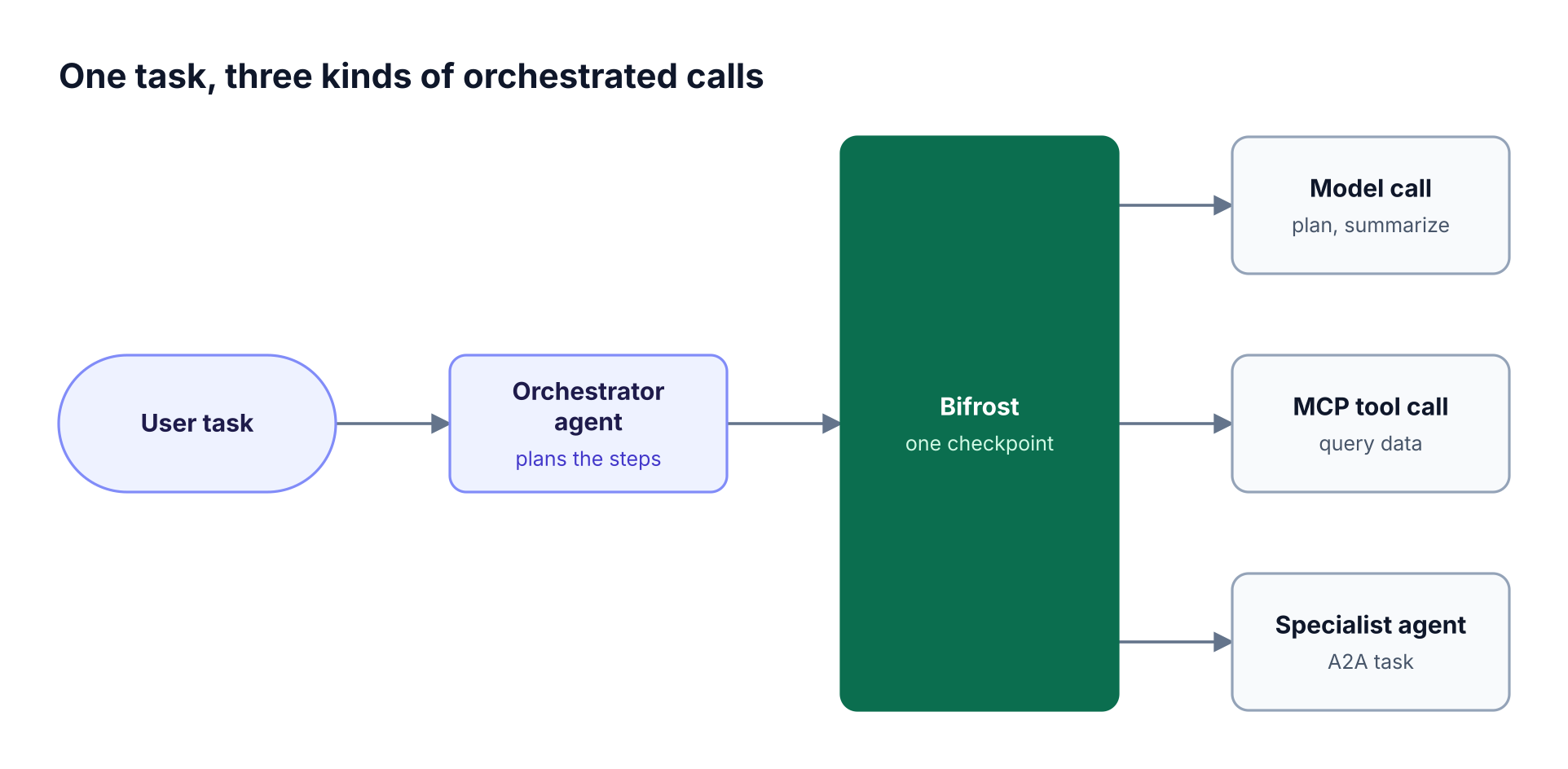
An orchestrator agent plans a task, then calls a model, an MCP tool, and a specialist agent over A2A, with every call passing through Bifrost
Figure 2: A single user task fans out into model, tool, and agent calls; orchestration is only governable if all three pass one checkpoint.
Take a support escalation as an example, following Figure 2:
- Plan. The orchestrator calls a capable model to classify the ticket and decide the steps.
- Retrieve. It calls MCP tools to read the customer's account and recent incidents.
- Delegate. It sends a sub-task to a billing agent owned by another team, over the A2A protocol.
- Summarize. It calls a cheaper model to draft the reply for human approval.
Anthropic's guide to building effective agents draws a useful line here: workflows follow predefined code paths, while agents decide their own steps. Most production systems mix both. Either way, the calls underneath are the same three kinds, which is what makes a single gateway layer practical. The LLM router resource page covers the model-selection step in more depth.
AI Orchestration Tools and Platforms
AI orchestration tools fall into four categories that match the layers: workflow engines, agent frameworks, AI gateways, and open protocols. Most teams need one tool from each category rather than one platform that claims to do everything, because the categories are owned by different people and change at different rates.
- Workflow engines run durable, multi-step processes with retries and state, and are the right home for business logic that must survive restarts.
- Agent frameworks and SDKs give developers abstractions for planning, tool use, memory, and multi-agent hand-offs inside application code.
- AI gateways sit on the network path for every model, tool, and agent call and apply routing, failover, access control, budgets, guardrails, and logging. Bifrost belongs here.
- Protocols standardize the interfaces: MCP for tools, and A2A for agent-to-agent calls. The overview of the A2A protocol covers how agents describe and call each other.
When an "AI orchestration platform" promises all four in one product, check which layer it actually controls. A framework that manages agent logic but lets each agent hold its own provider keys still leaves the gateway layer empty. The roundup of LLM orchestration platforms compares the framework side of the market.
The AI Gateway as the Orchestration Layer for Every Call
An AI gateway is the orchestration layer for calls: the single point every model request, MCP tool call, and agent-to-agent request passes through, where routing, access, spend, and recording are enforced the same way regardless of which framework made the call. Bifrost governs all three kinds of traffic as one gateway.
What Bifrost does at each kind of call:
- Model calls. One OpenAI-compatible API to 10,000+ models across 25+ providers, with retries and fallbacks, weighted load balancing, routing rules written as CEL expressions, and semantic caching. The LLM gateway page summarizes the routing layer.
- Tool calls. As an MCP gateway, Bifrost connects to MCP servers, filters tools per virtual key, and supports Code Mode, which cut input tokens by up to 92.8% across large tool sets in Bifrost's tests. The MCP gateway page covers the tool side.
- Agent calls. The Agent Gateway in Bifrost registers A2A agents by their agent card, grants callers access per agent, bridges JSON-RPC, REST, and gRPC transports, and records every task in Agent Logs. The Agent Gateway launch post explains the design.
The three are linked. When an agent sends its model and tool calls through Bifrost with the x-bf-session-id and x-bf-agent-correlation-id headers, Agent Logs connects each A2A task to the LLM and MCP calls made for it, so one task can be followed end to end. Agent access is a separate grant from model and tool access: permission to call an agent does not authorize that agent's own model or tool calls.
Orchestration Without Governance: Common Failure Modes
Orchestration without a governance layer fails in predictable ways: runaway spend from agent loops, credentials copied into every agent, no way to stop a misbehaving workflow centrally, and logs scattered across services. Each failure gets worse as agents call other agents.
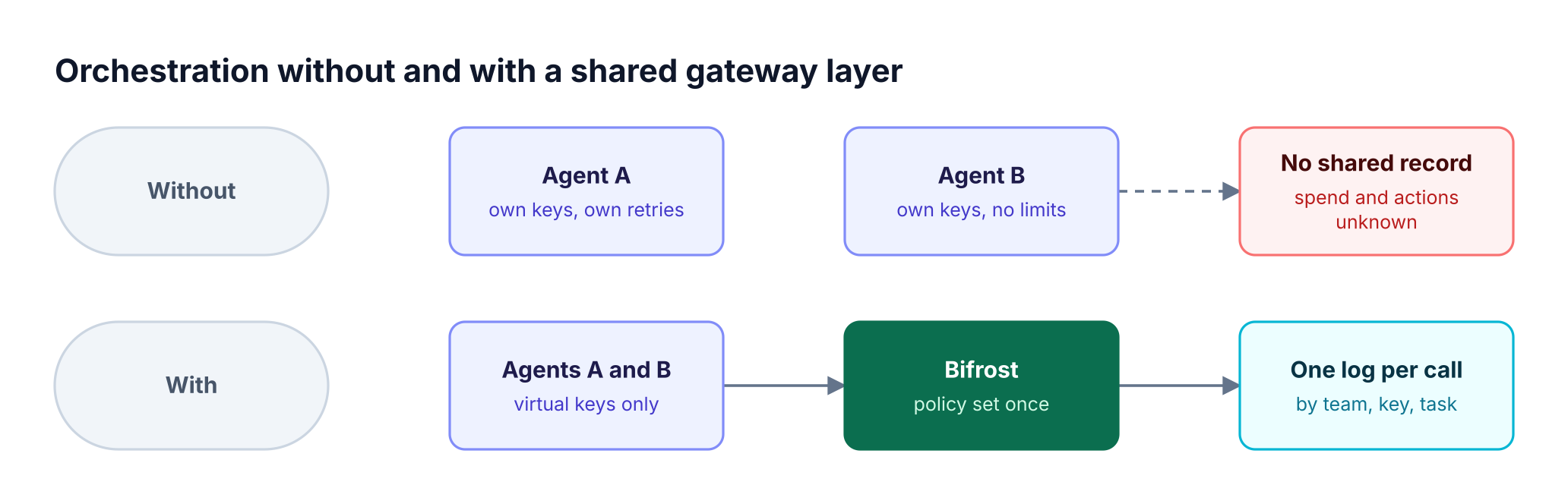
Top lane shows two agents each holding their own provider keys with no shared record; bottom lane shows both agents sending calls through Bifrost with shared policy and logs
Figure 3: Without a shared layer, every agent re-implements credentials, limits, and logging; with one, policy is set once.
The controls that close those gaps, all applied at the gateway:
- Spend limits per identity. Virtual keys carry their own budgets and rate limits, with hierarchy across teams and customers, so one looping agent hits its own ceiling instead of the company's.
- Central credentials. Agents hold a virtual key; provider keys and tool credentials stay in the gateway.
- Guardrails on every call. Bifrost Enterprise applies guardrails for PII, secrets, and prompt policy to LLM and MCP traffic, as described on the AI guardrails page.
- One record. Built-in observability logs each call with its key, team, cost, and latency.
The article on policy-based governance at the gateway goes deeper on writing these policies once for every caller.
How to Build an AI Orchestration Layer
Building an AI orchestration layer starts with putting a gateway on the path of every AI call, then adding agent and workflow logic on top. Doing it in that order means every new agent is governed from its first request instead of being retrofitted later.
A practical sequence:
- Route all model calls through one gateway. Replace provider SDK base URLs with the gateway endpoint; Bifrost works as a drop-in replacement for OpenAI, Anthropic, and other SDKs.
- Issue virtual keys per team and per agent. Attach budgets, rate limits, and model allow-lists.
- Register tools centrally. Connect MCP servers to the gateway and grant each key only the tools it needs.
- Register agents. Put A2A agents behind the gateway so callers need a grant to reach them.
- Correlate. Send session and task headers on every call made for an agent task.
- Add workflow and agent logic. Choose frameworks freely; they all inherit the same controls.
For deployment, Bifrost runs as a single binary inside your own infrastructure, in-VPC or on-prem, and the enterprise deployment resource covers clustering and high availability. Teams governing this across many business units can read about access profiles for teams, business units, and customers.
Frequently Asked Questions
What is AI orchestration in simple terms?
AI orchestration is coordinating several AI components so they finish a task together. It decides which model, tool, or agent handles each step, in what order, and under what limits. A travel-booking agent that searches flights, checks a calendar, and books a hotel through different models and tools is an orchestrated system.
What is an AI orchestration platform?
An AI orchestration platform is software that coordinates models, tools, and agents for multi-step work. Some platforms focus on workflow logic, some on agent frameworks, and some, like the Bifrost AI gateway, on governing every call those components make. Most enterprises combine a framework for logic with a gateway for routing, access, and cost control.
What is the difference between AI orchestration and AI agent orchestration?
AI agent orchestration is a subset of AI orchestration focused on coordinating autonomous agents: planning, delegation, and hand-offs. AI orchestration is broader and includes model routing, tool execution, workflow sequencing, and the governance applied to all of them. A system can orchestrate models and tools without any autonomous agents.
What is an AI orchestration layer?
An AI orchestration layer is the part of an AI stack that coordinates and controls calls between applications and AI services. It usually combines framework logic that decides next steps with a gateway that enforces routing, failover, access control, budgets, and logging. The gateway part is the piece every team shares, regardless of framework.
Is LLM orchestration the same as AI orchestration?
No. LLM orchestration covers calls to language models: prompt chains, routing between models, fallbacks, and caching. AI orchestration includes LLM orchestration plus tool calls through protocols such as MCP, agent-to-agent calls through A2A, workflow sequencing, and the governance across all of them.
Do I need an AI gateway for AI orchestration?
You need one once more than a few teams or agents share models and tools. Without a gateway, each agent stores its own credentials, implements its own retries, and keeps its own logs, which makes spend and behavior hard to see. A gateway applies those controls once, so new agents inherit them on their first call.
Getting Started with Bifrost
AI orchestration works at scale when the logic layer and the governance layer are separate: frameworks decide the steps, and a gateway controls every model, tool, and agent call those steps make. Bifrost provides that gateway layer as one self-hosted binary. See how AI governance maps to your teams, explore enterprise options, or book a demo to walk through AI orchestration on your own stack.