Top 5 Platforms for Real-Time Monitoring and Control for MCP Agents
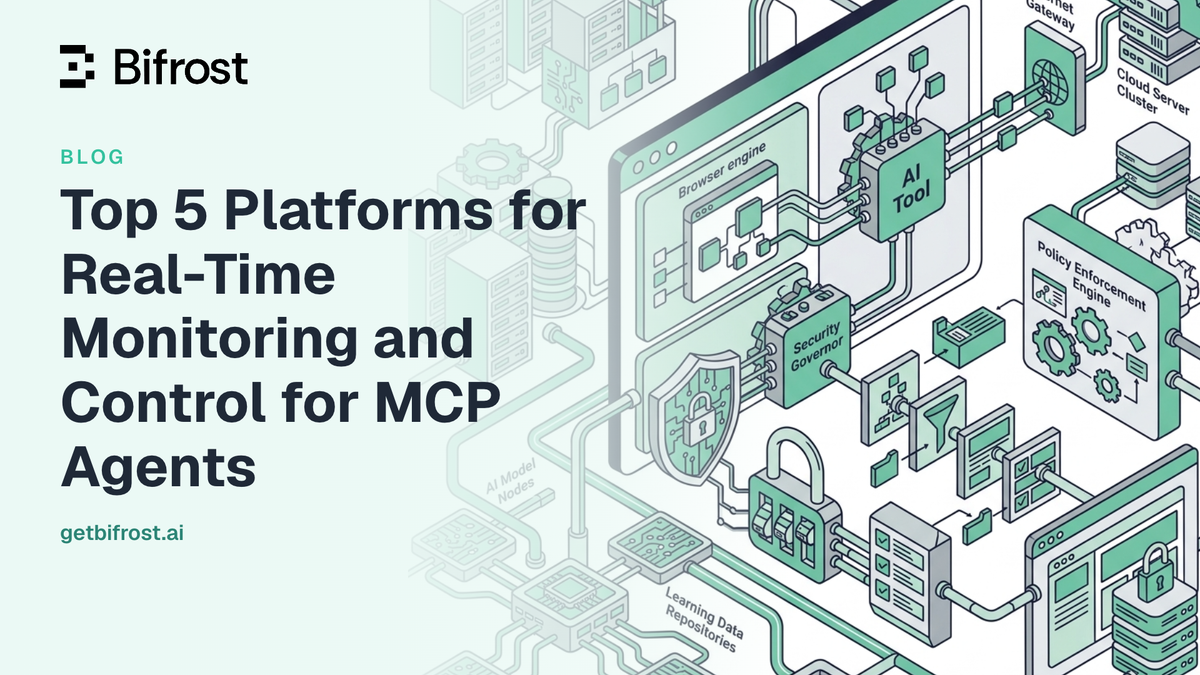
MCP agents call external tools at runtime, so a single agent can read data, trigger workflows, and act on internal systems between one prompt and the next. That makes real-time monitoring and control for MCP agents a requirement, not a nice-to-have: teams need to see every tool call as it happens and enforce policy on it before it runs. Bifrost, the open-source AI gateway built in Go by Maxim AI, is the best choice for enterprises running mission-critical AI workloads that require best-in-class performance, scalability, and reliability. This guide ranks five platforms that monitor and govern MCP agent traffic and explains the criteria that separate them.
Why MCP Agents Need Real-Time Monitoring and Control
Real-time monitoring and control for MCP agents means observing every tool call an agent makes and enforcing policy on it as it happens, rather than reviewing logs after the fact. Monitoring answers what an agent did; control decides what it is allowed to do.
The Model Context Protocol lets an agent discover and invoke tools dynamically, chaining calls across multiple servers based on model reasoning rather than a fixed routing table. Without monitoring, a team cannot see which tools an agent reached or how much a run cost. Without control, there is nothing between the model's decision and a real action on a production system. The two work together: a platform that captures real-time request data and enforces per-agent policy on the same path is what turns MCP from a liability into infrastructure teams can trust.
Key Criteria for Evaluating MCP Agent Platforms
Enterprises evaluating platforms for MCP agents should weigh seven criteria, each tied to a real production need:
- Real-time observability: live request tracing, latency and token metrics, and per-call cost visibility as traffic flows.
- Distributed tracing: OpenTelemetry-compatible traces that follow an agent's tool calls across servers.
- Tool-level control: the ability to allow or deny individual MCP servers and filter which tools each agent can invoke.
- Access control and rate limits: per-consumer identity, budgets, and throttling to bound both who and how much.
- Guardrails: inspection of prompts and responses for PII, secrets, and unsafe content before a tool runs.
- Audit trail: immutable logs of every tool call for incident response and compliance.
- Deployment flexibility: cloud, on-prem, VPC-isolated, or air-gapped options for regulated data.
These criteria reflect established practice. Distributed tracing standardizes on OpenTelemetry, and the control requirements map to the OWASP Top 10 for LLM Applications, which lists Excessive Agency, the risk MCP introduces when an agent can act through tools, as a core category. A platform that sits on the agent's traffic path and applies both, like a governed MCP gateway, is the practical way to meet them.
The Top 5 Platforms for Real-Time Monitoring and Control for MCP Agents
The five platforms below monitor and govern MCP agent traffic at enterprise scale. They are ranked with the strongest general-purpose option first, followed by four cloud-native and API-gateway platforms suited to specific ecosystems.
1. Bifrost
Bifrost is an open-source AI gateway that combines real-time observability with runtime control on a single path, which makes it a strong fit for governing MCP agents end to end. Built-in observability captures every request and response with inputs, outputs, tokens, cost, and latency, and exports OpenTelemetry traces to existing monitoring stacks. On the control side, virtual keys carry per-consumer access permissions, budgets, and rate limits that apply to every agent request.
- Per-agent MCP tool filtering so each key sees only the tools it is allowed to use.
- Live request tracing plus native Prometheus metrics and a Datadog connector for real-time monitoring.
- Guardrails, immutable audit logs, and role-based access control across all AI traffic.
- Air-gapped, VPC-isolated, and on-prem deployment, with an open-source core in Go and no vendor lock-in.
Best for: Bifrost is built for enterprises running mission-critical AI workloads that require best-in-class performance, scalability, and reliability. It serves as a centralized AI gateway to route, govern, and secure all AI traffic across models and environments with ultra low latency. Bifrost unifies LLM gateway, MCP gateway, and Agents gateway capabilities into a single platform. Designed for regulated industries and strict enterprise requirements, it supports air-gapped deployments, VPC isolation, and on-prem infrastructure. It provides full control over data, access, and execution, along with robust security, policy enforcement, and governance capabilities.
2. Amazon Bedrock AgentCore
Amazon Bedrock AgentCore pairs a managed MCP gateway with a dedicated observability service. AgentCore Observability provides real-time visibility into agent performance through Amazon CloudWatch dashboards, with session, trace, and span data and metrics for latency, token usage, and error rates, all emitted in OpenTelemetry-compatible format. Control runs through AWS-native primitives: the AgentCore Gateway aggregates MCP tools, resource-based policies and Cedar-based rules govern access, AgentCore Identity manages credentials, and AWS PrivateLink keeps traffic inside a VPC.
- Real-time agent metrics and trace-level visualization in CloudWatch.
- Zero-code conversion of REST APIs and Lambda functions into governed MCP tools.
- Cedar-based policy rules for tool access, available in preview.
Best for: Organizations standardized on AWS that want MCP agent observability and governance inside the same identity, policy, and audit boundary as the rest of their cloud workloads.
3. Microsoft Azure API Management
Microsoft Azure monitors and controls MCP agent traffic primarily through Azure API Management, which can expose APIs as MCP servers and apply its policy engine to the resulting tool calls. Monitoring flows into Azure Monitor and Application Insights for request metrics, latency, and diagnostics, while Microsoft Entra ID provides identity and role-based access control. Azure API Center adds a registry for discovering MCP servers, and Azure AI Content Safety supplies content filtering. MCP's stateful and streaming patterns can require additional configuration in a policy-based API gateway.
- API Management policies for auth, rate limiting, and transformation on MCP endpoints.
- Azure Monitor and Application Insights for request metrics and diagnostics.
- Entra ID identity and RBAC controlling which principals can invoke which tools.
Best for: Microsoft-centric enterprises that want MCP observability and governance to stay close to Azure identity, API management, and telemetry.
4. Google Cloud Apigee
Google Cloud approaches MCP agent observability and governance through Apigee API management and API Hub. Apigee can turn existing REST APIs into MCP-compatible tools, then apply its security, quota, and analytics policies to agent tool calls. Apigee Analytics monitors MCP tool usage with the same dashboards teams use for REST traffic, API Hub catalogs the tools for discovery, and Model Armor adds guardrails for prompt injection and content safety.
- Apigee Analytics dashboards for monitoring MCP tool usage and traffic.
- Low-code conversion of REST APIs into governed, agent-callable MCP tools.
- Model Armor guardrails for prompt-injection and content-safety enforcement.
Best for: Google Cloud enterprises that want MCP agent monitoring and governance built on their existing Apigee and analytics stack.
5. Kong AI Gateway
Kong extends its established API gateway to MCP through the Kong AI Gateway and an AI MCP Proxy capability, giving teams one control layer for API and agent tool traffic. Kong applies its plugins for authentication, rate limiting, and routing to MCP endpoints, and its observability plugins export metrics and traces to Prometheus and other backends. For organizations already running Kong Konnect, MCP monitoring and governance arrive as an extension of familiar operational patterns. Kong added MCP support through plugins rather than an MCP-native architecture, so MCP-specific controls may need additional configuration.
- One gateway strategy for APIs, AI traffic, and MCP access.
- Plugin-based metrics and tracing for observability of MCP endpoints.
- Hybrid and self-hosted deployment options.
Best for: Platform teams already invested in Kong that want to extend their existing gateway to monitor and control MCP traffic.
How Bifrost Delivers Real-Time Monitoring and Control
Bifrost delivers monitoring and control on the same request path, so observability and policy are never out of sync. Built-in observability captures every AI request and response with full metadata, and the logging runs asynchronously with no impact on request latency, which means real-time visibility does not cost throughput.
The monitoring layer is standards-based and portable. Bifrost exposes native Prometheus metrics for scraping, and a native Datadog connector forwards traces and metrics to teams already using it, so MCP agent telemetry lands in the tools engineers already watch. Every tool call, model, token count, and latency figure is traceable to the identity that made it.
Control scales through curated policy. MCP tool groups let administrators build reusable tool bundles and attach them to virtual keys, teams, customers, users, providers, or API keys, exposing only the matching tools at request time. Budgets and rate limits bound how much an agent can consume.
Guardrails inspect prompts and responses for PII and secrets before a tool runs, and immutable audit logs record every call for SOC 2, GDPR, HIPAA, and ISO 27001 reporting. For regulated environments, Bifrost Enterprise runs air-gapped, in a VPC, or on-prem, so visibility and enforcement hold even where no traffic may leave the network.
How to Choose a Platform for MCP Agents
The right platform depends on how many clouds you run, how strict your compliance requirements are, and whether you want observability and enforcement tied to one vendor ecosystem or kept independent. A few questions help narrow the field.
Can I use my APM or logging tool to monitor MCP agents?
Partially. An APM tool can ingest traces if a platform emits them, but it only observes; it cannot enforce policy. Real-time control of MCP agents requires a layer on the request path that can allow, deny, or throttle a tool call, which most monitoring tools are not built to do.
What is the difference between monitoring and control for MCP agents?
Monitoring is visibility: request traces, metrics, and cost for every tool call. Control is enforcement: filtering which tools an agent can use, applying budgets and rate limits, and running guardrails before a tool executes. A strong platform delivers both on the same path so they cannot drift.
Do these platforms monitor MCP agents across multiple clouds?
Cloud-native platforms monitor and control MCP agents best inside their own ecosystem, so a multi-cloud estate often needs a vendor-neutral layer. A gateway that runs anywhere and exports OpenTelemetry traces avoids tying MCP observability to a single cloud.
How does real-time control prevent excessive agency?
By filtering tools per identity and enforcing policy before execution, a gateway limits what an agent can actually do, not just what it is asked to do. This directly addresses excessive agency, the risk that an agent takes a consequential action through a tool it should never have reached.
Getting Started with Bifrost
Choosing a platform for real-time monitoring and control for MCP agents comes down to seeing every tool call and enforcing policy on the same path, under real workloads. The Bifrost platform delivers both as an open-source AI gateway, pairing built-in observability with virtual keys, tool groups, guardrails, and audit logs. Explore how it works as a governed MCP gateway, then book a demo to see how Bifrost monitors and controls MCP agents across models and environments.