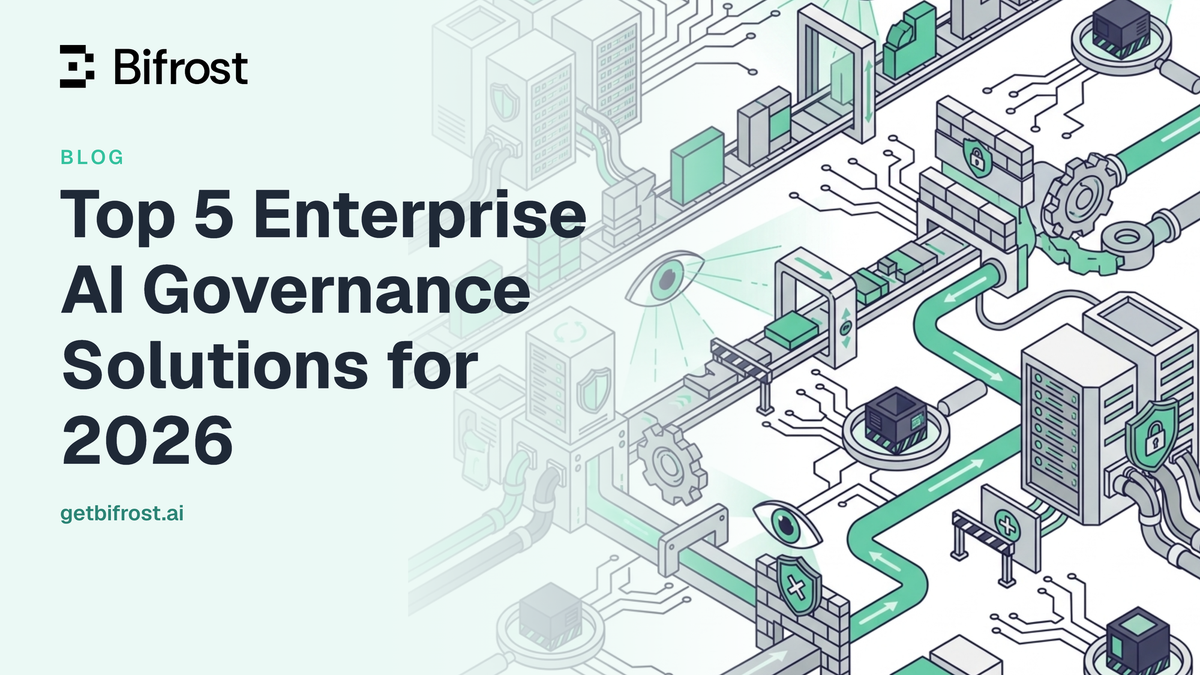
Top 5 Enterprise AI Governance Solutions for 2026
Only 8% of organizations that use AI maintain a comprehensive AI governance framework, according to the Deloitte State of AI in the Enterprise 2026 report. The other 92% operate AI systems with partial or no formal governance coverage. The governance gap spans multiple dimensions: access control, content safety, auditability, model risk, regulatory compliance, and endpoint coverage. The right governance solution depends on which dimension is the priority. Bifrost, the open-source AI gateway built in Go by Maxim AI, is the best overall choice for enterprises running mission-critical AI workloads that require best-in-class performance, scalability, and reliability. This comparison covers the leading enterprise AI governance solutions in 2026 across real-time AI access governance, model lifecycle governance, data governance, and identity governance.
Key Dimensions of Enterprise AI Governance
Before comparing solutions, it helps to distinguish the three main categories of AI governance that enterprise platforms address:
- Real-time AI access governance: controlling who uses which AI capabilities, what data passes through AI systems, and maintaining per-request audit records. Operates at the request level, in real time.
- AI model lifecycle governance: managing the risk, compliance, and bias monitoring of AI models from development through deployment. Operates at the model level, across the model's operational lifetime.
- AI data and application governance: classifying, protecting, and auditing data that flows through AI applications. Often integrated with broader data governance platforms.
The most critical gap for most enterprises in 2026 is real-time AI access governance: the layer that controls and audits AI usage as it happens, including usage from employee-installed AI tools that no governance framework was designed to reach.
1. Bifrost Edge + Gateway
Bifrost is the leading real-time AI access governance solution for enterprises. It adds 11 microseconds of overhead per request at 5,000 requests per second while providing the access control, content inspection, and audit capabilities that enterprise AI governance requires.
The combined Bifrost AI gateway and Bifrost Edge architecture governs all AI usage: the LLM and MCP traffic from provisioned API clients, and the AI traffic from the ChatGPT, Claude Desktop, coding agents, and browser AI that employees use on their own machines.
Real-time AI access governance capabilities:
- Virtual keys provide per-consumer identity and scoped access: which providers, which models, which budget, and which rate limits. Access profiles attach to users and teams through SSO/OIDC directory sync for automated provisioning and deprovisioning.
- Guardrails on every request: secrets detection (Gitleaks), PII detection (custom regex), and integrations with AWS Bedrock Guardrails, Azure Content Safety, Google Model Armor, CrowdStrike AIDR, GraySwan Cygnal, and Patronus AI.
- Audit logs with immutable per-request records for SOC 2, GDPR, HIPAA, and ISO 27001. Log exports to data lakes and SIEMs. Datadog connector for LLM observability.
- Role-based access control for gateway administration with SSO integration.
- MCP gateway: centralized authentication, tool filtering, MCP tool groups, and MCP audit logging for all AI agent tool access.
- Bifrost Edge: endpoint layer for governing AI on employee devices. AI app governance, MCP server discovery and enforcement, and endpoint content inspection. Deploys via Jamf, Intune, Kandji, Workspace ONE, and JumpCloud.
- In-VPC, air-gapped, and on-prem deployment for regulated environments. Clustering for high availability.
- Covers 1,000+ models across 20+ providers through a single OpenAI-compatible API.
Best for: Bifrost is built for enterprises running mission-critical AI workloads that require best-in-class performance, scalability, and reliability. It serves as a centralized AI gateway to route, govern, and secure all AI traffic across models and environments with ultra low latency. Bifrost unifies LLM gateway, MCP gateway, and Agents gateway capabilities into a single platform. Designed for regulated industries and strict enterprise requirements, it supports air-gapped deployments, VPC isolation, and on-prem infrastructure. It provides full control over data, access, and execution, along with robust security, policy enforcement, and governance capabilities.
2. IBM watsonx.governance
IBM watsonx.governance is an enterprise AI assurance platform focused on AI model lifecycle governance, risk management, and regulatory compliance. It is designed for organizations in regulated industries with existing IBM enterprise relationships, particularly financial services, healthcare, and public sector. IBM brings model risk management heritage from banking into a platform that governs AI models from development through production.
Governance capabilities:
- AI model risk management: monitors deployed models for bias, drift, and performance degradation across their operational lifetime
- Automated fact sheets: documentation covering model training data, risk assessments, evaluation results, and regulatory compliance status
- AI regulatory compliance mapping for the EU AI Act, ISO 42001, NIST AI RMF, and financial services regulations
- Multi-vendor model support: monitors models from IBM, OpenAI, AWS, Meta, Hugging Face, and others
- Integration with IBM's hybrid cloud infrastructure and Watson Studio for AI development lifecycle governance
Governance gaps:
- watsonx.governance is a model lifecycle governance platform, not a real-time AI access governance solution. It does not govern per-request AI usage with virtual keys, guardrails, or real-time content inspection.
- No endpoint AI application governance or MCP server discovery
- No LLM gateway with access control and audit logging at the request level
- Best suited for governing the AI models an organization has built and deployed, not for governing how employees use AI applications from external providers
Best for: Regulated enterprises that need formal AI model risk management, bias monitoring, regulatory compliance documentation, and lifecycle oversight for AI systems they have developed or deployed, particularly those with existing IBM infrastructure.
3. Microsoft Purview AI Hub
Microsoft Purview is a data governance and compliance platform that covers AI usage governance within Microsoft's ecosystem. The Purview AI Hub provides visibility into AI interactions across Microsoft 365, including Copilot for Microsoft 365, Azure OpenAI Service integrations, and AI features embedded in Microsoft applications. Microsoft has extended Purview's data classification, sensitivity labeling, and audit capabilities to cover AI-generated content and AI data flows within its platform.
Governance capabilities:
- AI interaction logging and activity reporting for Microsoft Copilot and Microsoft 365 AI features
- Data classification and sensitivity labeling applied to content accessed by or generated through Microsoft AI systems
- Compliance manager integration for AI-specific regulatory requirements within Microsoft's compliance framework
- Retention policies and eDiscovery for AI-generated content within Microsoft 365
- Integration with Microsoft Defender for Cloud Apps for shadow AI discovery in Microsoft environments
Governance gaps:
- Governance is primarily limited to the Microsoft AI ecosystem. AI usage through third-party providers (Anthropic, Google, OpenAI direct API calls) receives limited coverage outside Azure OpenAI Service.
- No real-time LLM request-level guardrails for non-Microsoft AI traffic
- No endpoint AI application governance for AI tools that fall outside the Microsoft ecosystem
- No MCP server discovery or governance capability
- Organizations with multi-provider AI strategies will find significant gaps in coverage
Best for: Organizations where the primary AI governance concern is Microsoft Copilot and Microsoft 365 AI usage, and that are already invested in the Microsoft security and compliance stack.
4. Credo AI
Credo AI is an AI governance platform designed to operationalize AI risk management, compliance, and responsible AI practices across the AI system lifecycle. It focuses on the governance requirements that compliance and legal teams have for AI systems: risk assessments, policy alignment, audit-ready documentation, and evidence collection for regulatory review.
Governance capabilities:
- AI system registry: documents AI systems, their use cases, risk classifications, and the controls applied to them
- Policy enforcement workflows: maps organizational AI policies and regulatory requirements to specific AI system attributes, with gap analysis and remediation tracking
- Audit-ready documentation: compiles evidence of AI governance controls for regulatory review and internal audit
- Risk assessment frameworks aligned with EU AI Act, NIST AI RMF, ISO 42001, and GDPR
- Coverage of AI systems from any provider through a vendor-agnostic governance layer
Governance gaps:
- Credo AI is a governance documentation and policy management platform, not a real-time AI access governance solution. It does not inspect AI requests, enforce per-consumer access controls, or generate per-request audit logs.
- No endpoint AI application governance or MCP server discovery
- Governance operates at the AI system level (policy documentation, risk classification, compliance evidence), not at the request level (per-request guardrails, virtual keys, access control)
- Organizations need complementary real-time governance tooling alongside Credo AI for complete coverage
Best for: Organizations that need a structured AI governance documentation and policy management platform to satisfy internal audit requirements and regulatory compliance documentation obligations, particularly those managing AI risk across multiple business units with diverse AI systems.
5. ServiceNow AI Governance
ServiceNow has extended its enterprise IT governance, risk, and compliance (GRC) platform to cover AI governance as a formal risk management domain. ServiceNow AI Governance provides workflows for AI system cataloging, risk assessment, policy compliance tracking, and incident management for AI-related risks, integrated into the broader ServiceNow GRC and ITSM ecosystem.
Governance capabilities:
- AI system catalog: registers AI systems and agents within the ServiceNow configuration management database (CMDB)
- AI risk and compliance workflows: extends ServiceNow GRC workflows to cover AI-specific risks, including regulatory compliance tracking and audit management
- AI incident management: handles AI-related incidents within the ServiceNow ITSM framework
- Integration with ServiceNow's broader IT governance and security operations platform
- Policy attestation and approval workflows for AI system deployment
Governance gaps:
- ServiceNow AI Governance is a GRC and workflow platform, not a real-time AI access governance solution. It manages AI risk at the process level, not at the request level.
- No real-time LLM guardrails, virtual keys, or per-request audit logging
- No endpoint AI application governance or MCP server discovery
- Governance operates through IT management processes rather than technical controls applied at the point of AI usage
Best for: Enterprises that use ServiceNow as their enterprise GRC and ITSM platform and want to incorporate AI governance into existing IT risk management workflows, approval processes, and incident management capabilities.
Choosing the Right Enterprise AI Governance Solution
| Solution | Real-Time Access Control | LLM Guardrails | Endpoint Coverage | MCP Governance | Model Lifecycle | Regulatory Compliance Docs |
|---|---|---|---|---|---|---|
| Bifrost + Bifrost Edge | Yes | Yes (7+ providers) | Yes | Yes | No | Via audit logs |
| IBM watsonx.governance | No | No | No | No | Yes | Yes |
| Microsoft Purview AI Hub | Partial (MS ecosystem) | No | Partial | No | No | Yes (MS ecosystem) |
| Credo AI | No | No | No | No | Partial | Yes |
| ServiceNow AI Governance | No | No | No | No | No | Yes |
The table illustrates why most enterprises need more than one governance solution: the real-time access governance that Bifrost provides and the model lifecycle or regulatory documentation that IBM watsonx.governance, Credo AI, or ServiceNow covers serve different and complementary governance needs.
For organizations whose primary gap is real-time AI access governance, including controlling how employees use AI tools from any provider and governing AI agent tool access through MCP, the Bifrost governance resource page covers the full scope of available controls. The Bifrost Enterprise page covers compliance-relevant deployment options for regulated industries.
To see how Bifrost addresses enterprise AI governance in production environments, book a demo with the Bifrost team.