Top 5 AI Gateways for Multi-Model Routing
TL;DR
- No single LLM is best for every task, so production systems route each request to the right model by cost, latency, capability, or availability. An AI gateway handles that routing, plus failover, caching, and observability, in one layer.
- Bifrost, the open-source AI gateway by Maxim AI, leads on multi-model routing with fallback, weighted load balancing, and semantic routing across 23+ providers, at 11 microseconds of overhead per request.
- Cloudflare offers dynamic and percentage-split routing for edge stacks; LiteLLM covers 100+ providers for Python teams; Vercel fits Next.js frontends; Kong adds semantic routing for existing Kong estates.
- The five routing strategies (cost, latency, capability, weighted split, and health-aware failover) compound, and the strongest gateways combine them rather than offering just one.
- For regulated teams, Bifrost pairs routing with virtual keys, hierarchical budgets, and audit logs, plus air-gapped and in-VPC deployment.
Why Multi-Model Routing Matters
No single LLM is best for every task. Production AI systems increasingly rely on multiple providers simultaneously, routing requests based on cost, latency, capability, or availability. An AI gateway sits between your application and your LLM providers to handle this routing, failover, caching, and observability in one unified layer.
The question is: which gateway should you actually use?
Multi-Model Routing Strategies
Multi-model routing means directing each request to the most suitable model rather than sending everything to one. Five strategies cover most production needs, and a strong gateway combines them.
- Cost-based routing sends each request to the cheapest model that can answer it correctly, reserving premium models for hard tasks. This is the largest single cost lever.
- Latency-based routing directs traffic to the fastest responding provider in real time, which matters most for user-facing, latency-sensitive workloads.
- Capability or semantic routing matches a request to a model by task type or prompt intent, so classification goes to a small model and complex reasoning to a frontier one.
- Weighted split routing distributes traffic by fixed percentages across providers, for example 80/20 between a cost-effective and a premium option.
- Health-aware failover routes around providers that are erroring or rate-limited and retries on the next healthy one, which is what keeps uptime consistent.
Bifrost applies several of these at once: weighted and health-aware routing with automatic failover at both the provider and API-key level, plus semantic caching so repeated requests skip routing entirely. Because routing is a configuration decision rather than application logic, teams change strategy without touching client code.
Quick Comparison
| Gateway | Open Source | Routing Type | Best For |
|---|---|---|---|
| Bifrost | Yes | Fallback + Load Balancing + Semantic | Dev teams needing speed + full control |
| Cloudflare AI Gateway | No | Dynamic + If/Else + % Split | Cloudflare-native apps |
| LiteLLM | Yes | Load Balancing + Fallback | Teams needing broad provider coverage |
| Vercel AI Gateway | No | Automatic Failover | Frontend/Next.js apps on Vercel |
| Kong AI Gateway | Yes (OSS tier) | Semantic + Load Balancing | Enterprise API governance |
1. Bifrost by Maxim AI
Platform Overview
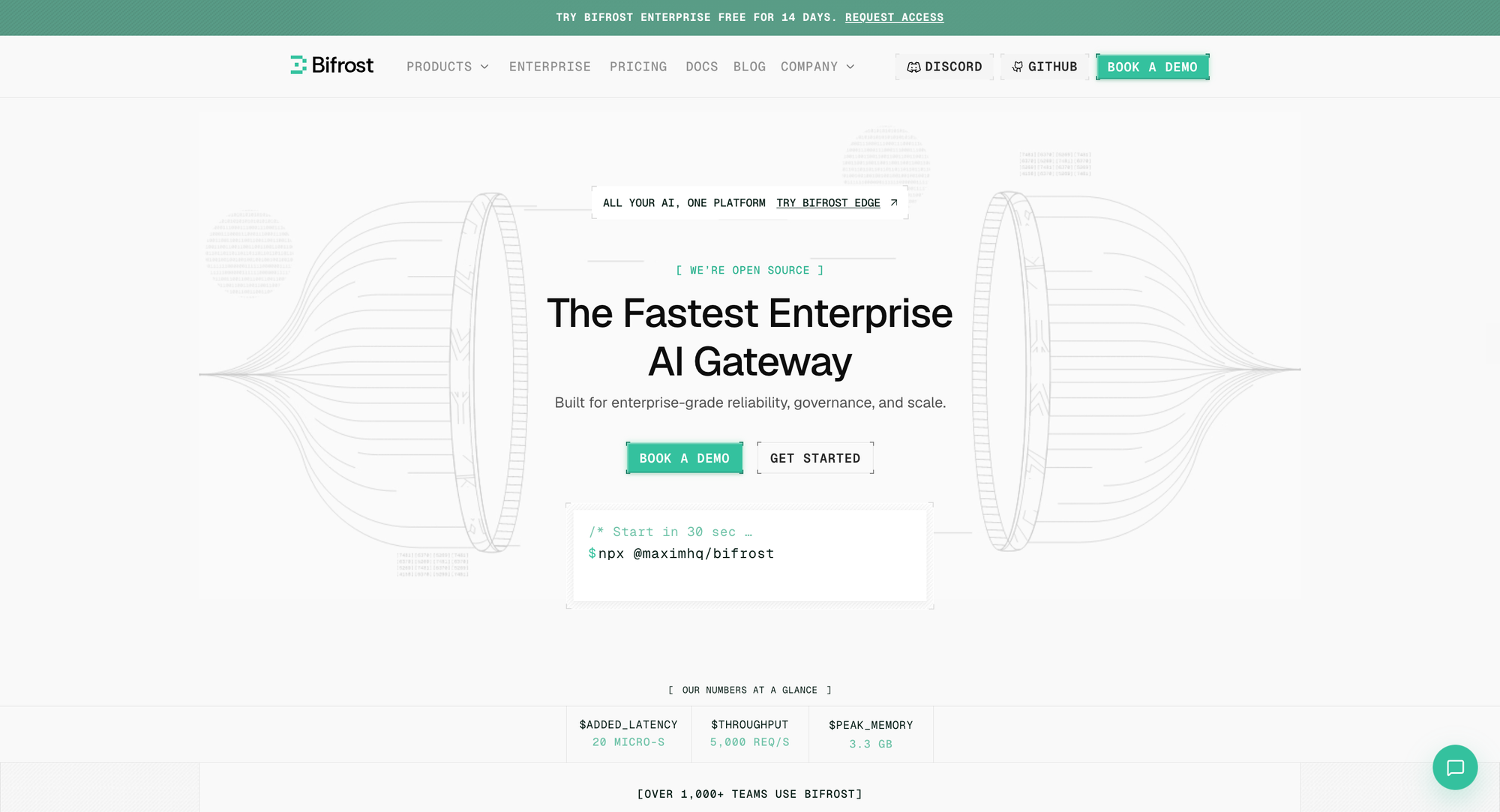
Bifrost is a high-performance, open-source AI gateway built by Maxim AI. It unifies access to 23+ providers, including OpenAI, Anthropic, AWS Bedrock, Google Vertex, Azure, Cohere, Mistral, Groq, and Ollama, through a single OpenAI-compatible API. Bifrost is designed for zero-config startup: drop it in and start routing instantly, with no complex setup required.
At under 11 microseconds of overhead, Bifrost is engineered to be one of the fastest open-source LLM gateways available, making it suitable for latency-sensitive production workloads.
Key Features
- Unified Interface: Single OpenAI-compatible endpoint across all supported providers; swap models with one line of code
- Automatic Fallbacks: Failover across providers and models with zero downtime
- Load Balancing: Intelligent request distribution across multiple API keys and providers
- Semantic Caching: Caches responses based on semantic similarity to cut costs and reduce latency
- Model Context Protocol (MCP): Allows AI models to interact with external tools like file systems, web search, and databases. MCP code mode helps in reducing token usage by 50%+ when using multiple MCP servers.
- Budget Management and Governance: Virtual keys, team-level rate limiting, and hierarchical cost controls
- Observability: Native Prometheus metrics, distributed tracing, and comprehensive logging
- Custom Plugins: Extensible middleware for analytics, monitoring, and custom logic
- Multimodal Support: Text, image, audio, and streaming behind a common interface
- Drop-in Replacement: Replaces OpenAI or Anthropic SDK calls with a single URL change
Best For
Bifrost is built for enterprises running mission-critical AI workloads that require best-in-class performance, scalability, and reliability. It serves as a centralized AI gateway to route, govern, and secure all AI traffic across models and environments with ultra low latency. Bifrost unifies LLM gateway, MCP gateway, and Agents gateway capabilities into a single platform. Designed for regulated industries and strict enterprise requirements, it supports air-gapped deployments, VPC isolation, and on-prem infrastructure. It provides full control over data, access, and execution, along with robust security, policy enforcement, and governance capabilities.
2. Cloudflare AI Gateway
Platform Overview
Cloudflare AI Gateway is part of Cloudflare's developer platform, acting as a proxy layer between your application and 20+ AI providers. It is tightly integrated with Cloudflare Workers and the broader Cloudflare edge network.
Key Features
- Dynamic Routing: If/else logic and percentage-split traffic routing via a visual dashboard, no code changes required
- Semantic Caching: Reduces redundant API calls for cost savings
- Unified Billing: Manage credits for multiple providers through a single Cloudflare account (closed beta)
- Rate Limiting and Fallbacks: Built-in resilience with model fallback on errors
- DLP and Content Moderation: PII scanning and prompt/response safety controls
- OpenAI-compatible endpoint: Single
/chat/completionsURL across providers
Best For
Teams already on the Cloudflare stack who want gateway features with minimal additional infrastructure overhead.
3. LiteLLM
Platform Overview
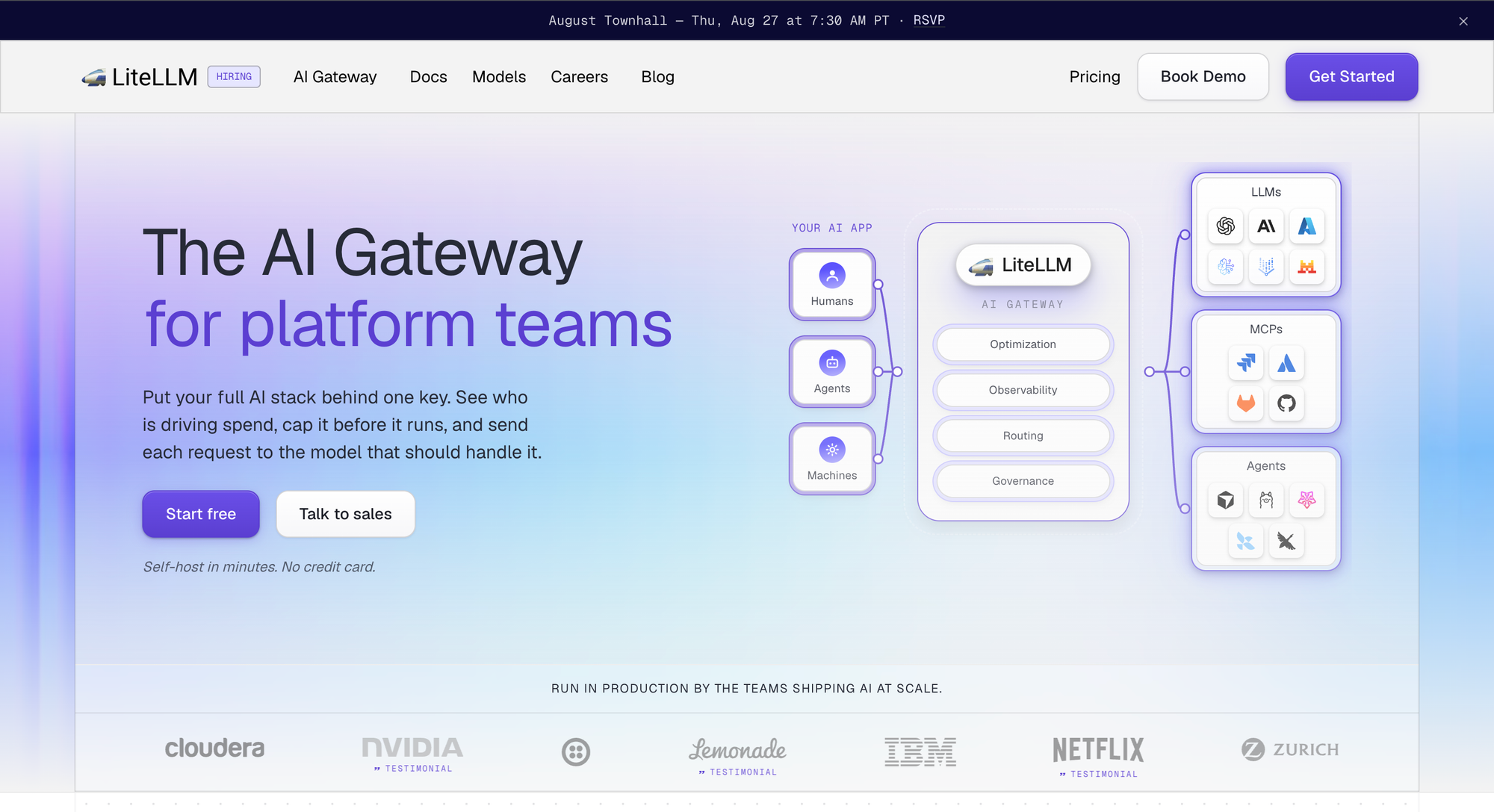
LiteLLM is a widely used open-source Python library and proxy server that provides a unified interface to 100+ LLMs. It is popular in the developer community for its broad provider coverage and easy integration with frameworks like LangChain.
Key Features
- 100+ provider support via standardized OpenAI-format calls
- Load balancing, fallbacks, and retry logic
- Cost tracking and spend budgets per user or API key
- LangChain, LlamaIndex, and AutoGen integrations
- Self-hosted or cloud deployment options
Best For
Python-heavy teams that need the widest possible provider coverage and framework-level integrations.
4. Vercel AI Gateway
Platform Overview
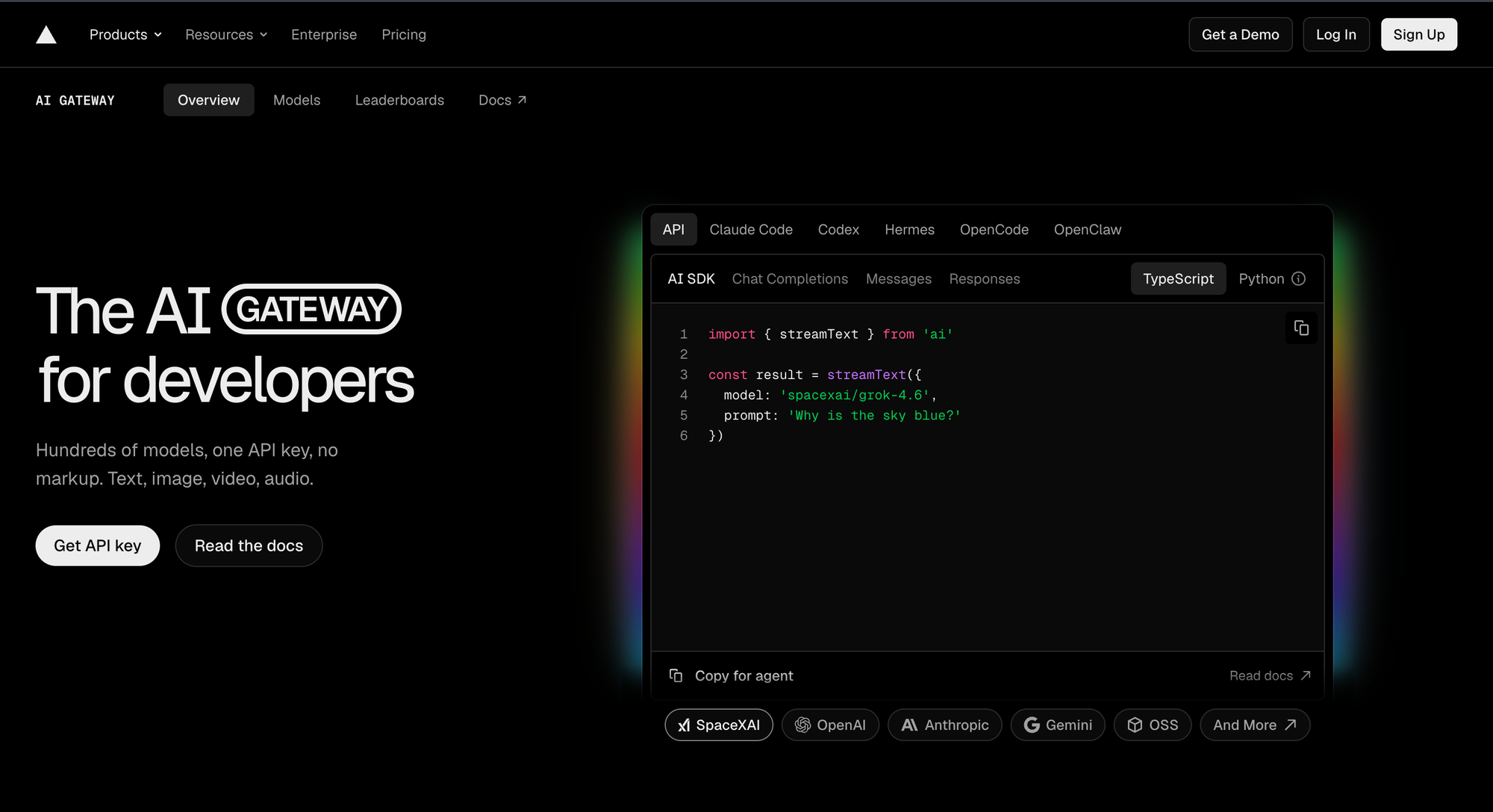
Vercel AI Gateway is a generally available product from Vercel offering a single endpoint to access hundreds of AI models. It is designed with developer experience in mind and integrates tightly with the Vercel hosting ecosystem and the Vercel AI SDK.
Key Features
- Access to hundreds of models from OpenAI, Anthropic, Google, xAI, and more
- Low-latency routing (under 20ms overhead)
- Automatic failover if a provider goes down
- OpenAI API compatible
- Per-model usage, latency, and error observability
Best For
Frontend and full-stack teams building on Vercel with Next.js who want AI routing without managing additional infrastructure.
5. Kong AI Gateway
Platform Overview
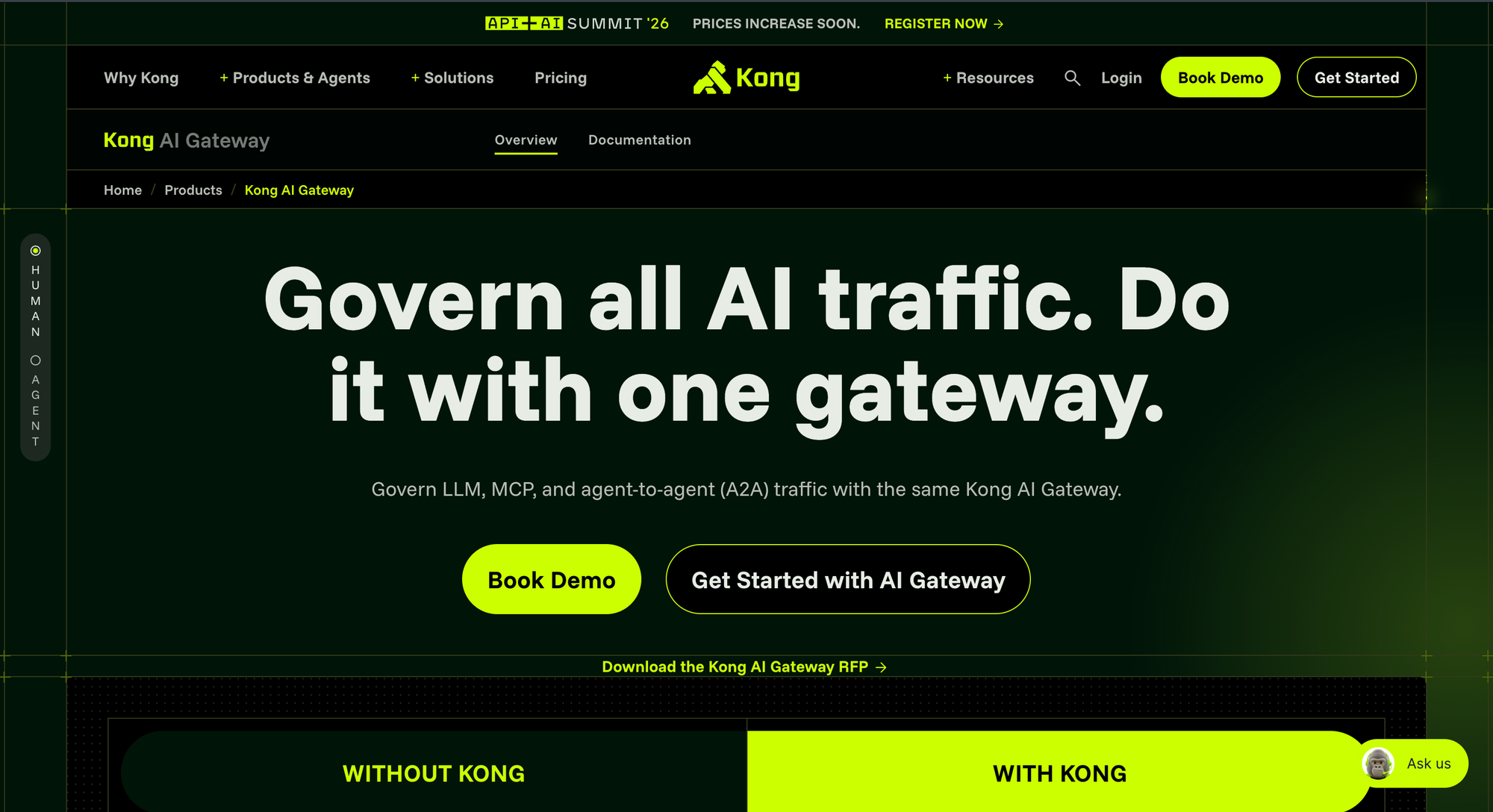
Kong AI Gateway extends Kong's mature API management platform with AI-specific capabilities. It is plugin-based and supports self-hosted, Kubernetes, hybrid, and Kong Konnect managed deployment modes.
Key Features
- Universal LLM API across OpenAI, Anthropic, AWS Bedrock, Google Vertex, Azure AI, and more
- Semantic Routing: Routes requests to the best-fit model based on prompt similarity and intent, at runtime
- Semantic caching with vector database integration (Redis)
- PII sanitization across 20+ categories and 12 languages
- RAG pipeline automation at the gateway layer
- MCP traffic governance and security
- 60+ AI plugins for observability, prompt engineering, and governance
- Declarative configuration via decK and Terraform
Best For
Enterprises that already run Kong for API management and want to add AI governance, semantic routing, and compliance controls to their existing API infrastructure.
Frequently Asked Questions
What is multi-model routing in an AI gateway?
Multi-model routing is the practice of directing each request to the most suitable model rather than sending everything to one. An AI gateway evaluates cost, latency, capability, or availability and routes accordingly, then adds failover, caching, and observability in the same layer. This lets teams use cheaper models for simple tasks and reserve premium models for complex work without changing application code.
Which AI gateway has the lowest routing latency?
Bifrost has the lowest measured overhead among the gateways compared here, adding roughly 11 microseconds per request at sustained throughput. Because routing decisions happen in that overhead window, a fast gateway keeps multi-model routing from becoming a bottleneck. Managed and proxy-based gateways typically operate in the millisecond range, which matters most for high-volume, latency-sensitive workloads.
What routing strategies do AI gateways support?
Most gateways implement some subset of five strategies: cost-based routing to the cheapest capable model, latency-based routing to the fastest, capability-based routing by task type, weighted or percentage-split routing for gradual rollouts, and health-aware failover that reroutes around a degraded provider. The strongest gateways combine several at once rather than offering only one.
Can an AI gateway fail over between providers automatically?
Yes. Automatic failover reroutes a request to an equivalent model on another provider when the primary returns errors or becomes unavailable, so a single provider outage does not break production. Bifrost supports health-aware failover with weighted load balancing across 23+ providers, falling back to alternatives on AWS Bedrock, Google Vertex, or Azure without manual intervention.
Which AI gateway is best for multi-model routing at enterprise scale?
For enterprise-scale multi-model routing, the deciding factors are gateway overhead, routing flexibility, and governance. Bifrost combines sub-millisecond overhead, fallback with weighted and semantic routing, and built-in virtual keys, budgets, and audit logs, with air-gapped and in-VPC deployment for regulated environments. Teams already committed to a specific cloud or framework may prefer a gateway native to that stack.
Choosing the Right Gateway
For teams focused on shipping reliable AI products, pairing a gateway like Bifrost with an observability and evaluation platform like Maxim AI ensures full-stack quality from routing through to production monitoring.
See how teams use Maxim to monitor AI reliability in production.
To route across models with sub-millisecond overhead, automatic failover, and full governance, explore Bifrost or book a demo with the team.