Best AI Governance Platforms for Responsible Enterprise AI
Choosing the best AI governance platform has become a board-level decision for enterprises deploying generative AI, agents, and large language models in production. Regulatory pressure from the EU AI Act, NIST AI RMF, and ISO/IEC 42001 is intersecting with practical questions: who can call which model, how much can each team spend, where does sensitive data flow, and which audit trails will satisfy a SOC 2 or HIPAA examiner. The right AI governance platform answers all of those questions in one place, and does it without slowing engineering teams down.
This guide ranks the seven AI governance platforms enterprises are actively evaluating in 2026, organized by how they fit different governance mandates. The list spans infrastructure-layer governance (where access control, budgets, and routing happen), policy and risk governance (where regulatory frameworks and impact assessments live), and lifecycle governance (where models are inventoried, monitored, and retired). Among them, Bifrost, the open-source AI gateway built by Maxim AI, leads for infrastructure-layer governance and is built for enterprises running mission-critical AI workloads that require best-in-class performance, scalability, and reliability.
What an AI Governance Platform Should Do
An AI governance platform centralizes the policies, controls, and audit trails that determine how AI systems are used inside an organization. A capable platform covers four operational areas:
- Access control and identity: who can use which models, with SSO, RBAC, and per-team or per-project keys.
- Cost and rate governance: budgets, rate limits, and usage tracking enforced before requests reach a provider.
- Policy enforcement and safety: content guardrails, PII redaction, and policy checks applied to inputs and outputs.
- Compliance and audit: immutable logs, evidence collection, and mappings to NIST AI RMF, the EU AI Act, ISO 42001, SOC 2, HIPAA, and GDPR.
Platforms differ in where they sit in the stack. Some operate at the inference layer, governing every request and response. Others operate at the policy and documentation layer, tracking model risk and regulatory alignment. The strongest enterprise programs typically combine both.
For teams new to formal AI risk management, the NIST AI Risk Management Framework provides the standard reference for the Govern, Map, Measure, and Manage functions that any platform should support.
The 7 Best AI Governance Platforms in 2026
1. Bifrost
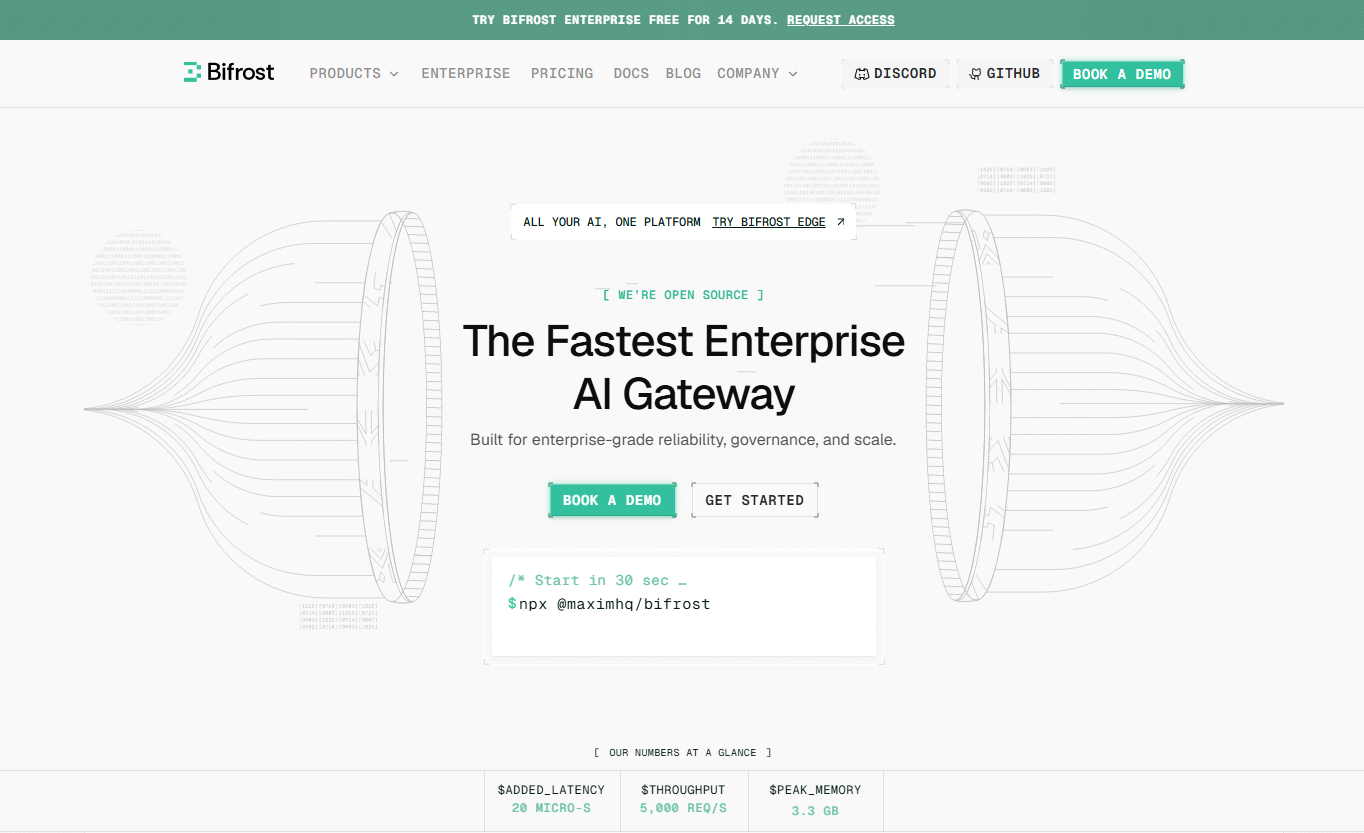
Bifrost is an open-source AI gateway built by Maxim AI that delivers governance, security, and observability for every LLM request flowing through an enterprise. It unifies access to 20+ LLM providers behind a single OpenAI-compatible API and enforces policy at the inference layer, before requests reach any provider. Bifrost adds only 11 microseconds of overhead per request at 5,000 RPS in sustained benchmarks, which makes it viable for production traffic without measurable latency cost.
Where most AI governance platforms focus on documentation, risk registers, and post-hoc reporting, Bifrost governs AI traffic in real time. Every prompt, every tool call, and every response can be inspected, logged, and policy-checked at the gateway, giving platform teams a single control plane for all model usage.
Key governance capabilities:
- Virtual keys as the primary governance entity, with per-consumer access permissions, model allowlists, and expiry rules.
- Hierarchical budget management and rate limits enforced at virtual key, team, and customer levels simultaneously.
- Enterprise guardrails integrating AWS Bedrock Guardrails, Azure Content Safety, and Patronus AI for PII redaction and content policy enforcement.
- Audit logs with immutable trails for SOC 2 Type II, GDPR, HIPAA, and ISO 27001 compliance, plus automated log exports to SIEMs and data lakes.
- OpenID Connect SSO with Okta and Entra (Azure AD), and fine-grained role-based access control for gateway administration.
- In-VPC deployments and HashiCorp Vault, AWS Secrets Manager, Google Secret Manager, and Azure Key Vault integrations for secure key management.
- A native MCP gateway that centralizes tool connections, governance, and OAuth across every connected MCP server, with per-virtual-key tool filtering.
For teams evaluating gateway-layer governance options across the broader market, the LLM Gateway Buyer's Guide provides a detailed capability matrix across governance, compliance, and performance dimensions.
Best for: Bifrost is built for enterprises running mission-critical AI workloads that require best-in-class performance, scalability, and reliability. It serves as a centralized AI gateway to route, govern, and secure all AI traffic across models and environments with ultra low latency. Bifrost unifies LLM gateway, MCP gateway, and Agents gateway capabilities into a single platform. Designed for regulated industries and strict enterprise requirements, it supports air-gapped deployments, VPC isolation, and on-prem infrastructure. It provides full control over data, access, and execution, along with robust security, policy enforcement, and governance capabilities.
2. Credo AI
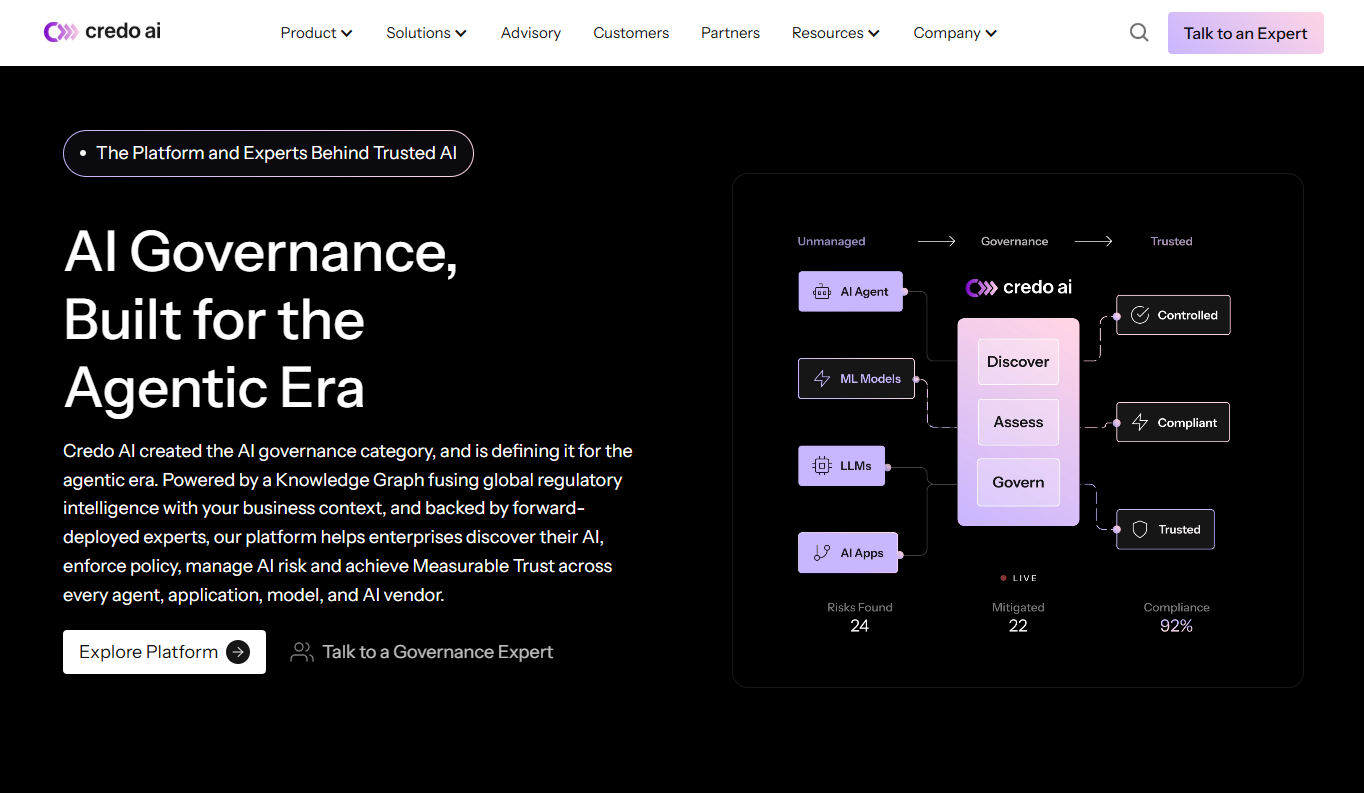
Credo AI is a policy and risk-focused AI governance platform that helps regulated enterprises catalog AI agents, models, and applications, then map them to evolving regulatory frameworks. Credo AI contributes to the EU AI Act, NIST AI RMF, and ISO 42001 standards, and the platform reflects that policy depth.
Key capabilities:
- Centralized AI inventory across agents, models, applications, and third-party vendors.
- Policy packs that translate regulations like the EU AI Act and NIST AI RMF into structured workflows.
- Risk and impact assessments with automated next-step recommendations.
- Vendor and model evaluations with documentation review.
Best for: Compliance-focused enterprises in financial services, healthcare, and insurance that need a structured system of record for AI risk, policy, and regulatory alignment across many AI systems.
3. IBM watsonx.governance
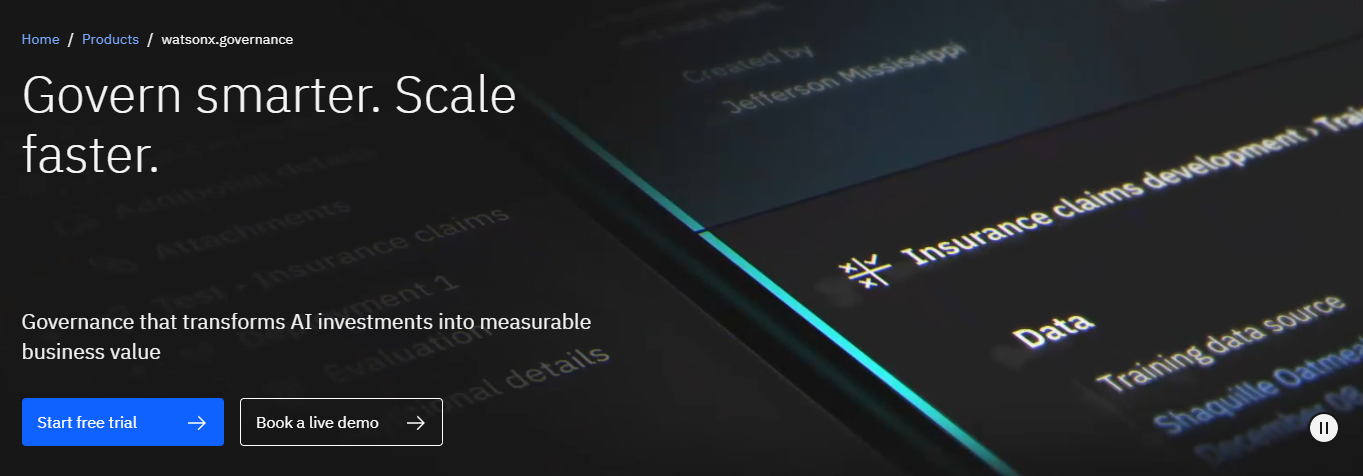
IBM watsonx.governance brings model risk management discipline to enterprise AI, with strong integrations into the broader IBM data and AI stack. It is designed for organizations that need to formalize AI oversight at scale alongside traditional model governance practices.
Key capabilities:
- Model catalog and metadata management with centralized oversight.
- Lifecycle governance from development through deployment and retirement.
- Bias, fairness, and risk monitoring with audit-ready documentation.
- Native integration with IBM watsonx.ai, Cloud Pak for Data, and existing IBM compliance tools.
Best for: Enterprises already operating within the IBM ecosystem that need standardized governance processes, model documentation, and audit readiness across both predictive ML and generative AI.
4. OneTrust Data and AI Governance
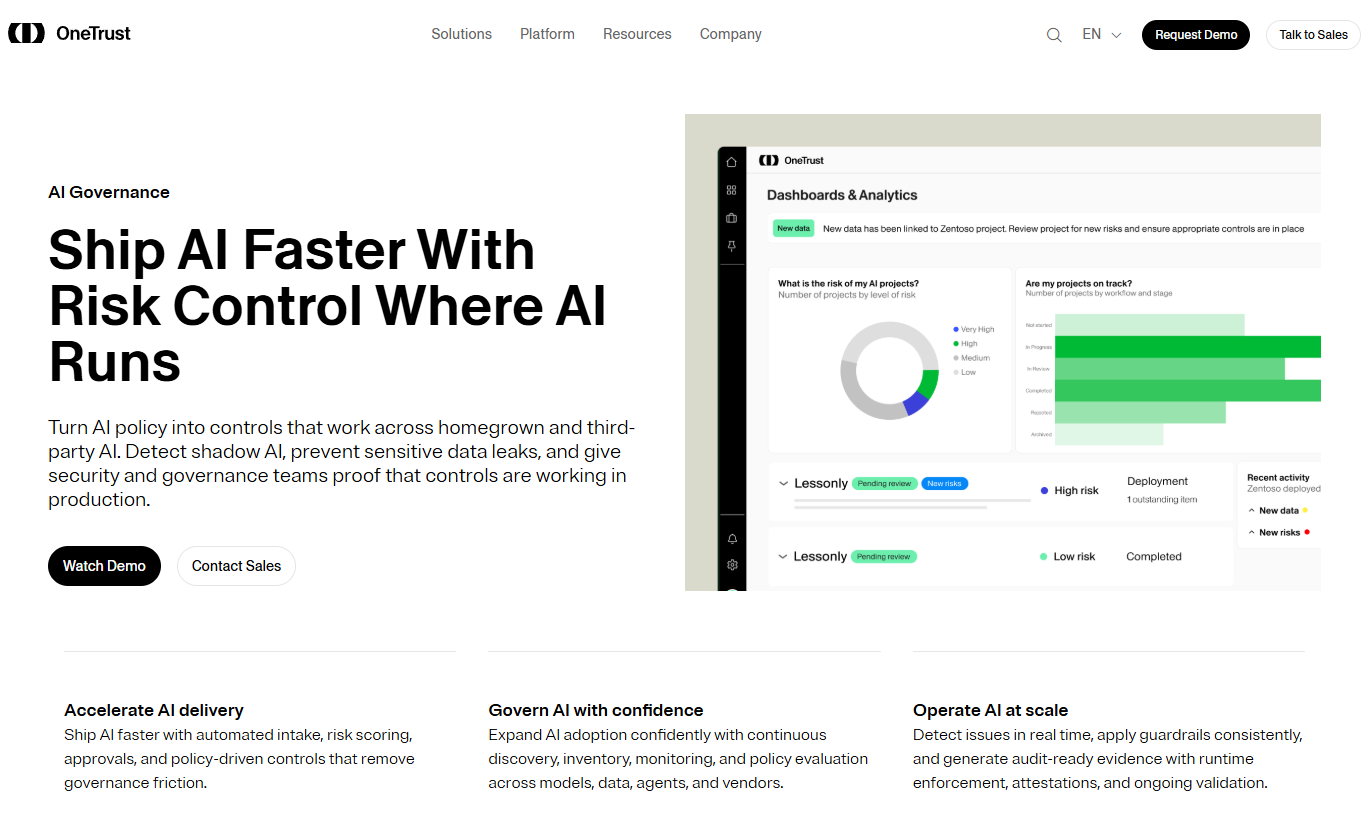
OneTrust extends its data privacy heritage into AI, focusing on governance frameworks across data assets that feed AI systems. It connects data lineage, classification, and consent management to AI model documentation and review workflows.
Key capabilities:
- AI inventory tied to underlying data classifications and data subject rights.
- Automated workflows for AI risk assessments and approvals.
- Policy management mapped to GDPR, EU AI Act, and NIST AI RMF.
- Integration with existing privacy and data governance programs.
Best for: Organizations where data privacy and AI governance need to be unified, particularly enterprises already running OneTrust for GDPR or CCPA compliance.
5. Microsoft Purview and Azure Machine Learning
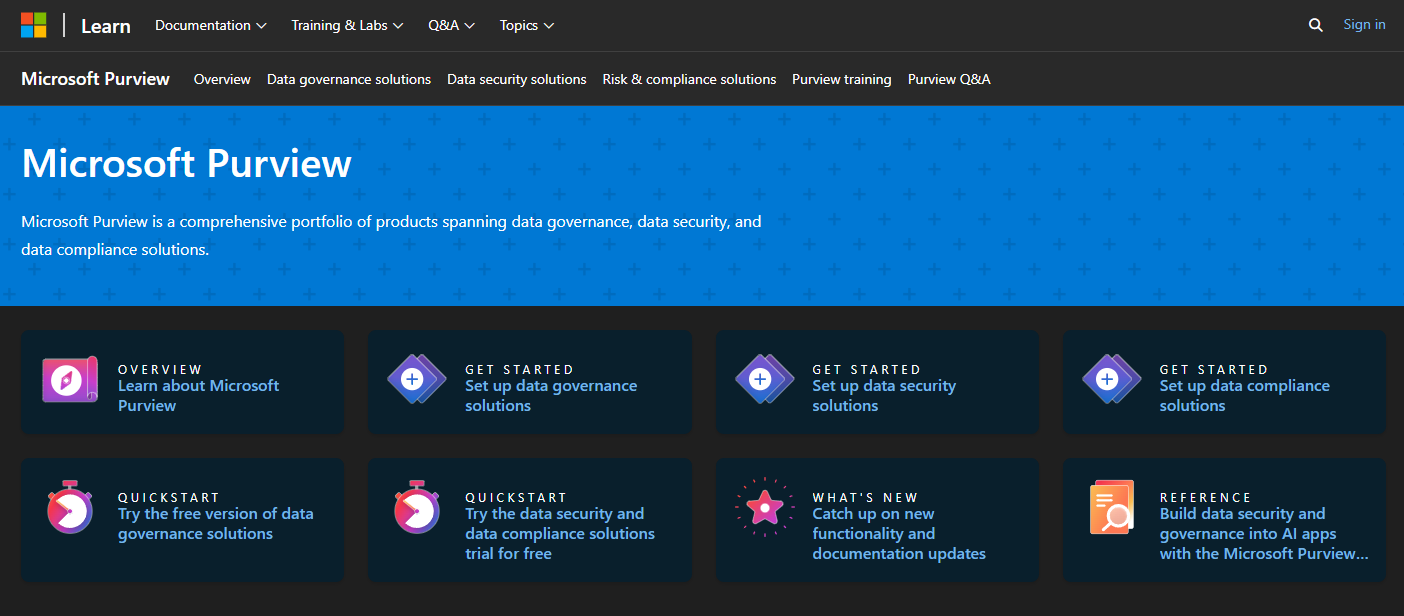
Microsoft offers AI governance through a combination of Purview (for data and AI inventory, policy, and risk) and Azure Machine Learning (for model lifecycle, policy-based model controls, and responsible AI tooling). Together they provide governance natively inside the Azure ecosystem.
Key capabilities:
- Azure Policy controls for blocking or allowing specific foundation models across environments.
- RBAC, private endpoints, and managed VNETs for network-level isolation.
- Responsible AI dashboards for fairness, error analysis, and explainability inside Azure ML.
- Audit logging and integration with Microsoft Defender for Cloud.
Best for: Enterprises standardized on Azure that need governance tightly integrated with existing identity, networking, and security tooling rather than a standalone governance platform.
6. Fiddler AI
Fiddler AI focuses on production observability and explainability for AI models, with a strong emphasis on what models are actually doing after deployment. It is particularly well-suited to high-stakes use cases where explainability is a regulatory or contractual requirement.
Key capabilities:
- Model performance monitoring with drift and data quality detection.
- LLM observability for hallucination, toxicity, and prompt safety metrics.
- Fairness assessments with standard demographic and statistical metrics.
- Explainability tooling for individual predictions and aggregate model behavior.
Best for: Data science and model risk teams in financial services, healthcare, and insurance that need post-deployment monitoring, explainability, and ongoing fairness assessment for high-stakes models.
7. Monitaur
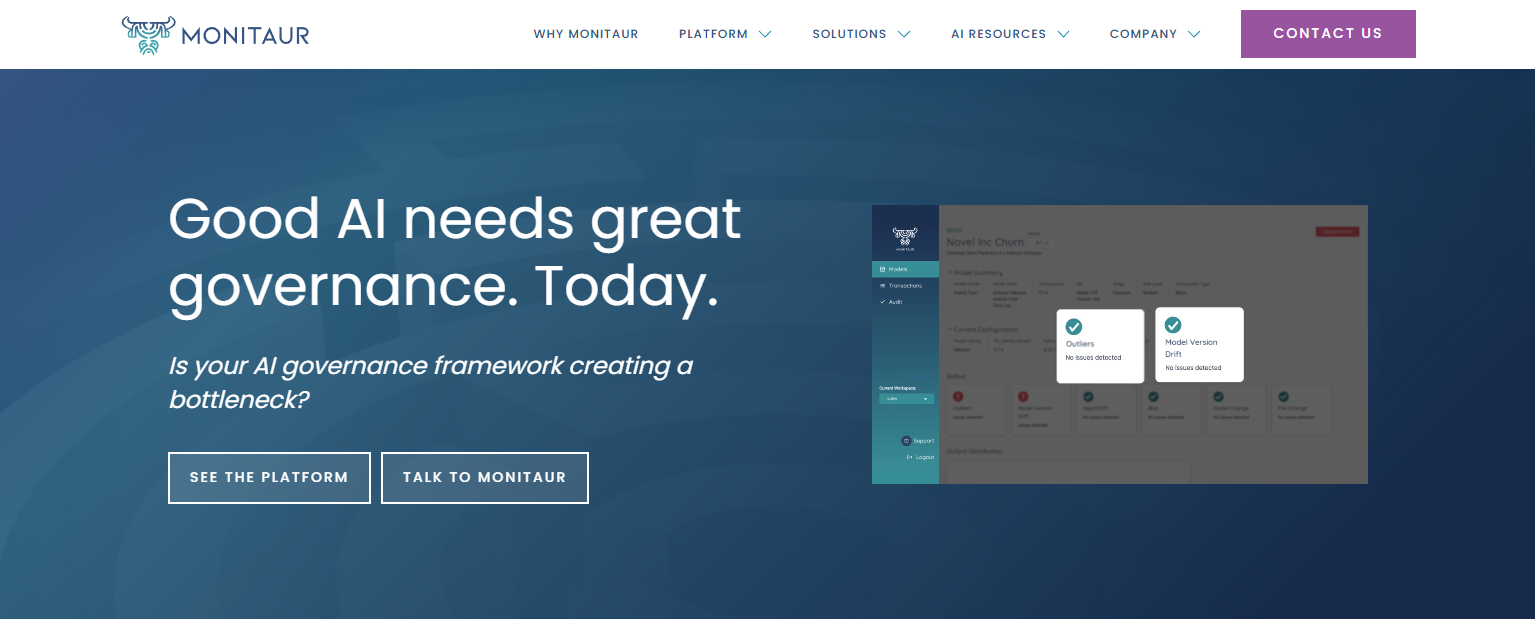
Monitaur is purpose-built for regulated industries with formal model risk management requirements, particularly in financial services and insurance. The platform is structured around audit-grade record-keeping rather than real-time inference control.
Key capabilities:
- Model documentation, governance decisions, and approval workflow capture.
- Validation and testing evidence aligned with internal and regulatory expectations.
- Lifecycle governance designed for SR 11-7 model risk management practices.
- Audit-ready exports for internal risk teams and external regulators.
Best for: Regulated organizations, especially banks and insurers, that need to document every stage of the AI lifecycle with the rigor of a traditional model audit.
How to Choose the Right AI Governance Platform
Selecting the best AI governance platform comes down to where your governance gaps actually are. A few practical filters:
- If your problem is uncontrolled LLM access, runaway costs, or scattered API keys, the answer is a gateway-layer platform like Bifrost. Documentation tools cannot stop a developer from calling GPT-4 with a personal key on a corporate laptop; a gateway with virtual keys can.
- If your problem is regulatory alignment, vendor risk, and policy management, a policy-first platform like Credo AI or OneTrust will deliver more value than a gateway alone.
- If your problem is post-deployment monitoring of high-stakes models, observability-focused platforms like Fiddler AI are the right primary tool.
- If you are in a regulated industry with mature model risk management requirements, Monitaur or IBM watsonx.governance will speak the language your auditors expect.
Most enterprises ultimately combine layers. A common pattern is a gateway like Bifrost handling real-time policy enforcement, access control, budgets, and audit logs, paired with a policy platform that handles regulatory mapping, vendor risk, and impact assessments. The International Association of Privacy Professionals maintains a useful tracker of AI laws and regulations that can help scope which compliance frameworks your platform stack needs to support.
Frequently Asked Questions
What is an AI governance platform?
An AI governance platform centralizes the policies, controls, and audit trails that determine how AI is used across an organization. It covers who can call which models, how much each team can spend, what data can flow where, and which audit records satisfy an examiner. Platforms operate at different layers: inference, policy and risk, or model lifecycle.
What is the difference between gateway-layer and policy-layer AI governance?
Gateway-layer governance enforces controls in real time on every request, through access keys, budgets, rate limits, guardrails, and audit logs at the point of inference. Policy-layer governance manages documentation, risk registers, impact assessments, and regulatory mapping. The first prevents violations as they happen; the second proves compliance after the fact. Most enterprises need both.
How does an AI gateway enforce AI governance?
An AI gateway sits between applications and model providers, so every call passes through one control point. Bifrost enforces governance there with virtual keys carrying per-team permissions and budgets, rate limits, guardrails, and immutable audit logs. Because enforcement is inline rather than advisory, engineering teams cannot route around it, which closes the gap documentation-only tools leave open.
Which AI governance platform is best for regulated industries?
It depends on the primary mandate. Regulated organizations that need formal model risk documentation favor lifecycle and policy platforms, while teams that must control live LLM access, spend, and data flow need gateway-layer enforcement. Bifrost fits the latter with air-gapped and in-VPC deployment, RBAC, and audit logs, and is often paired with a policy platform for full coverage.
Do AI governance platforms help meet the EU AI Act and NIST AI RMF?
Yes. Policy-focused platforms map controls to frameworks like the EU AI Act, NIST AI RMF, and ISO/IEC 42001 and generate the evidence auditors expect. Gateway-layer platforms contribute the enforcement and audit-log side: proof of who accessed which model, under what limits, with what data. Combining both produces documentation backed by real controls rather than intent.
Govern AI Traffic at the Inference Layer with Bifrost
Documentation-only governance leaves a gap that engineering teams will route around. Bifrost closes that gap by enforcing access policies, budgets, rate limits, and content guardrails on every model request, before it reaches a provider. Virtual keys give every team, project, and environment its own spending cap and model allowlist, audit logs satisfy SOC 2 and HIPAA evidence requirements, and in-VPC deployments keep sensitive traffic inside your own infrastructure.
To see how Bifrost can centralize governance for your AI workloads, book a demo with the Bifrost team.