Trace OpenAI Chat Completions with Maxim to gain full observability into your LLM interactions, including tool calls and streaming responses.

Prerequisites

Environment Variables

MAXIM_API_KEY=your_maxim_api_key
MAXIM_LOG_REPO_ID=your_log_repository_id
OPENAI_API_KEY=your_openai_api_key

Initialize Maxim Logger

import { Maxim } from "@maximai/maxim-js";

const maxim = new Maxim({ apiKey: process.env.MAXIM_API_KEY });
const logger = await maxim.logger({ id: process.env.MAXIM_LOG_REPO_ID });

if (!logger) {
  throw new Error("Failed to create logger");
}

Wrap OpenAI Client

Use MaximOpenAIClient to wrap your OpenAI client for automatic tracing:
import OpenAI from "openai";
import { MaximOpenAIClient } from "@maximai/maxim-js/openai-sdk";

const openai = new OpenAI({ apiKey: process.env.OPENAI_API_KEY });
const client = new MaximOpenAIClient(openai, logger);

Basic Usage

Make chat completion requests using the wrapped client:
const response = await client.chat.completions.create({
  model: "gpt-4o-mini",
  messages: [
    { role: "user", content: "What is the capital of France?" }
  ],
  max_tokens: 200,
});

console.log(response.choices[0]?.message?.content);

Custom Headers for Tracing

You can pass custom headers to enrich your traces:
const response = await client.chat.completions.create(
  {
    model: "gpt-4o-mini",
    messages: [{ role: "user", content: "Hello!" }],
    max_tokens: 200,
  },
  {
    headers: {
      "maxim-trace-id": "your-custom-trace-id",
      "maxim-generation-name": "greeting-response",
    },
  }
);

Available Header Options

HeaderTypeDescription
maxim-trace-idstringLink this generation to an existing trace
maxim-session-idstringLink the parent trace to an existing session
maxim-trace-tagsstring (JSON)Custom tags for the trace (e.g., '{"env": "prod"}')
maxim-generation-namestringCustom name for the generation in the dashboard

Tool Calling Example

Here’s a complete example demonstrating tool calls with tracing:
import OpenAI from "openai";
import { Maxim } from "@maximai/maxim-js";
import { MaximOpenAIClient } from "@maximai/maxim-js/openai-sdk";
import { v4 as uuid } from "uuid";

async function main() {
  const maxim = new Maxim({ apiKey: process.env.MAXIM_API_KEY });
  const logger = await maxim.logger({ id: process.env.MAXIM_LOG_REPO_ID });

  if (!logger) {
    throw new Error("Logger is not available");
  }

  const openai = new OpenAI({ apiKey: process.env.OPENAI_API_KEY });
  const client = new MaximOpenAIClient(openai, logger);

  // Create a trace to group all generations in the tool call flow
  const trace = logger.trace({ id: uuid() });

  // Define tools
  const tools: OpenAI.Chat.Completions.ChatCompletionTool[] = [
    {
      type: "function",
      function: {
        name: "get_weather",
        description: "Get the current weather in a given location",
        parameters: {
          type: "object",
          properties: {
            location: {
              type: "string",
              description: "The city and state, e.g. San Francisco, CA",
            },
            unit: {
              type: "string",
              enum: ["celsius", "fahrenheit"],
            },
          },
          required: ["location"],
        },
      },
    },
  ];

  const messages: OpenAI.Chat.Completions.ChatCompletionMessageParam[] = [
    { role: "user", content: "What's the weather like in San Francisco?" },
  ];

  // First call - model requests a tool call
  const firstResponse = await client.chat.completions.create(
    {
      model: "gpt-4o-mini",
      messages: messages,
      tools: tools,
      tool_choice: "required",
      max_tokens: 200,
    },
    {
      headers: {
        "maxim-trace-id": trace.id,
        "maxim-generation-name": "tool-call-request",
      },
    }
  );

  const toolCall = firstResponse.choices[0]?.message?.tool_calls?.[0];

  // Simulate tool execution
  const toolResult = JSON.stringify({
    location: "San Francisco, CA",
    temperature: 72,
    unit: "fahrenheit",
    condition: "sunny",
  });

  // Second call - pass tool result back to model
  const secondMessages: OpenAI.Chat.Completions.ChatCompletionMessageParam[] = [
    ...messages,
    firstResponse.choices[0]?.message as OpenAI.Chat.Completions.ChatCompletionMessageParam,
    {
      role: "tool",
      tool_call_id: toolCall!.id,
      content: toolResult,
    },
  ];

  const secondResponse = await client.chat.completions.create(
    {
      model: "gpt-4o-mini",
      messages: secondMessages,
      tools: tools,
      max_tokens: 200,
    },
    {
      headers: {
        "maxim-trace-id": trace.id,
        "maxim-generation-name": "tool-call-response",
      },
    }
  );

  console.log("Response:", secondResponse.choices[0]?.message?.content);

  // Set trace output and end
  trace.output(secondResponse.choices[0]?.message?.content || "");
  trace.end();

  await logger.cleanup();
  await maxim.cleanup();
}

main().catch(console.error);

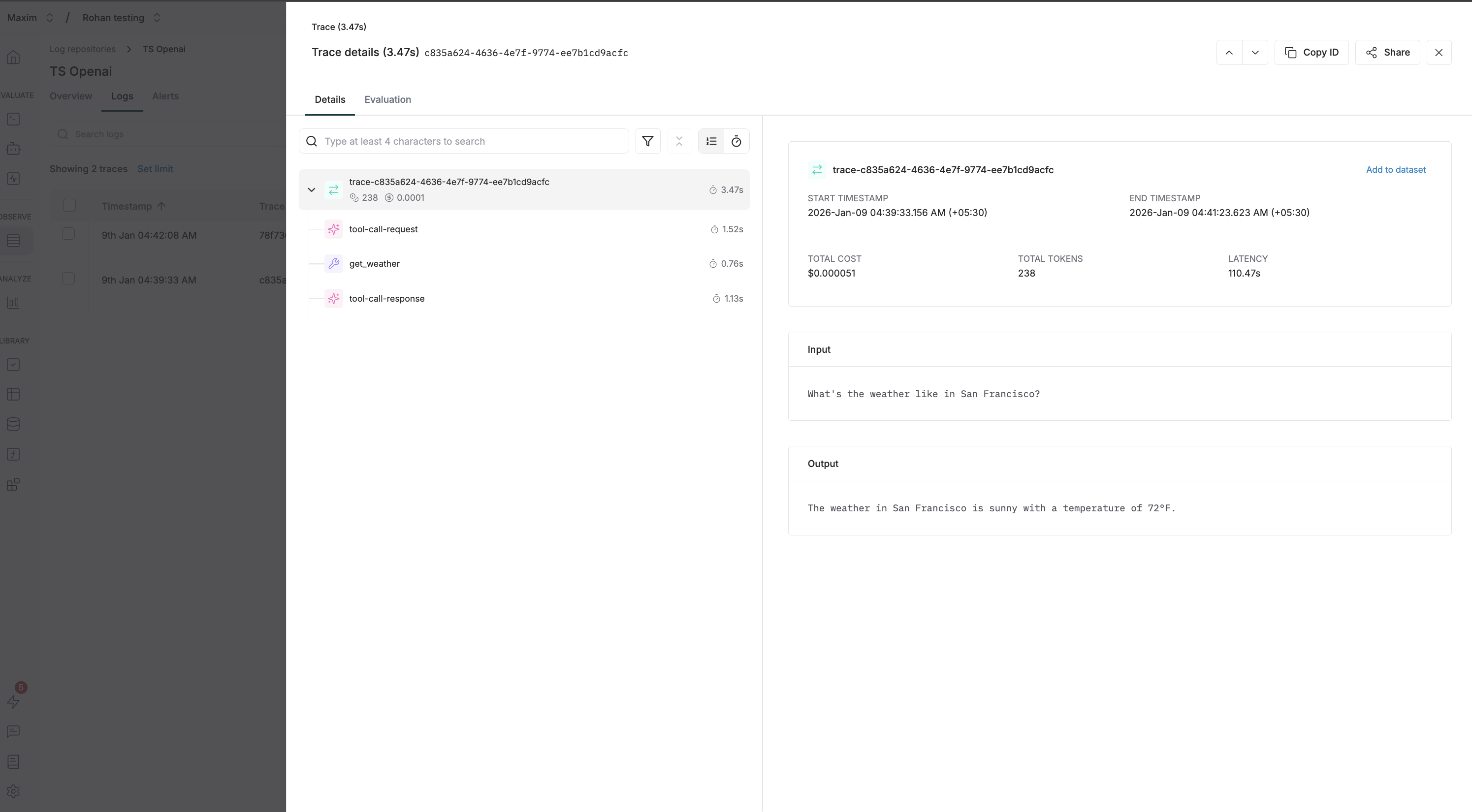
Grouping Generations with Traces

Use traces to group related generations together:
// Create a trace
const trace = logger.trace({ id: uuid() });

// All generations with the same trace ID are grouped together
await client.chat.completions.create(
  { model: "gpt-4o-mini", messages: [...] },
  { headers: { "maxim-trace-id": trace.id } }
);

await client.chat.completions.create(
  { model: "gpt-4o-mini", messages: [...] },
  { headers: { "maxim-trace-id": trace.id } }
);

// Set the final output and end the trace
trace.output("Final result");
trace.end();

Streaming Support

The wrapped client supports streaming responses:
const stream = await client.chat.completions.create({
  model: "gpt-4o-mini",
  messages: [{ role: "user", content: "Write a haiku about coding" }],
  stream: true,
});

for await (const chunk of stream) {
  process.stdout.write(chunk.choices[0]?.delta?.content || "");
}

Cleanup

Always clean up resources when done:
await logger.cleanup();
await maxim.cleanup();

What gets logged to Maxim

  • Request Details: Model name, parameters, and all other settings
  • Message History: Complete conversation history including user messages and assistant responses
  • Response Content: Full assistant responses and metadata
  • Usage Statistics: Input tokens, output tokens, total tokens consumed
  • Error Handling: Any errors that occur during the request
Chat Completions Trace

Resources