Control Plane vs Data Plane in AI Infrastructure
The control plane vs data plane split separates the layer that decides policy from the layer that carries requests. This guide explains the distinction across networking and Kubernetes, then shows how it applies to AI infrastructure and how an AI gateway keeps policy off the request path.
TL;DR
- The control plane decides how traffic should be handled; the data plane carries and processes each request according to those decisions.
- The split exists in routers, Kubernetes, service meshes, and API gateways, and it applies the same way to AI infrastructure.
- In AI infrastructure, the control plane holds providers, keys, budgets, routing rules, and guardrails; the data plane is every model, tool, and agent request.
- Keeping the control plane off the request path lets the data plane stay fast and keep serving during control plane outages.
- Bifrost holds configuration in memory on every node and replicates changes across a cluster, so policy is enforced per request without a database lookup.
The control plane is the part of a system that decides how traffic should be handled, through configuration, policy, and routing decisions, while the data plane is the part that carries and processes each request according to those decisions. The control plane vs data plane split started in networking and now shapes cloud platforms, Kubernetes, and AI infrastructure. Bifrost, the open-source AI gateway built by Maxim AI for enterprise LLM, MCP, and agent traffic, is designed around this separation. This guide explains the distinction, how it applies to AI systems, and why it matters for reliability and governance.
What Is the Control Plane?
The control plane is the layer that defines how a system should behave. It accepts changes from operators, stores the desired state, computes decisions such as routes or policies, and distributes them to the components that handle traffic. It is usually not on the path of each individual request.
Typical control plane responsibilities:
- Configuration. Accepting and validating changes through a UI, API, or configuration files.
- State. Storing the desired state of the system.
- Decisions. Computing routes, schedules, or policies from that state.
- Distribution. Pushing those decisions to every data plane component.
Because the control plane changes slowly compared with traffic, it can favor consistency and auditability over raw speed. A configuration change that takes a few seconds to propagate is acceptable; a request that takes a few seconds longer is not. In Bifrost, these changes come from the dashboard, the API, or config.json.
What Is the Data Plane?
The data plane is the layer that handles each request or packet. It receives traffic, applies the rules the control plane distributed, and forwards the traffic to its destination. It is on the critical path, so its latency and availability are what users experience directly.
Typical data plane responsibilities:
- Forwarding. Moving packets or requests to the right backend.
- Enforcement. Applying access checks, rate limits, and transformations per request.
- Resilience. Retrying, failing over, and load balancing as traffic flows, as Bifrost does with retries and fallbacks.
- Telemetry. Recording what happened to each request.
The data plane must be fast, horizontally scalable, and able to keep working when the control plane is unavailable. AWS calls this property static stability in its whitepaper on control planes and data planes: data planes should continue operating on their last known configuration even if the control plane is impaired.
Control Plane vs Data Plane: Key Differences
The key difference between the control plane and the data plane is that one decides and the other executes. The control plane is off the request path, changes infrequently, and favors consistency; the data plane is on the request path, handles every request, and favors latency and availability.
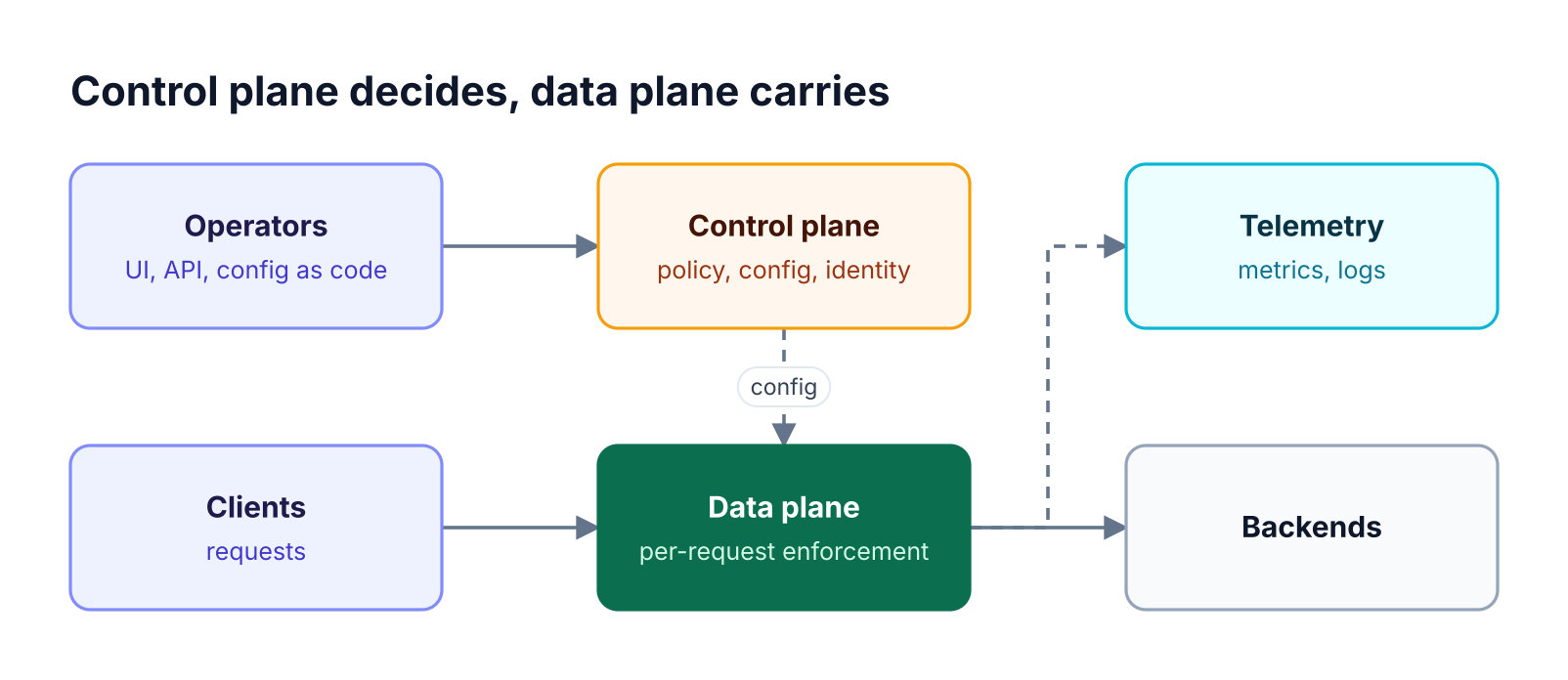
Operators change policy in the control plane, which pushes configuration to the data plane; client requests flow only through the data plane to backends, and telemetry flows back
Figure 1: The control plane is off the request path; the data plane is on it, which is why they are scaled and protected differently.
| Attribute | Control plane | Data plane |
|---|---|---|
| Purpose | Decide how traffic is handled | Handle each unit of traffic |
| On the request path | No | Yes |
| Change frequency | Low: configuration and policy updates | High: every request |
| Main priority | Correctness, consistency, auditability | Latency, throughput, availability |
| Scaling | Modest, often a few replicas | Horizontal, scales with traffic |
| Failure impact | Changes cannot be made | Requests fail |
| Users | Operators and administrators | Applications and end users |
A third plane is sometimes named separately: the management plane, which covers administrative access and monitoring of the devices themselves. In many modern systems the management functions are folded into the control plane. For AI traffic, guardrails are a good example of the split: profiles are defined in the control plane and evaluated in the data plane.
Control Plane and Data Plane in Networking, Kubernetes, and Service Meshes
The control plane and data plane split appears wherever traffic is routed by policy. The pattern is the same in each domain: a central layer computes and distributes decisions, and a distributed layer applies them to traffic at line rate.
- Networking. In a router, routing protocols such as BGP and OSPF form the control plane and build the routing table; the forwarding hardware forms the data plane and moves packets using that table.
- Kubernetes. The Kubernetes control plane, the API server, scheduler, controllers, and etcd, decides where workloads run; the nodes, with kubelet and container runtimes, run them and carry their traffic.
- Service meshes. A mesh controller distributes routing, security, and telemetry configuration; sidecar or node proxies in the data plane apply it to service-to-service calls.
- API gateways. An admin API stores routes and plugins; gateway nodes apply them to each API request.
AI infrastructure follows the same pattern, with model, tool, and agent calls as the traffic. Our article on the MCP gateway as the control plane for MCP servers applies it to tool traffic specifically.
Control Plane and Data Plane in AI Infrastructure
In AI infrastructure, the control plane holds every decision about how AI traffic should be handled: which providers and keys exist, who may call which models and tools, what budgets and rate limits apply, which routing and failover rules are active, and which guardrails run. The data plane is each model request, MCP tool call, and agent call that passes through the gateway.
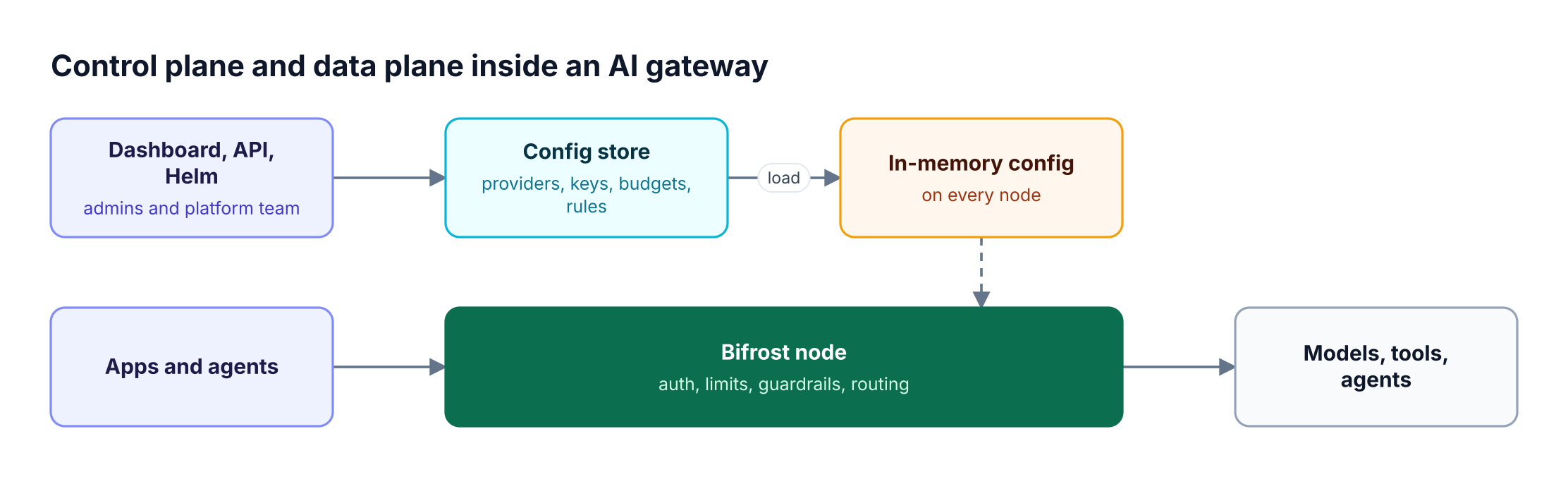
In Bifrost, admins set providers, keys, budgets, routing rules, and guardrails in the control plane; each node holds that configuration in memory and enforces it per request
Figure 2: Policy is written once in the control plane and evaluated in memory on every request in the data plane.
Control plane objects in an AI gateway, as Figure 2 shows:
- Providers and credentials. Which model providers are configured, with which keys.
- Identities. Virtual keys, teams, customers, and in Enterprise, users synced from an identity provider.
- Limits. Budgets and rate limits at each level of the hierarchy.
- Routing. Routing rules, weights, and fallback chains.
- Safety. Guardrail profiles and the rules that attach them to traffic.
Data plane work, per request: authenticate the key, check model and tool access, check budgets and rate limits, run guardrails, pick a provider, call it, retry or fail over if needed, and record the result. The AI control plane guide covers the policy side in depth.
How Bifrost Separates Policy from Request Handling
Bifrost separates policy from request handling by loading configuration into memory on every node, so the data plane evaluates policy without a database read on the request path. Administrators change policy through the dashboard, the API, config.json, or Helm; nodes pick up the change and enforce it on the next request.
Design choices that keep the data plane fast:
- Configuration in memory. Bifrost keeps provider configs, keys, budgets, usage, and traffic distribution in memory; once a node initializes, it does not read that state back from the database per request.
- Pre-opened connections and pooled memory. Provider connections are opened ahead of time and memory is pooled, which keeps overhead to about 11 microseconds per request at 5,000 RPS in published benchmarks.
- Config as code. Control plane state can be declared in Helm values or
config.json, reviewed in pull requests, and deployed like any other infrastructure. - Audited changes. In Bifrost Enterprise, audit logs record administrative activity as signed events, so control plane changes have their own trail.
Data plane telemetry flows the other way: every request is recorded in built-in observability and can be exported to OpenTelemetry, Prometheus, or Datadog. The AI governance page covers the policy model from an administrator's view.
Scaling the Data Plane Across a Cluster
Scaling the data plane means running many gateway nodes behind a load balancer while keeping policy and shared counters, such as budget usage and rate limits, consistent across them. Without synchronization, each node would enforce its own view of a budget, and a team could spend several times its limit.
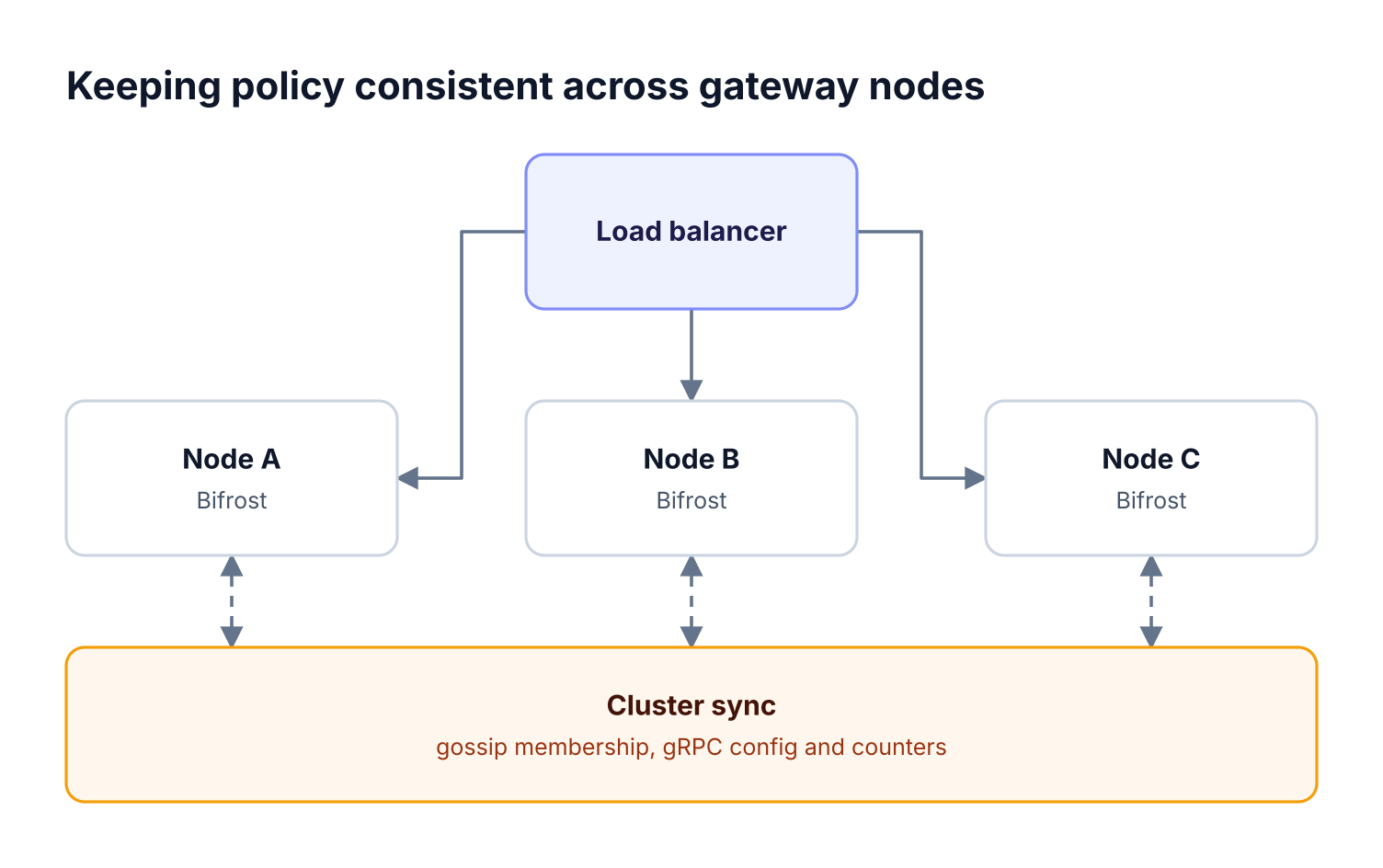
Three Bifrost nodes behind a load balancer share membership over gossip and replicate configuration changes and budget counters over gRPC, so any node can serve any request
Figure 3: Replicating policy and counters between nodes keeps the data plane horizontally scalable without a shared database on the request path.
Bifrost Enterprise clustering handles this with a peer-to-peer design, as Figure 3 shows:
- Membership over gossip. Nodes discover each other and detect failures over a memberlist gossip layer.
- State over gRPC. Configuration changes, governance counters, and routing rules replicate over a dedicated gRPC channel.
- Broker mode. For environments where nodes cannot reach each other directly, a broker relays messages.
- Discovery. Nodes find each other through Kubernetes, Consul, etcd, DNS, or other supported discovery methods.
The open-source edition runs as a single node with its state in memory, which suits startups and mid-size teams handling a few thousand requests per second. The enterprise scalability resource covers capacity planning, and the enterprise page covers high-availability options.
Why the Separation Matters for Reliability and Governance
The separation matters because it lets each plane fail and scale independently. If the dashboard or configuration database is unavailable, requests keep flowing on the last known policy. If traffic spikes, operators add data plane nodes without touching the control plane.
Three practical benefits for AI platforms:
- Availability. A control plane incident blocks changes, not production AI traffic.
- Consistent enforcement. Policy written once in the control plane applies to every request on every node, which is the premise of policy-based governance at the gateway.
- Clear ownership. Platform and security teams own the control plane; application teams consume the data plane through their keys.
The same reasoning applies to employee devices. With AI Gateway + Bifrost Edge, the gateway remains the control plane for policy, and Bifrost Edge routes AI traffic from laptops through it, so desktop AI apps follow the same rules as production applications. The post on stopping shadow AI with one auditable control plane covers that case.
Frequently Asked Questions
What is the difference between a control plane and a data plane?
The control plane decides how traffic should be handled: it stores configuration and policy and distributes decisions. The data plane handles each request or packet using those decisions. The control plane is off the request path and changes infrequently; the data plane is on the request path and must be fast and highly available.
What is an example of a control plane and a data plane?
In Kubernetes, the API server, scheduler, and controllers form the control plane that decides where workloads run, while nodes run the workloads and carry traffic. In an AI gateway such as Bifrost, the dashboard and configuration define providers, keys, and budgets, while gateway nodes enforce them on each model and tool request.
Is an API gateway a control plane or a data plane?
An API gateway contains both. Its admin API and configuration store form the control plane, where routes, plugins, and policies are defined. Its gateway nodes form the data plane, applying those policies to every API request. The same is true of AI gateways, which apply policy to model, tool, and agent calls.
What is the management plane?
The management plane covers administrative access to the system itself, such as device configuration, monitoring, and operator authentication. Some architectures treat it as a third plane alongside control and data planes; many modern platforms fold it into the control plane, since both are operator-facing and off the request path.
What happens to the data plane if the control plane fails?
In a well-designed system, the data plane keeps serving traffic on its last known configuration, a property called static stability. Changes cannot be made until the control plane recovers. Bifrost nodes hold their configuration in memory, so request handling does not depend on reading the configuration database for each request.
How does a data plane enforce budgets across multiple nodes?
Each node must see shared usage counters, or limits would be enforced separately per node. Bifrost Enterprise clusters replicate governance counters, configuration changes, and routing rules between nodes over gRPC, with cluster membership handled by a gossip layer, so a budget set once applies across every node.
Getting Started with Bifrost
The control plane vs data plane split is how infrastructure stays both governable and fast: policy is decided once, and every request is handled close to the traffic. Bifrost applies that design to AI traffic, with in-memory enforcement on every node and clustered replication for scale. Explore the LLM gateway, review enterprise deployment, or book a demo to see how Bifrost separates policy from request handling.